
Building a Debt Snowball Plan That Actually Works
What Is a Debt Snowball Plan — and Does It Actually Work?
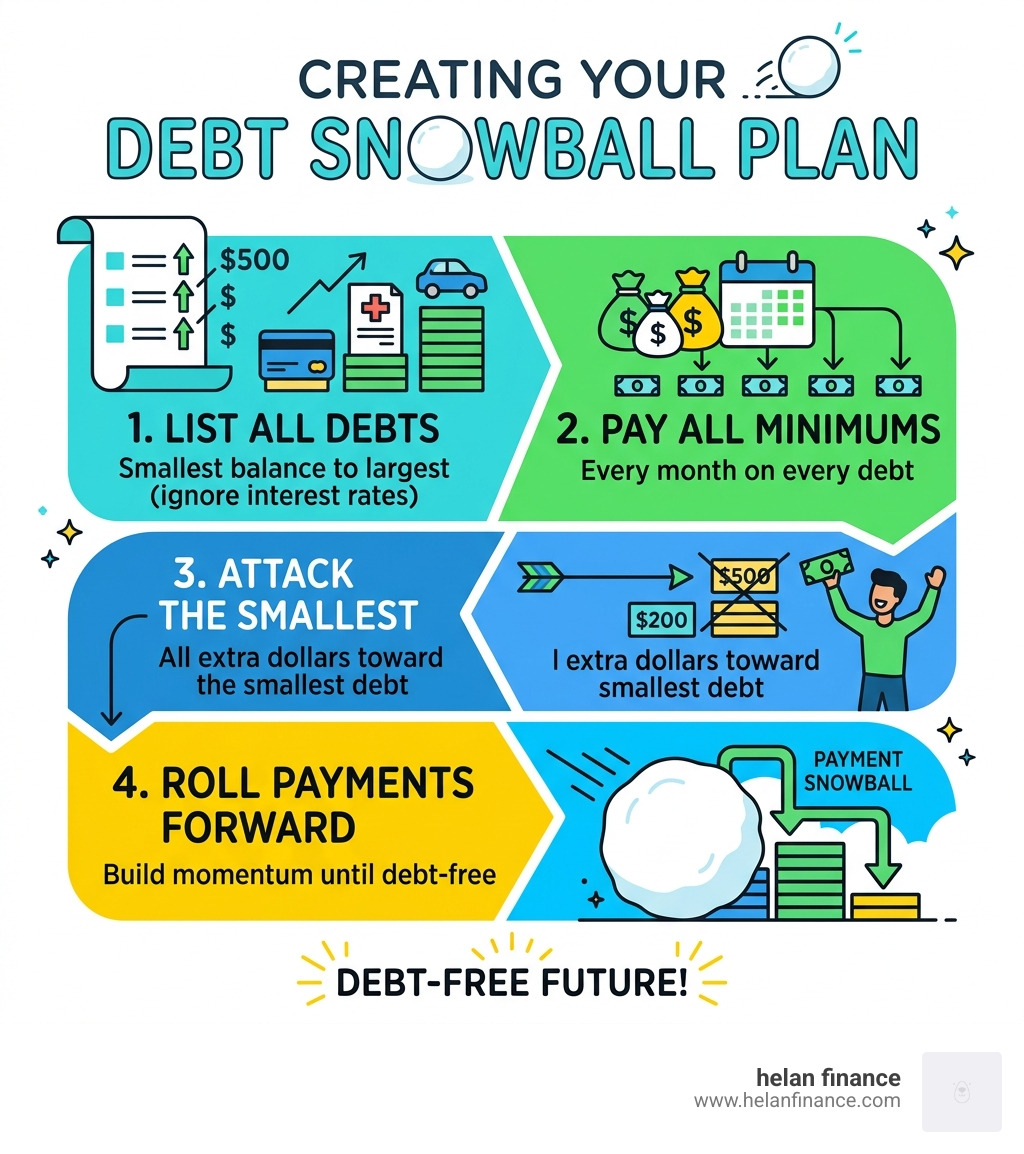
To create a debt snowball plan, follow these steps:
- List all your debts from smallest balance to largest (ignore interest rates)
- Make minimum payments on every debt each month
- Put every extra dollar toward the smallest debt until it’s gone
- Roll that payment into the next smallest debt
- Repeat until you’re debt-free
Debt can feel like a wall you can’t see over. You know you need to pay it down, but with multiple balances, due dates, and interest rates pulling your attention in every direction, it’s hard to know where to start.
That’s exactly why the debt snowball method has helped millions of people break through. The core idea is simple: start small, win fast, build momentum.
Research backs this up. A study from the Kellogg School of Business found that people who focused on their smallest balances paid off their debt faster than those who tried to optimize purely for interest savings. And three large field experiments published in the Journal of Consumer Research confirmed that tackling the smallest balance first has the most powerful effect on people’s sense of progress — which keeps them going.
Real results follow. People have reported paying off anywhere from $20,000 to $50,000 in debt within 18 to 48 months using this approach. The math doesn’t have to be perfect for the plan to work. Behavior matters more than optimization.
This guide walks you through exactly how to build your own debt snowball plan — step by step, without the overwhelm.
Why the Debt Snowball Method Works for Real People
We often think of personal finance as a math problem. If we just find the lowest interest rate or the most efficient spreadsheet, the debt will disappear, right? In reality, personal finance is about 80% behavior and only 20% head knowledge. If math were the only factor, most of us wouldn’t have credit card debt in the first place.
The debt snowball method works because it targets our psychology. When we create a debt snowball plan, we are looking for “quick wins.” Think about it: if you have a $500 medical bill and a $20,000 student loan, paying off that $500 bill in two months feels amazing. You can cross it off the list. You feel like a champion. That feeling — that hit of dopamine — is what gives us the power to keep going when things get tough.
The Science of Motivation
As mentioned in the introduction, researchers at the Kellogg School of Business at Northwestern University found that consumers who used the snowball method (paying off small balances first) were more likely to eliminate their entire debt load than those who focused on interest rates.
Why? Because the human brain is wired for progress. When we see an account balance hit zero, it reinforces the belief that we can actually do this. This “sense of progress” is the single most important factor in accomplishing a difficult, long-term task.
The 80/20 Rule in Action
In our experience at Helan Finance, we’ve seen that once people get that first win, they start looking for more ways to save. They begin cutting subscriptions, selling unused items, or picking up side hustles because they are “gazelle intense” about seeing the next debt disappear. By the time they reach their largest debts, their “snowball” of monthly payments has grown so large that the big debts don’t seem so scary anymore.
5 Steps to Create Debt Snowball Plan
Building a strategy doesn’t have to be a weekend-long project. You can create a debt snowball plan in about an hour if you have your documents ready. Here is the blueprint we recommend to get you moving toward a debt-free life in 2026.
Step 1: Gather Information to Create Debt Snowball Plan
Before we start rolling the snowball, we need to know exactly what we’re working with. This is often the scariest part because it requires looking the “debt monster” in the eye.
Gather every bill, log into every portal, and write down:
- The name of the creditor (who you owe).
- The current balance (exactly how much is left).
- The interest rate (APR).
- The minimum monthly payment.
Don’t leave anything out. Whether it’s a $50 store card or a $15,000 car loan, it needs to be on the list. Seeing your total debt load in one place is the first step toward taking control.

Step 2: List and Order Debts to Create Debt Snowball Plan
Now, we organize. To create a debt snowball plan that follows the traditional method, we list these debts from the smallest balance to the largest balance.
Important: Ignore the interest rates for a moment. Yes, we know it feels “wrong” to ignore a 24% credit card in favor of a 0% medical bill, but remember: we are solving for behavior, not math.
- List the debt with the lowest balance at the top.
- Continue listing them in ascending order.
- Your largest debt (like a student loan or a large personal loan) should be at the very bottom.
By ranking them this way, you are setting yourself up for those crucial early victories. If you need help visualizing this, you can use a Debt Snowball Calculator to see your projected debt-free date.
Step 3: Find Extra Cash in Your Budget
A snowball needs more than just a list; it needs fuel. To make the plan work, you must pay the minimum on every debt except the smallest one. For that smallest debt at the top of your list, you want to pay as much as humanly possible.
Look at your monthly spending. Can you find an extra $50, $100, or $500?
- The “Four Walls”: Ensure your food, utilities, shelter, and transportation are covered first.
- Cut the Fat: Cancel those streaming services you don’t watch.
- Side Hustles: Many people find that a temporary second job or selling items on online marketplaces can add “debt snowflakes” — small, one-off payments that speed up the process.
Step 4: Attack the Smallest Balance
Focus all your intensity on Debt #1. Pay the minimum plus every extra cent you found in Step 3. While you’re doing this, stay disciplined. Don’t take on new debt. If you’re paying off a credit card, stop using it immediately. We want to stop the bleeding so the wound can heal.
Step 5: Roll the Payments Forward
This is where the “snowball” effect happens. Once Debt #1 is gone, celebrate! Take a deep breath, and then take the entire amount you were paying on Debt #1 (the minimum plus the extra) and add it to the minimum payment of Debt #2.
Now, Debt #2 is being hit with a much larger payment than before. When Debt #2 is gone, you take that whole chunk of money and move it to Debt #3. By the time you get to the bottom of the list, you might be putting thousands of dollars a month toward your final debt.
Debt Snowball vs. Debt Avalanche: Which is Right for You?
When you decide to create a debt snowball plan, you might hear people mention the “Debt Avalanche.” It’s the primary alternative, and it’s important to understand the difference so you can choose the path that fits your personality.
| Feature | Debt Snowball | Debt Avalanche |
|---|---|---|
| Primary Focus | Smallest balance first | Highest interest rate first |
| Main Benefit | Psychological motivation and quick wins | Mathematical efficiency (saves interest) |
| Speed of “Wins” | Fast (usually within weeks/months) | Slower (depends on balance size) |
| Best For | People who need encouragement to stay on track | People who are highly disciplined and math-driven |
| Goal | Behavior modification | Interest minimization |
The Debt Avalanche is technically faster on paper because it reduces the amount of interest you pay over time. However, if your highest-interest debt is also your largest balance (like a $30,000 credit card), it might take you years to see that first “win.” Many people lose steam and give up before they see progress.
According to Experian, the snowball method is often more effective for the average person because the emotional satisfaction of clearing a debt keeps them in the game. If you’re the type of person who needs to see the “Paid in Full” stamp to stay motivated, stick with the snowball. If you have “ice in your veins” and don’t care about quick wins as long as the math is optimal, the avalanche might be for you.
For more tools to compare these, check out Undebt.it, which allows you to toggle between both strategies to see which one saves you more time or money.
Maintaining Momentum and Avoiding Common Pitfalls
Starting is the easy part; finishing is where the challenge lies. Most people who create a debt snowball plan face a “middle-of-the-marathon” slump where the initial excitement wears off.
Gamify Your Progress
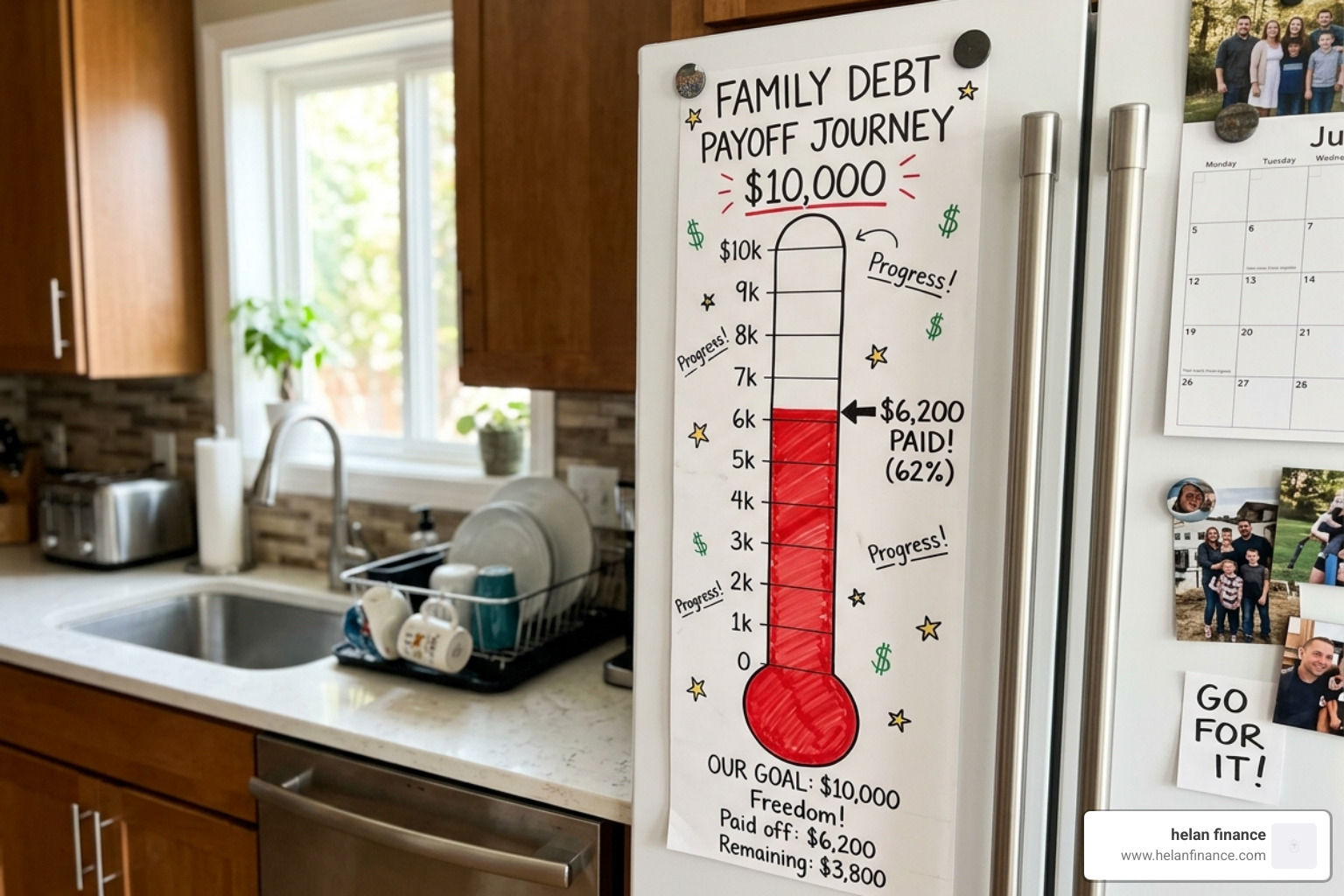
We love visual reminders. Create a “debt thermometer” on your fridge. Every time you pay off $1,000 or clear a specific account, color it in. It sounds simple, but seeing that red line climb toward the top is a powerful motivator. You can also use tools like Financial Mentor’s Debt Snowball Calculator to track your “Asset Snowball” — the point where your debt payoff transforms into wealth building.
The Starter Emergency Fund
One of the biggest mistakes is starting a debt snowball with zero savings. If your car breaks down or your water heater leaks, you’ll be tempted to reach for a credit card, which ruins your momentum.
Before you start the snowball, we recommend saving a “starter” emergency fund (usually $1,000). This acts as a buffer between you and life’s little surprises. It’s not a full safety net, but it’s enough to keep you from backsliding into more debt.
Avoid These Common Mistakes
- Closing all accounts immediately: While it might be tempting to close every credit card you pay off, be aware that this can impact your credit score. We’ll discuss this more in the FAQ section.
- Diverting “found” money: If you get a tax refund or a bonus at work, don’t spend it on a vacation. Throw it at the current debt in your snowball. These “debt snowflakes” can shave months off your timeline.
- Not budgeting: You cannot create a debt snowball plan that works without a written budget. You need to know where every dollar is going so you can tell it where to go.
Frequently Asked Questions about Debt Snowballing
How does the debt snowball impact my credit score?
Using the debt snowball method is generally very positive for your credit score. As you pay down balances, your credit utilization ratio (the amount of debt you have compared to your limits) decreases. This is a major factor in your score.
However, be careful about closing accounts. The LendingTree guide to debt snowballing notes that the age of your credit accounts makes up about 15% of your score. If you pay off your oldest credit card and close it, your “average age of credit” might drop, causing a temporary dip in your score. For many, the peace of mind of having the account closed is worth the small hit, but it’s something to keep in mind.
Should I include my mortgage in the debt snowball plan?
Generally, no. We categorize debt into “consumer debt” (credit cards, car loans, medical bills, student loans) and “mortgage debt.”
Because mortgages usually have much lower interest rates and are tied to an appreciating asset, they are handled separately. In many financial plans, like the “7 Baby Steps” taught by various experts, the mortgage is paid off much later, after you’ve cleared consumer debt and built a full emergency fund. Focus on the high-stress, high-interest consumer stuff first.
When should I pause my debt snowball plan?
Life happens. While we want you to be “gazelle intense,” there are times when you should temporarily stop the extra payments and just pay the minimums to keep your head above water:
- Major Life Changes: Having a baby, getting married, or moving.
- Job Loss: If you lose your income, stop the snowball and pile up as much cash as possible until you find a new job.
- Health Crisis: A major medical emergency requires you to prioritize cash flow over debt payoff.
- IRS Bills: If you owe the government, they often have more power to collect than a credit card company. Handle tax debt with high priority.
Once the storm passes, you can jump right back into your plan exactly where you left off.
Conclusion
The journey to debt freedom isn’t about being a math genius; it’s about being a “behavior genius.” When you create a debt snowball plan, you are choosing to prioritize your mental health and your motivation. You are choosing to believe that small wins lead to big victories.
By following the five steps — gathering info, ordering your debts, finding extra cash, attacking the smallest balance, and rolling those payments forward — you can join the millions of people who have successfully paid off tens of thousands of dollars.
Imagine a life where you don’t have a single monthly payment. No car payment. No credit card bill. No student loan hanging over your head. That money stays in your pocket, allowing you to build wealth, give generously, and live the life you’ve always wanted.
At Helan Finance, we believe financial planning should be simple and effective. Whether you use a spreadsheet, an app, or a simple piece of paper, the best time to start is today.
Start your journey with Helan Finance

