
How to set financial goals without the headache
Why Your Finances Need a Routine, Not Just a Resolution
Financial goal setting routines are the repeatable habits and scheduled check-ins that keep your money moving in the right direction — week after week, not just in January.
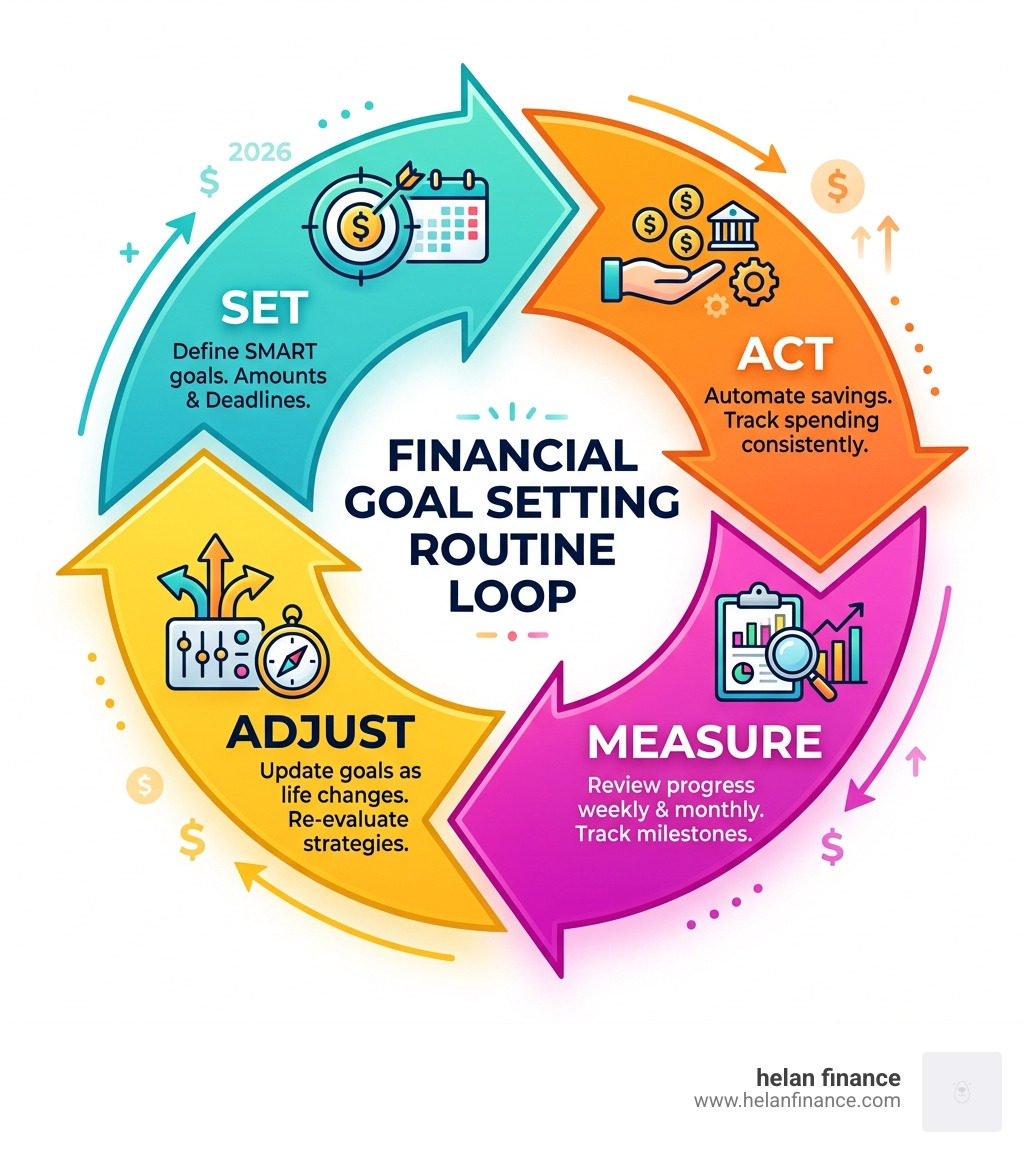
Here’s the quick version of what an effective routine looks like:
- Set – Define specific, time-bound goals with real dollar amounts
- Act – Automate savings and track spending consistently
- Measure – Review your progress weekly, monthly, and annually
- Adjust – Update your goals when life or income changes
Most people set financial goals once and forget them. A routine is different. It’s a system that runs in the background whether you’re motivated or not.
And the payoff is real. People who set clear financial goals are about three times as likely to feel happy about their financial situation compared to those who don’t plan ahead. Those who combine written goals with automatic saving strategies are even more likely to hit their milestones.
Think of it like brushing your teeth. You don’t decide each morning whether dental hygiene is worth it — you just do it. Your finances deserve the same low-drama consistency.
This guide is for busy people who want a simple, repeatable system — no spreadsheet obsession required.
Why Financial Goal Setting Routines Beat One-Time Resolutions
As we move through April 2026, many of those “New Year, New Me” financial resolutions have likely gathered dust. Why? Because resolutions rely on willpower, and willpower is a finite resource that tends to evaporate after a long day at work.
Financial goal setting routines, however, rely on systems. By framing financial maintenance as a “self-care routine” — much like your morning skincare or a weekly workout — you remove the emotional weight of “dealing with money.”

In behavioral psychology, the most successful habits are those that reduce friction. When you establish a “Money Date” or a paycheck routine, you aren’t making a difficult decision every time; you are simply following a schedule. This consistency is vital for long-term growth. Consider the S&P 500, which represents the 500 largest U.S. publicly traded companies. While the market fluctuates daily, the routine of staying invested typically yields an average return of 10% over a decade.
By Planning With Purpose: How to Set Financial Goals That Fit Your Life, you ensure that your money serves your life, rather than your life serving your bills.
Designing Your Financial Goal Setting Routines: A Step-by-Step Guide
To build a routine that actually sticks, we need to move away from vague wishes like “I want to save more” and move toward the SMART framework. This ensures every goal is:
- Specific: What exactly are you saving for?
- Measurable: How much do you need?
- Actionable: What is the first step?
- Realistic: Does it fit your current income?
- Time-bound: When is the deadline?
Categorizing Your Goals
We find it helpful to divide goals into three buckets based on your timeline:
- Short-term (Under 1 year): Building a $1,000 starter emergency fund, saving for a summer vacation, or paying off a small credit card balance.
- Midterm (1–5 years): Saving $25,000 for a house down payment, funding a wedding, or paying off student loans.
- Long-term (5+ years): Retirement planning, a child’s college fund, or achieving full financial freedom.
Before you start, you need to know your baseline. This means calculating your net worth — a fancy term for everything you own (assets) minus everything you owe (liabilities). Don’t be discouraged if your liabilities outweigh your assets right now; the goal of your new routine is to flip that script.
Establishing Weekly and Monthly Financial Goal Setting Routines
You don’t need hours to manage your money. A simple 30-minute weekly check can transform your financial health. During this “Money Date,” we recommend focusing on a few key metrics:
- Cash Flow: Did you spend more than you earned this week?
- Savings Rate: What percentage of your income went toward your goals? (Aim for 15-20% if possible).
- Credit Utilization: Are your credit card balances below 30% of your limit?
- Debt-to-Income (DTI): Is your total monthly debt payment less than 36% of your gross income?
Using a tool like the Helan Finance platform can help you keep these numbers in one place without the headache. During these weekly sessions, focus on “micro-actions.” Maybe it’s canceling a subscription you don’t use or moving $25 into your “sinking fund” for car repairs.
Annual and Quarterly Financial Goal Setting Routines for Long-Term Success
While weekly checks keep the engine running, quarterly and annual reviews are where you check the map.
Quarterly Actions:
- Review Credit Reports: Check for errors or identity theft.
- Portfolio Rebalancing: If one investment has grown significantly, you might need to sell some to get back to your original risk level.
- Adjust Spending Plan: Did your utility bills go up? Did you get a raise?
Annual Actions:
- Tax Planning: Review your withholding and update your W-4 if you received a large refund or owed a lot last year.
- Insurance Review: Shop around for better rates on auto and home insurance. Ensure your life insurance covers 10–12 times your annual income.
- Estate Planning: Update your will or beneficiaries on your retirement accounts.
| Task Frequency | Weekly | Monthly | Quarterly | Annually |
|---|---|---|---|---|
| Track Spending | X | |||
| Review Cash Flow | X | |||
| Pay Bills | X | |||
| Check Net Worth | X | |||
| Rebalance Investments | X | |||
| Tax & Insurance Check | X |
Remember to keep your cash in high-yield savings accounts. While big banks often pay a measly 0.01%, high-yield options in 2026 can offer 4–5%, all while being FDIC insured.
Prioritizing and Automating Your Financial Path
When resources are limited, you can’t do everything at once. We suggest a specific order of operations:
- The Starter Emergency Fund: Save $1,000 to $2,000 immediately to prevent new debt when the car breaks down.
- The Employer Match: If your job offers a 401(k) match, contribute enough to get the full amount. It’s a 100% return on your money.
- High-Interest Debt: Aggressively pay off anything with an interest rate above 7% (like credit cards).
- Full Emergency Fund: Build up 3–6 months of essential living expenses.

The secret weapon of financial goal setting routines is automation. We call this the “paycheck routine.” Set up your bank to automatically move money into named “sinking funds” (e.g., “Home Repair,” “Holiday Gifts,” “New Car”) the day after you get paid. This creates “friction” against spending that money elsewhere.
Additionally, use dollar-cost averaging for your investments. By investing a fixed amount every month regardless of whether the market is up or down, you buy more shares when prices are low and fewer when they are high. This removes the stress of trying to “time the market.”
Overcoming Setbacks and Adapting to Life Stages
Your routine should evolve as you do. Life stages significantly influence your financial priorities:
- In your 20s: Focus on building the habit of saving, even if it’s just $20 a week. Start your retirement fund early to take advantage of compound interest.
- In your 30s and 40s: You might be balancing a mortgage, childcare, and career growth. This is the time to maximize tax-advantaged accounts like HSAs.
- In your 50s: Use “catch-up contributions” for retirement accounts. In 2026, the 401(k) limit for those 50+ includes an extra $8,000.
When setbacks happen — and they will — lean on your “Why.” Why are you doing this? Is it to travel? To leave a legacy? To never worry about a medical bill again? Aligning your goals with your personal values makes it much easier to restart your routine after a job loss or an emergency.
If you’re feeling stuck, check out Setting My Financial Goals – ABLE National Resource Center for additional perspectives on goal setting for various life circumstances.
Frequently Asked Questions about Financial Goal Setting Routines
How often should I review and adjust my financial goals?
We recommend a “pulse check” weekly (30 minutes), a “deep dive” monthly (to check net worth), and a “full audit” annually. However, you should also adjust your goals immediately after major life events like a marriage, a new baby, or a significant change in income.
Should I prioritize saving for an emergency fund or paying off debt?
It’s a balance. We recommend building a $1,000–$2,000 starter emergency fund first. Once that’s in place, focus on high-interest debt (anything over 7-8%). Once the high-interest debt is gone, finish building your 3–6 month emergency fund before moving to aggressive long-term investing.
What are the most common mistakes in financial goal setting?
The biggest mistake is being too vague. “Save money” isn’t a goal; “Save $5,000 for a down payment by December 2026” is. Other mistakes include having too many goals at once (try to stick to 3 main ones), not accounting for “irregular” expenses like annual car registration, and failing to automate.
Conclusion
At Helan Finance, we believe that financial wellness isn’t about being a math genius; it’s about being consistent. By establishing financial goal setting routines, you take the “headache” out of money management and replace it with a sustainable system for success.
Don’t try to change everything today. Pick one micro-action — perhaps setting up a $25 weekly auto-transfer to an emergency fund — and start your routine now. Your future self in 2030 will thank you.
For more tools to simplify your journey, visit Your Money, Your Goals toolkit and let us help you build the life you’ve always wanted.

