
How to Build Better Money Habits Without Losing Your Mind
Why Wealth Building Habits Matter More Than Your Income
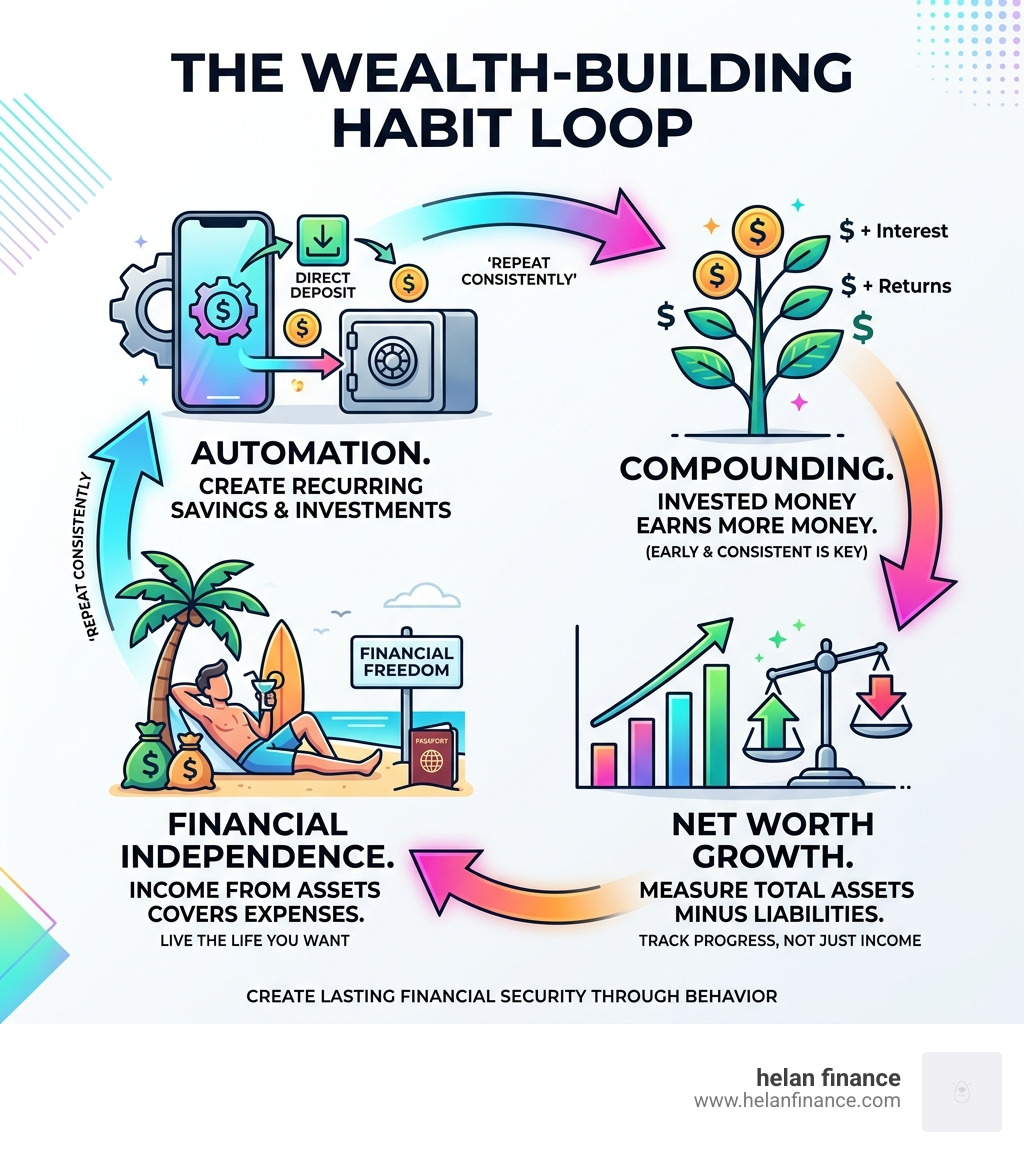
Wealth building habits are the small, consistent financial behaviors that — repeated over time — create lasting financial security and independence.
Here are the core habits that actually move the needle:
- Pay yourself first — automate savings before you spend anything
- Track your spending — know where every dollar goes
- Build an emergency fund — aim for 3-6 months of expenses
- Eliminate high-interest debt — prioritize it aggressively
- Invest early and consistently — time in the market beats timing the market
- Avoid lifestyle inflation — don’t upgrade your life every time income grows
- Diversify your income — build multiple streams over time
- Track your net worth — measure progress, not just income
Most people think wealth is about earning more. It isn’t. Research consistently shows the gap between those who accumulate wealth and those who don’t comes down to behavior, not salary.
Consider this: investing just $200 per month starting at age 25 can grow to roughly $525,000 by age 65. Wait until 35 to start, and that same habit produces only $243,000. Ten years of delay costs you over $280,000.
That’s the power of consistent habits — and it’s why when you start matters far more than how much you earn.
The good news? You don’t need a finance degree or a six-figure income. You need a handful of simple habits, applied consistently. That’s it.
The Science of Wealth Building Habits
Building wealth isn’t just about math; it’s about biology. When we talk about wealth building habits, we are really talking about training our brains.
Inside your brain, a region called the basal ganglia is responsible for habit formation. This area stores “routines” so your prefrontal cortex (the part that does the heavy lifting and decision-making) doesn’t have to work so hard. This is vital because humans suffer from “decision fatigue.” By the time you’ve decided what to wear, what to eat for lunch, and how to handle a difficult email, your willpower is drained. If you have to decide to save money every single day, you will eventually fail.

This is why we focus on creating a “saver identity.” Instead of telling yourself “I am trying to save money,” you start saying “I am the kind of person who prioritizes my future self.” This shift in behavioral economics moves saving from a chore to a core part of who you are.
The difference between sporadic financial decisions and ingrained habits is staggering. Let’s look at two hypothetical investors over a 20-year period to see how consistency beats “big moves.”
Investor A vs. Investor B: The Habit Comparison
| Feature | Investor A (The “Market Timer”) | Investor B (The “Habit Builder”) |
|---|---|---|
| Strategy | Waits for “the right time” to invest large sums | Automates $500 every single month |
| Behavior | Reactive to news and market dips | Consistent regardless of headlines |
| Total Invested | $120,000 (sporadically) | $120,000 (regularly) |
| Result | Often misses the best market days | Captures full market growth and compounding |
| Outcome | High stress, lower returns | Financial peace, significantly higher wealth |
To dive deeper into how your mindset shapes your bank account, check out our guide on Understanding the Psychology of Financial Habits.
Core Habits for Financial Stability and Growth
Before we can build a skyscraper, we need a foundation that won’t crack. In finance, that foundation is built on three pillars: the emergency fund, debt management, and tracking.
The Emergency Fund: Your Investment Protector
Only 41% of U.S. adults would use savings to cover an unexpected $1,000 expense. Without an emergency fund, a flat tire or a broken tooth becomes a high-interest credit card debt. We recommend aiming for 3 to 6 months of essential living expenses. Think of this not as “stagnant cash,” but as an insurance policy for your investments. It prevents you from being forced to sell your stocks when the market is down just because your water heater leaked.
Taming the Debt Monster
High-interest debt (anything over 7-10%) is a wealth-killer. It’s essentially “anti-compounding.” While your investments might grow at 7-10% annually, your credit card might be charging you 20-25%. We often suggest the Debt Avalanche method: list all debts, pay the minimum on everything, and throw every extra penny at the debt with the highest interest rate. This mathematically saves you the most money over time.
Tracking and Budgeting
You cannot manage what you do not measure. Expense tracking isn’t about deprivation; it’s about awareness. Many of our clients find $100–$300 in “lost” monthly subscriptions or small charges simply by looking at their statements.
A popular method is Zero-Based Budgeting, where every dollar you earn is assigned a job—whether that job is “Rent,” “Groceries,” or “Future Freedom.” For more on setting these foundations, explore Essential Money Management Habits for Long-Term Growth.
Automating Your Wealth Building Habits
If willpower is a muscle that gets tired, automation is a robot that never sleeps. Households with automated savings transfers are three times more likely to reach their savings goals.

To set up a “Set-it-and-Forget-it” framework, try these steps:
- Pay Yourself First: Set an automatic transfer from your checking to your savings or brokerage account to trigger the day after your paycheck arrives.
- Employer-Sponsored Plans: If your job offers a 401(k) match, contribute at least enough to get the full match. It is literally a 100% return on your money instantly.
- Dividend Reinvestment (DRIP): Ensure your investment accounts are set to automatically reinvest dividends. This allows your “snowball” to pick up more snow without you lifting a finger.
Tracking Progress and Evolving Your Wealth Building Habits
As you move from the “stability” phase to the “growth” phase, your habits should evolve. One of the most powerful rituals you can adopt is the Weekly Net Worth Check.
Your net worth is simply your Assets (what you own) minus your Liabilities (what you owe). Tracking this weekly or monthly provides a high-level view of your progress. It turns the “boring” act of saving into a game where you want to see the number go up.
Don’t forget to invest in your Human Capital. Your ability to earn is your greatest asset early in life. Dedicating just 15–30 minutes a day to reading about your industry or financial principles can lead to raises and promotions that provide more “fuel” for your investment engine.
Advanced Strategies for Long-Term Accumulation
Once the basics are automatic, it’s time to optimize. Wealthy individuals don’t just save; they protect and diversify.
The 72-Hour Rule
In an era of one-click shopping, impulse buys are the enemy of wealth building habits. Implement a 72-hour waiting period for any non-essential purchase over a certain dollar amount (e.g., $100). Usually, the “must-have” feeling fades, and the money stays in your pocket.
Avoiding Lifestyle Inflation
This is the most common trap for high earners. You get a $10,000 raise, and suddenly you “need” a more expensive car and a bigger apartment. If you can maintain your current lifestyle while your income grows, you can direct 100% of your raises into investments. This is how “ordinary” earners become millionaires.
Diversification and Income Streams
The average millionaire has seven income streams. While you don’t need seven today, starting a side hustle or investing in a diversified portfolio of stocks, bonds, and real estate helps hedge against risk. The average side hustler in April 2026 earns about $891 per month—investing that amount could shave a decade off your retirement date.
Frequently Asked Questions about Wealth Building
How do I start building wealth on a tight budget?
Start small. Micro-investing apps allow you to invest spare change or as little as $5. Focus on percentages rather than dollar amounts. If you can’t save $500 a month, save 1% of your income. Once you’re used to that, move it to 2%. “Found money,” like tax refunds or birthday gifts, should be split: 50% for fun and 50% for your future.
How long does it take for financial habits to stick?
While the old myth says 21 days, modern research suggests it takes closer to 40 to 66 days for a new behavior to feel automatic. The key is “habit stacking”—attaching a new financial habit to an old one. For example, “Every time I check my email on Monday morning, I will also log into my bank account to review my weekend spending.”
What is the most common mistake in wealth building?
Beyond lifestyle creep, the biggest mistake is market timing. Many people stop their automated investments when the news looks scary. However, market corrections are actually “wealth transfers” from reactive sellers to patient, habit-driven holders. Low-cost index funds and a long-term perspective are your best friends.
Conclusion
Building wealth isn’t about luck, and it isn’t about having a “genius” stock tip. It is about the boring, quiet consistency of daily habits. It’s about automating your future, respecting the power of compound interest, and having the patience to let your “snowball” roll for decades.
At Helan Finance, we believe that financial clarity shouldn’t be a source of stress. Our mission is to provide you with the tools and routines that make these habits second nature.
Ready to take control? You don’t have to do it all at once. Pick one habit—perhaps automating a $25 weekly transfer—and start today. To learn more about our philosophy and how we help people simplify their financial lives, visit our Sobre Nós page.
Start your journey to financial clarity today and build the life you’ve always wanted, one habit at a time.

