
The High Yields Savings Account Calculator That Makes Math Fun Again
Why a High Yields Savings Account Calculator Changes How You Save
A high yields savings account calculator is the fastest way to see exactly how much your money can grow — no finance degree required.
Quick answer: How to estimate your interest earnings
- Enter your starting balance — even $500 or $1,000 works
- Add your monthly contribution — any amount you can commit to
- Set your time period — months or years until your goal
- Input the APY — high-yield accounts currently offer around 3.65%–4.00% APY, versus the national average of just 0.38%
- Read your results — the calculator shows total balance, total contributions, and interest earned
Example: A $1,000 starting deposit with $200 added every month at 4% APY grows to roughly $6,067 in just two years — including $267 earned purely from interest.
Most people skip the math because it feels complicated. But here’s the thing: you don’t have to do any of it yourself. A savings calculator handles the compound interest formula behind the scenes and shows you a clear number in seconds.
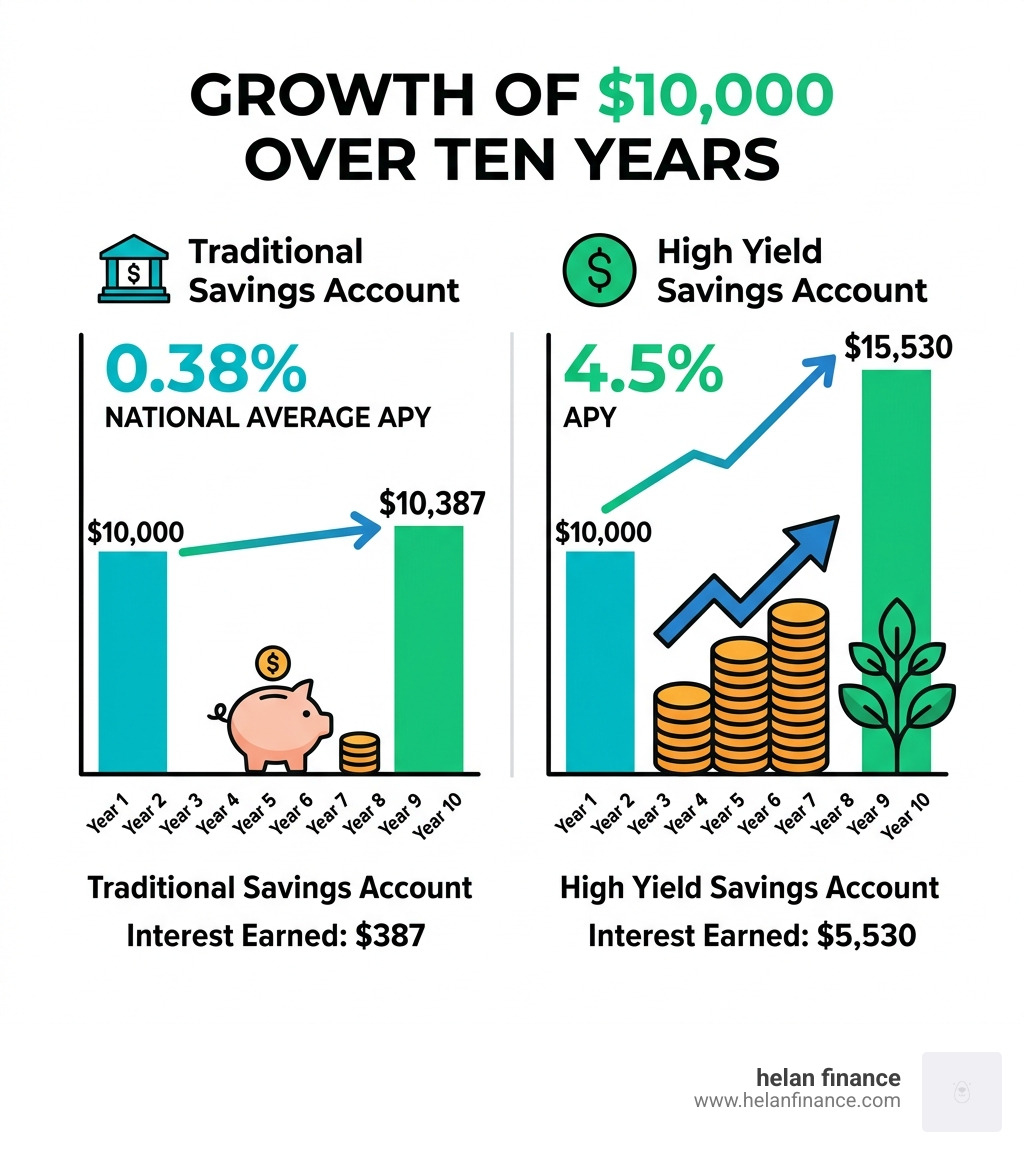
Traditional savings accounts earn almost nothing — we’re talking $0.38 for every $100 saved per year. High-yield savings accounts, by contrast, can earn more than 10 times that rate.
That gap is money you’re either keeping or leaving on the table.
If you’re a busy professional who wants financial progress without spreadsheets or guesswork, this tool is built for exactly that.
How to Use a High Yields Savings Account Calculator
We believe that financial planning should be as intuitive as checking the weather. Using a high yields savings account calculator provides instant financial transparency, allowing us to see the future of our wealth without the headache of manual long division. These digital interfaces are designed to do the heavy lifting, projecting how small, consistent habits turn into significant interest earnings over time.
To get the most out of a tool like the High Yield Savings Accounts Calculator, we need to understand the levers we can pull to speed up our progress.

Understanding the high yields savings account calculator inputs
To get an accurate projection, we need to feed the calculator four specific pieces of information:
- Initial Deposit: This is the “seed” money. Whether it’s $100 or $10,000, this is the amount currently sitting in your hand ready to start earning.
- Monthly Contributions: This is arguably the most important variable. Even a modest monthly addition can drastically change your final balance because it increases the principal that interest is calculated on every single month.
- Time Horizon: How long do you plan to leave the money alone? Compounding is a game of patience. The longer the time horizon, the more the “interest on interest” effect takes over.
- Annual Percentage Yield (APY): This is the real rate of return, including compounding. While the national average for conventional accounts is a measly 0.38% (as of July 2025), high-yield accounts in April 2026 are frequently offering upwards of 4.00%.
Setting realistic savings goals for 2026
As we navigate through 2026, we find that the most successful savers use calculators to work backward from a specific goal. Rather than just “saving money,” we suggest naming your “buckets.”
- Emergency Funds: The gold standard is three to six months of basic expenses. If your monthly expenses are $3,000, your goal is $9,000 to $18,000. A calculator shows you exactly how much to save monthly to hit that safety net within a year.
- Vacation Planning: Want to spend $5,000 on a dream trip in 18 months? Use the calculator to see if $250 a month gets you there, or if the interest earned at 4.2% APY lets you drop that contribution to $230.
- Down Payments: For larger goals like a home, the calculator helps us visualize the impact of a 5-year timeline versus a 7-year timeline.
- Retirement Projections: While not a replacement for a 401(k), a high-yield account is a perfect place for the “liquid” portion of your retirement strategy.
APY vs. Simple Interest: Why the Math Matters
If we want to maximize our wealth, we have to understand the difference between simple interest and APY. Simple interest is calculated only on the principal you deposit. Compound interest (which is what APY measures) is calculated on the principal plus the interest you’ve already earned.
Think of it like a snowball rolling down a hill. Simple interest is like pushing a snowball that stays the same size. Compound interest is the snowball picking up more snow as it rolls, getting bigger and faster with every rotation.

The power of daily compounding
Most high-yield savings accounts compound interest daily and pay it out monthly. This is great news for us. When interest compounds daily, your balance grows by a tiny fraction every day. The next day, the interest is calculated on that slightly larger balance.
This creates a “snowball effect.” While the difference between daily and monthly compounding might seem like pennies in the short term, over a decade, it can mean hundreds or thousands of extra dollars in your pocket. You can use the APY to APR Calculator | FinancialToolset to see how different compounding frequencies change the actual yield of an account.
Truth in Savings Act requirements
We are protected by federal mandates like the Truth in Savings Act. This law requires banks to be transparent. They must disclose the APY so that we can compare “apples to apples.”
Often, banks might advertise a “nominal interest rate” or APR, which looks lower because it doesn’t account for compounding. By forcing banks to show the APY, the government ensures we see the true earning potential of an account, protecting us from marketing sleight-of-hand.
Comparing Growth: Simple vs. Compound Interest
To visualize why we care about compounding, let’s look at a $10,000 deposit at a 5% interest rate over 5 years.
| Year | Simple Interest Balance | Compound Interest Balance (Monthly) | Total Difference |
|---|---|---|---|
| 1 | $10,500 | $10,511 | +$11 |
| 2 | $11,000 | $11,049 | +$49 |
| 3 | $11,500 | $11,614 | +$114 |
| 4 | $12,000 | $12,208 | +$208 |
| 5 | $12,500 | $12,833 | +$333 |
As you can see, by year five, the compound interest has earned an extra $333 simply by existing. This is the “free money” that a high yields savings account calculator helps us track.
Strategies to Maximize Your Savings Growth
At Helan Finance, we believe that tools are only as good as the habits behind them. To truly move the needle on your net worth, we recommend combining the calculator with proven budgeting frameworks.
Why every saver needs a high yields savings account calculator
The calculator isn’t just for a one-time check; it’s a tool for “scenario testing.”
- Contribution Adjustments: What happens if you skip one takeout meal a week and add that $50 to your savings? The calculator might show that this small change adds $3,000 to your 5-year total.
- Inflation Protection: By seeing your real yield, you can ensure your money is growing faster than the cost of living.
- Goal Tracking: Whenever you get a raise or a bonus, plug the new numbers into the high yields savings account calculator to see how much sooner you’ll hit your milestones.
Maximizing returns with online banking
One of the best ways to boost your APY is to look toward online banks. Because they don’t have the overhead costs of physical branches (rent, electricity, tellers), they can pass those savings on to us in the form of higher rates.
While a traditional “big bank” might offer 0.01% or 0.38% APY, online high-yield accounts are currently offering 3.30% to 4.50%. On a $10,000 balance, that is the difference between earning $1 a year and earning $450 a year. It’s a no-brainer.
Practical Tips for Success:
- The 50/30/20 Rule: Allocate 50% of your income to needs, 30% to wants, and 20% to savings.
- Automated Transfers: Set your bank to automatically move money to your high-yield account on payday. If you don’t see it, you won’t spend it.
- Zero-Based Budgeting: Give every dollar a job. If you have $10 left at the end of the month, send it to the savings account where it can start compounding.
Frequently Asked Questions about Savings Calculators
Is the APY in a savings calculator guaranteed?
No. High-yield savings accounts typically have variable rates. This means the bank can change the APY at any time, often in response to the Federal Reserve’s interest rate moves. If the Fed cuts rates, your APY might drop; if they raise rates, your APY could go up. A calculator provides a projection based on the current rate, but your actual results will shift as market conditions change.
Are high-yield savings accounts safe for large deposits?
Yes, provided the bank is FDIC-insured (or NCUA-insured for credit unions). This insurance covers up to $250,000 per depositor, per institution. If the bank were to fail, the U.S. government guarantees your money up to that limit. For amounts over $250,000, many people choose to spread their deposits across multiple banks to ensure everything is fully covered.
How much should I save each month to reach $5,000?
This depends on your timeframe and your APY. For example, if you start with $0 in an account earning 5% APY, you would need to save about $135 per month to hit $5,000 in three years. If you want to hit it in just one year, you’d need to save roughly $400 per month. Consistency is more important than the amount — starting small and building the habit is the key to long-term wealth.
Conclusion
The journey to financial wellness doesn’t have to be a slog through boring spreadsheets. By using a high yields savings account calculator, we turn the abstract concept of “saving” into a concrete, visual roadmap. Whether you are building an emergency fund, planning a wedding, or just wanting to see your money work as hard as you do, these tools provide the clarity needed to make confident decisions.
At Helan Finance, our mission is to simplify your financial life through routines and advice that actually fit into your day. We encourage you to run your numbers today—see what a small increase in your monthly contribution could do for your future self.
For more tools and advice on building a healthier financial life, explore our services and simplified planning resources. Let’s make your money grow, one compound period at a time.

