
Investment Planning: Beginner’s Guide
Why Investment Planning Is the Foundation of Financial Security
Investment planning is the process of defining your financial goals and aligning your money to reach them — step by step, with a clear strategy.
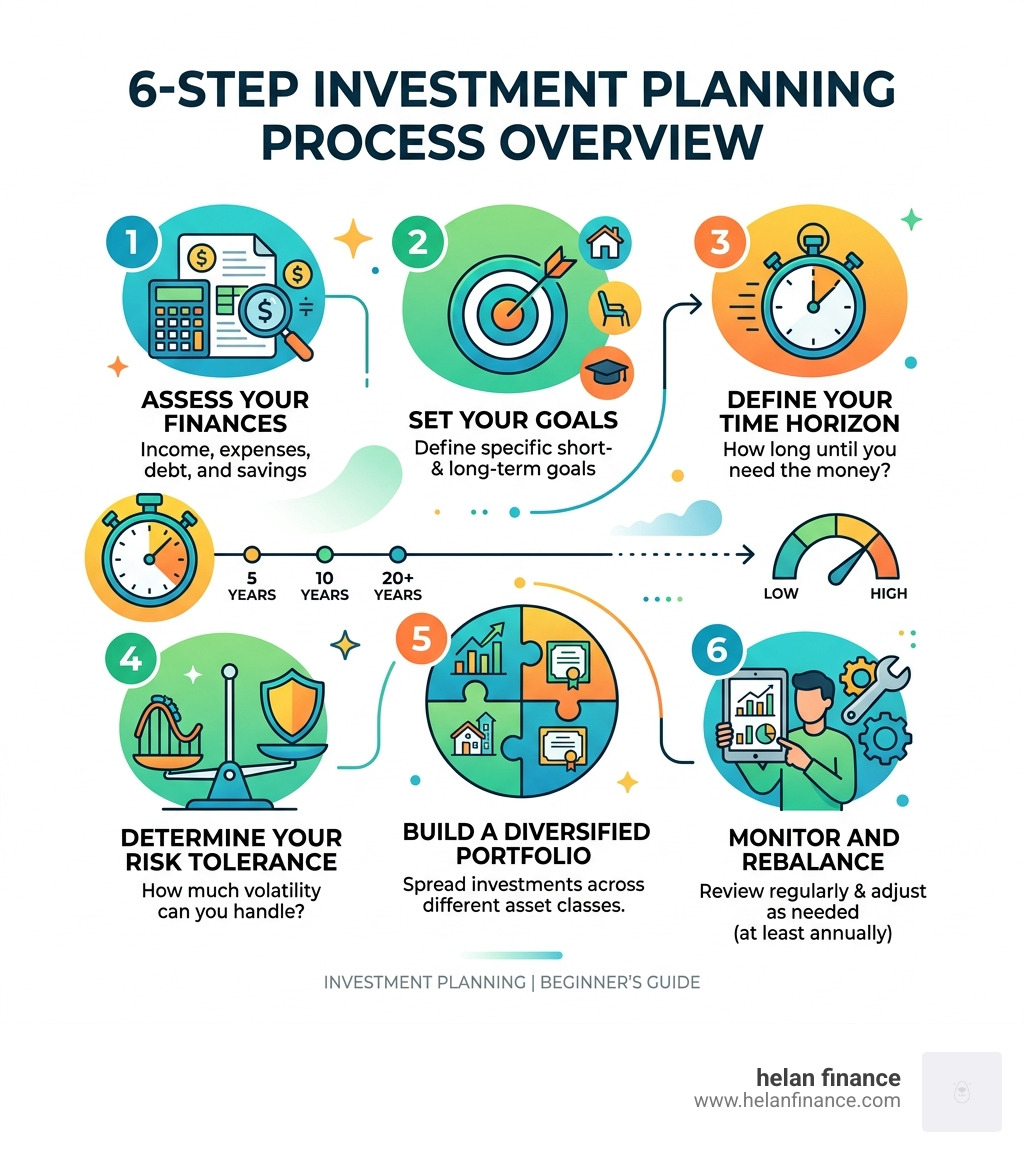
Here’s a quick overview of how it works:
- Assess your finances — Know your income, expenses, debts, and savings
- Set your goals — Retirement, home purchase, education, or wealth building
- Define your time horizon — How long until you need the money?
- Determine your risk tolerance — How much volatility can you handle?
- Build a diversified portfolio — Spread investments across stocks, bonds, and other assets
- Monitor and rebalance — Review at least once a year and adjust as needed
Most people skip the planning part and jump straight to picking investments. That’s a costly mistake.
Research consistently shows that how your money is allocated across asset classes explains roughly 91% of your long-term investment return — not which specific stocks you pick or when you buy and sell.
Yet the average investor earns far less than the market delivers. Why? Mostly because of emotional decisions — panic-selling during downturns, chasing hot stocks, or simply not having a plan at all.
Investment planning fixes that. It gives you a documented framework so your decisions are made before markets get scary — not during them.
Whether you’re saving for retirement 30 years out or a home down payment in five, a solid investment plan doesn’t have to be complicated. It just requires answering a few key questions about where you are, where you want to go, and how much risk you’re willing to take along the way.
What is Investment Planning and Why Does It Matter?
At its core, investment planning is about more than just picking stocks; it is about building a roadmap for your life. Think of it as the bridge between where you are today and where you want to be in April 2026 and beyond. By establishing a plan, we protect ourselves against the eroding power of inflation and ensure we aren’t just working for our money, but that our money is working for us.
Without a plan, we are essentially sailing a ship without a compass. You might move fast, but you probably won’t end up where you intended. A structured plan provides financial security by creating a buffer against life’s surprises and building long-term wealth through the power of compounding.
At Helan Finance, we believe that financial health is a vital part of your overall well-being. Just as you wouldn’t start a marathon without training, you shouldn’t start investing without a framework. To learn more about our philosophy of making finance simple and accessible, visit Sobre Nós.
Defining Your Goals for Investment Planning
The first step in any successful investment planning journey is knowing what you are saving for. We categorize these into three buckets:
- Short-term goals (0-3 years): These are immediate needs like a new car, a dream vacation, or a wedding. Because the timeline is short, these funds should generally stay in stable, liquid assets like high-yield savings or CDs.
- Intermediate-term goals (3-10 years): This might include a down payment for a house or starting a business. You can afford a bit more risk here, but you still need to be cautious as the date approaches.
- Long-term goals (10+ years): This is usually retirement or a child’s college fund. With a decade or more to go, you have the “time wealth” to weather market volatility in exchange for higher potential growth.
To make these goals effective, we recommend using the SMART criteria: Specific, Measurable, Actionable, Realistic, and Time-bound. Instead of saying “I want to save for retirement,” say “I want to have $1.5 million in my retirement account by age 65.”
Assessing Your Financial Starting Point
Before you can look forward, you have to look down at where your feet are currently planted. This means conducting a thorough assessment of your current financial health.
- Calculate Your Net Worth: List everything you own (assets) and everything you owe (liabilities). The difference is your net worth.
- Analyze Cash Flow: Track your income versus your expenses for at least six months. This helps identify your “investable surplus”—the money left over that can actually be put to work.
- The Emergency Fund Rule: Never invest money you might need next month. We suggest having 3 to 6 months of living expenses in a liquid account before you start buying stocks.
- Manage Debt: High-interest debt (like credit cards) is an “anti-investment.” If your debt costs you 20% in interest and the market returns 10%, you are losing money by investing instead of paying off the debt.
Building Your Portfolio with Strategic Investment Planning
Once your goals are set and your foundation is firm, it’s time to build. This is where investment planning becomes tangible.

The most important concept to grasp is asset allocation. This is the process of dividing your portfolio among different asset categories, such as stocks, bonds, and cash. As we mentioned earlier, studies (like the famous Brinson study) show that asset allocation accounts for about 91% of the variability of returns. Only 6% is driven by individual stock picking, and a mere 2% by market timing.
Core Concepts of Investment Planning
To invest like a pro, you need to understand the “laws of the jungle”:
- Risk-Return Trade-off: There is no such thing as a free lunch. If you want higher potential returns, you must be willing to accept higher risk (volatility). If you want safety, you must accept lower returns.
- Market Efficiency: It is very difficult to “beat the market” consistently. For most beginners, low-cost index funds that track the whole market are a smarter bet than trying to find the next “unicorn” stock.
- Behavioral Finance: Your biggest enemy isn’t the market; it’s your own brain. Humans are hardwired to feel the pain of a loss twice as much as the joy of a gain. This leads to panic selling. A plan helps you stay rational when everyone else is losing their cool.
- Time Horizon and Risk: The longer you hold an investment, the lower your risk of losing money. Historically, the S&P 500 has recovered from every single bear market.
Historical Returns (1926-2023) – Real Annual Return (After Inflation)
| Portfolio Type | Real Annual Return |
|---|---|
| 100% Stocks | 7.4% |
| 50% Stocks / 50% Bonds | 5.1% |
| 100% Bonds | 2.0% |
Selecting Your Investment Vehicles
How do you actually buy these assets? You need the right containers.
- Brokerage Accounts: These are standard accounts where you can buy and sell stocks, bonds, and ETFs. They are flexible but don’t offer special tax breaks.
- Tax-Advantaged Accounts (IRAs and 401(k)s): These are specifically for retirement. They either allow your money to grow tax-deferred or tax-free (in the case of a Roth IRA).
- ETFs and Mutual Funds: Instead of buying one stock, these allow you to buy a “basket” of hundreds of stocks or bonds at once, providing instant diversification.
- 529 Plans: Excellent vehicles if your goal is funding education, offering tax-free growth for qualified expenses.
Optimizing Returns by Minimizing Fees and Taxes
In investment planning, it’s not just about what you make; it’s about what you keep. Fees and taxes are the “silent killers” of wealth.

Consider this: Over 20 years, a $50,000 nest egg earning 7% annually would cost you only $4,002 in fees if your expense ratio is 0.25%. However, if you pay a 1.25% fee, those expenses skyrocket to $40,524. That is a massive difference in your future lifestyle!
Best Practices for Efficiency:
- Low-Cost Index Funds: Look for expense ratios below 0.20%.
- Tax-Loss Harvesting: This involves selling investments at a loss to offset gains in other areas, reducing your tax bill.
- Asset Location: Put your “tax-heavy” investments (like high-yield bonds) into tax-advantaged accounts and “tax-light” investments (like index stocks) into taxable brokerage accounts.
- Stay Invested: Missing just the 10 best days in the market between 2004 and 2023 would have slashed your annualized return from 9.7% to 5.5%. Patience pays—literally.
Maintaining Your Strategy Through Rebalancing
Your investment plan is a living document, not a “set it and forget it” statue. Over time, some investments will grow faster than others, causing your “pie chart” to drift. If your target was 60% stocks and 40% bonds, a great year in the stock market might leave you with 75% stocks. This makes your portfolio riskier than you intended.
Rebalancing is the process of selling a bit of what has performed well and buying more of what has lagged behind. This forces you to “buy low and sell high”—the golden rule of investing.
At Helan Finance, we simplify this through easy routines. We recommend an annual review (or whenever an asset class drifts by more than 5%). This keeps you aligned with your original risk tolerance and goals. If you’re feeling overwhelmed by the technicalities, our team is here to help you find a routine that fits your life. Contate Nos to start a conversation about your financial roadmap.
Frequently Asked Questions about Investment Planning
How much money do I need to start an investment plan?
You can start with as little as $1 to $10! Thanks to fractional shares and commission-free trading platforms, the barrier to entry has never been lower. The most important factor isn’t the amount you start with, but the consistency of your contributions. Even $50 a month can grow significantly over decades due to compounding.
How often should I monitor and rebalance my portfolio?
We recommend a “check-in” once a year. Monitoring your portfolio every day often leads to “behavioral risk”—the urge to tinker with things based on short-term news cycles. A yearly review is usually enough to catch portfolio drift and ensure your goals haven’t changed.
What is the difference between an investment plan and a strategy?
Think of the investment plan as the blueprint for the whole house—it includes your goals, your budget, and your timeline. An investment strategy is a specific tool you use within that plan, like “value investing” or “dividend growth.” The plan is the container; the strategy is what’s inside.
Conclusion
Achieving financial wellness doesn’t require a PhD in finance or a million-dollar salary. It requires long-term discipline and a clear framework. By defining your goals, understanding your risk, and minimizing the “leakage” from fees and taxes, you are already ahead of the average investor.
At HelaN Finance, our mission is to take the stress out of the process. We believe that by integrating simple exercises and healthy financial routines into your daily life, you can build a future of security and freedom. Start your journey today—your future self in April 2026 and beyond will thank you.

