
Excel Your Way to Wealth with the Savings Plan Formula
The Savings Plan Formula: Your Shortcut to Smarter Wealth Building
The savings plan formula is the math behind turning small, regular deposits into serious wealth over time. If you want the quick answer first:
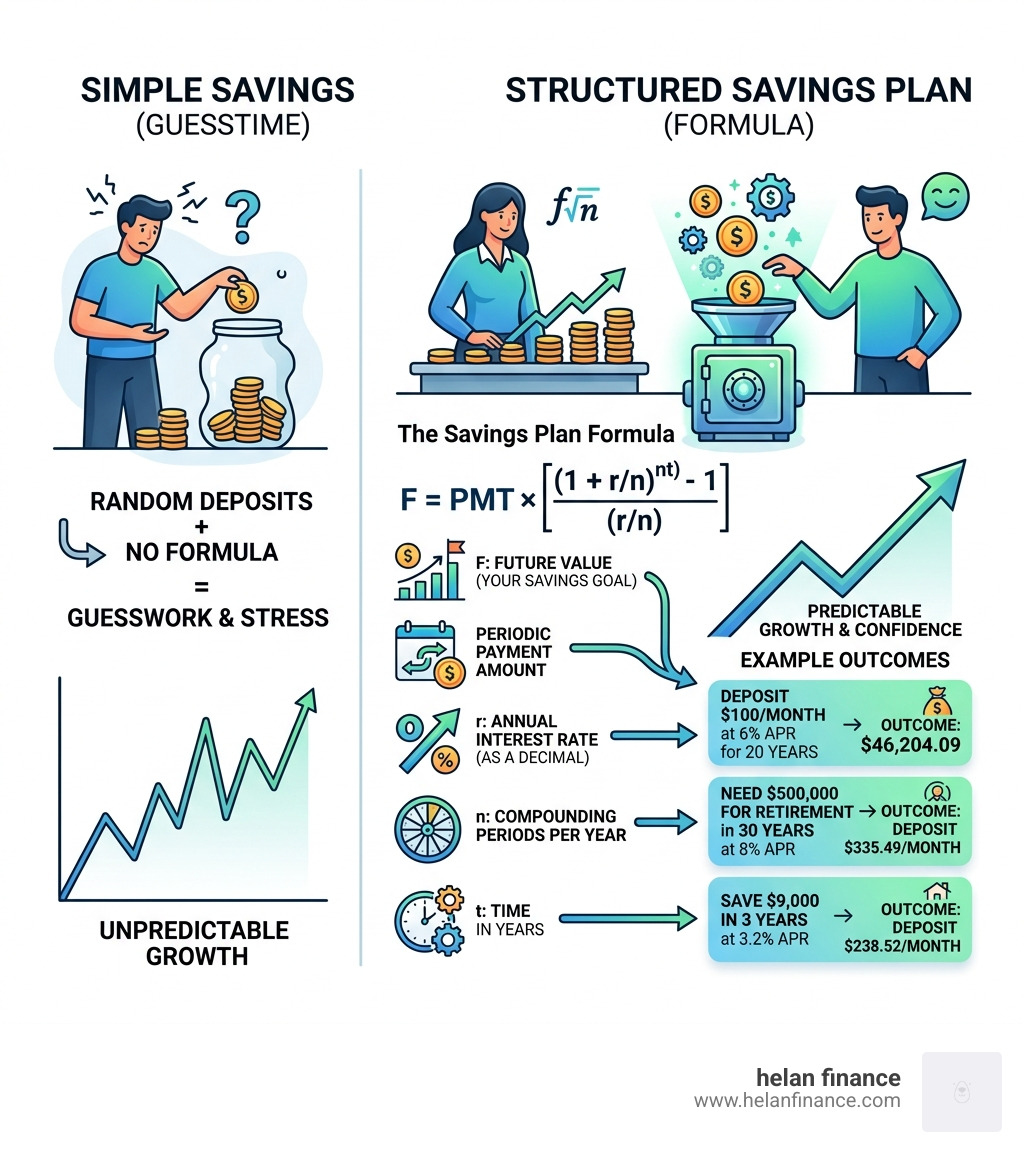
The core savings plan formula is:
$$F = PMT \times \frac{\left[\left(1 + \frac{r}{n}\right)^{nt} – 1\right]}{\frac{r}{n}}$$
| Variable | Meaning |
|---|---|
| F | Future Value (your savings goal) |
| PMT | Periodic payment amount (e.g., monthly deposit) |
| r | Annual interest rate (as a decimal) |
| n | Number of compounding periods per year |
| t | Time in years |
Quick examples of what this formula can do:
- Deposit $100/month at 6% APR for 20 years → $46,204.09
- Need $500,000 for retirement in 30 years at 8% APR → deposit $335.49/month
- Save $9,000 in 3 years at 3.2% APR → deposit $238.52/month
Most of us can’t drop a large lump sum into a bank account. Life doesn’t work that way. But almost anyone can set aside a fixed amount each week or month — and that’s exactly what a savings plan is built for.
The difference between hoping to save and actually building wealth often comes down to one thing: a formula that tells you precisely what to do.
Think of it this way. Without the formula, saving feels like guesswork. Am I saving enough? Will I hit my goal? With it, you have a clear, mathematical answer — no guesswork, no stress.
This guide breaks down the savings plan formula in plain English, walks through real examples, and shows you how to use it in Excel and beyond.
Understanding the savings plan formula and Its Variables
At its heart, a savings plan is an annuity. While “compound interest” usually refers to a single lump sum growing over time, a savings plan involves a series of regular, periodic payments. At Helan Finance, we believe understanding this distinction is the first step toward financial health.
When you use the savings plan formula, you aren’t just calculating interest on what you have; you are calculating interest on a balance that grows every single month (or week) as you add to it. This creates a recursive relationship where each new deposit starts earning its own interest immediately.

Breaking Down the Core savings plan formula
The formula might look like a jumble of parentheses and exponents, but it is actually quite elegant. It is derived from the sum of a geometric sequence. Essentially, it adds up the future value of every single individual deposit you make.
As highlighted in Math In Society: Savings Plans – Portland Community College, the formula assumes that the compounding frequency matches the payment frequency. If you deposit monthly, the interest should compound monthly. This alignment ensures the math works perfectly to reflect your real-world bank balance.
Variables and Definitions
To use the savings plan formula effectively, we need to speak the same language. Here is the breakdown of what each letter represents:
- F (Future Value): This is the “pot of gold” at the end of the rainbow—the total amount you will have after all your payments and interest.
- PMT (Periodic Payment): The amount of money you deposit each period (e.g., $100 every month).
- r (Annual Percentage Rate): The interest rate. Crucial tip: Always convert this to a decimal. For example, 6% becomes 0.06.
- n (Compounding Periods): How many times a year you make a deposit. If you save monthly, $n = 12$. If you save weekly, $n = 52$.
- t (Time): The total number of years you plan to save.
Step-by-Step Examples: Calculating Future Value and Payments
Let’s put the theory into practice. Whether you are saving for a vacation, a new vehicle, or retirement, the savings plan formula is your best friend.

Calculating Periodic Payments (PMT) for Specific Goals
Sometimes, you don’t want to know how much you will have; you want to know how much you need to save to reach a specific target. By rearranging the formula algebraically, we can solve for PMT.
Suppose you want to buy a trailer for $9,000 in three years. Your account offers a 3.2% APR compounded monthly. By plugging these numbers into the rearranged formula, you’ll find that you need to deposit exactly $238.52 per month. This turns a daunting $9,000 price tag into a manageable monthly bill.
Real-World Scenarios: Monthly, Quarterly, and Daily
The beauty of this math is its flexibility. We can apply it to any timeframe:
- Monthly IRA: If you deposit $100 a month into an IRA earning 6% APR for 20 years, you’ll end up with $46,204.09.
- Daily Savings: Small habits lead to big results. Saving just $5 a day at 3% APR compounded daily for 10 years grows to $21,282.07.
- The 52-Week Challenge: This is a popular “growing” savings plan where you save $1 the first week, $2 the second, and so on. By the end of the year, you’ve saved $1,378. While this doesn’t use the standard annuity formula (it’s an arithmetic sequence), it proves that consistency is king.
You can experiment with your own numbers using the Simple Savings Calculator | Bankrate to see how different frequencies change your outcome.
Determining Total Interest and Balance Percentages
One of the most motivating parts of using the savings plan formula is seeing how much of your wealth was “free money” from the bank.
In our $100/month example (6% for 20 years), your total contributions are only $24,000. That means $22,204.09 of your final balance is pure interest! That’s 48.1% of your total wealth created by compounding.
| APR | Total Balance (20 yrs, $100/mo) | Total Interest Earned | % of Balance from Interest |
|---|---|---|---|
| 4% | $36,677.46 | $12,677.46 | 34.6% |
| 6% | $46,204.09 | $22,204.09 | 48.1% |
| 8% | $58,902.04 | $34,902.04 | 59.3% |
Advanced Strategies: Solving for Time and Multi-Phase Goals
Life isn’t always a straight line. Sometimes you have an initial lump sum to start with, or your savings goals change as you age.
Solving for Time with the savings plan formula
What if you have a set amount you can save each month and a specific goal, but you don’t know how long it will take? To solve for $t$, we have to use logarithms and the power rule.
If Sara wants to reach a $10,000 goal by saving $300 a month at 6.8% interest, she can use the formula to find that it will take her approximately 2.6 years. Knowing your timeline allows you to plan other life milestones with confidence. Tools like the Savings Goal Calculator | Investor.gov are excellent for these “backwards” calculations.
Handling Two-Part Savings Problems
Many of our clients at Helan Finance start their journey with a “jumpstart,” like a $1,500 tax return. To calculate this, you combine two formulas:
- Compound Interest Formula for the initial $1,500.
- Savings Plan Formula for the regular monthly deposits.
For example, if you start with $1,500 and then add $150/month for 30 years at 5.5% APR, you’ll reach $144,822.87.
We also see “phased” retirement plans. Imagine saving $1,200 per quarter until age 60, then switching to $300/month until age 65. By treating these as two separate phases—where the final balance of Phase 1 becomes the “initial deposit” for Phase 2—you can accurately project a final retirement nest egg of $130,159.72.
Mastering Digital Tools: Excel Functions and Cloud Applications
In April 2026, we have incredible technology at our fingertips to do the heavy lifting for us. You don’t need a PhD in math to master your money; you just need to know which buttons to press.
Common Errors When Using the savings plan formula
When calculating manually or in a spreadsheet, the most common pitfall is rounding error. If you round the interest rate in the middle of your calculation, your final total could be off by hundreds or even thousands of dollars.
- Tip: Always keep the full decimal in your calculator until the very last step.
- Mismatches: Ensure your $n$ matches your payment frequency. If you are using an annual rate ($r$) but making monthly payments, you must divide $r$ by 12.
As noted in Understanding your analysis calculations – Savings Plans, even professional systems require precise lookback periods and historical data to ensure calculations are accurate.
Cloud and Enterprise Savings Plan Applications
The concept of a “savings plan” isn’t just for personal bank accounts. Large companies use similar logic to save on cloud computing costs. For instance, Understanding how Savings Plans apply to your usage – Savings Plans explains how businesses commit to an hourly spend in exchange for massive discounts.
Whether it’s AWS or Azure, these plans prioritize the highest discount rates first. According to How a savings plan discount is applied – Microsoft Cost Management | Microsoft Learn, these enterprise plans can offer up to 72% savings over standard “pay-as-you-go” rates. The logic is the same: consistency and commitment lead to wealth (or cost reduction).
The Power of Time: Why Starting Early Wins
If there is one thing we want you to take away from this guide, it’s that time is more valuable than money. Because the savings plan formula uses an exponent ($nt$), the longer the money stays in the account, the faster it grows.
Early vs. Late Investment Comparison
Consider two scenarios:
- The Early Starter: Invests $200/month for 15 years at 10% APR, then stops adding money but lets it sit for another 20 years. Final balance: $607,453.85.
- The Late Starter: Waits 15 years, then invests $200/month for the next 20 years at the same 10% rate. Final balance: $151,873.77.
The early starter ended up with four times more money, even though they actually contributed less total cash! This is the “Time Value of Money” in action. Over a 35-year retirement horizon, it’s common for interest to make up over 70% of your final balance. For example, $250/month for 35 years at 6.5% APR results in $400,079.05, where 73.8% of that money is interest.
Frequently Asked Questions about Savings Plans
What is the difference between a savings plan and compound interest?
While both involve interest earning interest, “compound interest” usually refers to a single lump sum growing over time. A savings plan involves regular, periodic deposits. It uses a more complex formula to account for the fact that your principal balance is increasing every time you make a deposit.
How does compounding frequency (n) affect my final balance?
The more often interest compounds, the faster your money grows. However, the difference between monthly and daily compounding is usually smaller than the difference between annual and monthly. The most important thing is that your compounding frequency ($n$) matches how often you are putting money into the account.
Can I use the savings plan formula for daily deposits?
Absolutely! If you are saving $5 a day, you simply set $PMT = 5$ and $n = 365$. As we saw earlier, even small daily amounts can grow to over $21,000 in a decade thanks to the power of the savings plan formula.
Conclusion
Building wealth doesn’t require a miracle; it requires a plan. At Helan Finance, we specialize in taking the complexity out of your financial journey. By mastering the savings plan formula, you’ve moved from “guessing” to “knowing.”
Whether you are automating a $100 monthly transfer or planning a multi-phase retirement, the math remains your most reliable ally. Start early, stay consistent, and let the formula do the heavy lifting for you.

Ready to put these formulas to work? Start your journey to financial health today and let us help you simplify your path to wealth.

