
Keep Your Nest Egg Growing While You’re Busy Relaxing
Why Investing During Retirement Is More Important Than Ever
Investing during retirement is not something you stop doing the day you leave work — it’s something you keep doing, just with a different goal in mind.
Here’s a quick answer if you’re in a hurry:
How to invest during retirement (at a glance):
- Set your withdrawal rate — Start at 4-5% of your portfolio in year one, then adjust for inflation each year
- Keep a balanced mix — Stocks, bonds, and cash; roughly 60/35/5 in your 60s, shifting more conservative as you age
- Build an income floor — Cover essential expenses with guaranteed income (Social Security, pensions, annuities)
- Hold a cash cushion — Keep 1 year of expenses liquid, and 2-4 years in short-term bonds
- Withdraw in the right order — Taxable accounts first, then traditional tax-deferred, then Roth last
- Don’t abandon stocks — You may need your money to last 30+ years; growth still matters
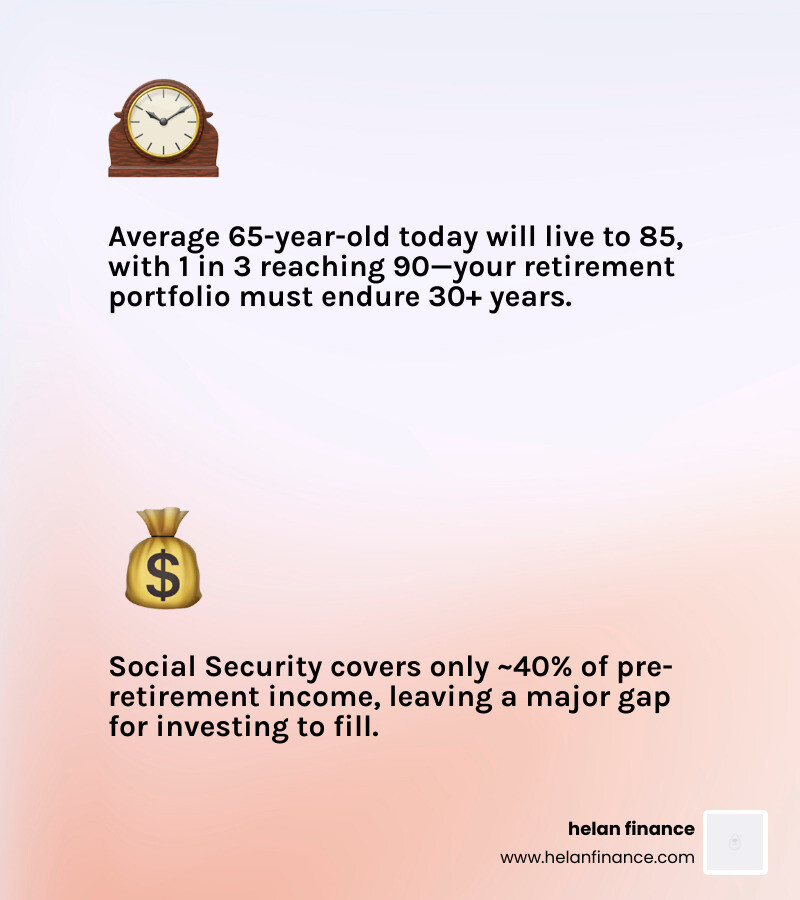
The challenge is real. The average 65-year-old in the U.S. can expect to live to around 85 — and one in three will reach 90. That means your portfolio may need to last three full decades after you retire.
And yet, Social Security only replaces about 40% of pre-retirement income for most people. The rest has to come from somewhere.
That gap is exactly what smart retirement investing is designed to fill.
The good news? You don’t need to reinvent your entire financial approach. The core principles — the right asset mix, steady income, and disciplined withdrawals — are simpler than most people think. This guide pulls together expert perspectives to show you how to make your nest egg last, without losing sleep over it.
Calculating Your Retirement Spending Gap and Longevity
The first step in investing during retirement isn’t looking at stock charts; it’s looking at your life. We need to figure out exactly how much your portfolio needs to “earn” to keep your lifestyle afloat. Most financial experts now suggest aiming for 70% to 100% of your pre-retirement income. If you were making $100,000, you might need $80,000 to $100,000 a year to live comfortably, especially if you plan on traveling or pursuing new hobbies.

We have to account for the “Social Security Gap.” Social Security usually only replaces about 40% of earnings for those making under $100,000, and only about 33% for higher earners. If your annual needs are $80,000 and Social Security provides $30,000, your portfolio has a $50,000 “gap” to fill every year.
Longevity is the biggest wild card. As of April 2026, data shows that one in seven 65-year-olds will live to age 95. Planning for a 30-year or even 40-year retirement is the only safe bet. If we don’t account for this, we risk running out of money just when we need it most. Furthermore, we can’t ignore the “silent tax” of inflation. Even a modest 2.5% annual inflation rate can erode the purchasing power of a dollar by 46% over 25 years. This means that $50,000 you need today will feel like much less in a few decades. For more on managing these moving parts, check out our guide on Investing in Retirement: Strategies for Managing Your Portfolio.
Determining Your Portfolio Withdrawal Rate
Once we know the gap, how much can we safely take out? The 4% Rule has long been the gold standard: you withdraw 4% of your total balance in the first year and adjust that dollar amount for inflation every year after. For a $1 million portfolio, that’s $40,000 in year one. If inflation hits 3%, you take $41,200 in year two.
However, modern research suggests a bit more flexibility. A 5% initial drawdown might be sustainable if you are willing to tighten your belt during market downturns. We often see a “spending curve” in retirement—higher spending in the early “go-go” years (travel, home upgrades), a dip in the “slow-go” years, and a potential spike in the “no-go” years due to healthcare. Distinguishing between essential expenses (food, taxes) and discretionary expenses (cruises, gifts) allows you to adjust your withdrawal rate dynamically based on how your investments are performing.
Strategic Asset Allocation for Investing During Retirement
Many people think that the day they retire, they should move everything into “safe” investments like savings accounts. This is a common mistake. Investing during retirement requires a delicate balance between preservation (protecting what you have) and growth (making sure it keeps up with inflation).

Because your timeline is likely 30 to 40 years, you still need the growth potential of stocks. Without them, inflation will eventually win. A balanced portfolio typically involves a mix of stocks, bonds, and cash that aligns with your specific risk tolerance and income needs. Our team at Helan Finance focuses on Customized Asset Allocation for Your Golden Years to ensure your mix matches your personality—if market dips make you lose sleep, we tilt toward stability.
Age-Based Guidelines for Investing During Retirement
While every plan is unique, here are some general frameworks for how to structure your portfolio as you age:
- The 60s (Transition Phase): Roughly 60% stocks, 35% bonds, and 5% cash. This keeps the growth engine running while providing a five-year “safety net” in bonds and cash.
- The 70s (The Sweet Spot): Roughly 40% stocks, 50% bonds, and 10% cash. At this stage, we prioritize income and stability, but still keep enough in stocks to fight off inflation.
- The 80s and Beyond (Preservation Phase): Roughly 20% stocks, 50% bonds, and 30% cash. Here, the focus is almost entirely on liquidity and making sure the remaining funds are easily accessible for healthcare or legacy goals.
Rebalancing is key. We recommend reviewing your mix at least annually or quarterly. If stocks have a great year and now make up 70% of your portfolio instead of 60%, sell the excess and move it into bonds. This “sell high, buy low” discipline happens automatically when you rebalance.
Generating Sustainable Income: Dividends, Bonds, and Growth
In retirement, we shift from a “total wealth” mindset to a “cash flow” mindset. We want our money to work for us so we don’t have to. A “total return approach” is often the most efficient way to do this. This means your income comes from a combination of interest, dividends, and the strategic sale of appreciated assets.
Instead of just spending the interest, we look at the whole picture. If your stocks grew by 8% and your bonds paid 4%, you can take your 4-5% withdrawal without ever touching your “principal” or original investment. This keeps the “growth plant” healthy for the long term. Learn more about Investment Options to Generate Income in Retirement.
Best Income-Producing Assets for Investing During Retirement
To build this income stream, we look at several specific tools:
- Dividend-Paying Stocks: Companies that share their profits with you. Utilities and Real Estate Investment Trusts (REITs) are classic choices because they tend to offer higher yields.
- Bonds: These are essentially loans you make to governments or companies. U.S. Treasuries are the safest, while Corporate and Municipal bonds often offer higher interest rates (with “Munis” often being tax-free).
- Total Return Funds: These are diversified mutual funds or ETFs designed to provide a steady stream of income and growth in one package.
Creating a Reliable Income Floor
We always suggest building an “income floor”—a guaranteed amount of money that hits your bank account every month regardless of what the stock market does. This should cover your essential expenses (housing, utilities, groceries).
Your floor is built from Social Security, any pensions you might have, and potentially annuities. By covering the basics with guaranteed sources, you can afford to be more patient with your stock investments, knowing you won’t be forced to sell them during a market crash just to buy eggs.
Tax-Efficient Withdrawal Strategies and Account Sequencing
It’s not just about how much you withdraw; it’s about where you take it from. The IRS wants their cut, and the order of your withdrawals can save you thousands in taxes over a lifetime.
| Account Type | Tax Status | Recommended Withdrawal Order |
|---|---|---|
| Taxable Accounts (Brokerage/Savings) | Pay tax on gains only | First (allows tax-deferred accounts more time to grow) |
| Traditional IRA / 401(k) | Withdrawals taxed as ordinary income | Second (subject to RMDs at age 73) |
| Roth IRA / 401(k) | Withdrawals are tax-free | Last (most valuable assets to leave growing) |
Required Minimum Distributions (RMDs) currently kick in at age 73. If you don’t need the money, RMDs can be a nuisance because they force you to take taxable income. Strategic “Roth Conversions” in your early 60s—moving money from a Traditional IRA to a Roth while you are in a lower tax bracket—can help reduce the size of those future RMDs.
Maximizing Social Security and Pension Benefits
One of the best “investments” you can make is simply waiting. If you delay Social Security until age 70 instead of taking it at 62, your monthly benefit increases by roughly 76%. Even waiting from your full retirement age (66 or 67) until 70 provides a 32% boost. This is a guaranteed, inflation-adjusted return that no market investment can match.
For those with pensions, you’ll often face the choice between a “Lump Sum” and “Monthly Payments.” While a lump sum gives you control, the monthly payment acts as a lifetime annuity, providing that essential income floor we discussed earlier.
Protecting Your Portfolio from Inflation and Market Volatility
Market volatility is scary, but “Sequence of Returns Risk” is the real monster. This is the risk that a market crash happens in the first few years of your retirement. If you are forced to sell stocks while they are down 20% to pay your bills, your portfolio may never recover.
Historically, bear markets take about three and a half years to recover from peak to peak. To survive this, you need a “buffer.” We advocate for a multi-layered safety net:
- The Cash Cushion: Keep 1 year of spending in a liquid, high-yield savings account or money market fund.
- The Short-Term Bucket: Keep 2 to 4 years of spending in short-term bonds or CDs (Certificates of Deposit).
- The Growth Bucket: The rest stays in stocks.
If the market crashes, you spend your cash. If it stays down, you spend your short-term bonds. This gives your stocks 3 to 5 years to bounce back before you ever have to touch them.
Managing Risk When Investing During Retirement
Beyond the cash cushion, consider “laddering” your investments. A CD ladder or Bond ladder involves buying assets that mature at different times (e.g., a 1-year, 2-year, 3-year, and 4-year CD). As each one matures, you have ready cash. If you don’t need the cash, you reinvest it at the current (hopefully higher) rate.
We also look at defensive sectors—like healthcare and consumer staples—which tend to hold up better during recessions. Protecting your purchasing power is a marathon, not a sprint. For a deeper dive into this, see The Impact of Inflation on Retirement Savings.
Frequently Asked Questions about Retirement Investing
How much cash should I hold in retirement?
We generally recommend holding one full year of essential spending in cash or cash equivalents (like money market funds). This ensures that no matter what happens in the world, your bills are paid for the next 12 months. This “liquidity” is your best defense against emotional selling during market panics.
Should I still hold stocks after age 70?
Yes! Unless you have a very short life expectancy or an incredibly large surplus of cash, you likely need stocks to protect against longevity risk and inflation. Even at age 70, you might live another 20+ years. A 20% to 40% allocation to high-quality, dividend-paying stocks provides the growth necessary to ensure your money doesn’t lose its “buying power” over time.
What are the most common mistakes retirees make?
The “Big Three” mistakes are:
- Ignoring Inflation: Thinking that $5,000 a month today will be enough in 2046.
- Paying High Fees: Many advisors charge 1% or more, plus fund expenses. On a $1 million portfolio, that’s $17,000+ a year. Switching to low-cost index funds can save you a fortune.
- Being Too Conservative: Moving entirely to cash and watching the value of your savings melt away as prices rise at the grocery store.
Conclusion
At Helan Finance, we believe that investing during retirement shouldn’t be a source of stress. Our goal is to simplify the complex, providing you with exercises and routines that make financial health feel as natural as physical health. By setting a smart withdrawal rate, maintaining a balanced asset mix, and protecting yourself with a cash cushion, you can stop worrying about the “what ifs” and get back to what really matters: enjoying the retirement you worked so hard to earn.
Ready to see how your current plan stacks up? Explore Customized Asset Allocation for Your Golden Years or More info about our services to refine your strategy and relax with confidence.

