
Don’t Go Broke Trying to Plan Your Future
Why the Financial Planning Process Steps Matter More Than You Think
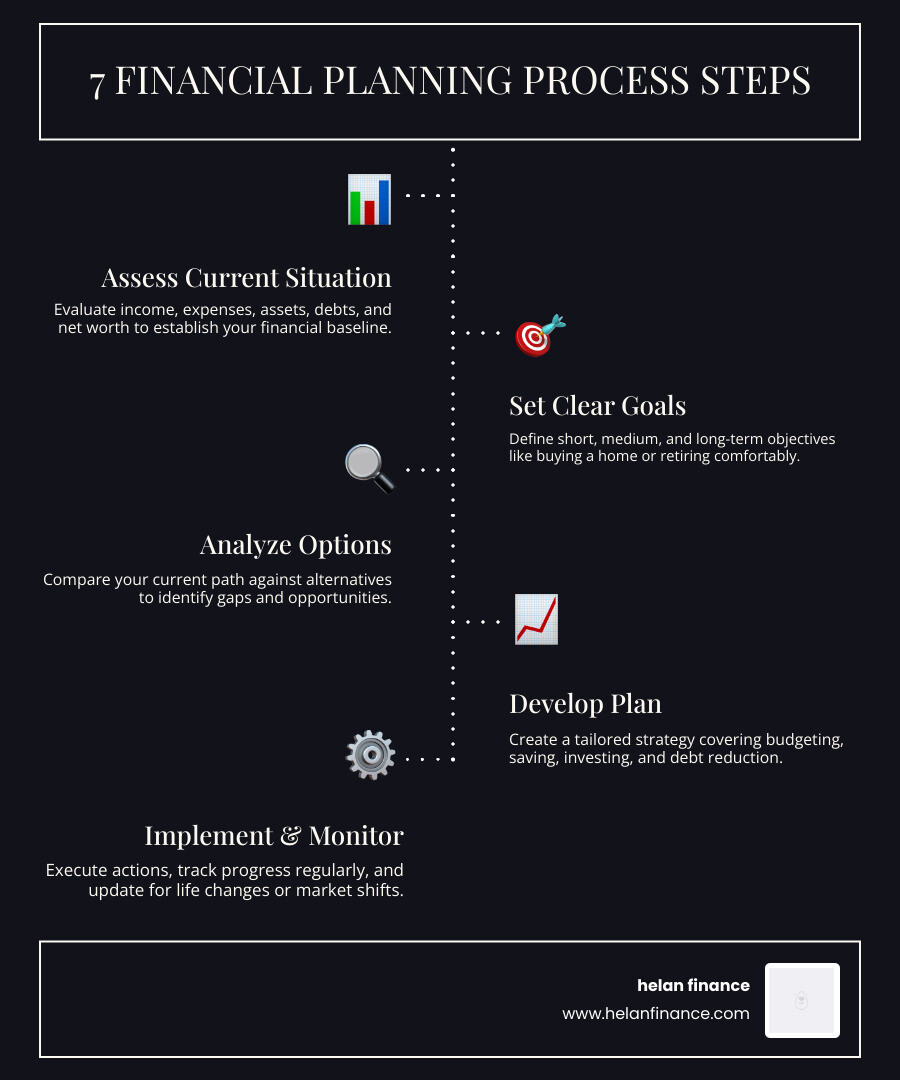
The financial planning process steps give you a clear, repeatable system to go from financial chaos to financial confidence. Here’s a quick overview:
- Understand your current situation – income, expenses, assets, debts
- Set clear financial goals – short, medium, and long-term
- Analyze your options – compare your current path to better alternatives
- Develop a plan – build a strategy that fits your life
- Implement the plan – take action with accounts, budgets, and investments
- Monitor progress – track results and stay on course
- Update as life changes – adjust when your goals or circumstances shift
Building wealth takes years of hard work. But hard work without a plan is just guessing.
Most people know they should have a financial plan. Yet only about 36% of Americans actually have one, according to a Schwab survey. The rest are making money decisions in isolation — reacting to emergencies, missing opportunities, and wondering why the numbers never seem to add up.
The problem usually isn’t discipline or income. It’s the absence of a clear process.
Whether you’re juggling student loans, trying to save for a home, or just trying to stop living paycheck to paycheck — a structured approach makes every decision easier. It tells you what to do first, what to do next, and what to stop doing altogether.
The good news? The process doesn’t have to be complicated or expensive.
Mastering the 7 Financial Planning Process Steps
When we talk about professional standards, we look to the The 7 Step Financial Planning Process | CFP Board. In 2019, the standard for certified professionals shifted from a six-step to a seven-step model. This wasn’t just bureaucracy; it was a move to ensure that financial planning is a collaborative, human-centered journey rather than just a math equation.

At its heart, this process is about ethical standards and transparency. A professional planner is a fiduciary—meaning they are legally bound to act in your best interest. But even if you are managing your own money, following these steps ensures you aren’t leaving your future to chance.
The seven steps include:
- Understanding the Client’s Circumstances: Gathering all data, both the hard numbers and the “soft” feelings about money.
- Identifying and Selecting Goals: Deciding what you actually want your money to do.
- Analyzing the Current Course of Action: Looking at what will happen if you don’t change anything.
- Developing Recommendations: Finding the “gap” and figuring out how to bridge it.
- Presenting Recommendations: Reviewing the strategy to ensure it makes sense.
- Implementing Recommendations: The “doing” phase—opening accounts, buying insurance, or moving money.
- Monitoring Progress and Updating: The lifelong commitment to checking in and adjusting.
Why Assessment is the Foundation of Financial Planning Process Steps
You wouldn’t start a road trip without knowing your starting point, right? That’s why The First Step in the Financial Planning Process is always assessment. It is the most critical phase because it prevents you from making decisions based on incomplete information.
To assess your situation correctly, we look at two types of data:
- Quantitative Data: This is the objective stuff. Your pay stubs, bank statements, tax returns, mortgage balances, and insurance policies.
- Qualitative Data: This is the subjective stuff. How do you feel about risk? What are your health expectations? Do you want to leave an inheritance, or do you want to “die with zero”?
During this stage, we calculate your Net Worth (Assets minus Liabilities) and your Cash Flow (Income minus Expenses). Understanding your cash flow is the foundation of everything else. If you have a negative cash flow, no amount of complex investing will save your plan. You have to plug the leaks first.
Implementing Your DIY Financial Planning Process Steps
You don’t always need a high-priced advisor to get started. Many of us at Helan Finance believe that a self-directed roadmap can be just as effective for those starting out. If you want to take the DIY route, follow these 9 key steps:
- Write down your goals: Be specific. Instead of “I want to save,” try “I need $50,000 for a house down payment by April 2028.”
- Calculate your net worth: List everything you own and everything you owe.
- Track your cash flow: See where every dollar goes for at least 30 days.
- Create a budget: Use a simple guideline like 60% for needs, 30% for wants, and 10% for savings (or the 50/30/20 rule).
- Build a “Starter” Emergency Fund: Aim for $1,000 or one month of expenses to avoid new debt.
- Capture the Match: If your employer offers a 401(k) match, contribute enough to get it. That’s a 100% return on your money!
- Attack High-Interest Debt: Use the “debt avalanche” or “debt snowball” to clear credit cards.
- Full Emergency Fund: Once the high-interest debt is gone, build 3–6 months of essential expenses.
- Automate Everything: Set up automatic transfers to your savings and investment accounts so you don’t have to “remember” to be responsible.
By following these steps, you build a “fortress” around your finances. To learn more about our philosophy on simple, routine-based planning, visit our Sobre Nós page.
Personal vs. Business Financial Planning: Key Differences
While the core logic remains the same, business financial planning has its own unique set of hurdles. For an individual, the goal is often lifestyle and retirement. For a business, the goal is profitability, liquidity, and growth.

In a business context, the financial planning process steps often focus heavily on Liquidity Forecasting. A business can be profitable on paper but still go bankrupt if it runs out of cash to pay its employees.
| Feature | Personal Financial Planning | Business Financial Planning |
|---|---|---|
| Primary Goal | Retirement & Lifestyle | Profitability & Growth |
| Time Horizon | Multi-generational | Short (12mo) to Strategic (5yr+) |
| Key Metric | Net Worth | Cash Flow & Liquidity |
| Risk Focus | Life & Health Insurance | Market Share & Capital Requirements |
| Review Frequency | Annual / Life Events | Monthly / Quarterly |
Business planning requires detailed Sales Forecasts and a clear understanding of Capital Requirements. If you’re running a company, you need to know exactly when you’ll need to borrow money or seek equity investors. As noted in Financial Planning – A Six Step Process – Oury Clark, the collaborative nature of planning is even more vital in a business where multiple stakeholders are involved.
Advanced Strategies for High-Net-Worth Individuals
For those with significant assets, the financial planning process steps become more about “defense” than “offense.” It’s not just about making money; it’s about keeping it.
High-net-worth individuals (HNWIs) face unique challenges like the “death tax” (estate tax), complex capital gains, and the need for sophisticated risk management.
- Tax Optimization: This goes beyond just filing your returns. It involves tax-loss harvesting, using trusts to move assets out of your taxable estate, and timing income to stay in lower tax brackets.
- Estate Planning: This isn’t just a will. It’s a comprehensive strategy involving Power of Attorney, Healthcare Proxies, and Revocable or Irrevocable Trusts to ensure your legacy is protected and probate is avoided.
- Risk Management: This includes “umbrella” liability insurance to protect against lawsuits, which are a much higher risk for those with visible wealth.
- Sophisticated Investments: Accessing private equity, real estate syndications, or hedge funds to diversify beyond the standard stock and bond markets.
If you find your situation becoming increasingly complex, don’t hesitate to reach out. You can Contate Nós to discuss how specialized planning can safeguard your family’s future.
Avoiding Common Mistakes in Your Financial Journey
Even with the best intentions, it’s easy to stumble. Here are the most common pitfalls we see when people try to implement the financial planning process steps:
- Siloed Advice: This happens when your tax person doesn’t talk to your insurance person, who doesn’t talk to your investment person. Your finances are an ecosystem; if you change one part, it affects the others.
- Procrastination: The “cost of delay” is the most expensive tax you will ever pay. Starting your retirement savings at 35 instead of 25 can literally cost you millions of dollars in lost compounding by age 65.
- Ignoring Insurance: We’ve seen decades of perfect planning wiped out by a single disability or a lack of long-term care insurance. Insurance is the “floor” of your financial house.
- Violating the 28/36 Rule: This is a classic debt guideline. Your housing costs should not exceed 28% of your pre-tax income, and your total debt (including cars and student loans) should not exceed 36%.
- Forgetting the 60/30/10+15 Guideline: Some experts suggest a slightly more aggressive “optimized” budget: 60% for essentials, 30% for discretionary, and 10% for goals, while aiming for a total of 15% of pre-tax income going toward retirement.
Always remember that your use of any financial tool or strategy should be governed by clear agreements. Be sure to review our Termos de Uso for more information on how we provide our guidance.
Frequently Asked Questions about Financial Planning
Can I create a financial plan without a professional?
Absolutely. For many people, a DIY approach is the perfect way to start. By following the 9-step roadmap mentioned earlier, you can create a cost-free roadmap that covers the basics: budgeting, emergency funds, and debt repayment. Self-directed planning helps you understand the “mechanics” of your money. However, as your net worth grows or your tax situation complicates (like starting a business), professional eyes become much more valuable.
How often should I review and update my financial plan?
At a minimum, you should do an annual review. April 2026 is a great time to look back at the previous year and adjust for the year ahead. However, you should also trigger an update after any major life event:
- Marriage or divorce
- Birth of a child or grandchild
- Changing jobs or starting a business
- Receiving an inheritance
- Significant market fluctuations that shift your asset allocation by more than 5%
What is the difference between financial planning and investment management?
Think of it this way: Investment management is about the “engine” (your stocks, bonds, and ETFs). Financial planning is the “entire car” and the “map.” Investment management focuses on asset allocation and trying to get the best risk-adjusted return. Financial planning is a holistic picture that coordinates those investments with your taxes, your insurance, your estate plan, and your specific life goals. You can have great investments and still fail your financial plan if you don’t have the right insurance or tax strategy.
Conclusion: Your Path to Financial Peace
Financial planning isn’t a one-time event; it’s a lifestyle. It’s about creating routines that make wealth-building feel like second nature rather than a chore. At Helan Finance, we specialize in taking these complex financial planning process steps and turning them into simplified tools.
Whether it’s through our interactive exercises, daily financial routines, or even health tips that help you reduce stress (because financial stress is a health issue), we are here to help you navigate the journey. You don’t have to go broke trying to plan your future. With a clear process and a little bit of discipline, financial peace is well within your reach.
Ready to take the first step? Start by calculating your net worth today and see where you stand. Your future self will thank you.

