
7 No-Nonsense Tips for Financial Habits
Why Financial Habits Matter More Than Income
Financial habits are the small, repeated money behaviors that quietly shape your entire financial future — and the good news is, they’re learnable at any stage of life.
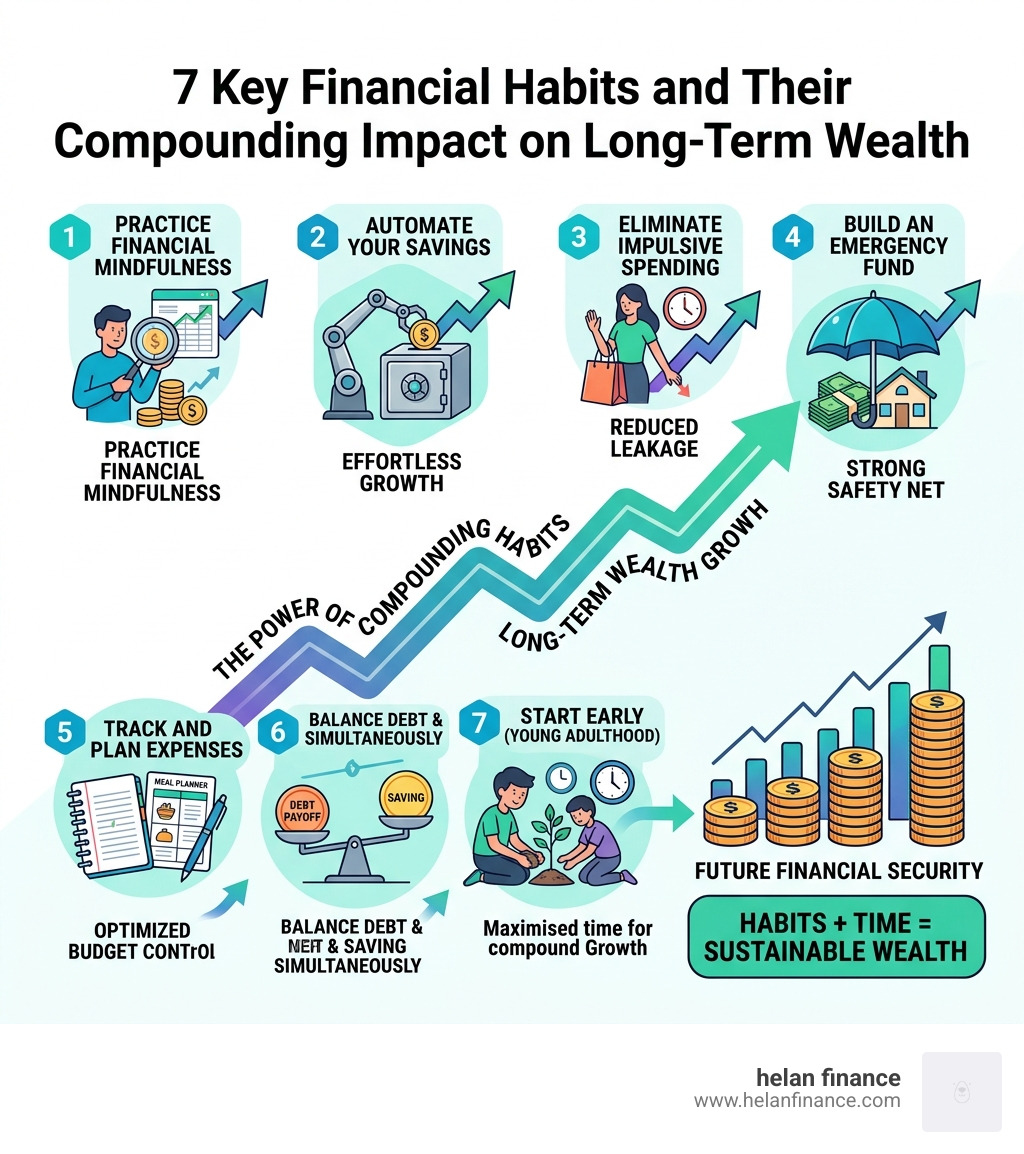
Here are the core financial habits that actually move the needle:
- Practice financial mindfulness — know what you have, owe, and spend without judgment
- Automate your savings — set it and forget it, before you can spend it
- Eliminate impulsive spending — use simple rules like a 24-hour waiting period before buying
- Build an emergency fund — aim for 3–6 months of living expenses in a liquid account
- Track and plan daily expenses — meal planning, expense logs, and cash-back rewards add up fast
- Balance debt and saving simultaneously — you don’t have to wait to be debt-free to start saving
- Start early, especially in young adulthood — time is your biggest financial advantage
Nearly half of Americans live paycheck to paycheck. Not because they don’t earn enough — but because small, consistent habits were never built. Research consistently shows that financial behavior and discipline matter more than income level when it comes to long-term wealth.
The gap between someone who feels financially secure and someone who feels constantly behind often isn’t salary. It’s systems.
This guide gives you 7 no-nonsense tips to build financial habits that actually stick — without overhauling your entire life.
Building a Foundation with Mindfulness and Automation
To build lasting financial habits, we first have to look at what’s going on under the hood—our psychology. According to Scientific research on money attitudes, our beliefs about money significantly dictate our saving and spending patterns. For many, money is a source of security. While this “money-as-security” mindset encourages us to save more, it can also lead to higher risk aversion, making us hesitant to invest.
At Helan Finance, we believe that true financial wellness starts with awareness. You can learn more about our philosophy and how we approach these challenges on our Sobre Nós page. By combining financial awareness (knowing the numbers) with financial acceptance (not beating yourself up over the numbers), we create a foundation where automation can do the heavy lifting.
1. Practice Financial Mindfulness for Better Decision-Making
Mindfulness isn’t just for meditation; it’s a tool for your wallet. Financial mindfulness is the habit of being present with your money. It involves two main components: awareness and acceptance.
Overcoming Emotional Spending
Have you ever bought something just because you were stressed, bored, or felt pressured by friends? That’s emotional spending. By practicing mindfulness, we learn to pause. Instead of reacting to an impulse, we acknowledge the feeling. “I’m feeling stressed, and I want to buy this gadget to feel better.” Simply naming the emotion can often break the cycle of impulsive behavior.
Awareness Rituals and Money Conversations
We recommend turning “money talk” into a ritual. Once a month, grab a coffee at your favorite shop and review your bank statements. This turns a potentially scary task into a pleasurable routine. Furthermore, start open money conversations with friends or partners. Breaking the taboo around discussing finances helps normalize healthy financial habits and reduces the shame often associated with debt or lower income.
Avoiding the Sunk Cost Fallacy
Mindfulness also helps us avoid the “sunk cost fallacy”—the tendency to keep pouring money into a bad investment or a car that keeps breaking down just because we’ve already spent so much on it. Mindful individuals are better at cut-and-run decisions because they focus on the future utility rather than past losses.
2. Automate Your Way to Long-Term Wealth
If we rely on willpower to save money, we will eventually fail. Willpower is a finite resource; automation is infinite.
The Power of “Pay Yourself First”
The most effective way to save is to “pay yourself first.” This means setting up an autosave function where a portion of your paycheck is diverted to a savings or investment account before you even see it in your checking account. If the money isn’t there, you can’t spend it. Even starting with as little as $20 or $60 a month can lead to over $700 in a year, proving that small adjustments have outsized impacts.
The 50/30/20 Rule
To manage your automated flows, consider the 50/30/20 rule:
- 50% for Necessities: Rent, groceries, utilities, and insurance.
- 30% for Non-essentials: Dining out, hobbies, and “nice-to-haves.”
- 20% for Savings and Debt Repayment: This is your future-building fund.
By understanding Financial habits and norms, we see that these structures help us navigate day-to-day life without constant decision fatigue. Automation ensures that wealth accumulation happens in the background while you live your life.
Strategies to Curb Spending and Protect Your Future
Building wealth isn’t just about what you earn; it’s about what you keep. As we move into April 2026, the temptation to spend is everywhere—from “one-click” shopping to social media influencers. We need physical and digital barriers to protect our cash flow.

3. Use Micro-Habits to Eliminate Impulsive Spending
Impulsive spending is often the biggest leak in a household budget. It’s rarely the $1,000 purchase that breaks us; it’s the twenty $50 purchases.
- The 24-Hour Basket Rule: This is a game-changer. If you find something you want online, put it in the cart and then close the tab. Wait 24 hours. Most of the time, the “must-have” feeling fades, and you’ll realize you don’t actually need it.
- Zero-Dollar Days: Challenge yourself to have two or three days a week where you spend absolutely $0. No coffee runs, no quick grocery trips, no digital downloads. This trains your brain to find contentment without spending.
- Subscription Rotation: We often pay for five streaming services but only watch one. Audit your subscriptions monthly. Cancel what you aren’t using. You can always resubscribe next month if a new season of your favorite show drops.
- Delete Delivery Apps: The convenience fees and service charges on food delivery can easily double the price of a meal. A $15 restaurant meal might cost $30 delivered, but only $2 to $5 to prepare at home.
- Bulk Buying: For non-perishable essentials, buying in bulk reduces the unit cost significantly. Just be careful not to “bulk buy” snacks that you’ll just eat faster because they are in the house!
4. Build a Bulletproof Emergency Fund
An emergency fund is the “stress-relief” account. It isn’t for a vacation or a new car; it’s for the transmission that dies or the medical bill that arrives out of nowhere.
The $2,000 Benchmark
While the ultimate goal is to have 3-6 months of living expenses, that can feel overwhelming when you’re starting from zero. Research shows that having just $2,000 in a dedicated emergency account increases financial well-being by 21%. It’s the difference between a car breakdown being a “tragedy” and it being a “nuisance.”
Where to Keep It: Savings vs. CDs
You need this money to be liquid—meaning you can get to it today if needed.
| Feature | Savings Account | Certificate of Deposit (CD) |
|---|---|---|
| Accessibility | High (Withdraw anytime) | Low (Penalty for early withdrawal) |
| Interest Rate | Variable (Lower) | Fixed (Higher) |
| Best For | Emergency Fund | Long-term goals (1-5 years) |
| Risk | Very Low | Very Low |
For your emergency fund, stick to a high-yield savings account. You want the peace of mind that comes with instant access.
Master the Daily Logistics of Financial Habits
Once the big systems are automated, we focus on the daily logistics. This is where tracking and planning become your secret weapons.

5. Balance Debt Repayment with Consistent Saving
One of the most common questions we hear is: “Should I pay off my debt or save for the future first?” Our answer: Why not both?
If you wait until you are 100% debt-free to start saving, you miss out on years of compounding interest. We suggest paying the minimum on all debts, then picking a strategy for the “extra” cash:
- The Snowball Method: Pay off the smallest balance first. This gives you a psychological win and builds momentum.
- The Avalanche Method: Pay off the debt with the highest interest rate first. This saves you the most money in the long run.
Focusing on your debt-to-income ratio and maintaining a high credit score is essential. A higher credit score doesn’t just help you get loans; it lowers the interest rates on those loans, saving you thousands of dollars over your lifetime.
6. Optimize Daily Expenses Through Tracking and Planning
Small daily leaks are often invisible until you track them. For one month, record every single penny that leaves your pocket. You’ll likely find “ghost” expenses—subscriptions you forgot about or daily habits that don’t actually bring you joy.
- Meal Planning: This is the single most effective way to cut grocery costs. By planning your meals and shopping with a strict list, you avoid the “what’s for dinner?” panic that leads to expensive takeout.
- Unit Costs: Always look at the price per ounce or price per unit on the grocery shelf tag. Sometimes the “family size” is actually more expensive per unit than the smaller one!
- Public Transportation and Car-Free Days: If you live in an area with transit, try one or two car-free days a week. Between gas, parking, and wear-and-tear, you could save hundreds a month.
- Secondhand Shopping: Before buying new, check thrift stores or online marketplaces. In 2026, the “circular economy” is stronger than ever, and you can find high-quality goods for a fraction of the retail price.
Adapting Your Money Mindset for 2026 and Beyond
As we navigate the financial landscape of April 2026, we must recognize that demographics play a role in our financial habits. Age, gender, and household income influence how we view risk and security. However, regardless of your starting point, the principles of financial socialization remain the same: the values we learn early on dictate our adult success.
At Helan Finance, we aim to bridge the gap between where you are and where you want to be. Our mission, detailed on our Sobre Nós page, is to simplify these complex behaviors into daily routines that feel natural.
7. Developing Healthy Financial Habits in Young Adulthood
For college students and young professionals, the habits formed today will compound for 40+ years. This is the “golden era” of habit formation.
- Tackle Student Debt Early: One in five Americans has student debt. Even making small payments of $25 or $50 while still in school can help build your credit score and reduce the principal before interest starts to balloon.
- Maximize Student Discounts: Never pay full price if you don’t have to. From software to insurance to food, keep that student ID handy.
- The F.I.R.E. Movement: Financial Independence, Retire Early (F.I.R.E.) might seem extreme, but its core principles—aggressive saving and low-cost living—are excellent for young adults.
- Early Investing: If your employer offers a 401(k) match, that is essentially “free money.” Contribute at least enough to get the full match. It’s an immediate 100% return on your investment.
The Role of Financial Literacy in Sustaining Financial Habits
Financial literacy isn’t just about knowing what an IRA is; it’s about investment discipline. It’s the ability to stay the course when the market is volatile.
- Insurance Review: Once a year, review your health, auto, and life insurance. As your life changes, your coverage should too.
- Retirement Contributions: Aim to increase your retirement contribution by just 1% every year. You won’t notice the difference in your paycheck, but your 65-year-old self will thank you.
- Your Financial Health Score: Think of your finances like your physical health. Do you have a “balanced diet” of savings, investments, and controlled spending?
Frequently Asked Questions about Financial Habits
How long does it take to build a new financial habit?
While the old myth says 21 days, research suggests it actually takes about 66 days for a new behavior to become automatic. The key is consistency over perfection. If you miss a day of tracking, don’t quit—just start again tomorrow.
What is the most effective small habit for saving money?
Automating your savings. Removing the human element of “deciding” to save ensures that it happens every single month, regardless of your mood or willpower.
How much should I realistically save for an emergency fund in 2026?
Aim for a minimum of $2,000 as a “starter” fund. Once that is established, work toward covering 3 to 6 months of your essential living expenses (rent, food, utilities, insurance).
Conclusion
Mastering your financial habits is a journey, not a destination. It’s about building a lifestyle that supports your goals and provides the security you deserve. By practicing mindfulness, embracing automation, and being intentional with your daily choices, you can transform your financial reality.
At Helan Finance, we are dedicated to helping you simplify this process. Through our exercises, routines, and expert advice, we make financial planning accessible to everyone. Ready to take the next step? Explore our resources on the Helan Finance – Home page and start building the future you’ve always imagined. It’s not about how much you make—it’s about the habits you keep.

