
Crafting a Retirement Plan as Unique as Your Golf Swing
Why Most Americans Are Behind on Their Personal Retirement Plan (And How to Fix It)
A personal retirement plan is a customized strategy for building enough wealth to stop working on your terms — combining the right account types, contribution amounts, and income sources for your specific life.
Here’s a quick-start summary if you’re short on time:
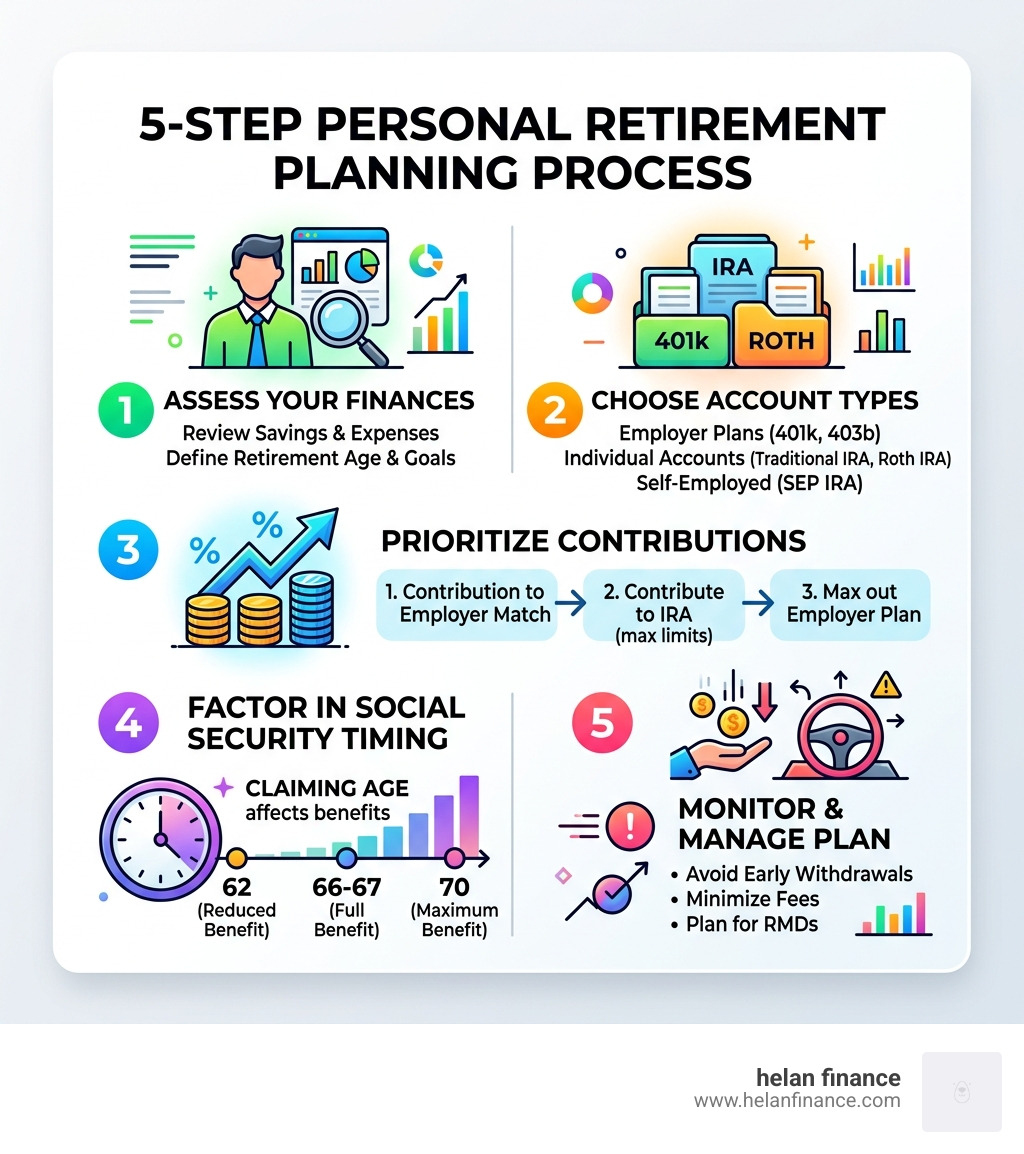
How to Build a Personal Retirement Plan in 5 Steps:
- Assess where you stand — calculate your current savings, expected expenses, and retirement age target
- Choose the right accounts — 401(k), IRA, Roth, SEP IRA, or a combination based on your employment situation
- Prioritize contributions — start with your employer match, then max out an IRA, then return to your employer plan
- Factor in Social Security — decide when to claim (ages 62–70) to maximize your monthly benefit
- Avoid costly mistakes — skip early withdrawals, watch for fees, and plan for required minimum distributions (RMDs)
Here’s a number that should get your attention: 57 percent of working Americans say they’re behind on retirement savings. That’s not a small group of outliers — that’s the majority.
And yet the gap between knowing you should save and actually building a plan that works for you is enormous.
Most people either ignore retirement planning until it feels urgent, or they treat it like a one-size-fits-all checklist. Neither approach works.
Think of your retirement strategy like a golf swing. No two are exactly alike. Your income, your employer, your tax situation, your timeline — they all shape what the right plan looks like for you.
The good news? You don’t need to be a financial expert to get this right. You just need a clear framework, the right accounts, and a realistic savings target. Financial experts like those at T. Rowe Price recommend aiming to save at least 15 percent of your income each year — a useful benchmark to work toward.
This guide breaks it all down, step by step.
Assessing Your Course: The Foundations of a Personal Retirement Plan
Before we start swinging for the fences, we need to look at the layout of the course. In April 2026, the financial landscape for a personal retirement plan is more complex than it was for our parents. We have more choices, but we also carry more of the risk.
The first step in any plan is a thorough assessment. We need to look at our current savings, our projected expenses, and the tools available to us. This is where retirement calculators and income estimators become our best friends. These tools allow us to model different scenarios—what happens if we retire at 65 versus 70? What if inflation averages 3 percent instead of 2 percent?
A solid foundation also requires accounting for the “hidden” hazards of retirement: healthcare costs and inflation. It is a common mistake to assume our expenses will drop significantly. While we might save on commuting, healthcare costs tend to rise as we age. We must factor in Medicare Part B premiums, which are often deducted directly from Social Security benefits, and the potential need for long-term care.
To get a clear picture of your trajectory, we recommend visiting the Retirement Planning | Preparing For Retirement – Fidelity Investments page, which offers excellent modeling tools to help you visualize your future income.
Understanding Defined Contribution vs. Defined Benefit Plans
In the “old days” of retirement planning, many workers relied on a defined benefit plan, more commonly known as a pension. With a pension, the employer bears the investment risk and promises a specific monthly benefit for life. However, as of 2024, only about 15 percent of private industry workers had access to one.
Today, the 401(k) is ubiquitous. This is a defined contribution plan. In this setup, we bear the investment risk. The eventual size of our “nest egg” depends on how much we contribute and how our investments perform. This shift means we must be proactive. We are no longer just “participants”; we are the managers of our own pension funds.
The IRS provides a comprehensive breakdown of these structures on their Types of retirement plans | Internal Revenue Service page. Understanding whether you have a “defined benefit” (employer-managed) or “defined contribution” (you-managed) plan is the first step in knowing how much heavy lifting your personal savings need to do.
Eligibility for 403(b) and 457(b) Specialized Accounts
Not everyone works for a traditional corporation. If you work for a public school, a hospital, or a tax-exempt organization, you likely have access to a 403(b) plan. These function very similarly to 401(k)s but are tailored for the non-profit sector.
If you are a state or local government employee, you might have a 457(b) plan. These are particularly interesting because they often allow for penalty-free withdrawals once you leave your job, regardless of your age. This can be a massive advantage for those looking to retire early or transition careers before age 59½. Knowing which specialized accounts you qualify for is like knowing which specialized wedges to keep in your bag—they can get you out of specific financial “bunkers” that a standard 401(k) cannot.
Choosing Your Clubs: Comparing Account Types and Tax Treatments
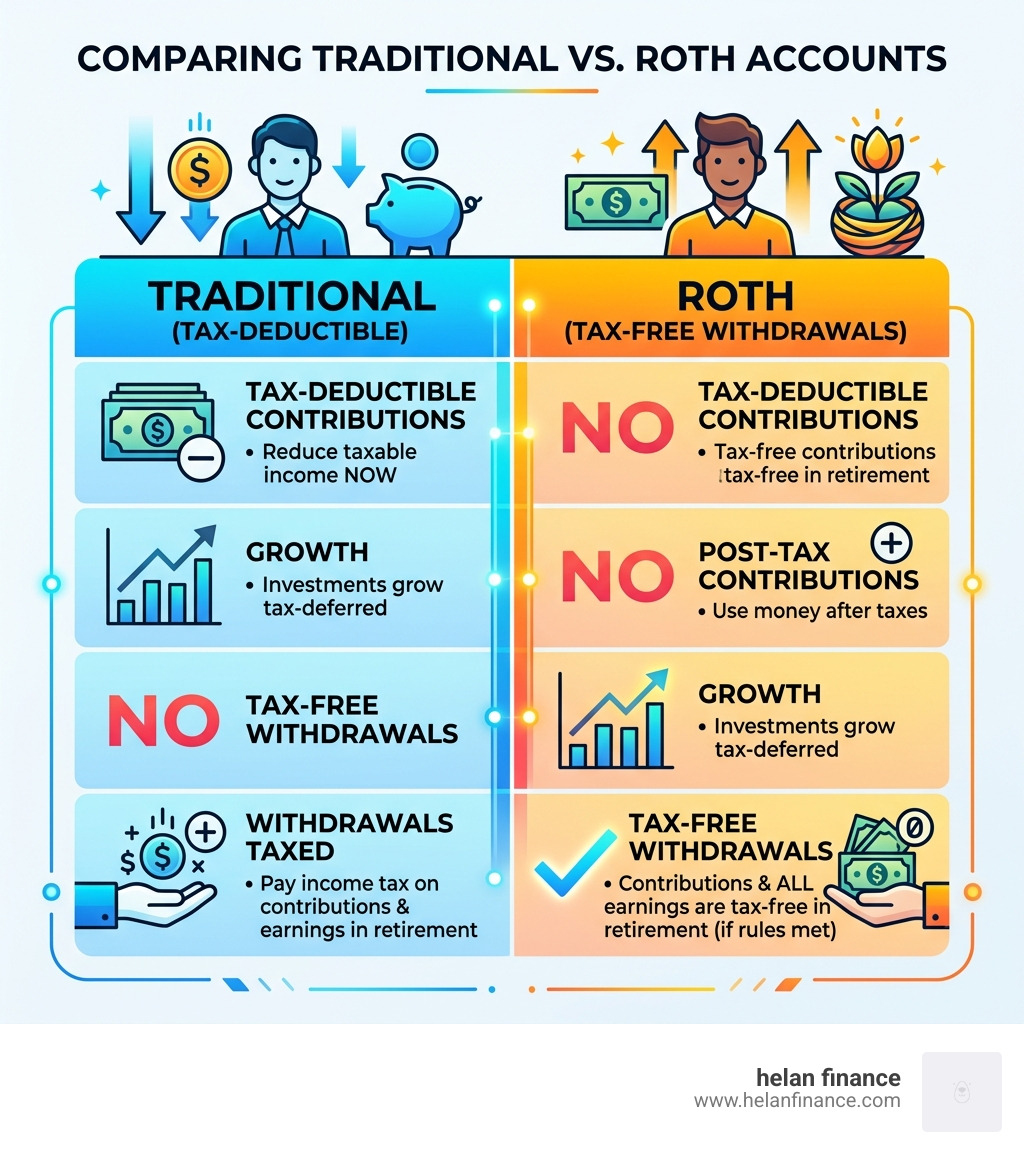
Once we know the course, we need to pick our clubs. For a personal retirement plan, your “clubs” are your account types: Traditional vs. Roth. The choice here isn’t just about what you save, but how that money is taxed.
Maximizing Your Personal Retirement Plan Limits
As we move through 2026, staying updated on contribution limits is vital. For the 2025 tax year, employees could contribute up to $23,500 to a 401(k) or 403(b). For 2026, that limit has increased to $24,500.
If you are age 50 or older, you can take advantage of “catch-up” contributions. In 2026, the standard catch-up for those 50+ is $7,500. However, thanks to recent legislation, there is a special “super catch-up” for those aged 60 to 63, allowing for a limit of $11,250. These extra contributions are like a power-boost on the back nine of your career.
For IRAs, the 2025 limit was $7,000 ($8,000 for 50+). In 2026, we are looking at a limit of $7,500 ($8,600 for 50+). While these numbers might seem small compared to a 401(k), the tax-free growth over decades is a game-changer.
The Strategic Order of Contributions
One of the most frequent questions we hear is: “Where do I put my next dollar?” We like to follow a specific “order of operations” to ensure no “free money” is left on the table.
- The Employer Match: If your company offers a 401(k) match, this is your first priority. It is an immediate 100% return on your investment. If you don’t contribute enough to get the full match, you’re essentially turning down a part of your salary.
- The IRA (Traditional or Roth): Once you’ve secured the match, we often suggest moving to an IRA. Why? IRAs typically offer more investment flexibility and lower fees than many employer-sponsored plans.
- The HSA (Health Savings Account): If you have a high-deductible health plan, the HSA is the “triple-threat” of the financial world. Contributions are tax-deductible, growth is tax-free, and withdrawals for medical expenses are tax-free. In retirement, this can effectively become another retirement account.
- Back to the 401(k): If you still have money to save after maxing out your IRA and HSA, go back to your employer plan and work toward that $24,500 limit.
For more details on setting up these accounts, the Individual retirement arrangements (IRAs) | Internal Revenue Service page is the definitive resource.
Navigating the Hazards: Social Security, RMDs, and Rollovers
Even the best golfers find themselves in the sand traps occasionally. In a personal retirement plan, the “hazards” are often regulatory—Social Security timing, Required Minimum Distributions (RMDs), and the complexities of moving money between jobs.
Integrating Social Security into Your Personal Retirement Plan
Social Security is a foundational piece of the puzzle, but the timing of when you claim can change your monthly check by more than 75 percent. You can start as early as 62, but your benefit will be permanently reduced. If you wait until your “Full Retirement Age” (usually 66 or 67), you get 100 percent. If you can hold out until age 70, your benefit increases by about 8 percent for every year you delay past your full retirement age.
We generally suggest delaying as long as possible if you are in good health and have other assets to live on. It’s the only “guaranteed” return of 8% you’ll find in the market. However, family and survivor benefits don’t increase past your Full Retirement Age, so the math changes if you are planning for a spouse.
Avoiding Common Mistakes and Managing Withdrawals
The biggest hazard? Early withdrawals. Taking money out of a traditional 401(k) or IRA before age 59½ usually triggers a 10% penalty plus ordinary income taxes. It’s a double-bogey that can set your plan back years.
Then there are RMDs—Required Minimum Distributions. The government eventually wants its tax money. Currently, RMDs start at age 73 (moving to 75 in 2033). If you don’t take the required amount out, the penalty is a staggering 25% of the amount you should have withdrawn.
Finally, let’s talk about job changes. When you leave an employer, you have options:
- Leave the money where it is (if the plan allows).
- Roll it into your new employer’s 401(k).
- Perform a “Direct Rollover” into an IRA.
We almost always recommend a direct rollover. This keeps the money tax-deferred and avoids the 20% mandatory federal tax withholding that happens if the check is made out to you instead of the new financial institution.
The Pro Shop: Specialized Plans for the Self-Employed
If you are your own boss, you don’t have an HR department to set up your personal retirement plan. But being self-employed actually gives you some of the most powerful retirement tools available.
Choosing a Personal Retirement Plan for Small Business
The SEP IRA (Simplified Employee Pension) is a favorite for freelancers and solo entrepreneurs. It is incredibly easy to set up—often just a one-page form. You can contribute up to 25% of your net earnings, with a cap of $70,000 for 2025 (and slightly higher in 2026). The best part? You can set it up and fund it as late as your tax filing deadline, including extensions.
For more on how to get started, see the Simplified Employee Pension plan (SEP) | Internal Revenue Service guide.
The Advantages of the Solo 401(k)
If you have no employees (other than a spouse), the Solo 401(k) is often the “driver” of retirement plans. It allows you to contribute in two capacities: as the employee (up to $24,500 in 2026) and as the employer (up to 25% of compensation).
The Solo 401(k) has a few “pro” features that the SEP IRA lacks:
- Loan Features: You can often borrow up to $50,000 from your own plan.
- Roth Option: You can choose to make Roth contributions, which isn’t always an option with SEPs.
- Catch-up Contributions: If you’re 50+, you get that extra $7,500 limit.
The IRS details these “one-participant” plans here: One Participant 401k Plans | Internal Revenue Service.

Frequently Asked Questions about Retirement Planning
When should I start claiming Social Security?
It depends on your health and other savings. Claiming at 62 gives you a smaller check for more years. Claiming at 70 gives you the largest possible check. If you expect to live past age 80, waiting until 70 usually results in more total lifetime money.
What is the difference between a SEP IRA and a Solo 401(k)?
A SEP IRA is simpler to set up and has no annual filing requirements until it gets very large. A Solo 401(k) allows for higher contribution amounts at lower income levels and offers a Roth option and loan features.
How do I roll over my 401(k) when I change jobs?
The easiest way is a “Direct Rollover.” Contact the financial institution where you want to move the money (like a brokerage) and they will provide you with the “Pay to the Order Of” instructions for your old employer. This ensures the money never touches your personal bank account, avoiding taxes and penalties.
Conclusion
Building a personal retirement plan doesn’t have to feel like a grueling 18 holes in the rain. At Helan Finance, we believe that financial planning should be as routine and healthy as your morning coffee. By breaking these complex topics into simple exercises and routines, we help you take control of your future without the stress.
Whether you are just starting your career or you are approaching the 18th green, the best time to refine your strategy is right now. We are here to help you simplify the process, avoid the hazards, and ensure your retirement is exactly what you imagined.
Ready to take the next step? Let’s plan your retirement together and build a strategy that works for your unique life.

