
Efficient Money Saving Strategies for Your Monthly Saving Plan
Why a Monthly Saving Plan Is the Foundation of Financial Security
A solid monthly saving plan is one of the simplest ways to take control of your money — whether you’re building an emergency cushion, saving for a home, or planning for retirement.
Before diving in, here’s a quick snapshot of the most effective monthly saving strategies to compare:
| Strategy | Best For | Savings Target |
|---|---|---|
| 50/30/20 Rule | General budgeting | 20% of take-home pay |
| 60/30/10 Rule (Fidelity PYP) | Structured spenders | 10% near-term + 15% pre-tax retirement |
| Emergency Fund First | Beginners | $1,000 starter, then 3-6 months expenses |
| 15% Retirement Rule | Long-term wealth building | 15% of gross income (incl. employer match) |
| 5% Starter Rate | Low income or high debt | 5% of income, increase over time |
The reality is that most people know they should save more — but without a clear framework, good intentions don’t stick.
According to Bankrate’s 2025 Emergency Savings Report, only 41% of U.S. adults could cover an unexpected $1,000 expense from savings. That gap between intention and action is exactly what the right monthly saving plan is designed to close.
The good news? You don’t need to overhaul your entire financial life at once. Small, consistent steps — guided by the right structure — build real wealth over time.
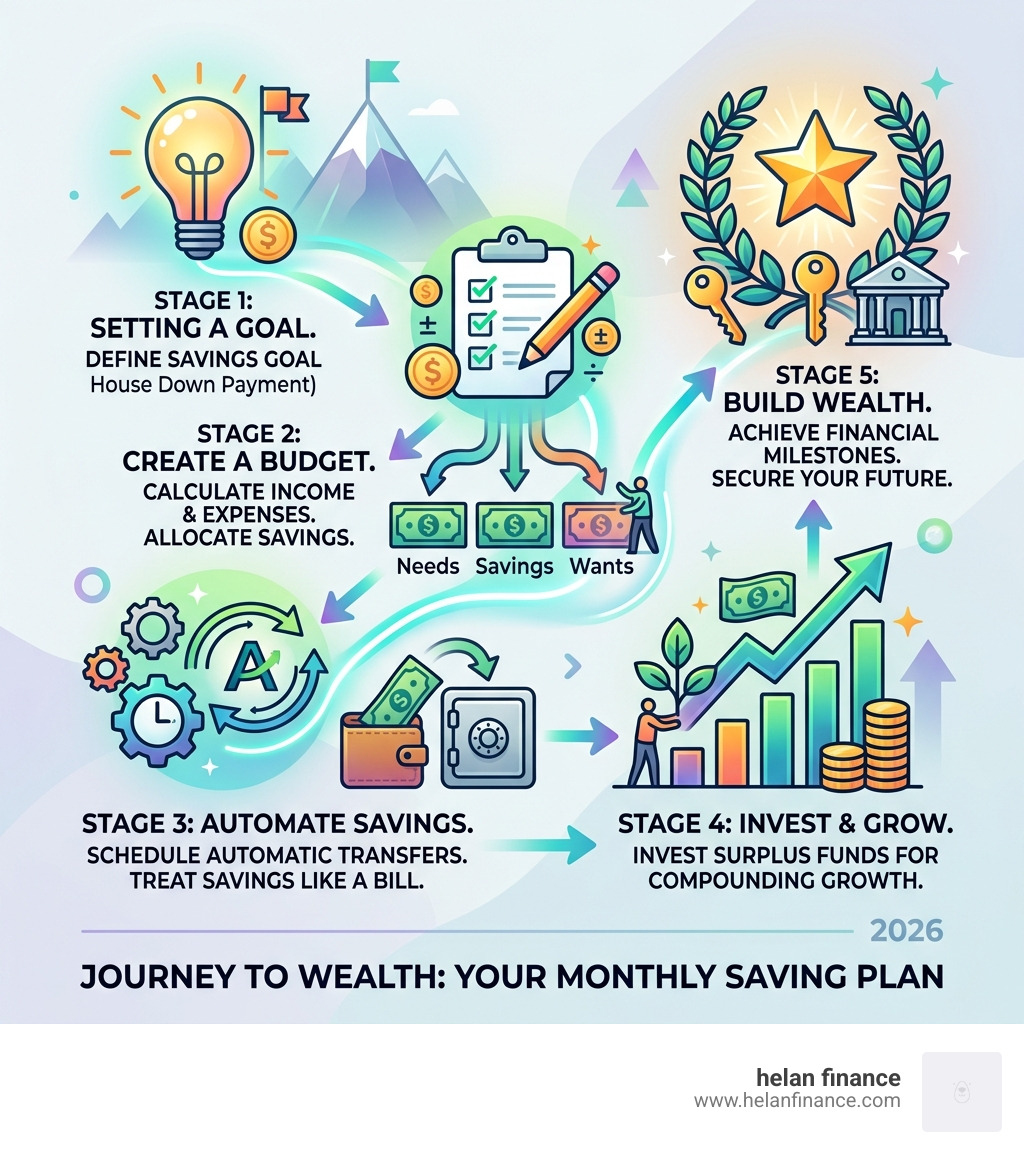
Core Frameworks for a Monthly Saving Plan
When we talk about a monthly saving plan, we aren’t just talking about “putting money away.” We are talking about creating a repeatable system that balances your today with your tomorrow. As we move into April 2026, the cost of living remains a topic of conversation, making these frameworks even more essential.

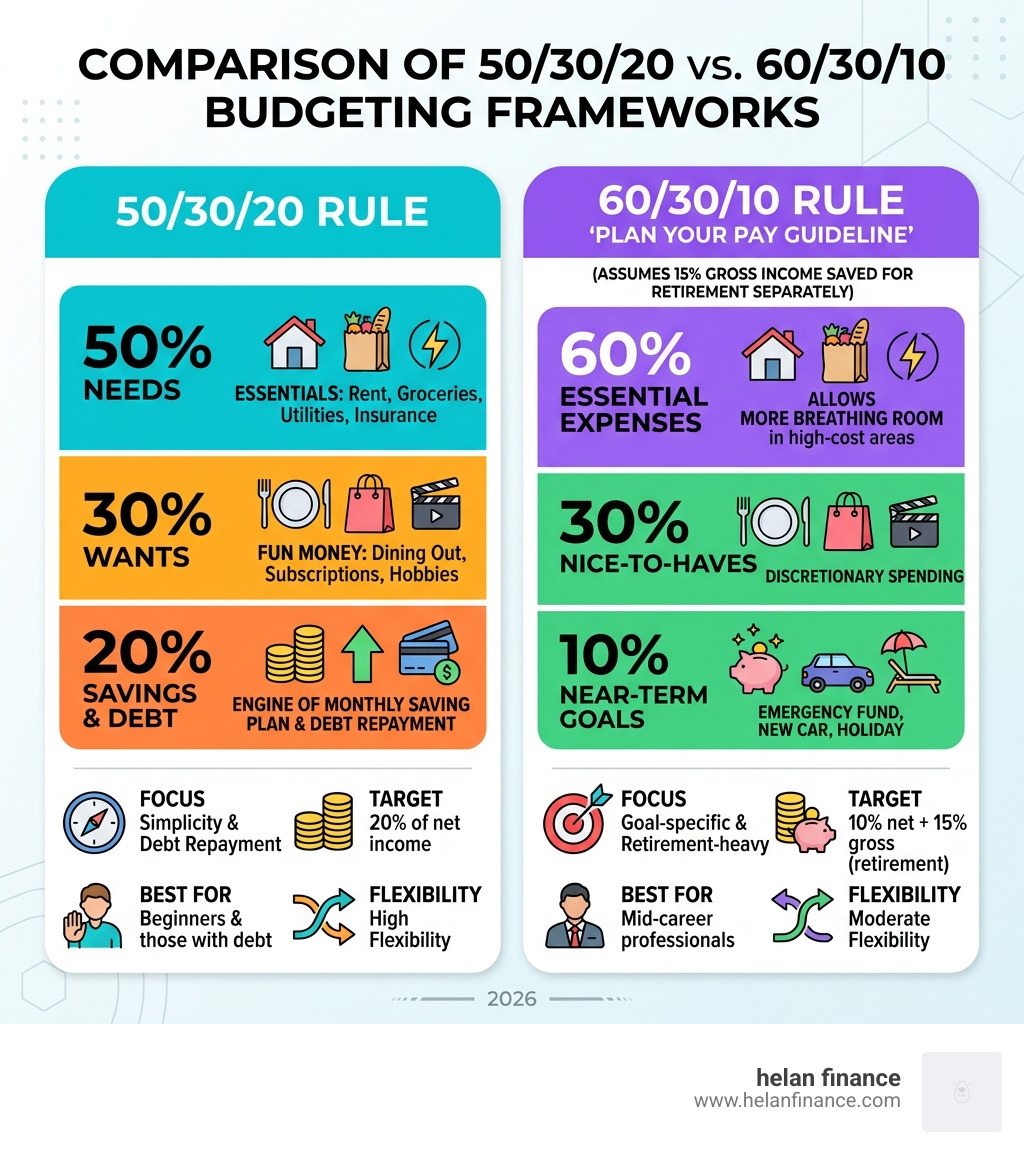
The 50/30/20 Rule
This is the “gold standard” of budgeting rules. It suggests that you allocate your take-home pay (after taxes) into three buckets:
- 50% for Needs: This covers your essentials—rent or mortgage, groceries, utilities, and insurance.
- 30% for Wants: This is your “fun money”—dining out, subscriptions, and hobbies.
- 20% for Savings and Debt Repayment: This is the engine of your monthly saving plan.
The 60/30/10 “Plan Your Pay” Guideline
Developed by experts at Fidelity, this framework offers a slightly different perspective, especially for those who want to separate retirement from their daily spending. It suggests:
- 60% Essential Expenses: Similar to the 50% above but allows for a bit more breathing room in high-cost areas.
- 30% Nice-to-Haves: Your discretionary spending.
- 10% Near-Term Goals: This is specifically for things like your emergency fund, a new car, or a holiday.
The catch? This rule assumes you are also saving 15% of your gross income for retirement separately (often directly from your paycheck).
| Feature | 50/30/20 Rule | 60/30/10 Rule |
|---|---|---|
| Focus | Simplicity & Debt Repayment | Goal-specific & Retirement-heavy |
| Savings Target | 20% of net income | 10% net + 15% gross (retirement) |
| Best For | Beginners & those with debt | Mid-career professionals |
| Flexibility | High | Moderate |
Prioritizing Your Monthly Contributions
One of the biggest mistakes we see people make is trying to save for everything at once. If you spread your money too thin, you might find that none of your goals actually get funded. We recommend a “sequential funding” approach.
- Starter Emergency Fund: Aim for a $1,000 target immediately. This is your “oh no” fund for flat tires or broken appliances.
- The Employer Match: If your job offers a 401(k) match, contribute enough to get the full amount. This is essentially “free money” and an instant 100% return on your investment.
- High-Interest Debt: Before you save for a vacation, pay off debt with interest rates above 7-8% (like credit cards).
- Full Emergency Fund: Once the high-interest debt is gone, build your cushion to cover 3-6 months of essential living expenses.
- Personal Goals: Now you can aggressively save for that house deposit or wedding.
To help you visualize how this fits together, you can learn how to structure your monthly saving | Helan Finance to ensure your priorities align with your long-term health and happiness.
Maximizing Growth with the Right Accounts and Tools
Where you keep your money is just as important as how much you save. In April 2026, keeping your monthly saving plan contributions in a standard checking account is like letting your money take a nap when it should be at the gym.

High-Yield Savings Accounts (HYSA)
Currently, top HYSAs are offering between 4% and 5% APY. Compared to the national average of 0.39%, the difference is staggering. For example, saving $500 a month for five years in a standard account might earn you pennies, but in a HYSA, you could earn thousands in interest alone.
The Magic of Compounding
Compound interest is the interest you earn on your interest. The frequency of compounding (daily, monthly, or annually) affects how fast your money grows. Most HYSAs compound daily and pay out monthly, which is ideal for a monthly saving plan.
To see exactly how your initial investment and monthly contributions will grow over your time horizon, use our Savings Goal Calculator | Helan Finance. It allows you to input your goal, your starting balance, and your expected interest rate to see exactly when you’ll hit your target.
Inflation Protection
Inflation (historically around 2-3%) acts as a “hidden tax” on your savings. If your interest rate is lower than the inflation rate, your purchasing power is actually shrinking. This is why choosing high-yield accounts or diversified investments for long-term goals is non-negotiable.
Behavioral Hacks to Sustain Your Progress
Saving money is 20% math and 80% behavior. We can have the best spreadsheet in the world, but if we don’t stick to the plan, it doesn’t matter.
Automating Your Monthly Saving Plan
The most effective way to save is to remove “willpower” from the equation.
- Pay Yourself First: Set up a split deposit with your employer so a portion of your check goes directly into your savings account before you even see it.
- Automatic Transfers: Schedule a transfer from your checking to your savings for the day after your payday.
- Round-Up Apps: Use tools that round up your purchases to the nearest dollar and save the change.
Psychological Strategies for a Monthly Saving Plan
We humans are visual creatures. We respond better to “Hawaii Trip Fund” than “Savings Account 0402.”
- Mental Accounting & Goal Labeling: Research shows that people are significantly less likely to “borrow” from an account if it has a specific name and purpose.
- Visual Cues: Keep a progress thermometer on your fridge or a digital tracker on your phone.
- Micro-Celebrations: When you hit 10% of your goal, treat yourself to a small reward. This releases dopamine and reinforces the saving habit, helping you avoid “savings burnout.”
Frequently Asked Questions about Monthly Savings
How much of my income should I save each month?
While 15-20% of gross income is the standard expert recommendation, we believe in starting where you are. If you can only manage 5%, start there and aim to increase it by 1% every few months.
Fidelity offers helpful age-based benchmarks: aim to have 1x your annual salary saved by age 30, 3x by 40, and 8x by 60. However, don’t let these numbers discourage you; a monthly saving plan started today is better than one started tomorrow, regardless of your age.
Where is the best place to keep my monthly savings?
It depends on your timeline:
- Short-term (0-2 years): High-Yield Savings Accounts (HYSA) for liquidity and safety.
- Mid-term (2-5 years): Certificates of Deposit (CDs) if you want to lock in a high rate and don’t need the cash immediately.
- Long-term (5+ years): Tax-advantaged accounts like IRAs or 401(k)s, and potentially brokerage accounts for diversified market exposure.
How do I adjust my plan if my income changes?
Life happens! If your income increases, practice “saving the raise.” Instead of upgrading your lifestyle, direct at least 50% of that new money into your savings.
If your income drops or becomes variable, switch to a percentage-based contribution. Saving 10% of $2,000 is easier to stomach than a fixed $500 commitment when money is tight. We recommend a quarterly review of your monthly saving plan to ensure it still fits your current reality.
Conclusion
Building a monthly saving plan doesn’t have to be a chore of deprivation. At Helan Finance, we believe that simplified financial planning is the key to a healthier, happier life. By combining the right frameworks like the 50/30/20 rule with powerful tools and behavioral hacks, you can turn your financial goals into a reality.
The most important step is simply getting started. Whether it’s $10 or $1,000, that first contribution is the seed of your future wealth. Through our routines, exercises, and expert advice, we are here to help you every step of the way.
Ready to take control? Start your financial journey with us today and see how easy it can be to build the life you’ve always wanted.

