
How to save on taxes this year
Why Smart Tax Planning in 2026 Can Put Real Money Back in Your Pocket
Tax savings smart tips can save the average American thousands of dollars a year — but most people leave that money on the table simply because they don’t know where to start.
Here are the most impactful ways to reduce your tax bill in 2026:
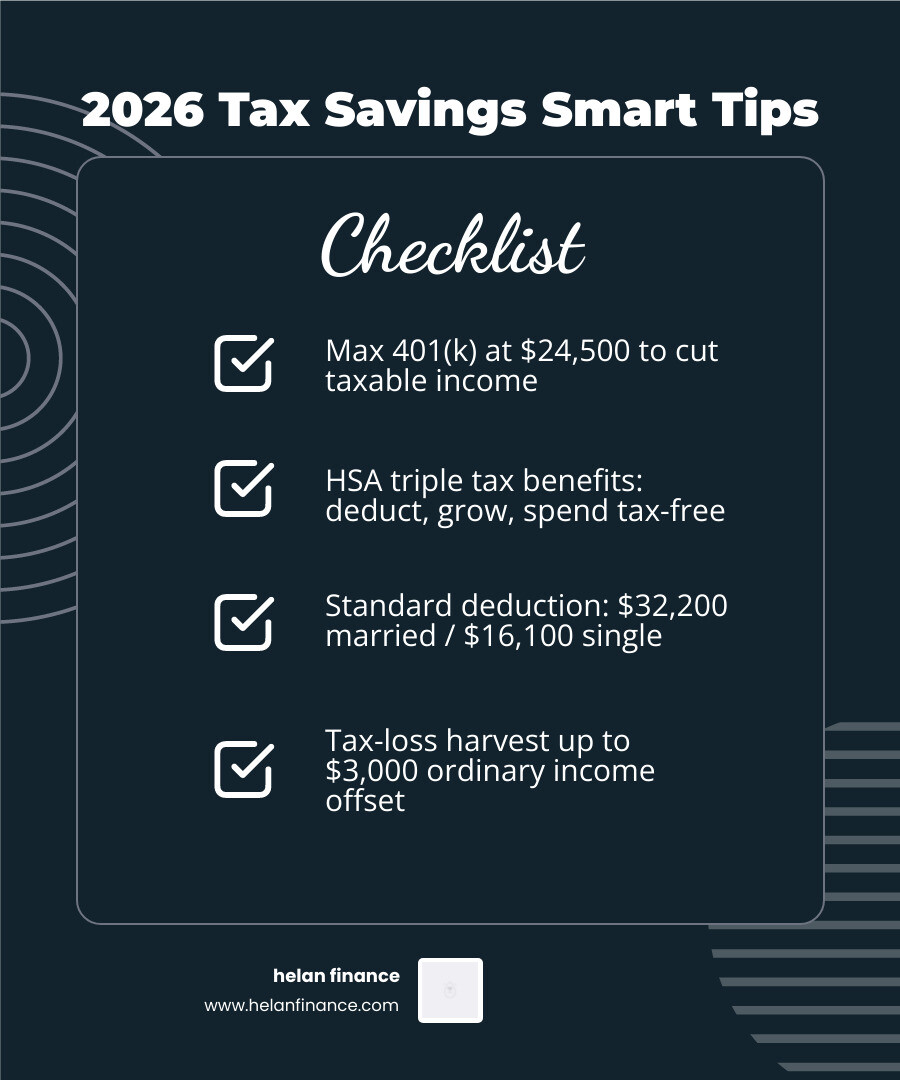
- Max out pre-tax retirement accounts — 401(k) contributions up to $24,500 directly lower your taxable income
- Use an HSA — triple tax advantage: deductible contributions, tax-free growth, tax-free withdrawals for medical costs
- Know your deduction — the 2026 standard deduction is $32,200 (married) or $16,100 (single); only itemize if you can beat it (check the latest IRS guidelines for details)
- Harvest investment losses — offset gains and up to $3,000 of ordinary income per year
- Give smarter — donate appreciated stock or use a donor-advised fund to maximize charitable deductions
- Use a 529 plan — tax-free growth for education costs, with K-12 limits doubling to $20,000 in 2026
- Check the new SALT cap — the OBBBA raises the state and local tax deduction from $10,000 to $40,000 through 2029
The 2026 tax year brings significant changes thanks to the One Big Beautiful Bill Act (OBBBA), signed into law in 2025. New deductions, higher limits, and updated rules mean your old tax strategy may no longer be optimal.
The good news? You don’t need to be a tax expert to benefit. Most of the best moves are straightforward — and the earlier in the year you make them, the more they can save you.
The average tax refund in 2024 was $3,138. That’s roughly $261 a month that was sitting with the IRS interest-free. With the right strategy, some of that money could be working for you all year instead.
Maximize Retirement Accounts with Tax Savings Smart Tips
When we talk about building wealth and lowering taxes simultaneously, retirement accounts are our best friends. For 2026, the IRS has increased contribution limits, providing an even larger “umbrella” to shield your income from Uncle Sam.
The most effective way for most of us to lower our tax bill is through a workplace 401(k) or 403(b). In 2026, the employee elective deferral limit is $24,500. If you are in the 24% tax bracket, maxing out this contribution could save you approximately $5,880 in federal taxes. That is money that stays in your account, compounding for your future, rather than being sent to the IRS.

Don’t forget the Individual Retirement Account (IRA). For 2026, the contribution limit has risen to $7,500. If you are 50 or older, you can add a “catch-up” contribution of $1,100, bringing your total to $8,600. For those aged 60 to 63, the OBBBA introduced a “super catch-up” for workplace plans, allowing up to $11,250 in additional contributions.
We always recommend at least contributing enough to get your full employer match. It is essentially a 100% return on your money before you even consider the tax savings.
Leverage New Savings Accounts for Children
One of the most exciting updates from the OBBBA is the introduction of a new retirement-style account for children under 18, often referred to as a “minor retirement account.” Previously, children usually needed earned income to start a Roth IRA. Now, parents can open these accounts with an annual aggregate contribution limit of $5,000.
Even better, for children born between 2025 and 2028, there is a potential $1,000 federal “seed” contribution. This is a game-changer for long-term family wealth. By starting a retirement fund for a child today, you are giving them decades of tax-free compounding growth.
Roth Conversions and Market Volatility
While traditional accounts give you a tax break now, Roth accounts give you tax-free income later. A Roth conversion involves moving money from a traditional IRA or 401(k) into a Roth IRA. You pay taxes on the amount converted now, but all future growth and withdrawals are tax-free.
Why do this in 2026? If the market experiences a pullback, your account value drops. Converting during a dip allows you to move more shares into the Roth bucket while paying taxes on a lower total value. Just remember the five-year rule: you generally must wait five years after a conversion before you can withdraw earnings tax-free.
Navigating the OBBBA: Standard Deduction vs. Itemizing
The OBBBA has fundamentally changed the “Standard vs. Itemized” debate. For 2026, the standard deduction has been adjusted for inflation to $16,100 for individuals and $32,200 for married couples filing jointly.
About 87% of taxpayers take the standard deduction because it’s simple and often higher than their actual expenses. However, the OBBBA significantly raised the cap on the State and Local Tax (SALT) deduction.
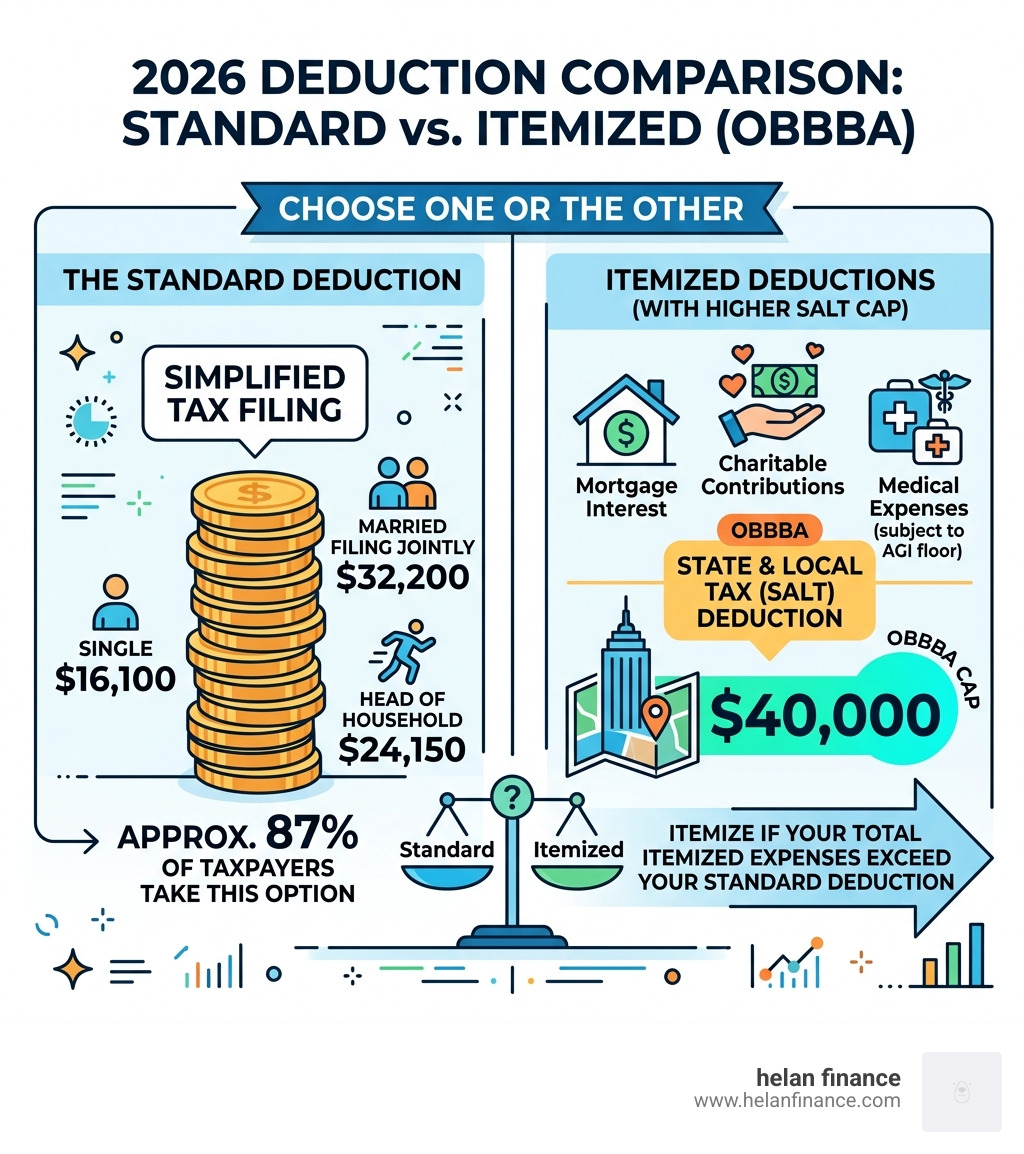
| Filing Status | 2026 Standard Deduction | SALT Deduction Cap (OBBBA) |
|---|---|---|
| Single | $16,100 | $40,000 |
| Married Filing Jointly | $32,200 | $40,000 |
| Head of Household | $24,150 | $40,000 |
Note: The $40,000 SALT limit begins to phase out for those with Adjusted Gross Incomes (AGI) above $500,000.
The New Senior Deduction for 65+
If you or your spouse are 65 or older, there is a new reason to smile. Through the 2028 tax year, seniors can claim an additional $6,000 deduction ($12,000 for couples). This deduction is designed to provide relief for those on fixed incomes, though it does phase out if your Modified Adjusted Gross Income (MAGI) exceeds $75,000 for individuals or $150,000 for couples.
Bunching Deductions for Impact
If your total itemized deductions (mortgage interest, SALT, and charity) fall just short of the $32,200 threshold, you might feel like you’re missing out. This is where “bunching” comes in.
By concentrating two years’ worth of property taxes or charitable gifts into a single tax year, you can surpass the standard deduction and itemize for a massive tax break. In the following year, you simply take the standard deduction. This is one of our favorite tax savings smart tips for homeowners who want to maximize every dollar.
Strategic Charitable Giving and Education Savings
Giving back feels good, but giving smart feels even better. U.S. families give over $1 billion to charity every day, and the tax code rewards this generosity.
Instead of writing a check, consider donating appreciated stock you’ve held for more than a year. When you do this, you avoid paying capital gains tax on the growth, and you can still deduct the full fair market value of the stock. It’s a double win for you and the charity.

On the education front, 529 plans remain the gold standard. These accounts allow for tax-free growth and withdrawals for qualified education expenses. Starting in 2026, the limit for using 529 funds for K-12 tuition increases from $10,000 to $20,000 per year. Additionally, the list of eligible expenses has expanded to include books, digital tools, and even testing fees.
Using DAFs for Tax Savings Smart Tips
A Donor-Advised Fund (DAF) is like a personal charitable savings account. You can “frontload” several years of donations into a DAF in a high-income year to get an immediate tax deduction. You can then recommend grants to your favorite charities over time. This is a perfect strategy if you are expecting a lower tax bracket in retirement but want to maximize your deductions while you’re still working.
Qualified Charitable Distributions (QCDs)
For those of us 70½ or older, the Qualified Charitable Distribution (QCD) is a powerful tool. You can transfer up to $108,000 directly from your IRA to a qualified charity. This counts toward your Required Minimum Distribution (RMD) but is not included in your taxable income. Because it lowers your AGI, it can also help keep your Medicare premiums lower and prevent other deductions from phasing out.
Tax-Efficient Investing and Healthcare Accounts
Your investment portfolio shouldn’t just be about what you earn; it should be about what you keep. Tax-loss harvesting is the process of selling underperforming investments to offset gains. If your losses exceed your gains, you can use up to $3,000 of that excess loss to offset your ordinary income.
Just be careful of the wash-sale rule: you cannot claim the loss if you buy the same or a “substantially identical” security within 30 days before or after the sale.
HSA Triple Advantages and Tax Savings Smart Tips
Many experts call the Health Savings Account (HSA) the ultimate retirement vehicle. It offers a triple tax advantage:
- Contributions are 100% tax-deductible (lowering your AGI).
- The money grows tax-free.
- Withdrawals for qualified medical expenses are tax-free.
For 2026, the contribution limits are $4,400 for individuals and $8,750 for families. Unlike an FSA, the money in an HSA rolls over every year. If you can afford to pay for medical bills out of pocket now, you can leave the HSA funds to grow for decades and use them as a tax-free healthcare fund in retirement.
FSA Management and Rollovers
If you have a Flexible Spending Account (FSA) through work, the 2026 limit is $3,400. These are “use-it-or-lose-it” accounts, so we recommend checking your balance in October or November. If your employer allows it, you can roll over up to $680 into 2027, but anything beyond that will be forfeited.
Don’t forget the Dependent Care FSA, which allows you to set aside up to $5,000 pre-tax for childcare or eldercare expenses. For many families, this is a much better deal than the standard child care tax credit.
Frequently Asked Questions about Tax Savings
How does the OBBBA affect my SALT deduction in 2026?
The OBBBA is a major win for people in high-tax states. It increases the SALT cap from $10,000 to $40,000 for those who itemize through 2029. This includes state and local income taxes (or sales taxes) and property taxes. However, keep in mind that this deduction begins to phase out once your AGI hits $500,000.
What are the benefits of the new minor retirement accounts for kids?
These new accounts allow children under 18 to start a retirement fund even if they don’t have a summer job. You can contribute up to $5,000 annually. It’s a fantastic way to teach kids about investing while utilizing decades of tax-free growth. For those born between 2025 and 2028, look out for that $1,000 federal seed money!
Should I take the standard deduction or itemize this year?
The math is simple: add up your mortgage interest, your SALT (up to $40,000), and your charitable gifts. If that total is higher than $16,100 (single) or $32,200 (married), you should itemize. If not, take the standard deduction. Most people find that the higher standard deduction under the OBBBA is the better deal unless they have a large mortgage or very high charitable giving.
Conclusion
Tax planning isn’t something that should only happen in April. By being proactive and using these tax savings smart tips throughout the year, you can ensure you’re keeping as much of your hard-earned money as possible. Whether it’s maxing out your 401(k), leveraging the new SALT limits, or opening a retirement account for your child, every small move adds up to significant long-term wealth.
At Helan Finance, we believe financial planning should be easy and efficient. Our mission is to simplify the complex world of money so you can focus on what matters most. For more tools and personalized advice, explore how we can help you with Simplified financial planning.

