
Picking the Right Retirement Investments Without Losing Your Mind
Why Choosing the Right Investment Options for Retirement Matters More Than You Think
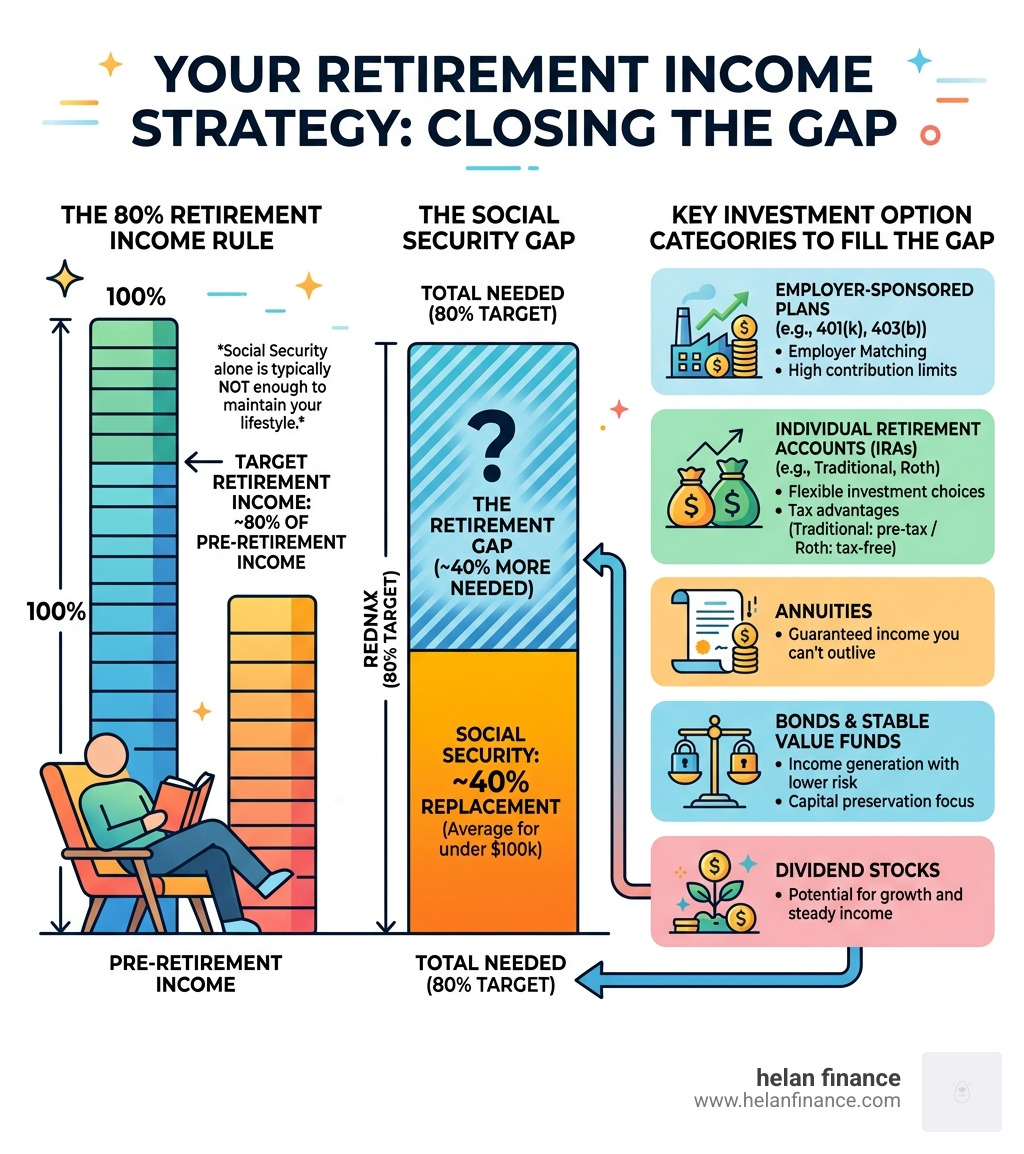
The best investment options for retirement fall into a few core categories — and knowing which ones fit your situation can make the difference between a comfortable retirement and a stressful one. Here’s a quick overview:
- Employer-sponsored plans — 401(k), 403(b), 457(b); often include employer matching
- Individual Retirement Accounts (IRAs) — Traditional, Roth, SEP, SIMPLE
- Annuities — provide guaranteed income you can’t outlive
- Bonds and dividend stocks — generate steady income with varying risk levels
- Government bonds and stable value funds — lower risk, capital preservation focus
- Social Security — replaces roughly 40% of pre-retirement income on average
Here’s the uncomfortable truth: Social Security alone won’t cut it.
Most people earning under $100,000 a year can expect Social Security to replace only about 40% of their pre-retirement income. For higher earners, that figure drops to around 33%. Meanwhile, financial experts generally suggest you’ll need roughly 80% of your pre-retirement income to maintain your lifestyle once you stop working.
That gap doesn’t close itself.
And with 1 in 3 people aged 65 today expected to live past 90, your savings may need to stretch for 25 to 30 years — or longer. That’s a long time for poorly chosen investments to quietly underperform.
The good news? You don’t need to be a financial expert to build a solid retirement plan. You just need to understand what’s available, how each option works, and how to match them to your situation.
This guide breaks it all down — clearly, without the jargon.
Understanding the Landscape of Investment Options for Retirement
When we look at the big picture of retirement planning in April 2026, it helps to categorize our options into two main buckets: defined benefit plans and defined contribution plans. These are the fancy terms for “pensions” and “savings accounts,” and they are largely governed by the Employee Retirement Income Security Act (ERISA).
Defined Benefit vs. Defined Contribution
A defined benefit plan (the classic pension) promises you a specific monthly benefit when you retire. Usually, this is calculated using a formula that looks at your salary and how many years you worked for the company. The cool thing here is that these plans are often insured by the Pension Benefit Guaranty Corporation (PBGC). If the company goes belly-up, there’s a safety net.
On the flip side, defined contribution plans—like your 401(k)—don’t promise a specific check. Instead, you (and often your employer) put money into an account, you choose the investments, and the final balance depends on how well those investments performed. You take on the “investment risk,” but you also have more control.
The Math of Longevity and Inflation
As we mentioned, the “80% rule” is a solid benchmark. If you’re making $100,000 now, you should aim for $80,000 in annual retirement income. But don’t forget the “silent thief”: inflation. A $50,000 lifestyle today might cost $118,000 in thirty years if inflation averages 3%.
Furthermore, we have to talk about longevity risk. Statistics show that 1 in 7 65-year-olds will live to see age 95. That is 30 years of retirement! To survive that long, your investment options for retirement need to include more than just a savings account; they need assets that grow over time, like stocks and diversified funds.

Employer-Sponsored Plans: 401(k)s, 403(b)s, and State Systems
For most of us, our employer is the gateway to retirement savings. These plans are powerful because they allow for automatic payroll deductions—you save before you even see the money in your bank account.
The “Big Three”: 401(k), 403(b), and 457(b)
- 401(k) Plans: The most common plan for private-sector employees. Many companies offer a “match”—for example, if you put in 5%, they put in 5%. That is a 100% return on your money instantly. Always, always grab the full match.
- 403(b) Plans: Very similar to 401(k)s but designed for employees of public schools and certain tax-exempt organizations.
- 457(b) Plans: Typically for state and local government employees. A unique perk here is that there is often no 10% penalty for withdrawals if you leave your employer before age 59½.
The Florida Retirement System (FRS) and State Plans
If you work in the public sector, you might have access to something like the FRS Investment Plan. This is a great example of a modern defined contribution system. The FRS offers about 20 different funds, including:
- Target Date Funds: These use a “glide path.” They start aggressive (mostly stocks) when you are young and automatically become more conservative (more bonds) as you get closer to your retirement date.
- Stable Value Funds: These are unique because they use “wrap contracts” from insurance companies to protect your principal. They aim to provide better returns than a money market fund while keeping your balance stable.
- Self-Directed Brokerage Account (SDBA): For those who want more control, the FRS allows you to open an SDBA. However, you must maintain a $5,000 minimum balance in your primary funds and transfers must be at least $1,000. This is generally for experienced investors who want to buy specific stocks or ETFs.
Individual Retirement Accounts (IRAs) and Tax Efficiency
If you don’t have an employer plan, or if you’ve already maxed it out, IRAs are your next best friend. These are accounts you open yourself through a bank or brokerage.
- Traditional IRA: Your contributions might be tax-deductible today, and your investments grow tax-deferred. You pay taxes later when you take the money out in retirement.
- Roth IRA: You put in after-tax money (no deduction now), but your withdrawals in retirement are completely tax-free. Plus, Roth IRAs don’t have Required Minimum Distributions (RMDs) during your lifetime.
- SEP IRA: Perfect for small business owners or freelancers. It allows for much higher contribution limits than a standard IRA.
- SIMPLE IRA: A “Savings Incentive Match Plan for Employees” for small businesses that don’t want the complexity of a 401(k).
For more official details on how these work, you can check out Individual Retirement Accounts (IRAs) | Investor.gov or the latest rules on Roth IRAs | Internal Revenue Service.
Comparing Traditional and Roth Investment Options for Retirement
Choosing between Traditional and Roth usually comes down to one question: Will my tax rate be higher now or later? If you think you’ll be in a higher bracket in retirement, go Roth. If you’re in your peak earning years now and want a tax break, go Traditional.
| Feature | Traditional IRA | Roth IRA |
|---|---|---|
| Tax Break | Immediate (deductible) | None (after-tax) |
| Withdrawals | Taxed as ordinary income | Tax-free (if qualified) |
| RMDs | Start at age 73 | None during your life |
| Income Limits | None to contribute* | Limits apply for eligibility |
| Withdrawal Flexibility | Penalty before 59½ | Can withdraw contributions anytime |
Note: Deductibility of Traditional IRA contributions may be limited if you or your spouse have a retirement plan at work. For deeper tax dives, see Tax Information for Retirement Plans | IRS.
Generating Guaranteed Income and Managing Risk
As we transition from “saving” to “spending,” the goal shifts. We need to make sure the pile of money doesn’t disappear before we do.
Annuities: The DIY Pension
Annuities are contracts with insurance companies. You give them a lump sum, and they promise to pay you a certain amount for the rest of your life.
- Pros: They provide an “income floor” and solve the longevity risk.
- Cons: They can be expensive (fees) and are less “liquid” than stocks—you can’t always get your lump sum back easily.
Income-Producing Assets
Beyond annuities, many retirees look for investment options for retirement that “pay” them to stay invested:
- Dividend-Paying Stocks: Companies that share their profits with you.
- REITs (Real Estate Investment Trusts): These allow you to invest in large-scale real estate (like apartment buildings or malls) and collect a portion of the rent as dividends.
- Government Bonds: Treasuries are backed by the “full faith and credit” of the U.S. government. They are generally seen as the safest place for your “sleep-at-night” money.
- Cash Value Life Insurance: Some whole life policies allow you to build “cash value” that you can borrow against or withdraw in retirement, often with tax advantages.
Income-Producing Investment Options for Retirement
One popular strategy is the Total Return Approach. Instead of just living off dividends or interest, you look at the growth of your entire portfolio and systematically withdraw 3% to 5% each year. This allows you to stay invested in growth stocks (to beat inflation) while still getting the cash you need.
Another method is Bond Laddering. You buy bonds that mature at different times (e.g., 1 year, 2 years, 5 years). This way, you always have a bond “maturing” to provide cash, regardless of what the stock market is doing that month.
Withdrawal Strategies and Portfolio Management
You’ve spent 40 years building the mountain; now you have to get down safely. This is where withdrawal strategies come in.
The 4% Rule
A classic rule of thumb is the 4% rule. It suggests that if you withdraw 4% of your portfolio in the first year of retirement and adjust that amount for inflation every year after, your money has a high probability of lasting 30 years. However, in our current 2026 environment, some experts suggest being more conservative (around 3.3% to 3.5%) if the market looks volatile.
Required Minimum Distributions (RMDs)
Uncle Sam wants his cut eventually. For Traditional IRAs and 401(k)s, you must start taking RMDs at age 73. If you don’t, the penalties are steep—up to 25% of the amount you were supposed to withdraw! You can find the latest tables and rules at Retirement Plan and IRA Required Minimum Distributions FAQs | IRS.
Managing Risks
- Early Withdrawal Penalty: If you take money out before age 59½, you’ll usually face a 10% penalty plus income taxes. There are exceptions (like a first-home purchase or certain medical expenses), but it’s best to leave that money alone.
- Rebalancing: At least once a year, we should check our asset allocation. If your stocks did great and now make up 80% of your portfolio when you only wanted 60%, it’s time to sell some stocks and buy bonds to bring things back into balance.

Frequently Asked Questions about Retirement Investing
How much of my income will Social Security replace?
On average, Social Security replaces about 40% of your pre-retirement earnings. If you earn less than $100,000, it’s closer to that 40% mark. If you’re a high earner, it might only replace 33% or less. This is why having your own investment options for retirement is non-negotiable.
What are the risks of a Self-Directed Brokerage Account (SDBA)?
The main risk is “you.” In an SDBA, you aren’t limited to the pre-vetted, diversified funds your employer chose. You can buy individual stocks or niche ETFs. If you bet big on a single company and it fails, your retirement could be in jeopardy. Most plans, like the FRS, require you to be an “experienced investor” and maintain a $5,000 cushion in core funds for a reason.
When should I consider annuities for retirement?
Consider an annuity if you are worried about outliving your money or if your fixed income (Social Security + pension) doesn’t cover your basic living expenses (mortgage, food, utilities). It creates a “guaranteed floor.” However, watch out for high commissions and understand if the annuity is fixed (stable) or variable (tied to market performance).
Conclusion
Retirement planning doesn’t have to be a headache. It’s really about building a “layered” approach: Social Security as the base, employer plans and IRAs as the growth engine, and perhaps annuities or bonds as the safety net.
At Helan Finance, we believe that financial planning should be easy and efficient. We specialize in simplifying the complex by integrating financial routines with overall health and wellness. Whether it’s through our interactive exercises, daily routines, or expert advice, we’re here to help you navigate your investment options for retirement so you can focus on enjoying the years you’ve worked so hard for.
Ready to take the next step toward a stress-free future? More info about financial planning services is just a click away. Let’s build a routine that secures your financial health today.

