
The Life Insurance Retirement Plan Guide for People Who Like Money
Is a Life Insurance Retirement Plan Right for You?
A life insurance retirement plan (LIRP) is a strategy that uses the cash value inside a permanent life insurance policy to generate tax-advantaged income in retirement — on top of, or beyond, what traditional accounts like a 401(k), RRSP, or TFSA can provide.
Here’s the short answer on what a LIRP does:
- Builds cash value inside a permanent life insurance policy, tax-deferred
- Generates retirement income through tax-free policy loans or withdrawals
- Leaves a death benefit to your heirs, paid out tax-free
- Has no contribution limits (unlike registered or government accounts)
- Requires no mandatory withdrawals at any age
A well-designed LIRP is most valuable for high-income earners who have already maxed out traditional retirement accounts and need another tax-efficient place to grow wealth.
It’s not a replacement for your 401(k) or RRSP. Think of it as an additional layer — one that keeps growing quietly in the background, shielded from annual taxes, until you’re ready to draw from it.
The strategy has a dual purpose: it protects your family now with life insurance coverage, and funds your lifestyle later with tax-free income. That “double duty” is what makes it appealing for people who want their money working harder without adding complexity.
The numbers can be striking. A 29-year-old contributing $9,000 per year for 37 years — a total of $333,000 — could potentially generate over $3.1 million in tax-free retirement income, plus a death benefit near $918,000. That’s based on a well-structured indexed policy with consistent contributions.
But the results depend heavily on how the policy is designed, which type of permanent insurance you choose, and whether the strategy fits your specific situation.
This guide walks you through all of it — clearly, without the jargon.
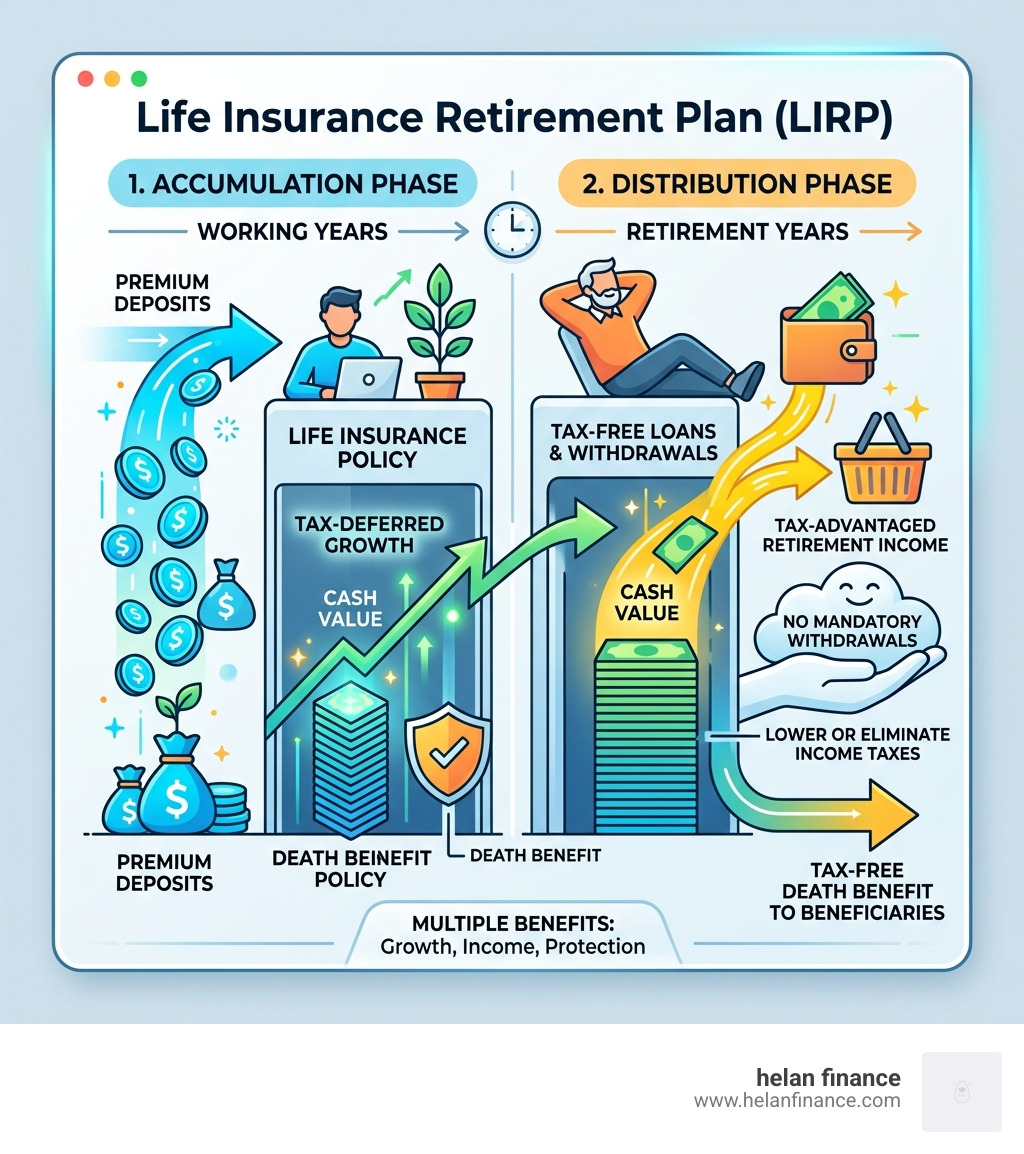
What is a Life Insurance Retirement Plan and How Does It Work?

At its core, a life insurance retirement plan is not a specific “product” you buy off a shelf; it is a strategy. We use permanent life insurance policies—typically Whole Life or Universal Life—because they contain a “savings” component known as cash value.
The Accumulation Phase
During your working years, you pay premiums into the policy. A portion of that premium covers the cost of insurance (the death benefit), while the rest goes into the cash value account. Because this is a permanent policy, that money grows tax-deferred. In a well-structured LIRP, we often “overfund” the policy, paying more than the minimum required premium to maximize the growth of this cash bucket.
The Distribution Phase
When you reach retirement (usually after at least 10 to 20 years of funding), you stop putting money in and start taking it out. However, instead of simply withdrawing the cash—which could trigger taxes once you exceed what you paid in—we use a “collateral loan” strategy. You take a loan from the insurance company or a third-party bank, using your policy’s cash value as collateral. Because loans aren’t considered income by tax authorities, this money arrives in your bank account tax-free.
The Structure
The “magic” happens because your cash value continues to earn interest or dividends even while you have a loan against it. When you eventually pass away, the tax-free death benefit is used to pay off the loan balance, and the remaining money goes to your beneficiaries. It’s a seamless cycle of wealth creation, usage, and transfer.
The Tax Advantages of the LIRP Strategy
If you like money, you probably hate losing it to the taxman. The life insurance retirement plan is one of the most powerful tax-diversification tools available in April 2026.
Tax-Free Access via IRC 7702
In the United States, Internal Revenue Code Section 7702 governs how life insurance is taxed. It allows the cash value to grow without annual “tax drags.” When you access that money via loans, it is generally tax-free under Section 72(e).
Comparing the Math
Consider this: $100,000 in tax-free LIRP income is equivalent to needing $131,579 from a taxable account (assuming a 24% federal tax rate). That is an annual tax saving of $31,579. Over 20 years of retirement, that’s over $630,000 staying in your pocket instead of going to the government.
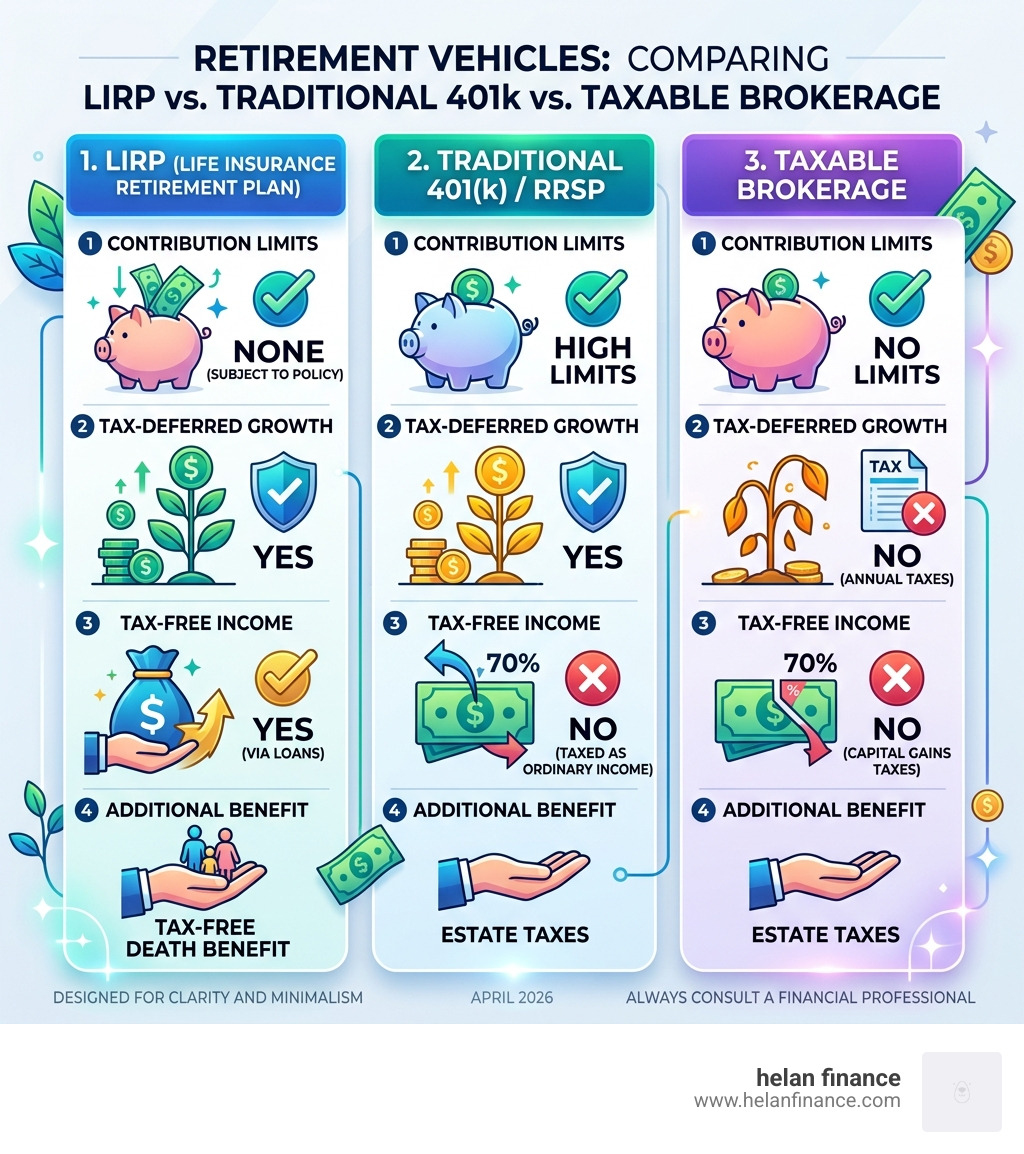
| Feature | LIRP | Traditional 401(k) / RRSP | Taxable Account |
|---|---|---|---|
| Contribution Limits | None (subject to policy) | High Limits | No Limits |
| Tax-Deferred Growth | Yes | Yes | No |
| Tax-Free Income | Yes (via loans) | No (taxed as income) | No (capital gains) |
| Death Benefit | Yes | No | No |
| Probate Avoidance | Yes | No | No |
Estate Planning and Probate
Beyond retirement income, a LIRP is an estate planning powerhouse. The death benefit typically bypasses probate, meaning your heirs get the money faster and more privately. It provides immediate liquidity to pay for final expenses or estate taxes, ensuring your legacy remains intact.
Choosing the Right Policy for Your Life Insurance Retirement Plan

Not all life insurance is created equal. If you buy a “Term” policy, you have zero cash value and no retirement plan. To build a LIRP, you need permanent coverage.
Whole Life Insurance
Whole life is the “steady Eddie” of the insurance world. It offers guaranteed growth and, if you choose a mutual company, annual dividends. Historically, dividend-paying whole life policies have seen returns in the 5-6% range. It’s a great fit for those who want absolute certainty and a “volatility shield” for their portfolio.
Indexed Universal Life (IUL)
IUL is currently a very popular choice for a life insurance retirement plan. Its growth is tied to a stock market index (like the S&P 500).
- The Upside: You get to participate in market gains, often with “caps” around 10-12%.
- The Downside Protection: Most IULs have a “floor” of 0%. If the market drops 20%, your account simply stays flat. You don’t lose your principal.
- Performance: Well-designed IULs have historically averaged 6-8% returns.
Avoiding the Modified Endowment Contract (MEC) Trap
This is the most critical part of policy design. If you put too much money into a policy too quickly, the IRS (or CRA in Canada) will reclassify it as a Modified Endowment Contract (MEC). Once a policy becomes a MEC, it loses its tax-free loan status. We use the “Seven-Pay Test” to ensure your premiums stay within legal limits while still maximizing your cash accumulation.
Implementation: Funding and Accessing Your Wealth
Setting up a life insurance retirement plan requires more than just signing a paper. It requires precise engineering.
Underwriting and Insurability
Because there is a death benefit involved, you have to qualify medically. This involves a health review. Generally, the younger and healthier you are when you start, the lower the “Cost of Insurance” (COI) will be, leaving more of your premium to grow in the cash value account.
Overfunding for Efficiency
We recommend a “maximum funded” approach. By keeping the death benefit as low as the law allows while paying the maximum premium possible, you minimize the fees and maximize the growth. Think of it like a bucket: the death benefit is the size of the bucket, and your premiums are the water. We want the smallest bucket possible so the water overflows into your savings as quickly as possible.
Using Policy Loans for Tax-Free Income
When it’s time to retire, you have two main ways to get your money:
- Direct Policy Loans: Borrowing directly from the insurance carrier.
- Third-Party Lending: Using your policy as collateral for a line of credit from a bank. Banks often advance 90-100% of the cash value for Whole Life and 50-90% for Universal Life.
Often, the interest rate you pay on the loan is lower than the interest or dividends you are earning inside the policy. This is called “positive arbitrage,” and it means your money is growing even while you are spending it.
Risks, Costs, and Common Pitfalls to Avoid
We believe in transparency. While a life insurance retirement plan is powerful, it isn’t magic. There are risks to monitor:
- Policy Lapse: If you stop paying premiums too early or take out too large a loan, the policy could lapse. If it lapses with a loan outstanding, you could face a massive tax bill.
- Interest Rate Spread: If the cost of your loan rises significantly above the returns of your policy, the plan becomes less efficient.
- Premium Loads and Fees: In the first few years, a large chunk of your money goes toward commissions and setup costs. You shouldn’t start a LIRP unless you have at least a 10-15 year time horizon.
- Longevity Risk: If you live to be 120 and keep drawing income, you must ensure the policy has enough “gas in the tank” to stay in force until the end.
Annual reviews with a professional are non-negotiable. You need to monitor your “loan-to-value” ratio to ensure your retirement stream remains secure.
Frequently Asked Questions about LIRPs
Who is the ideal candidate for a LIRP?
The ideal candidate is typically between age 35 and 55, earns a high income, and has already maximized their contributions to traditional accounts like a 401(k), IRA, or RRSP. They should have a need for permanent life insurance and be comfortable using debt (loans) as a strategic tool.
How do LIRP fees compare to traditional investments?
Initially, LIRP fees are higher due to the cost of insurance and premium loads (which can be 4-8% in early years). However, over 20-30 years, the tax savings often far outweigh these costs. While a mutual fund might charge 1% annually forever, LIRP costs often decline as a percentage of the total account value over time.
What are the Canadian-specific considerations for these plans?
In Canada, this is often called an Insured Retirement Plan (IRP). The Canada Revenue Agency (CRA) has strict “tax-exempt” limits. If you are a business owner, a corporate-owned LIRP can be even more powerful, as it allows you to move “trapped” corporate surplus into a tax-free death benefit that flows through the Capital Dividend Account (CDA) to shareholders.
Conclusion
At Helan Finance, we believe that financial planning shouldn’t be a headache. Whether you are looking at a life insurance retirement plan to supplement your income or as a way to leave a lasting legacy, the key is starting with a clear strategy.
By integrating routines, healthy financial habits, and the right tools, you can build a retirement that isn’t just “funded,” but flourishing. A LIRP offers a unique combination of protection, tax-free growth, and flexibility that few other vehicles can match.
Ready to see how the numbers look for your specific situation? Start your financial planning journey today and take the first step toward a retirement you actually look forward to.

