
Accelerate Your Debt Reduction Plan with These Daily Habits
Why a Beginner Debt Payoff Routine Can Change Your Financial Life
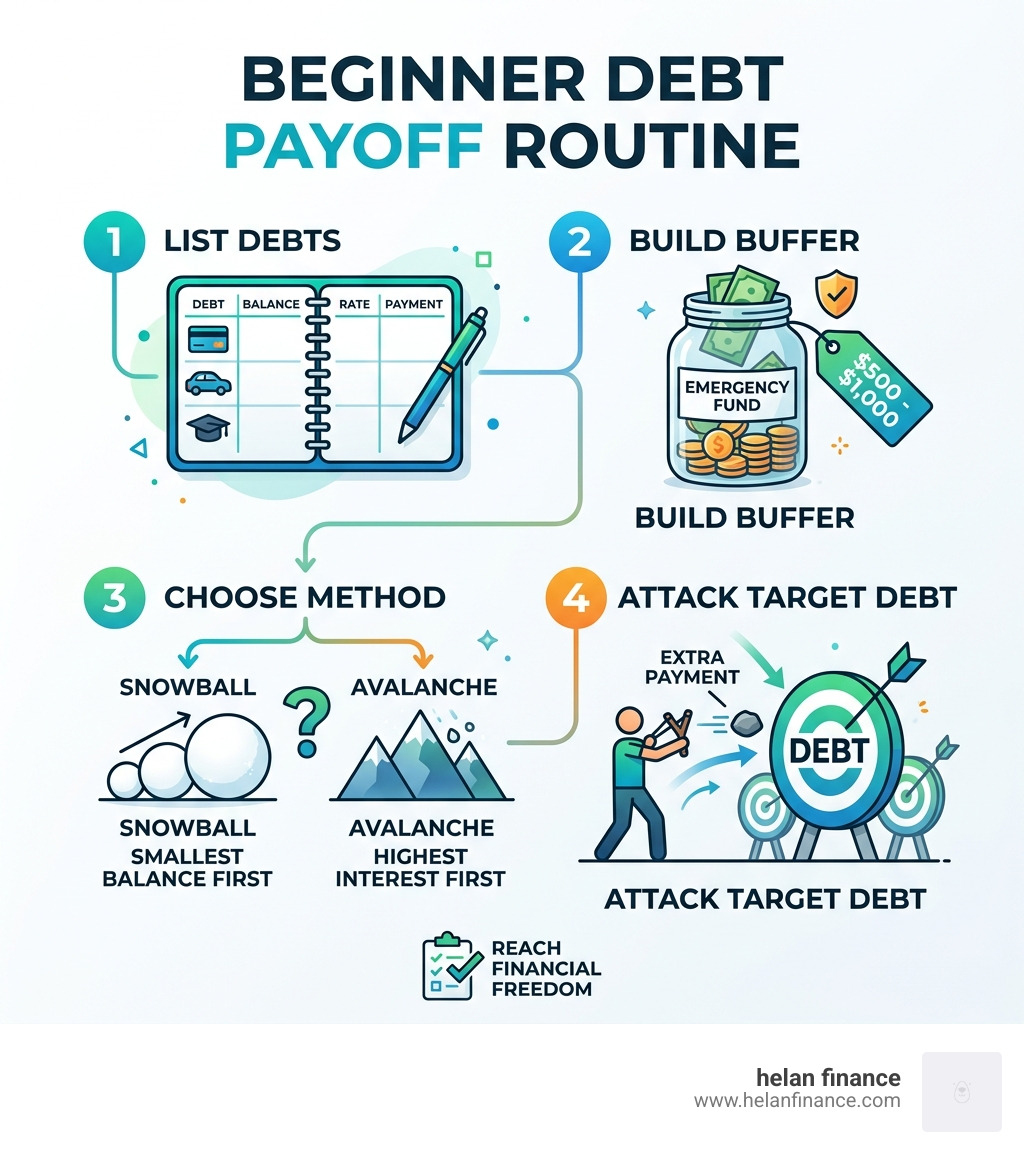
A beginner debt payoff routine is a simple, repeatable system for eliminating debt step by step — and the fastest way to start is with these four actions:
- List every debt you owe (balance, interest rate, minimum payment)
- Build a small emergency buffer of $500–$1,000 so surprises don’t send you back to square one
- Choose a payoff method — the debt snowball (smallest balance first) or debt avalanche (highest interest first)
- Pay minimums on all debts, then throw every extra dollar at your target debt
That’s the core of it. The rest is about building habits that make it stick.
Right now, U.S. consumers are carrying over $1 trillion in credit card debt. If you’re feeling the weight of that — monthly statements, minimum payments that never seem to move the needle, the quiet stress of knowing part of your paycheck is already spent — you’re not alone.
The good news? Getting out of debt isn’t about being perfect with money. It’s about having the right sequence of moves and repeating them consistently.
People like Cassandra Ohl paid off $35,000 in student debt in just two years. Kari M. Cecil went from $150,000 in debt to $19,000 in three years. These aren’t extreme cases — they’re what focused, routine-driven payoff looks like in practice.
The average person who works a structured debt payoff plan with real focus clears all their consumer debt in 18 to 24 months. That’s less than two years to go from overwhelmed to financially free.
This guide will walk you through exactly how to build that routine — even if you’re busy, starting from zero, and not sure where to begin.
Assessing Your Financial Starting Point
Before we can run toward the finish line, we have to know exactly where we’re standing. Most of us avoid looking at our bank accounts when things get tight, but debt thrives in the dark. We need to shine a light on every single penny.
Creating Your Debt Snapshot
The first step in any beginner debt payoff routine is visibility. We recommend sitting down with a beverage of your choice and pulling up every credit card portal, student loan dashboard, and car loan statement you have.
You need to list:
- The name of the lender.
- The total current balance.
- The interest rate (APR).
- The minimum monthly payment.
This list isn’t meant to scare you; it’s your map. Without it, you’re just throwing money at a wall and hoping it sticks.
Calculating Your Debt-to-Income (DTI) Ratio
To understand how serious your situation is, we use the Debt-to-Income (DTI) ratio. This is the percentage of your gross monthly income (before taxes) that goes toward paying debts.
How to calculate it: Divide your total monthly debt payments by your gross monthly income. For example, if you pay $1,500 in debt and earn $4,000 a month, your DTI is 37.5%.
- 36% or less: This is generally considered a healthy debt load. You can likely handle this with a DIY routine.
- 37% to 42%: You’re in the “caution” zone. You might need to consolidate or seek credit counseling to stay afloat.
- 43% or more: This is a red flag. When debt consumes nearly half your income, it becomes incredibly difficult to cover basic living expenses. At this level, you should seriously consider professional debt relief options.
- 50% or more: This often signals that bankruptcy might be a necessary “fresh start” to consider.
Knowing these numbers helps you decide which strategy is realistic for your life. For more detailed guidance on organizing these numbers, you can follow the Three Steps to Managing and Getting Out of Debt – DFPI.

Choosing Your Beginner Debt Payoff Routine
Once you have your list, it’s time to pick your “engine.” There are two primary ways to order your debts, and both have their fans. We like to think of it as a choice between “Math” and “Motivation.”
| Feature | Debt Snowball | Debt Avalanche |
|---|---|---|
| Primary Focus | Smallest balance first | Highest interest rate (APR) first |
| Main Benefit | Psychological “quick wins” | Saves the most money on interest |
| Strategy | Pay minimums on all, extra on smallest | Pay minimums on all, extra on highest APR |
| Best For | Beginners who need motivation | People motivated by mathematical efficiency |
The Debt Snowball Method
With the snowball method, you ignore interest rates for a moment. You list your debts from the smallest balance to the largest. You attack that tiny $300 medical bill with everything you’ve got while paying minimums on everything else. When it’s gone, you take that entire payment and “roll” it into the next smallest debt.
The Debt Avalanche Method
The avalanche method is the mathematical winner. You list debts by interest rate. You target the credit card charging you 24% first, even if it has a $5,000 balance, while paying minimums on the 6% student loan. This prevents the most “interest bleed” over time.
Why the Snowball Method is the Best Beginner Debt Payoff Routine
As we look at the data in April 2026, it’s clear that while the avalanche saves money on paper, the beginner debt payoff routine that actually gets finished is usually the snowball.
Why? Because human beings aren’t calculators. We are emotional creatures. If you spend six months attacking a high-interest debt and don’t see a single account hit $0, you’re likely to get discouraged and quit.
The power of the “Quick Win”: When you pay off a small $200 store card in the first month, your brain gets a hit of dopamine. You realize, “I can actually do this!” That psychological momentum is what carries you through the 18–24 months it typically takes to become debt-free.
Success stories like Paula Patterson, who paid off $33,500 in three years, often credit this “momentum” for their success. When you’re staring down a $1 trillion national credit card debt crisis, starting small is the smartest way to ensure you don’t become just another statistic.
Implementing Your Daily Beginner Debt Payoff Routine
A routine only works if it’s sustainable. You can’t live on beans and rice for five years without burning out. Here is how we recommend building your daily habits:
1. Automate Your Minimums Never miss a payment. Set up every single debt on autopay for the minimum amount. This protects your credit score and avoids those pesky $40 late fees that act like a tax on being in debt.
2. The Daily “Cash Flow Audit” Spend five minutes every morning looking at your transactions from the day before. We call this looking for “spending leaks.” Did you spend $7 on a delivery fee for a sandwich? That’s $210 a month if you do it daily. Identifying these leaks is the easiest way to find “extra” money for your debt.
3. Build Your $1,000 Fortress Before you put an extra cent toward your debt, you need an emergency fund. We recommend a starter buffer of $1,000. Why? Because life happens. Your car will need a tire, or your water heater will leak. Without this $1,000, you’ll just put those repairs back on a credit card, and you’ll be stuck in the “debt loop” forever.
For a deeper dive into building this structure yourself, check out the Ultimate Guide to Creating Your Own DIY Debt Management Plan.
Step-by-Step Guide to Your New Daily Routine
Now, let’s get tactical. How do you actually find the money to fuel your beginner debt payoff routine? It comes down to a zero-based budget.
The Zero-Based Budget
A zero-based budget doesn’t mean you have zero dollars in your bank account. It means every dollar you earn has a “job” to do before the month begins.
- Income: $4,000
- Rent: $1,500
- Groceries: $400
- Utilities: $200
- Minimum Debt Payments: $600
- The “Debt Target”: $1,300
When you give every dollar a name, you stop “wondering” where your money went at the end of the month.
Conducting a Cash Flow Audit
Pull your last 90 days of bank statements. It’s a bit like a financial colonoscopy—unpleasant, but necessary for health.
- Subscription Cancellation: The average American spends $219 a month on unused subscriptions. Cancel the gym you don’t go to and the streaming service you haven’t opened in months. That’s an extra $2,000+ a year toward your debt.
- The 24-Hour Rule: Before any non-essential purchase over $30, wait 24 hours. Most impulse buys lose their “spark” by the next morning.
Redirecting Windfalls
Whenever you get a “bonus” — a tax refund, a birthday check from Grandma, or a small work bonus — 100% of it should go to your target debt. In 2024, the average tax refund was over $3,000. That single payment could cut months off your payoff timeline.

Advanced Strategies: Consolidation and Relief
Sometimes, the interest rates on credit cards (averaging 21.76% in recent data) are so high that you feel like you’re running up a down escalator. This is where advanced tools come in.
Balance Transfers
If you have a credit score of 670 or higher, you might qualify for a 0% APR balance transfer card. This allows you to move high-interest debt to a card with no interest for 12–18 months.
- The Catch: Most cards charge a 3% to 5% transfer fee.
- The Goal: You must have a plan to pay off the entire balance before the 0% period ends, or the interest will come roaring back.
Debt Consolidation Loans
A personal loan can often consolidate multiple credit card balances into one monthly payment with a lower interest rate. While credit cards average nearly 22%, 24-month personal loans average around 12.33%. This can save you thousands in interest and simplify your life into one single due date.
When to Seek Debt Relief
If your debt is greater than 43% of your income, a DIY beginner debt payoff routine might not be enough.
- Debt Management Plans (DMP): Nonprofit credit counseling agencies can negotiate with creditors to lower your interest rates (often to 6–9%) in exchange for closing the accounts. You make one monthly payment to the agency, and they pay your creditors.
- Bankruptcy: If your debt exceeds 50% of your income and there is no realistic path to payoff within five years, bankruptcy is a legal tool designed to give you a fresh start. It’s a last resort, but it’s better than spending decades in a debt trap.
Staying Motivated and Avoiding Common Pitfalls
The middle of the debt payoff journey is the hardest. The initial excitement has worn off, and the finish line is still months away.
Use Visual Trackers
We are visual creatures. Create a “debt thermometer” on your fridge or a grid of squares where each square represents $100. Coloring those in provides a physical sense of progress that a digital banking app just can’t match.
Beware of Lifestyle Creep
As you pay off debt, your “minimum payments” disappear, leaving you with more cash in your pocket. The biggest mistake beginners make is using that “extra” money to upgrade their lifestyle — a better car, a nicer apartment, or more dinners out. The Rule: Until you are debt-free, that “freed-up” money belongs to the next debt on your list.
Celebrate Milestones
Don’t wait until you’re 100% debt-free to celebrate. When you pay off a specific card or hit the halfway mark, treat yourself to something small and low-cost, like a movie night or a favorite meal. You need to reward the behavior you want to see continue.
Maintaining Your Beginner Debt Payoff Routine Long-Term
Paying off debt is a marathon, not a sprint. The average focused person finishes in 18–24 months. Consistency is more important than intensity. It’s better to pay an extra $200 every single month than to pay $1,000 once and then nothing for six months because you ran out of cash.
Once you are debt-free, don’t stop the routine! Take the total amount you were paying toward debt and redirect it immediately into investing. If you were paying $1,000 a month toward debt, and you start putting that into a retirement account with an 8% return, you could have $45,000 in just 10 years.
Frequently Asked Questions about Debt Payoff
How long does a typical beginner debt payoff routine take?
For most people working with “focused intensity,” it takes about 18 to 24 months to clear all consumer debt (credit cards, car loans, personal loans). Of course, this depends on your total debt amount and how much extra “surplus” you can find in your budget.
Should I build an emergency fund while paying off debt?
Yes! We recommend a “starter” emergency fund of $1,000 before you start making aggressive extra payments. This acts as a safety net. If you don’t have this buffer, the first time your car breaks down, you’ll be forced to use a credit card, which breaks your momentum and can be incredibly discouraging.
What is the fastest way to pay off credit card debt?
Mathematically, the debt avalanche is the fastest because it minimizes the interest you pay. However, the “real world” fastest way is whichever method you will actually stick to. For many, that is the debt snowball because the quick wins keep them from quitting. Combining either method with a “cash flow audit” to find extra budget surplus is the ultimate speed booster.
Conclusion
At Helan Finance, we believe that financial freedom shouldn’t be a mystery. It’s about simple routines, clear math, and the grit to keep going. By implementing a beginner debt payoff routine today, you aren’t just paying off past mistakes—you are buying back your future.
Whether you choose the snowball for the wins or the avalanche for the savings, the most important step is the one you take today. Start by listing those debts, build your $1,000 buffer, and watch how quickly your life changes when you are the one in control of your paycheck.
Ready to take the next step in your financial journey? Start your journey with Helan Finance and let us help you simplify your path to wellness.

