
52-Week Money Challenge: The Only Money Saving Plan You Need
Why Most People Never Stick to a Money Saving Plan (And How to Fix That)
A solid money saving plan gives you a clear path from where you are now to where you want to be financially. Here is a quick overview of what works:
The core steps of an effective money saving plan:
- Track your spending – Know exactly where your money goes each month
- Apply the 50/30/20 rule – 50% on needs, 30% on wants, 20% on savings or debt
- Build a starter emergency fund – Start with $1,000, then grow to 3-9 months of expenses
- Automate your savings – Set up automatic transfers so saving happens without thinking
- Use registered accounts – TFSAs, RRSPs, and FHSAs grow your money with tax advantages
- Review monthly – Adjust what is not working and celebrate what is
Here is the honest truth: most people do not fail at saving because they lack discipline. They fail because they never had a clear, simple system to follow.
A Bankrate survey found that 56% of people cannot cover an unexpected $1,000 expense from savings. That is not a character flaw. It is a planning gap.
The good news? You do not need to overhaul your entire lifestyle. Small, consistent actions — done in the right order — build real financial breathing room over time, even on a tight budget.
In this guide, you will learn how the 52-week savings challenge pairs with proven budgeting rules and Canadian registered accounts to create one simple, repeatable money saving plan that actually sticks.
The 52-Week Challenge and the 50/30/20 Budgeting Rule
If you have ever felt that saving money is like trying to hit a moving target, you are not alone. In April 2026, with the cost of living remaining a primary concern for most households, the “all-or-nothing” approach to finances usually results in “nothing.” This is why we advocate for the 52-week money saving plan.
How the 52-Week Challenge Works
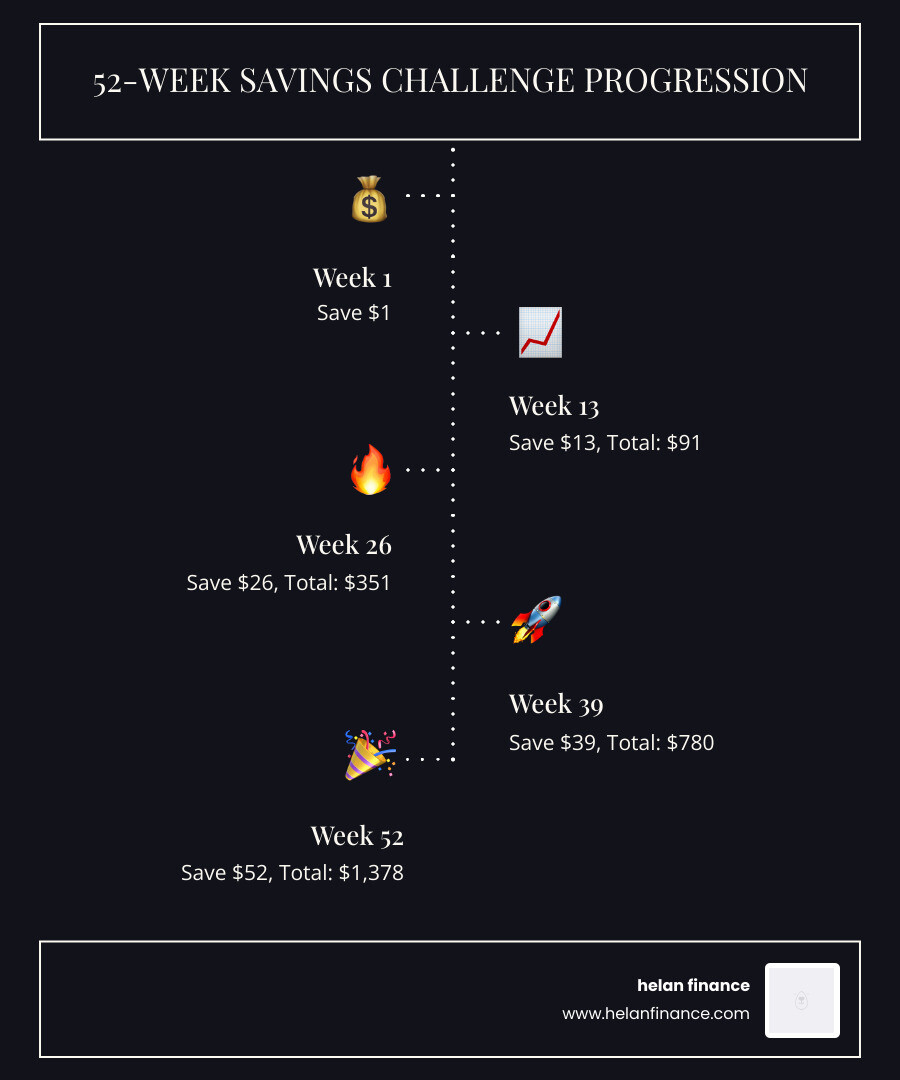
The beauty of this challenge lies in its psychological simplicity. You start small—so small it feels effortless—and build momentum. In the classic version:
- Week 1: You save $1.
- Week 2: You save $2.
- Week 52: You save $52.
By the end of the year, you will have saved exactly $1,378. While that might not buy a house, it is the perfect “starter” emergency fund that breaks the cycle of relying on credit cards for car repairs or medical bills.
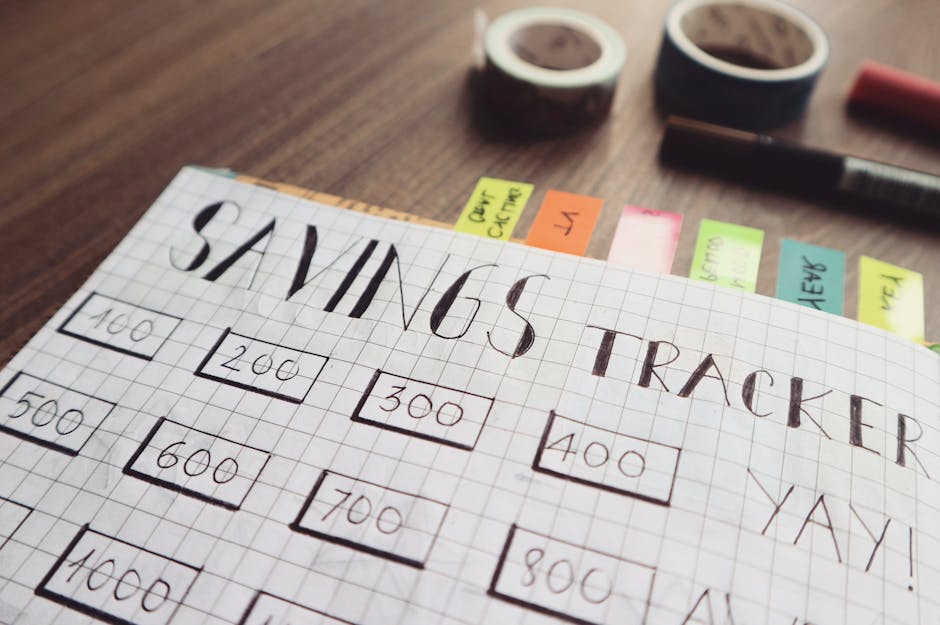
Variations to Fit Your Life:
- The Reverse Challenge: Start at $52 in Week 1 and work your way down. This is great for people who have high motivation (or a holiday bonus) in January and want the “hard” part out of the way first.
- The Biweekly Variation: If you get paid every two weeks, simply double the weekly amounts to match your pay cycle.
- The Double-Up: If $1,378 feels too low, double every deposit to end the year with $2,756.
The 50/30/20 Rule: The Framework for Success
The 52-week challenge is a great “sprint,” but the 50/30/20 rule is the marathon strategy. It provides a balanced way to allocate your take-home pay:
- 50% for Needs: Rent/mortgage, groceries, utilities, and insurance.
- 30% for Wants: Dining out, subscriptions, and hobbies.
- 20% for Savings and Debt: This is where your money saving plan truly lives.
By sticking to these ratios, you ensure that you are living within your means while still enjoying your life today.
50/30/20 Allocation Comparison Table
| Monthly Take-Home | Needs (50%) | Wants (30%) | Savings/Debt (20%) |
|---|---|---|---|
| $3,000 | $1,500 | $900 | $600 |
| $4,500 | $2,250 | $1,350 | $900 |
| $6,000 | $3,000 | $1,800 | $1,200 |
To see how these numbers look for your specific situation, you can use a Savings Goal Calculator to work backward from your target amount.
Maximizing Long-Term Growth with Registered Accounts
Once you have mastered the habit of putting money aside, the next step in your money saving plan is making sure that money works as hard as you do. In Canada, we have access to powerful registered accounts that offer significant tax advantages.
- TFSA (Tax-Free Savings Account): This is perhaps the most flexible tool in your kit. Any growth—whether from interest, dividends, or capital gains—is completely tax-free. You can also withdraw money at any time without penalty, making it ideal for medium-term goals like a new car or a wedding.
- RRSP (Registered Retirement Savings Plan): Contributions to an RRSP are tax-deductible, meaning they lower your taxable income for the year. This is a “future you” account. If your employer offers a matching program, take it! It is essentially a 100% return on your money before it even hits the market.
- FHSA (First Home Savings Account): A newer addition to the Canadian landscape as of 2023, the FHSA combines the best of both worlds. Like an RRSP, contributions are tax-deductible. Like a TFSA, withdrawals for your first home purchase are tax-free.
- RESP (Registered Education Savings Plan): If you have children, the RESP is a must. The government provides grants (CESG) that match 20% of your contributions up to a certain limit. It is one of the few places where the government literally hands you money for saving.
Beginner-Friendly Investment Options
Many people get paralyzed by the word “investing,” but your money saving plan doesn’t need to be complex.
- GICs (Guaranteed Investment Certificates): These are the safest bet. You lend the bank money for a set term (e.g., 1 year), and they guarantee your principal plus a fixed interest rate.
- Mutual Funds and ETFs: These allow you to buy a “basket” of stocks or bonds, providing instant diversification.
- High-Interest Savings Accounts (HISA): For your emergency fund, a HISA is often better than a traditional chequing account because it offers a higher APY (Annual Percentage Yield) while keeping your cash liquid.
Practical Strategies to Fuel Your Money Saving Plan
You cannot save what you do not have. To find the “extra” money for your 52-week challenge, we need to look at where the “leaks” are in your daily spending.
High-Impact Expense Cuts
Small changes in your household habits can lead to massive annual savings. Here are the most effective areas to target:
- The 20% Water Heater Rule: Did you know your water heater can consume up to 20% of your annual electricity bill? Lowering the temperature slightly or insulating the tank can put hundreds back in your pocket.
- Fuel-Efficient Driving: It sounds simple, but driving at 100 km/h instead of 120 km/h significantly reduces fuel consumption. Over a year of commuting, this adds up.
- The Subscription Audit: We often suffer from “subscription creep.” Review your bank statements for apps, streaming services, or gym memberships you haven’t used in 30 days. Cancel them immediately.
- Meal Planning: Shopping with a list after you have already eaten can reduce grocery spending by 20-30%. Avoid the “convenience tax” of pre-cut vegetables or individual snack packs.
Managing Debt and Emergency Funds
It is difficult to save when you are being dragged down by high-interest debt.
- The Debt Trap: A $2,000 purchase on a credit card at 20% interest will cost you $4,240 if you only make minimum payments. You are paying more than double for the same item!
- Mortgage Acceleration: If you have a mortgage, adding just $2,000 per year to your principal on a $300,000 mortgage (at 5% interest) can save you $41,252 in total interest over the life of the loan.
- Tax Credits: If you are a student, don’t forget tuition tax credits. A $3,000 tuition fee can earn up to $450 in tax credits (15% federal + 8% provincial), which can be funneled directly into your savings.
Automation and Side Hustles for Your Money Saving Plan
Willpower is a finite resource. Automation is infinite.
- Direct Deposit Splits: Ask your employer to send a portion of your paycheck (even just $25) directly to a separate savings account. If you never see it in your chequing account, you won’t miss it.
- Round-Up Programs: Many banking apps now offer “round-up” features where every purchase is rounded to the nearest dollar, and the change is moved to savings.
- Side Hustles: If your budget is already lean, the answer is increasing income. Tutoring, freelance writing, or gig work can provide the “seed money” for your investments.
A Note on Fraud: As you build wealth, you become a target. Stay vigilant against “pig butchering” scams or crypto frauds that promise “guaranteed” high returns. If it sounds too good to be true, it is. Always verify that a person or company is registered to give financial advice.
Tracking and Adjusting Your Money Saving Plan
We recommend a monthly review. Research shows that “leak spending”—money that disappears on small, unplanned purchases—usually accounts for 5% to 15% of a household’s cash flow. By auditing your spending every 30 days, you can catch these leaks before they become floods.
Use “digital envelopes” or specialized apps to categorize your spending. If you overspend in one category (like “Wants”), simply adjust and reduce another category for the following month. Perseverance is more important than perfection.
Frequently Asked Questions about Saving Money
How do I start saving money effectively on a tight budget?
The best way to start is by tracking your spending for 30 days. You cannot fix what you cannot see. Once you see where the money is going, apply the “48-hour rule” for non-essential purchases. If you still want the item after two days, then consider it. Usually, the impulse fades, and the money stays in your pocket.
What is the best way to build an emergency fund?
Aim for a “starter” fund of $1,000 as quickly as possible—even if it means selling unused items or taking on a short-term side hustle. Once that is in place, work toward covering 3 to 9 months of living expenses. Keep this money in a separate, high-interest savings account so it is accessible but not “too” easy to spend on a whim.
How can I protect my savings from common financial scams?
Education is your best defense. Stay informed by visiting resources like MyMoney.gov to learn about investor protection. Never share your banking passwords, be wary of “urgent” requests for money via text or email, and always research an investment platform before committing funds.
Conclusion
At Helan Finance, we believe that financial freedom isn’t reserved for the wealthy—it is built by anyone willing to implement a consistent money saving plan. By combining the structured growth of the 52-week challenge with the smart tax-shielding of registered accounts, you are not just “saving money”; you are buying your future time and security.
The hardest part of any journey is the first $1. Whether you are cutting back on utility costs, accelerating your mortgage, or starting your first TFSA, every small action counts.
Start your money saving plan today with Helan Finance and take control of your financial story. Success is not about how much you earn, but how much you keep. Stay persistent, stay informed, and watch your wealth grow.

