
How to manage your money without losing your mind
Why Financial Planning Feels Hard (And How to Make It Simple)
Financial planning tips for beginners can feel overwhelming — but the core idea is straightforward: understand where your money goes, set clear goals, and build simple habits to get there.
Here are the essential steps to get started:
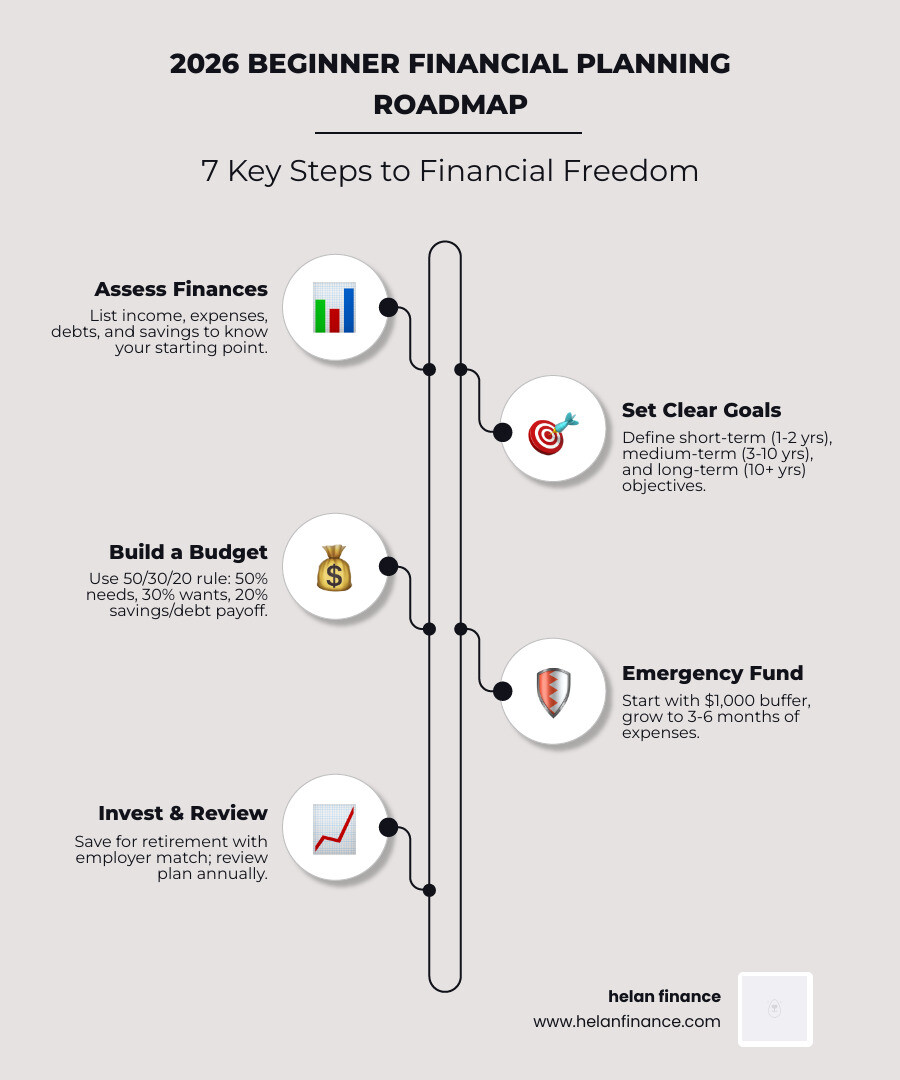
- Assess your finances — list your income, expenses, debts, and savings
- Set clear goals — short-term (1-2 years), medium-term (3-10 years), and long-term (10+ years)
- Build a budget — try the 50/30/20 rule: 50% needs, 30% wants, 20% savings and debt
- Start an emergency fund — aim for a $1,000 buffer first, then build to 3-6 months of expenses
- Pay down high-interest debt — tackle the highest interest rate first
- Save for retirement — contribute at least enough to capture your employer’s full match
- Protect yourself — get basic health, disability, and life insurance coverage
- Review your plan — at least once a year, or after any major life change
Most people don’t struggle with finances because they lack income. They struggle because no one taught them a system.
A financial plan is not a complicated spreadsheet or a Wall Street strategy. It’s simply knowing where you stand today, deciding where you want to go, and making small, consistent moves to get there. As one financial planning guide puts it: it’s about understanding where you are now and creating a roadmap to help you get there.
The good news? You don’t need to be perfect. Progress beats perfection every time.
Essential Financial Planning Tips for Beginners
To truly grasp the FINANCIAL Definition & Meaning – Merriam-Webster, we have to look past the dry terminology. At its heart, “financial” simply relates to how we manage our money. For us at Helan Finance, it’s about making that management as painless as possible.
The first step in any journey is knowing where you’re standing. You wouldn’t start a hike without checking a map, and you shouldn’t start a financial plan without checking your cash flow. This is a fancy way of saying: “How much is coming in versus how much is going out?”
We recommend starting with a “values-based” approach. Instead of just cutting costs until you’re miserable, look at your spending and ask if it aligns with what you actually care about. If you value travel but spend $200 a month on streaming services you never watch, that’s a misalignment. Fixing these small leaks is the easiest way to find “extra” money without feeling deprived.

Defining Clear Goals: Financial Planning Tips for Beginners
One of our favorite financial planning tips for beginners is to use the “80th Birthday Scenario.” Close your eyes and imagine your 80th birthday party. What do you want people to say about your life? What did you achieve? This exercise helps move your goals from abstract numbers to emotional priorities.
To make these dreams a reality, we break them down by time:
- Short-term goals (1-2 years): This might be building your initial emergency fund, paying off a specific credit card, or saving for a much-needed vacation.
- Medium-term priorities (3-10 years): Think about a down payment on a home, starting a small business, or perhaps a wedding.
- Long-term vision (10+ years): This is almost always focused on retirement and long-term wealth building.
Remember to make these SMART: Specific, Measurable, Achievable, Relevant, and Time-bound. “I want to save money” is a wish; “I want to save $3,000 for a car down payment in 12 months” is a goal.
Tracking Your Progress and Net Worth
Your net worth is your financial baseline. It’s a simple math problem: Assets (what you own) minus Liabilities (what you owe).
Don’t be discouraged if your net worth is negative when you start—that is incredibly common if you have student loans or a fresh mortgage. The goal isn’t to be a millionaire overnight; it’s to see that number trend upward over time. Use an asset inventory to list your bank accounts and any property, then track your liabilities like credit cards and loans. For a deeper dive, check out our guide on How to Track Your Financial Growth – Helan Finance.
Mastering Your Budget and Debt Management
Budgeting isn’t about restriction; it’s about clarity. When you know where every dollar is going, you stop wondering where it went. It’s the “blocking and tackling” of financial health.

Creating a Realistic Monthly Budget
In 2026, we have to be honest about the cost of living. While inflation has cooled since the peaks of 2022, food costs remain a significant factor. In 2025, food prices were predicted to increase by another 2.9%, following massive jumps in previous years. Your budget needs to account for these “real-world” shifts.
We often suggest the 50/30/20 rule as a starting point:
- 50% for Needs: Rent, groceries, utilities, and insurance.
- 30% for Wants: Dining out, hobbies, and that extra latte.
- 20% for Savings and Debt Repayment: This is your “future you” fund.
If your “Needs” are eating up more than 50% (common in high-cost cities), some experts suggest a 60/30/10+15 guideline, where 60% goes to essentials, but you still prioritize that 15% for retirement. The key is to find a system, like zero-based budgeting, where every dollar is assigned a job before the month begins.
Strategies for Crushing High-Interest Debt
Not all debt is created equal. We generally categorize debt with an interest rate above 6% as “high-interest” that needs aggressive attention. Credit cards are the biggest offenders here, often charging between 14% and 25%.
Two popular strategies include:
- The Debt Avalanche: You pay the minimum on all debts but throw every extra cent at the one with the highest interest rate. This saves you the most money over time.
- The Debt Snowball: You pay off the smallest balance first. This gives you a quick win and psychological momentum to keep going.
If you have student loans, the Federal Student Aid website is an essential resource for understanding your repayment options. For those struggling with high credit card rates, consider a zero-interest balance transfer or a lower-rate personal loan to refinance that debt and stop the interest bleeding.
Building Your Safety Net: Financial Planning Tips for Beginners
Life is full of “what-ifs.” An emergency fund is the difference between a car breakdown being a minor inconvenience or a total financial disaster. Think of it as “shockproofing” your life.
Establishing Your Emergency Fund
Before you start investing heavily in the stock market, you need a liquid safety net. We recommend a tiered approach:
- The Starter Buffer: Aim for $1,000 or one month of essential expenses. This covers the “small” emergencies like a broken appliance.
- The Robust Fund: Eventually, you want 3 to 6 months of essential living expenses (housing, food, medical).
Keep this money in a separate, high-yield savings account. It should be accessible, but not too easy to spend. Some of our members even keep it in an account without a debit card to remove the temptation of “dipping in” for non-emergencies. You can find more on this in our guide on Building Your Financial Foundation – Helan Finance.
Protecting Your Assets with Insurance
Insurance is the part of financial planning that everyone finds boring until they desperately need it. It protects you from the “big” risks that could wipe out your savings.
- Health Insurance: A single hospital stay can cost tens of thousands of dollars.
- Disability Insurance: This is often overlooked. It replaces a portion of your income (typically around 60%) if you’re unable to work.
- Term Life Insurance: Crucial if you have anyone (kids, spouse) who depends on your income.
- Renters/Homeowners Insurance: Protects your belongings from theft or disaster.
Pro-tip: Review your beneficiary updates annually. Life moves fast—make sure your accounts are set to go to the right people if the worst happens.
Investing for the Future and Retirement
Investing is how you make your money work for you. Thanks to compound interest, the earlier you start, the less you actually have to save out of your own pocket.
Getting Started with Retirement Savings in 2026
In 2026, the limits for retirement accounts have shifted to help us save more.
- 401(k) / 403(b): The employee contribution limit is $24,500. If you are 50 or older, you can add an $8,000 catch-up. For those aged 60-63, that catch-up is even higher at $11,250.
- IRA Limits: You can contribute up to $7,500 ($8,600 if you’re 50+).
The absolute “golden rule” of retirement? Capture the employer match. If your company offers a 3% match, that is a 100% return on your money instantly. It is literally “free money.” Most experts suggest aiming to save at least 15% of your pre-tax income for retirement, including that match.
Choosing an Appropriate Investment Mix
As a beginner, don’t get distracted by “hot” stock tips or market hype. The two biggest enemies of an investor are greed and fear. When markets go up, greed makes us want to over-invest; when they go down, fear makes us want to sell at a loss.
Instead, focus on a diversified mix:
- Index Funds & ETFs: These allow you to own a small piece of hundreds of companies at once, lowering your risk.
- Asset Allocation: This is the balance between stocks (for growth) and bonds (for stability).
- Rebalancing: Once a year, check if your mix has shifted. If your 60% stock portion has grown to 70% because the market did well, sell a little and move it back to 60%. This forces you to “buy low and sell high” automatically.
Frequently Asked Questions about Financial Planning
How much should I save for retirement?
We recommend aiming for 15% of your pre-tax income. While an old rule of thumb suggested you might only need 80% of your current income in retirement, we prefer a safer target of 100% of your pre-retirement expenses (minus what you were saving). This accounts for rising healthcare costs—a 65-year-old retiring in 2025 may need an average of $172,500 just for medical expenses.
How often should I review my financial plan?
At a minimum, conduct an annual review. However, you should also revisit your plan during major life milestones: getting married, having a child, changing jobs, or receiving a windfall. Monthly check-ins on your budget will keep you on track between these larger reviews.
What is the best way to start investing as a beginner?
Start with automated transfers. Set it and forget it. Use low-cost index funds or target-date funds that automatically adjust your risk as you get closer to retirement. This removes the “emotion” from investing and ensures you benefit from dollar-cost averaging.
Conclusion
Building financial resilience doesn’t happen overnight. It is a journey of progress over perfection. By applying these financial planning tips for beginners, you are taking control of your future and reducing the “mental load” that money stress creates.
At Helan Finance, we believe that managing your money should be as routine as brushing your teeth. By using simplified tools, setting healthy routines, and following a clear roadmap, you can achieve the life you’ve imagined without losing your mind in the process.
Ready to take the first step toward a calmer financial life? Start your journey with Helan Finance and let us help you build the roadmap to your goals.

