
The Ultimate Guide to Becoming Debt Free in One Year
Becoming Debt Free in One Year Is Possible — Here’s How
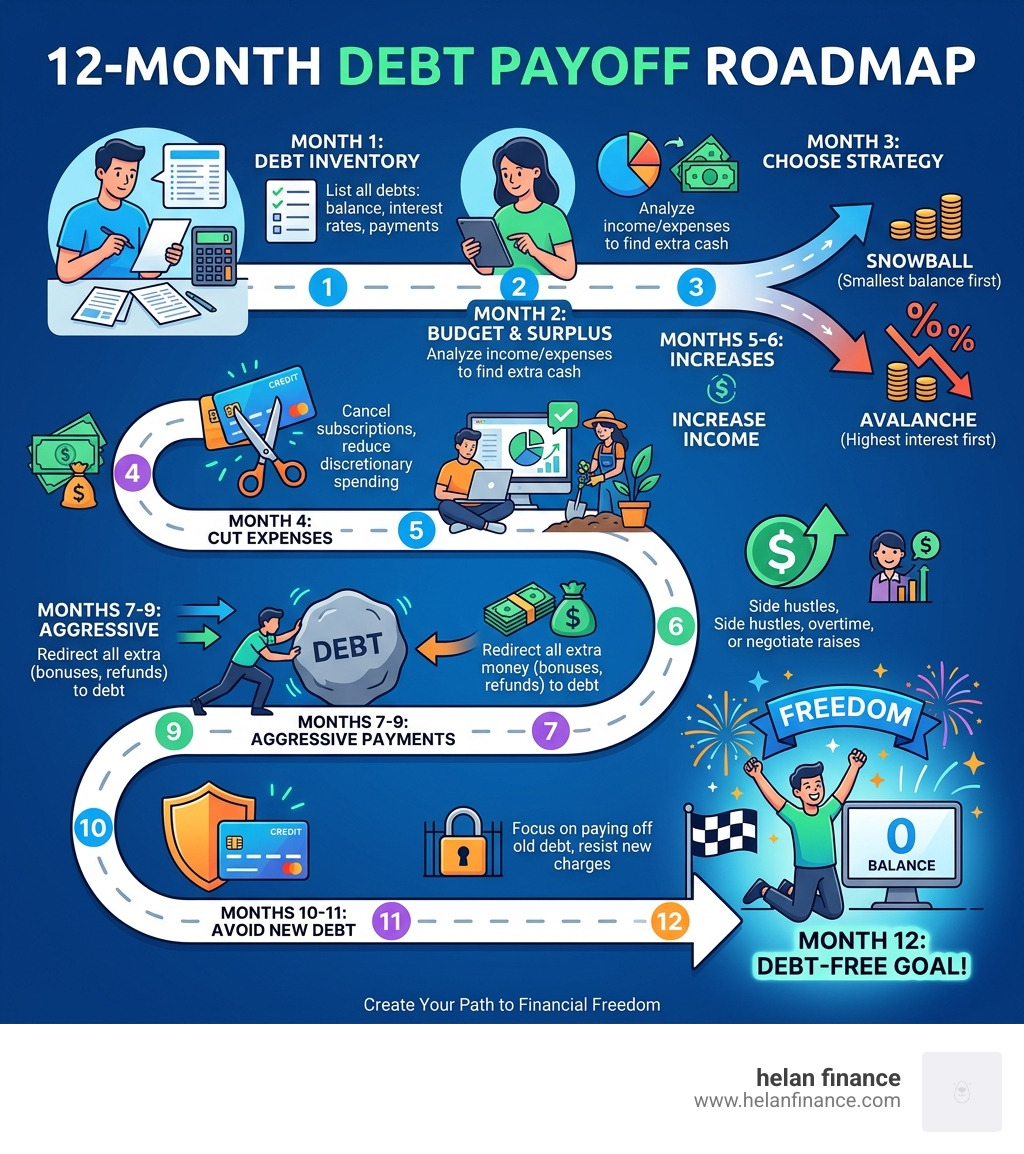
Becoming debt free in one year is realistic for most people with a clear plan, a focused budget, and a willingness to make temporary sacrifices. Here’s the short version:
- List every debt — balance, interest rate, and minimum payment
- Build a budget that creates a monthly surplus
- Choose a payoff strategy — snowball (smallest first) or avalanche (highest interest first)
- Cut expenses to free up $300–$800 or more per month
- Increase income through side hustles, overtime, or raises
- Redirect every extra dollar — bonuses, tax refunds, windfalls — straight to debt
- Avoid new debt while you pay off the old
The math is straightforward: an extra $1,000 per month clears $12,000 per year. An extra $2,000 clears $24,000. The timeline depends on how much surplus you can create.
Nearly half of all credit card holders carry a balance from month to month — and with average credit card interest rates hovering between 20% and 30%, that debt grows fast. High-interest debt is one of the biggest drivers of financial stress. The longer you carry it, the more it costs you.
The good news? A structured 12-month plan changes everything.
Real people have done it — including someone who paid off $25,000 in credit card debt in just over ten months, and another who wiped out $20,347 in a single year. These aren’t outliers. They followed a system.
This guide walks you through that system, step by step.
Assessing Your Financial Starting Point
Before we can sprint toward the finish line, we need to know exactly where the starting blocks are. Many people avoid looking at their total debt because the number feels overwhelming. However, clarity is the first step toward freedom. We recommend sitting down with a “financial mirror” and looking at every single cent you owe.
Create Your Debt Inventory
We need more than just a vague idea of our balances. Grab a notebook or open a spreadsheet and list every debt you have. To get a full picture, How to Pay Off Debt in a Year – Experian recommends checking your credit report to ensure no hidden accounts are dragging you down.
Your inventory should include:
- Lender Name: (e.g., Chase, Wells Fargo, Student Loan Provider)
- Total Balance: The exact amount required to pay it off today.
- Interest Rate (APR): This is crucial for choosing your strategy.
- Minimum Monthly Payment: The absolute baseline you must pay to avoid fees.

The Cash Flow Audit
Once you know what you owe, you need to know what you have. A cash flow audit involves looking at your last two months of bank statements. Most of us find between $300 and $800 in “recoverable spending”—money that disappears into forgotten subscriptions, convenience meals, or impulse buys. By identifying this surplus, we can calculate our net worth and determine how much “fuel” we have to pour into our debt-free engine.
Proven Strategies to Become Debt Free in One Year
Becoming debt free in one year isn’t about luck; it’s about choosing a mathematical or psychological framework and sticking to it. If you try to pay a little extra here and there without a system, the momentum often fizzles out by month three.
| Method | Focus | Best For… |
|---|---|---|
| Debt Snowball | Smallest Balance First | Psychological wins and staying motivated. |
| Debt Avalanche | Highest Interest Rate | Saving the most money on interest charges. |
| Hybrid | Smallest then Highest | Getting a quick win, then optimizing the math. |
Using the Debt Snowball for Quick Wins
The Debt Snowball method is a favorite for those of us who need to see progress to stay interested. You ignore the interest rates for a moment and focus entirely on the smallest balance. When that $150 medical bill or $300 department store card hits zero, you get a rush of dopamine.
This behavioral psychology creates a “snowball effect.” You take the entire payment you were making on that first debt and roll it into the next smallest. One success story shows an individual paying off $25,000 in under a year by focusing on these early victories. As Debt-Free Living: How I Paid Off $25K in One Year | Career Contessa highlights, the lifestyle sacrifices feel much smaller when you are constantly crossing debts off your list.
Maximizing Interest Savings to be Debt Free in One Year
If you are driven by the cold, hard math, the Debt Avalanche is your best friend. Here, we target the debt with the highest APR first—usually credit cards that charge 24% or more. By crushing the most expensive debt first, you reduce your “daily stupid tax”—the interest that accrues every 24 hours.
To accelerate this, consider:
- Negotiation Scripts: Call your creditors. Many people have successfully negotiated interest rates down by simply asking. A 5% reduction can save you hundreds over a 12-month period.
- 0% APR Balance Transfers: If your credit score is decent (usually 670+), you might qualify for a card that offers 0% interest for 12–21 months. This “freezes” your debt, allowing every penny of your payment to hit the principal balance.
Creating a High-Performance Budget and Increasing Income
You cannot get debt free in one year on a “vibes-based” budget. We need a mechanical system that makes overspending nearly impossible. One effective method is the 4-account system: one for fixed bills, one for daily spending (the “prepaid lifestyle”), one for your emergency fund, and one for your debt-crushing surplus.
The Expense Purge
We need to become “subscription killers.” The average person pays for three to five services they rarely use, often totaling over $100 a month. That’s $1,200 a year—enough to wipe out a small credit card balance entirely. We should also look at “MVNO” switches for cell phone plans or shopping around for insurance to find an extra $50–$100 in monthly margin.

Aggressive Income Tactics to Stay Debt Free in One Year
Cutting expenses is only half the battle. To clear large amounts like $20,000 or $30,000 in 12 months, we usually need to play offense. As seen in I’ve Been Completely Debt-Free for One Year — Here’s How My Life …, the freedom that comes from being debt-free allows you to eventually choose work you love, but during the “sprint year,” you might need to choose work that pays.
- The Gig Economy: DoorDash, Uber, or TaskRabbit can bring in an extra $500–$1,000 a month if you commit 10–15 hours a week.
- Selling Assets: The average household has about $3,200 worth of sellable items. From old furniture to electronics, selling these can provide a massive lump sum to jumpstart your 12-month journey.
- Windfall Allocation: We must commit to the “100% Rule.” If you receive a tax refund, a work bonus, or a cash gift, 100% of it goes to the target debt. No “treating yourself” until the balances are gone.
Avoiding Pitfalls and Staying Motivated
The middle of the year is where most people fail. The initial excitement has worn off, and you’re tired of saying “no” to dinner out. To prevent burnout, we recommend visual tracking. Use a chart on your fridge where you color in progress. Watching the numbers move is one of the most effective ways to stay on track.
The Starter Emergency Fund
One of the biggest pitfalls is an unexpected car repair or medical bill that forces you back into debt. Before you start your aggressive payoff, save a “starter” emergency fund of $1,000 to $2,000. This acts as a buffer between you and the credit card.
Scam Awareness
Be wary of “debt settlement” companies that promise to wipe out your debt for pennies on the dollar. These often involve stopping payments, which destroys your credit score and leads to massive fees. Stick to a self-managed system or a non-profit credit counselor if you need professional guidance.
Frequently Asked Questions about Rapid Debt Payoff
Is it realistic to pay off $30,000 in 12 months?
Yes, but it requires a high “intensity” level. For someone earning $60,000, paying off $30,000 in a year means living on half of your income. It usually requires a combination of aggressive budgeting (cutting 20% of expenses) and a side hustle that brings in at least $800 extra per month. It is a “sprint” year, not a forever lifestyle.
Should I pause debt payoff for emergencies?
Absolutely. If you experience a job loss or a major health crisis, you should shift to “survival mode.” This means paying only the minimums to keep your accounts current while you stockpile cash to cover your basic needs (housing, food, utilities). Once the crisis passes, you can resume your aggressive timeline.
Does paying off debt hurt my credit score?
Initially, you might see a small dip if you close an old account, but the long-term impact is overwhelmingly positive. By reducing your “credit utilization” (the amount of debt you use compared to your limits), your score will likely jump significantly—sometimes by 40 to 80 points—once the balances are cleared.
Conclusion
At Helan Finance, we believe that financial planning shouldn’t be a source of stress. By implementing simplified routines and exercises, you can turn the “impossible” goal of being debt free in one year into a series of small, manageable wins.
Becoming debt-free isn’t just about the money; it’s about gifting yourself peace of mind. Imagine a life where every dollar you earn belongs to you, not a bank. No more 2 a.m. anxiety about interest rates or minimum payments. Once you clear the slate, you can finally focus on building long-term wealth and enjoying the financial freedom you’ve worked so hard to achieve.
Start your debt-free journey today

