
Stop Guessing and Start Tracking Your Wealth Building Habits
Stop Guessing: The Best Wealth Building Habit Trackers in 2026
Wealth building habit trackers are apps and tools that help you form consistent money habits — like tracking spending, monitoring net worth, and reviewing subscriptions — so your finances grow on autopilot over time.
Key features of top wealth building habit trackers in 2026:
- Habit Formation: Science-backed programs that help you stick to a routine for 66 days.
- Net Worth Benchmarking: Tools that compare your progress against financial milestones.
- All-in-One Tracking: Dashboards that combine net worth with personalized growth plans.
- Behavioral AI: Nudges and community accountability to keep you on track.
- Cash Flow Analysis: AI advisors that predict trends and manage subscriptions.
- Gamification: RPG mechanics and challenges that make saving fun.
- Ecosystem Integration: Automation with health and productivity suites.
Here’s a number that stops most people cold: 68% of people say finances are their biggest source of stress — yet most never take a single step to track where their money actually goes.
The problem isn’t income. It’s habits.
Generic budgeting apps show you the numbers. But numbers alone don’t change behavior. What actually moves the needle is building small, consistent daily actions that compound over time — the same way interest compounds in an investment account.
That’s exactly what wealth building habit trackers are designed to do. They sit at the intersection of behavioral psychology and personal finance, turning abstract money goals into trackable daily wins.
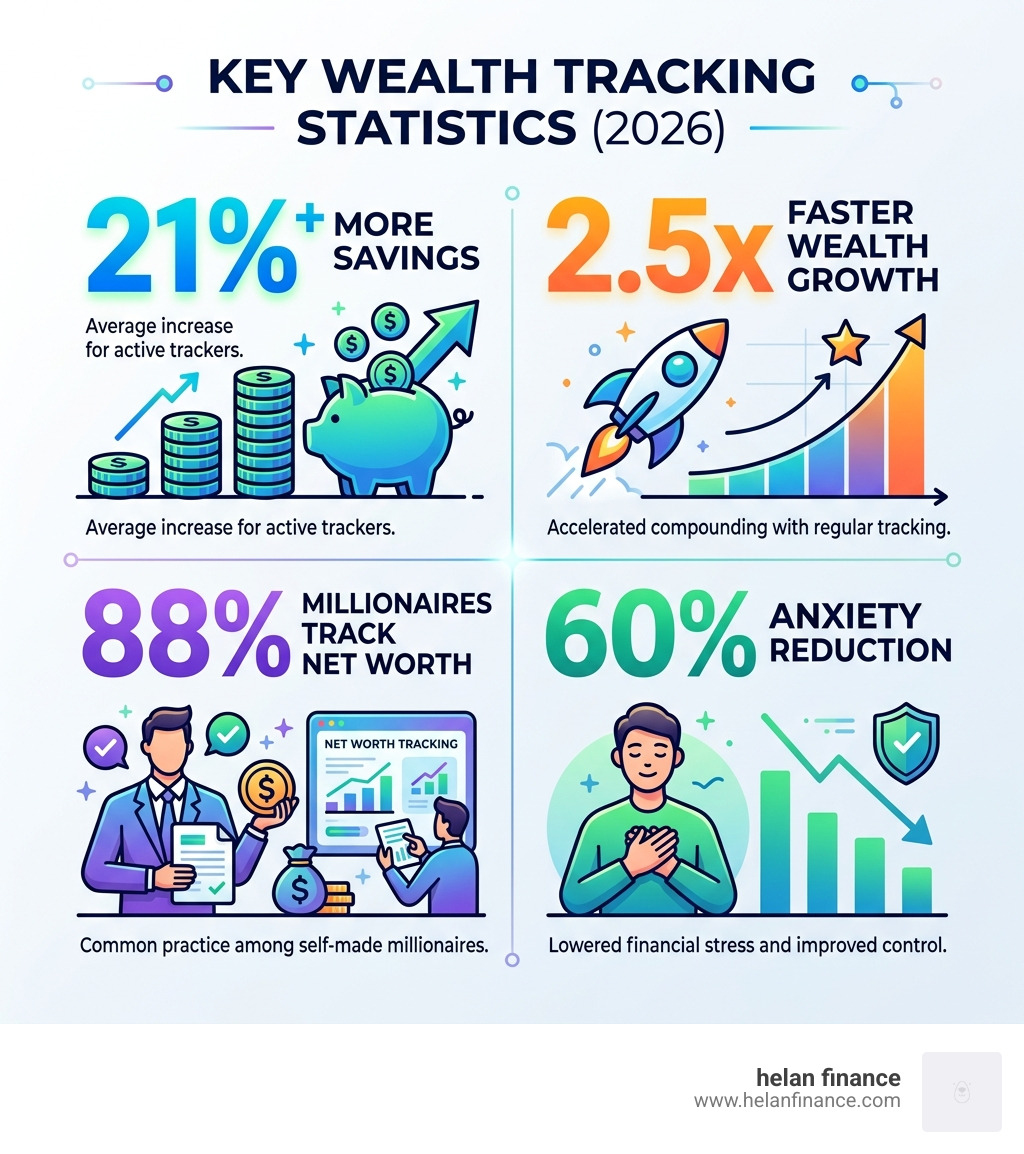
And the data backs this up hard. People who actively track their finances save 21% more on average, make 20% better financial decisions, and grow wealth 2.5x faster than those who don’t. Meanwhile, 88% of self-made millionaires regularly track their net worth.
The tools to do this have never been better — or more accessible.
Why Wealth Building Habit Trackers Are the Secret to Financial Freedom
We often think of wealth as a destination — a specific number in a bank account. But real wealth is actually a side effect of daily systems. This is why wealth building habit trackers differ so significantly from traditional budgeting apps. While a budget tells you what you can’t do, a wealth habit tracker focuses on what you are doing to grow your future self.
The science of wealth building is rooted in the “compounding effect.” Just as your investments earn returns that then earn more returns, your habits work the same way. When we track our habits, we create a feedback loop that lowers financial anxiety by a staggering 60%. Why? Because the “unknown” is the biggest driver of stress. Once you see your net worth on a screen, even if it’s smaller than you’d like, you regain a sense of control.
Statistics show that households tracking their net worth grow their assets 2.5 times faster. This isn’t magic; it’s focus. By keeping your “eyes on the prize,” you naturally begin to prioritize Building Better Money Habits for the Future over short-term impulses. For the 88% of self-made millionaires who track their progress, the habit tracker isn’t just a tool—it’s a daily ritual of success.

Key Features of a High-Performance Wealth Tracker
When choosing a wealth building habit tracker, we shouldn’t just look for a pretty interface. We need a tool that handles the “heavy lifting” of financial psychology. The best trackers in 2026 combine several high-performance features:
- Net Worth Monitoring: This is the “North Star” of wealth. It tracks your assets (cash, property, stocks, crypto) minus your liabilities (mortgages, loans).
- AI-Powered Insights: Modern apps now use “AI advisors” to spot patterns. For example, if you spend more on weekends, the AI might suggest a “weekend buffer” to keep you on track.
- Subscription Management: In 2026, “subscription creep” is a real wealth killer. A good tracker identifies recurring charges and reminds you to cancel what you don’t use.
- Personalized Goal Plans: Rather than a one-size-fits-all approach, high-end trackers generate plans based on your specific age, income, and goals.
Comparison: Manual Entry vs. Automated Sync
| Feature | Manual Entry Trackers | Automated Sync Trackers |
|---|---|---|
| Privacy | High (Data stays on device) | Moderate (Third-party servers) |
| Intentionality | High (You feel every entry) | Low (Easy to ignore data) |
| Accuracy | Prone to human error | High (Direct bank data) |
| Speed | Takes 5-10 mins/week | Instant updates |
The Importance of Tracking Your Net Worth cannot be overstated. Whether you choose the privacy of manual entry or the convenience of automation, the goal is clarity.
The Science Behind the 66-Day Financial Habit Transformation
Why 66 days? While popular culture says it takes 21 days to form a habit, researchers at University College London found that the average time for a behavior to become automatic is actually 66 days. This is why many leading wealth building habit trackers center their entire experience around a 66-day “reset.”
This program isn’t about perfection; it’s about “adaptive difficulty.” On Day 1, the task might be as simple as “open your bank app.” By Day 40, it might be “allocate 5% of your paycheck to a growth account.” This gradual ramp-up prevents the “overwhelm” that causes most people to quit their New Year’s resolutions by February.
Behavioral economics plays a huge role here. By using daily reflections and gratitude journals within the tracker, we shift our mindset from “scarcity” (what we lack) to “abundance” (what we are building). This mental shift is the foundation of How Habits Are Formed. When you check off a streak on your 66-day calendar, your brain releases dopamine, making you want to save money rather than feeling forced to.

Choosing Between Different Wealth Building Habit Trackers
The market for wealth building habit trackers has exploded in 2026, offering everything from hardcore financial tools to gamified RPGs. Your choice depends on what motivates you most: privacy, data, or fun.
Specialized Wealth Building Habit Trackers for Net Worth Growth
For those focused on the “big picture,” specialized tools offer a “Wealth Age” score. This compares your net worth growth to peers in your age bracket using data from major financial institutions. These trackers excel at:
- Asset Allocation: Seeing if you are too heavy in one area (like crypto) vs. another (like real estate).
- Milestone Detection: Automatically celebrating when you hit your first $10k, $100k, or $1M.
- Liability Payoff Projections: Showing you exactly when you’ll be debt-free if you maintain current habits.
Comparing General vs. Finance-Specific Wealth Building Habit Trackers
General habit trackers are fantastic for building consistency across your whole life—gym, reading, and saving. They use gamification, where skipping a “wealth habit” might cause your digital character to lose health or progress.
However, finance-specific trackers provide deeper “AI nudges.” They don’t just tell you that you spent $50; they tell you that your “Savings Rate” has dropped by 2% this month and suggest a specific action to fix it. If you are a beginner, a finance-specific tool is usually better because it teaches you the “why” behind the numbers.
How to Integrate Habit Tracking into Your 2026 Financial Strategy
A tracker is only as good as the strategy behind it. To get the most out of your wealth building habit trackers, we recommend a “Plan, Build, Grow” framework:
- Plan (The Snapshot): Start by creating a monthly money snapshot. List your net income and group your expenses into essentials, commitments, and lifestyle.
- Build (The Foundation): Use your tracker to build an emergency fund. Aim for $500–$1,000 initially, then work toward 3–6 months of expenses. People who track this goal increase their monthly deposits by 30%.
- Grow (The Upgrade): Once your habits are steady, use the tracker to automate your “growth upgrade.” This means moving 1–2% of your paycheck into long-term investments.
By integrating these steps, you move from “guessing” to “knowing.” Active trackers make 20% better financial decisions because they aren’t reacting to emergencies; they are following a pre-set habit loop.
Frequently Asked Questions about Wealth Building
How do wealth trackers differ from standard budgeting apps?
Standard budgeting apps focus on the past—what you spent. Wealth building habit trackers focus on the future—what you are becoming. Budgeting apps create “spending guilt,” while wealth trackers build “growth confidence.” Instead of just categorizing a coffee purchase, a wealth tracker asks if your daily habits are moving your “Wealth Age” forward.
Is it safe to link my bank accounts to a habit tracker?
Most modern apps use 256-bit encryption and read-only access, meaning they can see the data but cannot move your money. However, if privacy is your top concern, many top-rated wealth building habit trackers offer manual entry or on-device storage. This keeps your data entirely off third-party servers.
How long does it take to see results from tracking financial habits?
You will feel the “mental” results—reduced anxiety—almost immediately, usually within the first week. Physical results, like a noticeable increase in net worth, typically become apparent after the first 66-day cycle. Wealth is built “quietly” through small actions that compound over months and years.
Conclusion
At Helan Finance, we believe that financial freedom shouldn’t be a complex puzzle. Our mission is to provide simplified financial planning tools that focus on the person, not just the portfolio. By using wealth building habit trackers, you are taking the first step toward a life where money is a tool for joy rather than a source of stress.
Whether you choose a gamified app to keep things fun or a data-heavy tracker to monitor every cent, the most important step is to start. Your wealthier self is waiting 66 days away.
Start your journey with Helan Finance

