
Financial Planning 101
Why Financial Planning Is the Most Important Thing You Can Do for Your Money
Financial planning is the process of creating a clear roadmap for your money — where it is now, where you want it to go, and exactly how to get there.
If you want the short version:
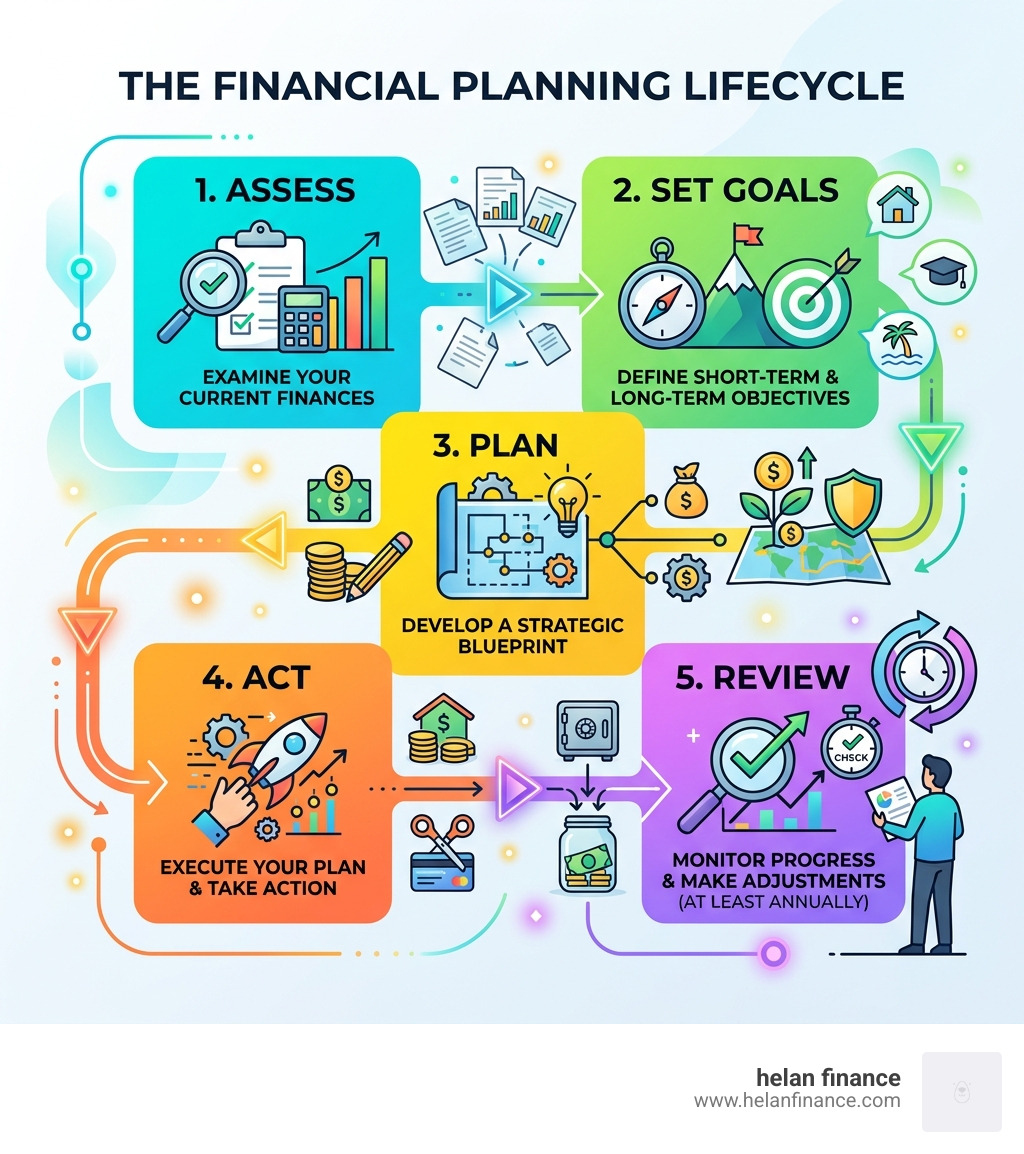
- Assess your current finances (income, debts, assets)
- Set goals — both short-term (1-3 years) and long-term (5+ years)
- Build a plan covering budgeting, saving, investing, and protection
- Take action — emergency fund, debt reduction, retirement contributions
- Review and adjust at least once a year
That’s financial planning in a nutshell. The rest of this guide shows you exactly how to do each step.
Here’s something striking: half of Americans don’t have a written financial plan — yet 76% of people say they wish they had created one sooner. And 66% report they lack real confidence in their ability to reach their long-term goals.
That gap between knowing you should plan and actually doing it? That’s exactly what this guide is designed to close.
Whether you’re juggling a busy career, scattered accounts, and too little time — or you simply don’t know where to start — financial planning doesn’t have to be complicated. It just needs to be yours.
What is Financial Planning and Why is it Essential?
At its core, Financial Planning is a comprehensive look at your entire financial picture. It’s a strategic roadmap that helps you manage and optimize your resources to secure your future. It’s not just about picking stocks or saving for a rainy day; it’s about aligning your money with your values and life stages.
Why is it essential? Because life is full of curveballs. Whether it’s a global pandemic, a sudden job change, or a joyous life event like a new baby, a plan provides the framework to navigate these moments without panic. Research shows that people with a written plan are significantly more confident. Yet, as of April 2026, the “76% regret” statistic remains a powerful reminder: most people wish they had started sooner.
By defining your financial planning process, you bridge the confidence gap. Instead of “making it up as you go,” you gain a clear understanding of your cash flow and net worth, transforming your relationship with money from one of stress to one of empowerment.
The Psychological Benefits of a Financial Plan
Money is one of the leading causes of stress, but a solid plan acts as a powerful antidote. Industry-wide research indicates that people with a plan are less likely to worry about staying on track (36% worry reduction compared to those without a plan).
The benefits extend far beyond your bank balance:
- Anxiety Reduction: Knowing you have an emergency fund and a retirement strategy allows you to sleep better at night.
- Relationship Health: Respondents with a plan are about 10% more likely to be satisfied with their personal relationships. When you and your partner are on the same page about spending and saving, friction decreases.
- Resilience: During the 2020 market crash, more than three-quarters of investors who were “on track” with their plans stayed the course, even at the market’s bottom. A plan prevents emotional decision-making when volatility strikes.
The 5 Key Areas of a Comprehensive Financial Plan

A holistic approach to financial planning means looking at more than just your savings account. We like to think of a plan as a house; you need a solid foundation before you can build the roof. According to the SEC’s Investor Bulletins, a comprehensive plan must cover several distinct but interconnected areas.
One of the most pressing topics today is the “Great Wealth Transfer.” An estimated $30 trillion to $70 trillion is expected to pass from baby boomers to their heirs over the coming decades. Without a plan, much of this wealth could be lost to taxes or mismanagement. This is why the demand for personal financial advisors is expected to grow by 13% through 2032—people realize they need expert guidance to navigate these complexities.
Advanced Types of Financial Planning
As your net worth grows, your plan should evolve to include specialized strategies:
- Tax Minimization: It’s not just about what you earn; it’s about what you keep. This involves using deductions, credits, and tax-advantaged accounts. For those with Restricted Stock Units (RSUs), understanding that they are taxed as ordinary income upon vesting is crucial for avoiding a surprise bill.
- Estate Planning: This isn’t just for the ultra-wealthy. It involves creating wills and trusts to ensure your wishes are followed and your heirs are protected.
- Education Funding: With the cost of tuition rising, 529 plans offer a tax-efficient way to save for a child’s (or grandchild’s) future.
- Philanthropy: Strategic giving allows you to support causes you care about while potentially reducing your tax liability through stock donations or donor-advised funds.
The Core Pillars of Investment Planning
Investment planning is the engine that drives your long-term goals. It’s built on several core pillars:
- Compound Returns: The earlier you start, the more time your money has to grow. Even small, consistent contributions can snowball into significant wealth.
- Risk Tolerance: Your plan must reflect your ability to stomach market swings. A 25-year-old can afford more risk than someone retiring in 2027.
- Asset Allocation: This is the process of spreading your investments across different categories like stocks, bonds, and cash to balance risk and reward.
- Tax-Advantaged Accounts: Maximize your 401(k) and IRA contributions. In 2026, the IRS limits have increased, allowing you to shield more of your wealth from immediate taxation.
How to Create Your Step-by-Step Financial Plan
Creating a plan can feel overwhelming, but we recommend breaking it down into manageable bites. You first need to decide whether to go the DIY route or hire a professional.
| Feature | DIY Financial Planning | Professional Financial Advisor |
|---|---|---|
| Cost | Low (software/app fees) | Higher (hourly or % of assets) |
| Complexity | Best for simple W-2 situations | Essential for complex taxes/estates |
| Objectivity | Hard to remain unemotional | Provides an unbiased third party |
| Time Investment | High (you do the research) | Low (advisor does the heavy lifting) |
Regardless of the path you choose, you must start by calculating your Net Worth (Assets minus Liabilities) and your Cash Flow (Income minus Expenses). Many people find success with the 50/30/20 rule: 50% of income to needs, 30% to wants, and 20% to savings and debt repayment. If you prefer more control, zero-based budgeting ensures every dollar has a “job” before the month begins. You can find many Free Financial Planning Tools online to help with these calculations.
Building Your Financial Planning Foundation
Before you start picking the next “hot stock,” you must “shockproof” your life.
- Emergency Funds: Aim for 3-6 months of essential living expenses held in a liquid, high-yield savings account. This is your safety net for medical emergencies or job loss.
- Debt Management: Prioritize high-interest debt, like credit cards. Using a “debt avalanche” (paying highest interest first) or “debt snowball” (paying smallest balance first) can help you gain momentum.
- Insurance Coverage: Protect your ability to earn an income. Disability insurance is often overlooked but is vital, as are life, health, and property insurance.
Monitoring and Adjusting Your Strategy for Long-Term Success

A financial plan is not a “set it and forget it” document. It is a living, breathing strategy that must evolve as you do. We recommend an annual checkup at a minimum. However, major life events—like a marriage, a career pivot, or the birth of a child—should trigger an immediate review.
Currently, only 38% of people track their progress toward specific goals, even though 83% track their account balances. Don’t fall into the trap of watching the “number” without knowing if that number is actually enough to fund your dream retirement. Use scenario modeling to ask “what if?” What if inflation stays high? What if I retire two years early? Recalibrating your “GPS for money” ensures you stay on the right path.
Frequently Asked Questions about Financial Planning
When is the best time to create a financial plan?
The best time was yesterday; the second best time is today. While major life milestones like getting married or starting a business are common catalysts, you don’t need a “reason” to start. Even if you are just starting your career, the power of compounding makes early planning incredibly lucrative.
How often should I monitor and adjust my financial plan?
At Helan Finance, we suggest a deep dive once a year. However, you should check your budget monthly and your investment performance quarterly. If you experience a “windfall” (like an inheritance) or a “shortfall” (like a job loss), adjust your plan immediately to reflect your new reality.
Should I hire a professional financial advisor or do it myself?
If your situation is straightforward (one source of income, no complex debt, and you enjoy spreadsheets), DIY might work for you. However, if you are navigating the “Great Wealth Transfer,” complex tax situations, or feel paralyzed by market volatility, a fee-only fiduciary advisor is well worth the investment.
Conclusion
At Helan Finance, we believe that financial planning shouldn’t feel like a chore. Our mission is to provide simplified tools that integrate into your daily life. By combining financial exercises with healthy routines and expert advice, we help you build a “wealth span” that matches your life expectancy.
Financial well-being is a form of self-care. When your money is in order, your stress levels drop, and your overall health improves.
Ready to take control? Here are your next steps:
- Calculate your net worth tonight using a simple spreadsheet.
- Set three concrete goals: one for this year, one for five years out, and one for retirement.
- Automate your savings so you pay yourself first before you have a chance to spend it.
- Check your insurance policies to ensure your “foundation” is secure.
Start your financial planning journey with us today and turn your financial dreams into a documented reality. Your future self will thank you.

