
How to Maintain Your Financial Health After Paying Off Debt
Why Debt Free Daily Habits Are the Real Secret to Lasting Financial Health
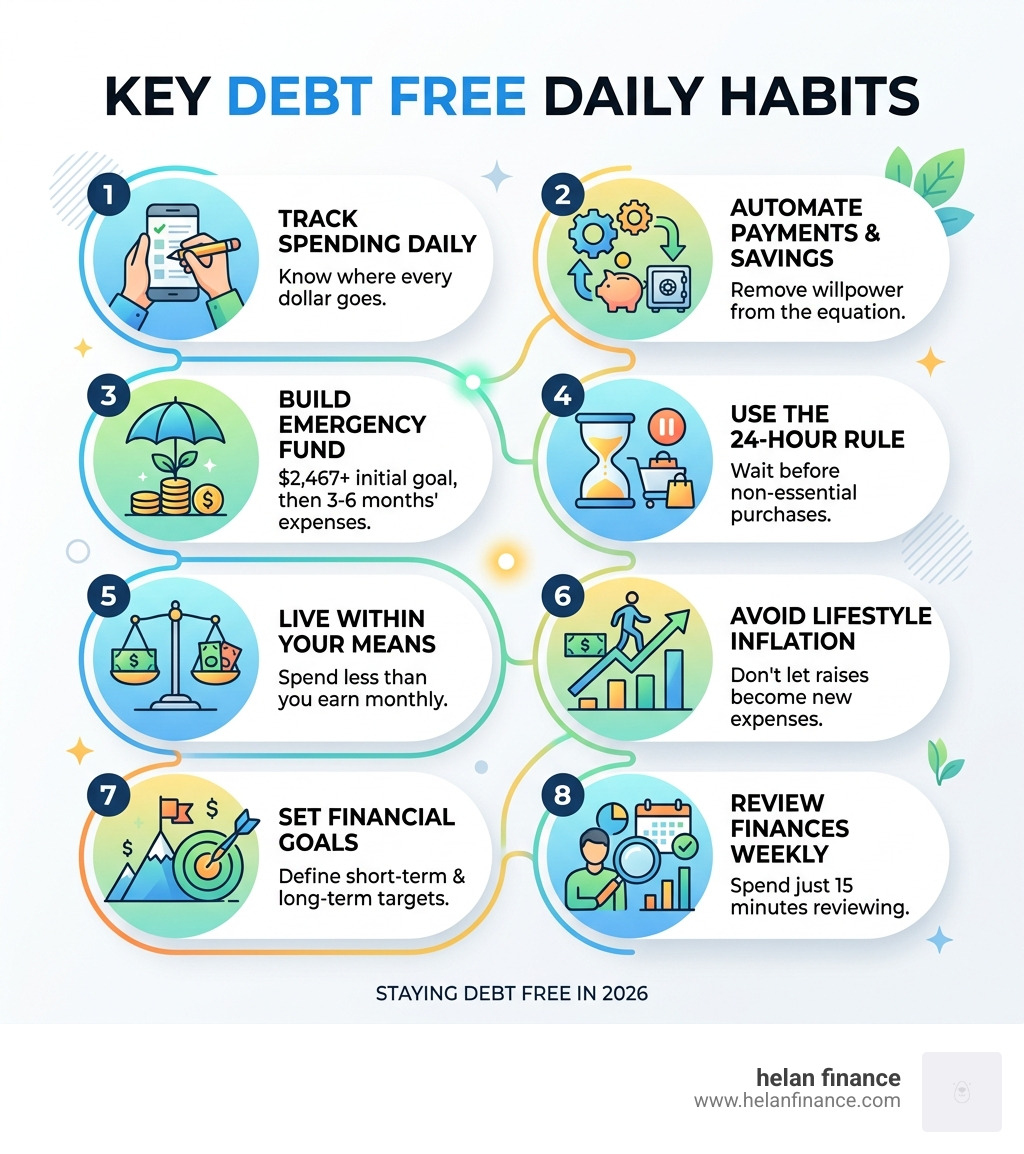
Debt free daily habits are the small, consistent actions that keep you out of debt long after you’ve paid it off. Here’s a quick overview of the most important ones:
- Track your spending daily — know where every dollar goes
- Automate bill payments and savings — remove willpower from the equation
- Build and protect an emergency fund — start with $2,467, aim for 3-6 months of expenses
- Use the 24-hour rule — wait before any non-essential purchase
- Live within your means — spend less than you earn, every single month
- Avoid lifestyle inflation — don’t let raises become new expenses
- Set clear financial goals — short-term and long-term
- Review your finances weekly — 15 minutes is enough
Paying off debt feels incredible. But here’s the hard truth: getting out of debt is only half the battle.
Less than 25% of Americans are currently debt-free. And many people who do pay off their balances find themselves right back in the same hole within a few years — not because they’re careless, but because they never built the daily habits to protect their progress.
It’s not about earning more or being perfect with money. It’s about small, repeatable actions that quietly compound over time.
Think of it like this: the same discipline that got you out of debt is what keeps you out. The difference is that now, instead of paying down a balance, you’re building something — wealth, stability, and real peace of mind.
This guide walks you through the exact habits that debt-free people practice every day, so you can make them part of your routine too.
The Psychology of Financial Freedom
Achieving a debt-free life in April 2026 isn’t just about math; it is a mind game. We often think that once the balance hits zero, the stress disappears. However, without a shift in how we view money, we are prone to “lifestyle inflation”—the phenomenon where our spending rises to match our income.

To stay debt-free, we must master delayed gratification. This is best illustrated by the famous Stanford Marshmallow Experiment, which found that those who could wait for a second marshmallow (a greater future reward) tended to have better life outcomes. This means choosing a secure retirement or a paid-off home over a flashy new gadget today. Learn the 5 Best Financial Habits From Debt-free People shows that thinking long-term is the hallmark of those who stay free from the credit cycle.
Mindset Shifts for 2026
As we navigate the current economic landscape, certain mindset shifts are non-negotiable:
- Gratitude Practice: We find that the secret to “having it all” is realizing we already do. Contentment is the ultimate shield against the urge to spend.
- De-influencing: We are constantly bombarded by social media ads designed to make us feel inadequate. Debt-free people actively “de-influence” themselves by unfollowing accounts that trigger envy.
- Value-Based Spending: We stop asking “Can I afford the monthly payment?” and start asking “Does this purchase align with my long-term vision?”
Daily Tracking and Debt Free Daily Habits
You cannot manage what you do not measure. Debt-free individuals don’t guess; they know. According to 10 Habits of Debt-Free People You Can Start Now – Prosper, tracking every cent is the foundation of financial health.
We recommend a daily 10-minute check-in. Look at yesterday’s transactions, update your net worth, and categorize your expenses. This transparency isn’t about restriction; it’s about awareness. When 3 in 5 Americans carry a credit card balance averaging $5,875, knowing your numbers is your best defense against becoming a statistic.
Master Your Debt Free Daily Habits Through Automation
Willpower is a finite resource. If we have to decide to save money every single day, eventually, we will fail. That’s why we use automation to “remove the human” from the equation.

By setting up autopay for bills and automatic transfers to savings, we reduce “financial friction.” This means the money is gone before we even have a chance to spend it. As noted in Tips For Living Debt Free: A Practical Step-by-Step Plan, building these systems is what separates those who “try” to be debt-free from those who actually are.
Setting Up Financial Guardrails
To protect our progress, we need boundaries. We suggest a two-account system: one for fixed essentials (rent, utilities) and one for flexible life spending. This prevents “accidental” overspending on groceries from eating into the mortgage money.
We also need to audit our subscriptions. Most Americans underestimate their monthly subscription spending by over $100. Quarterly audits help us prune the “vampire” expenses that bleed our accounts dry. Furthermore, transparency is key—42% of people in relationships have hidden a financial secret. We believe in total “money dates” with partners to ensure everyone is pulling in the same direction.
Social Circles and Debt Free Daily Habits
The people we surround ourselves with have a massive impact on our bank accounts. If your friends’ idea of fun is $200 brunches every weekend, staying debt-free will be an uphill battle.
We encourage finding a community that values frugal hobbies—think hiking, potlucks, or board game nights. Having an accountability partner or a supportive peer group makes it easier to say “no” to expensive invitations without feeling like you’re missing out.
Strategic Spending and Impulse Control
Impulse purchases are the “death by a thousand cuts” for any budget. To combat this, we swear by the 24-hour rule: if you want something non-essential, you must wait 24 hours before buying it. Often, the “need” vanishes by the next morning.
Cutting Expenses Without Sacrifice
Living a debt-free lifestyle doesn’t mean living a miserable one. It means being strategic. We focus on the “Big Three” expenses: housing, transportation, and food.
- Housing: 27.4% of homeowners are “house poor,” spending over 30% of their income on housing. We look for ways to lower this, whether through downsizing or renegotiating insurance.
- Transportation: With the average new car payment hitting $726, we opt for reliable used cars and avoid the trap of perpetual auto loans.
- Food: The average American spends $2,375 on takeout annually. We prioritize meal planning and store-brand alternatives.
| Item Type | Name Brand Cost (Avg) | Store Brand Cost (Avg) | Annual Savings (Est) |
|---|---|---|---|
| Groceries | $150 / week | $90 / week | $3,120 |
| Cleaning Supplies | $20 / month | $12 / month | $96 |
| Over-the-counter Meds | $15 / bottle | $6 / bottle | $108 |
By switching to store brands, we can save up to 40% on our grocery bills without a noticeable dip in quality.
Handling Financial Windfalls
How we handle “extra” money—like tax refunds or work bonuses—is a major indicator of future wealth. Instead of immediately spending a windfall, we use the 70/20/10 rule:
- 70% goes toward long-term wealth (investments or principal reduction on a mortgage).
- 20% goes to our “sinking funds” or emergency savings.
- 10% is for a responsible self-reward.
This allows us to enjoy our success while still fueling our financial engine.
Frequently Asked Questions about Debt-Free Living
How do I handle unexpected windfalls?
When you receive a bonus or a tax refund, it’s tempting to treat yourself. We recommend a “debt-free sprint” if you still have any small balances, or immediately moving 80% of that money into a high-yield savings account. Use the remaining 20% for something you’ve been wanting—this keeps you motivated without derailing your plan.
Is an emergency fund really necessary?
Absolutely. Economists have found that $2,467 is the “magic number” that covers the most common household emergencies. Yet, 27% of Americans have no emergency savings at all. Without this buffer, one flat tire or medical bill will send you right back into credit card debt. We aim for 3-6 months of essential expenses tucked away in a high-yield account.
How can I cut expenses without losing quality of life?
Start with a subscription audit. Are you really watching all four streaming services? Next, try meal planning. Most food waste (and extra cost) comes from not having a plan for the ingredients we buy. Finally, look at energy efficiency—small changes in home habits can shave 10-15% off utility bills.
Conclusion
Maintaining your financial health after paying off debt is about more than just numbers—it’s about the debt free daily habits that define your lifestyle. At Helan Finance, we believe that financial peace is achievable for everyone through simplified planning and consistent routines.
By automating your systems, guarding your mindset, and controlling your impulses, you aren’t just avoiding debt; you’re buying your future freedom.
Ready to take the next step in your journey? Explore our simplified tools and routines to keep your financial health in peak condition. Start your journey to lasting financial health today.

