
Mastering the Art of the Savings Withdrawal
How Long Will Your Savings Actually Last?
A savings withdrawal calculator is a simple tool that shows you how long your savings will last when you take regular withdrawals — or tells you the maximum amount you can safely withdraw each period to hit a target timeline.
Here’s what it can answer for you right now:
| Question | What You Need to Input |
|---|---|
| How long will my savings last? | Starting balance, withdrawal amount, interest rate |
| How much can I withdraw each month? | Starting balance, desired duration, interest rate |
| What balance will remain after X years? | Starting balance, withdrawal amount, duration, interest rate |
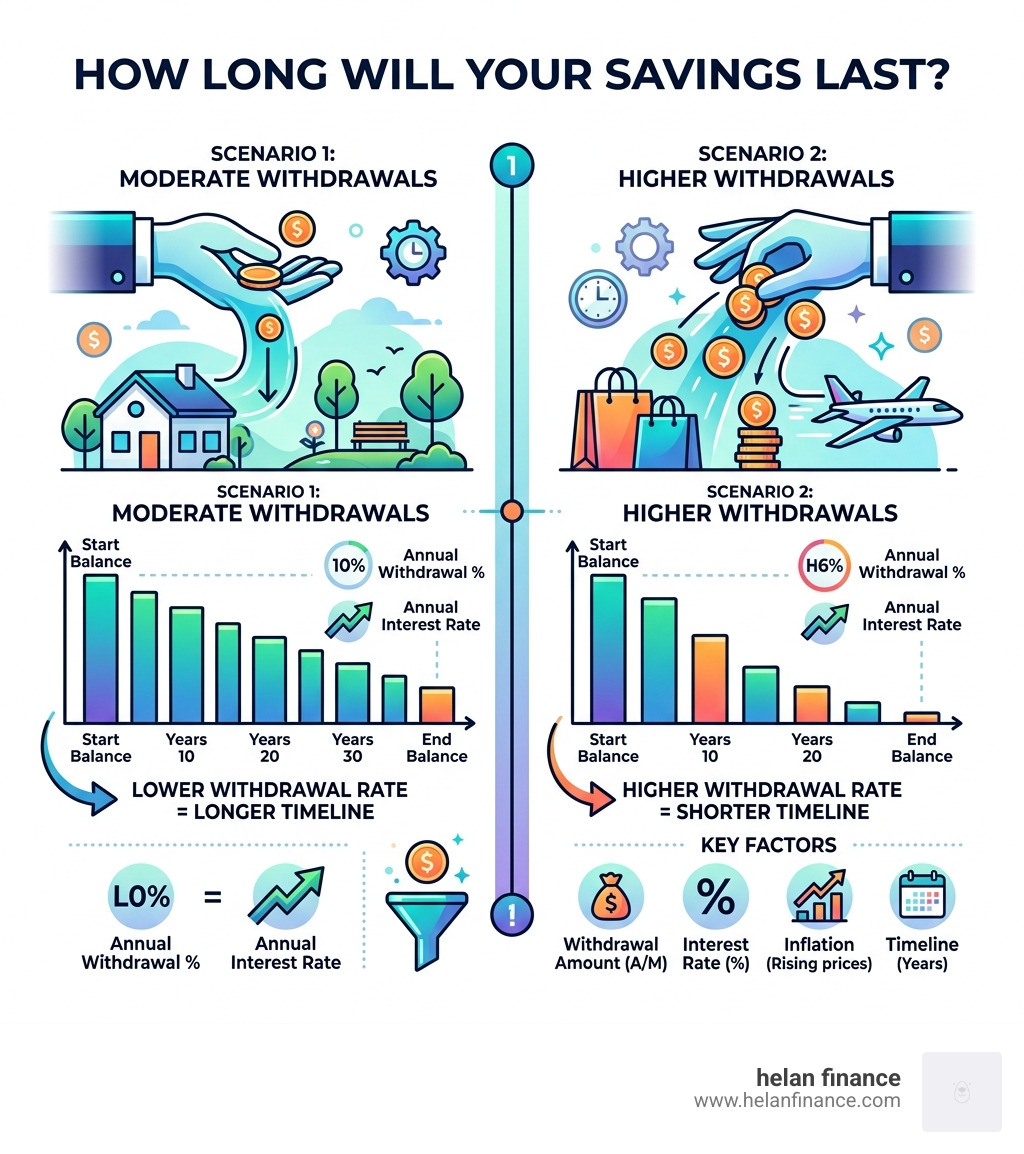
Quick example: $1,000,000 saved at 6% annual interest lasts roughly 30 years at $6,000/month — but drop to $6,500/month and that shrinks to about 24.5 years. Small changes in withdrawal amounts make a big difference.
You’ve worked hard to build your savings. But knowing when to tap into them — and how much to take — is just as important as saving in the first place.
Most people guess. They pick a number that feels right and hope it works out. That’s a risky strategy when your financial security is on the line.
The good news? You don’t need to guess. A savings withdrawal calculator takes the uncertainty out of the equation and gives you a clear picture of where you stand — in minutes, not hours.
Whether you’re planning for retirement, thinking about an early exit from the workforce, or just want to know your financial runway, this guide walks you through everything you need to know.
Mastering Your Finances with a Savings Withdrawal Calculator
At its core, the primary purpose of a savings withdrawal calculator is to help us visualize the “capital depletion” of our assets. In plain English, that means seeing how our money disappears over time as we spend it. While that sounds a bit grim, it is actually the ultimate tool for financial empowerment. By knowing the end date of our funds, we can adjust our lifestyle today to protect our future.

To get the most accurate results, we need to understand the “Big Four” inputs:
- Starting Amount: This is your current nest egg or the balance you expect to have when you start withdrawals.
- Periodic Withdrawal: How much you plan to take out (monthly, quarterly, or annually).
- Rate of Return: The annual interest or investment growth you expect to earn.
- Interest Compounding: How often the bank adds interest to your balance (daily, monthly, or yearly).
If you are looking for a streamlined way to run these numbers, the Helan Finance Savings Distribution Tool is designed to simplify these complex calculations into actionable insights.
How to Use a Savings Withdrawal Calculator for Retirement
Retirement planning is the most common reason people use these tools. We often think of retirement as a single number—the “nest egg”—but the reality is that retirement is about income.
When we use a savings withdrawal calculator for retirement, we are essentially solving for one of two things:
- Duration: “I want to spend $5,000 a month. How many years will my $800,000 last?”
- Amount: “I need my money to last exactly 30 years. How much can I take out each month without hitting zero?”
For example, research shows that with $500,000 in initial savings earning 6% interest, a monthly withdrawal of $6,500 will last approximately 8 years and 2 months. If you need that money to last 20 years, you’ll quickly see that $6,500 is far too high and needs to be adjusted.
Determining Your Safe Withdrawal Amount
A popular benchmark in the financial world is the “4% Rule.” This suggests that if you withdraw 4% of your initial balance in the first year of retirement (and adjust that amount for inflation every year after), your money has a high probability of lasting 30 years.
However, a savings withdrawal calculator allows us to be much more precise than a general rule of thumb. We can factor in our specific interest rates and remaining balance goals. Some of us don’t want to hit zero; we might want to leave a legacy for our children. In that case, we use the calculator to ensure the “ending balance” stays above a certain threshold.
Critical Factors Affecting Your Savings Longevity
It would be wonderful if we lived in a vacuum, but real-world factors like inflation and bank regulations constantly tug at our purse strings.

The Impact of Interest Rates and Compounding
Where you keep your money matters just as much as how much you save. The difference between a traditional savings account and a high-yield option is staggering over a long period.
| Account Type | Average APY (Annual Percentage Yield) |
|---|---|
| Traditional Savings | 0.25% |
| High-Yield Savings | Up to 2.25% |
| Certificates of Deposit (CDs) | Up to 3.7% |
As of April 2026, high-yield accounts and CDs are essential for making your money last. Higher interest earnings significantly extend your savings’ longevity because the “interest on interest” (compounding) helps replenish some of what you withdraw. If your withdrawals are frequent, choosing an account with daily compounding can provide a slight edge over annual compounding.
Navigating Regulation D and Withdrawal Limits
While we think of the money in our savings as “ours,” the Federal Reserve has historically had a say in how we access it. Under Regulation D, there has typically been a federally enacted limit of six withdrawals per month from savings accounts.
While some banks have become more flexible recently, exceeding these limits can still result in:
- Excessive withdrawal fees.
- The bank converting your savings account into a checking account.
- Account closure in extreme cases.
To stay safe, we recommend making larger, less frequent withdrawals or transferring money to a linked checking account via an ATM or in person, as these methods often don’t count toward the limit. Additionally, your savings are federally insured up to $250,000, providing a safety net in the rare event of bank bankruptcy.
Strategic Retirement Planning and Market Realities
If your savings are invested in the market rather than a simple bank account, the math gets a bit “spicier.”
Historical Market Performance and Your Nest Egg
When we input a “rate of return” into a savings withdrawal calculator, we often look at the S&P 500® for guidance. History shows us a wild ride:
- The 10-year average: For the decade ending December 31st, 2025, the annual compounded rate of return was a whopping 14.8%.
- The long-term average: From 1970 through 2025, the average was approximately 11.3%.
- The extremes: Since 1970, the market has swung from a +61% high in a single year (1982-83) to a -43% low during the 2008-09 financial crisis.
This volatility introduces “sequence of returns risk.” If the market crashes right when you start taking withdrawals, your savings will deplete much faster than the calculator predicts. This is why we advocate for Helan Finance Savings Income Planning to help build “buffers” into your strategy.
Understanding the Limitations of a Savings Withdrawal Calculator
As helpful as these tools are, they are not crystal balls. Most calculators work on “linear” assumptions—they assume you earn the same interest rate and withdraw the same amount every single month.
In real life:
- Taxes: Most calculators don’t automatically deduct the IRS’s cut (more on this below).
- Social Security/Pensions: These are external income sources that reduce the amount you need to withdraw from savings.
- Unexpected Expenses: A roof leak or medical bill doesn’t care about your “monthly withdrawal” plan.
Maximizing Your Nest Egg: Strategies for Success
How do we make the money last longer? It’s about more than just spending less.
Strategies to Make Your Savings Last Longer
One of our favorite techniques is the CD Ladder. Instead of keeping all your money in a low-interest account, you split it into several Certificates of Deposit with different maturity dates (e.g., 6 months, 12 months, 24 months). This allows you to capture higher interest rates (up to 3.7%) while still having “rungs” of the ladder become available for withdrawal regularly.
Other strategies include:
- Dynamic Withdrawals: Taking less money out during years when the market is down.
- Inflation-Adjusted Increases: Only increasing your withdrawal amount by 2-3% a year to match the cost of living, rather than taking large jumps.
- Credit Unions: These member-owned institutions often offer better interest rates than big-name banks.
Managing Taxes on Savings Interest
Don’t forget that the IRS views interest as income. If you earn more than $10 in interest in a year, your bank will send you a 1099-INT form.
Even if you don’t receive a form, you are legally required to report that interest. Depending on your marginal tax bracket (which can range from 0% to 37% or higher for top earners), a significant chunk of your “earnings” might actually go to taxes. When using a savings withdrawal calculator, it is often wise to use a “net” interest rate (your expected rate minus your tax rate) for a more realistic projection.
Frequently Asked Questions About Savings Withdrawals
What is the primary purpose of a savings withdrawal calculator?
The primary purpose is longevity estimation. It helps you determine if your current spending habits are sustainable or if you are at risk of running out of money. It’s a reality check for your financial goals.
How does inflation impact my withdrawal strategy?
Inflation erodes your purchasing power. If $4,000 a month pays your bills in 2026, that same $4,000 might only buy $3,000 worth of goods in 2036. To stay ahead, you must either earn a higher interest rate or plan for your withdrawal amounts to increase annually.
Are there penalties for withdrawing too often from savings?
Yes, due to Regulation D, many banks charge a fee (often $10–$25) for every withdrawal beyond the sixth one in a month. If you do this repeatedly, they may close the account. Always check your specific bank’s policy, as some have waived these fees since the pandemic.
Conclusion
Mastering the art of the savings withdrawal is about moving from “hope” to “certainty.” By using a savings withdrawal calculator, you can see the future of your finances today and make the necessary tweaks to ensure you never run out of runway.
At Helan Finance, we believe that financial planning shouldn’t feel like a chore. Our simplified tools, routines, and advice are designed to fit into your life, not take it over. Whether you’re just starting to save or you’re ready to start spending, we’re here to help you navigate every step.
Start your financial journey with Helan Finance and take the guesswork out of your future today.
External Resources for Further Planning:
- Savings Distribution Calculator
- Savings Income Calculator – Bankrate
- How long will my money last with systematic withdrawals? – CalcXML

