
Master Your Morning with These Daily Money Habits
Why Daily Money Habits Are the Real Secret to Building Wealth
Daily money habits are small, consistent actions you take every day to manage, save, and grow your money — and they matter far more than any single big financial decision you’ll ever make.
Here are the most effective daily money habits to start today:
- Do a 60-second morning money check-in — glance at your balance and upcoming bills
- Pause before non-essential purchases — use a 24-hour rule for anything over $50
- Track your top two spending categories — food/drinks and discretionary “extras”
- Automate one savings or bill payment — remove the decision entirely
- Set a daily spending limit — divide your monthly discretionary budget by 30
- End the day with one small win — note one good financial choice you made
Most people assume building wealth requires a high salary, a lucky break, or hours spent on complex spreadsheets. It doesn’t.
The research is clear: financial success depends far more on behavior patterns than on income level. Small choices, repeated daily, compound into real results over time — just like interest in a savings account.
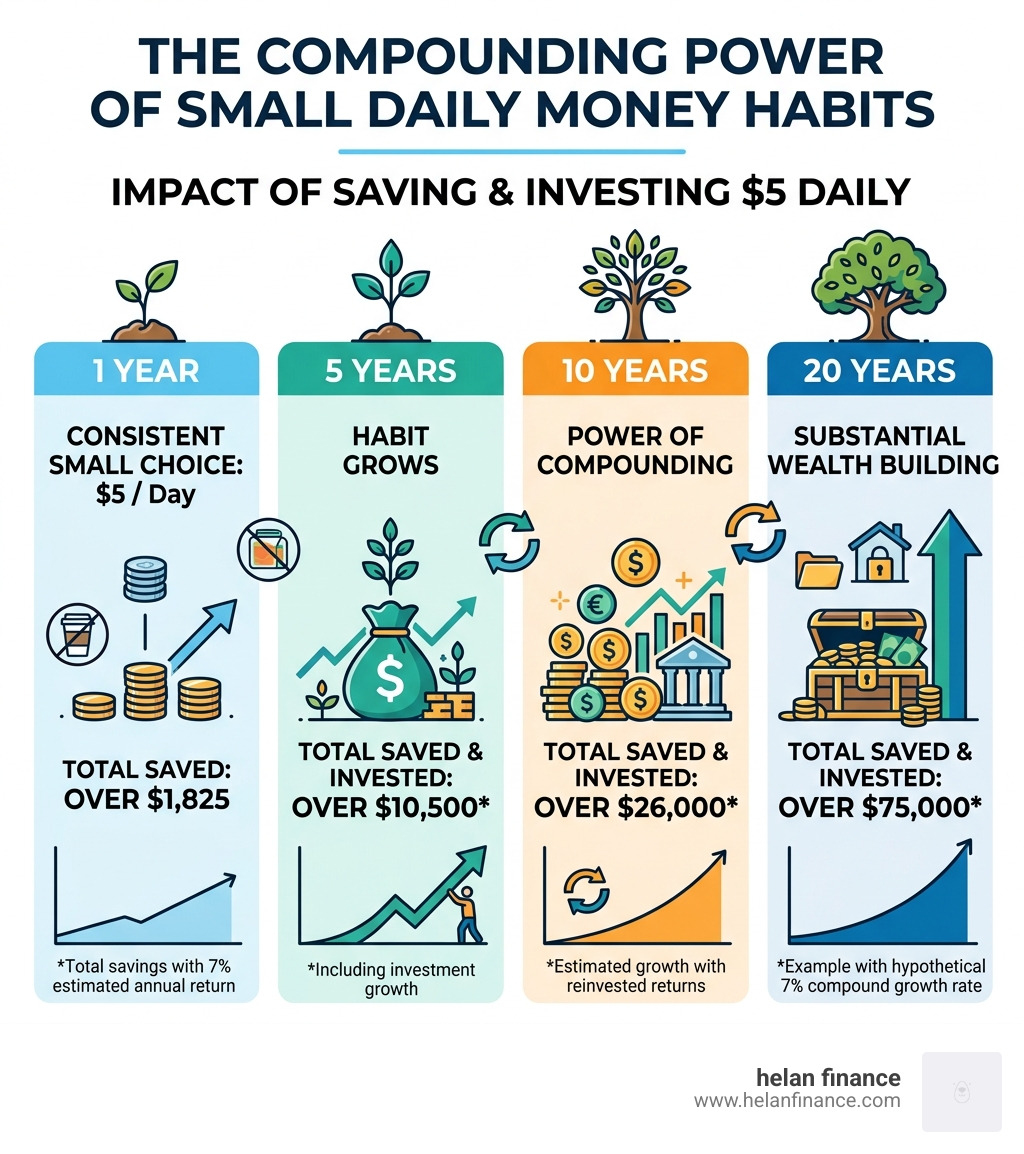
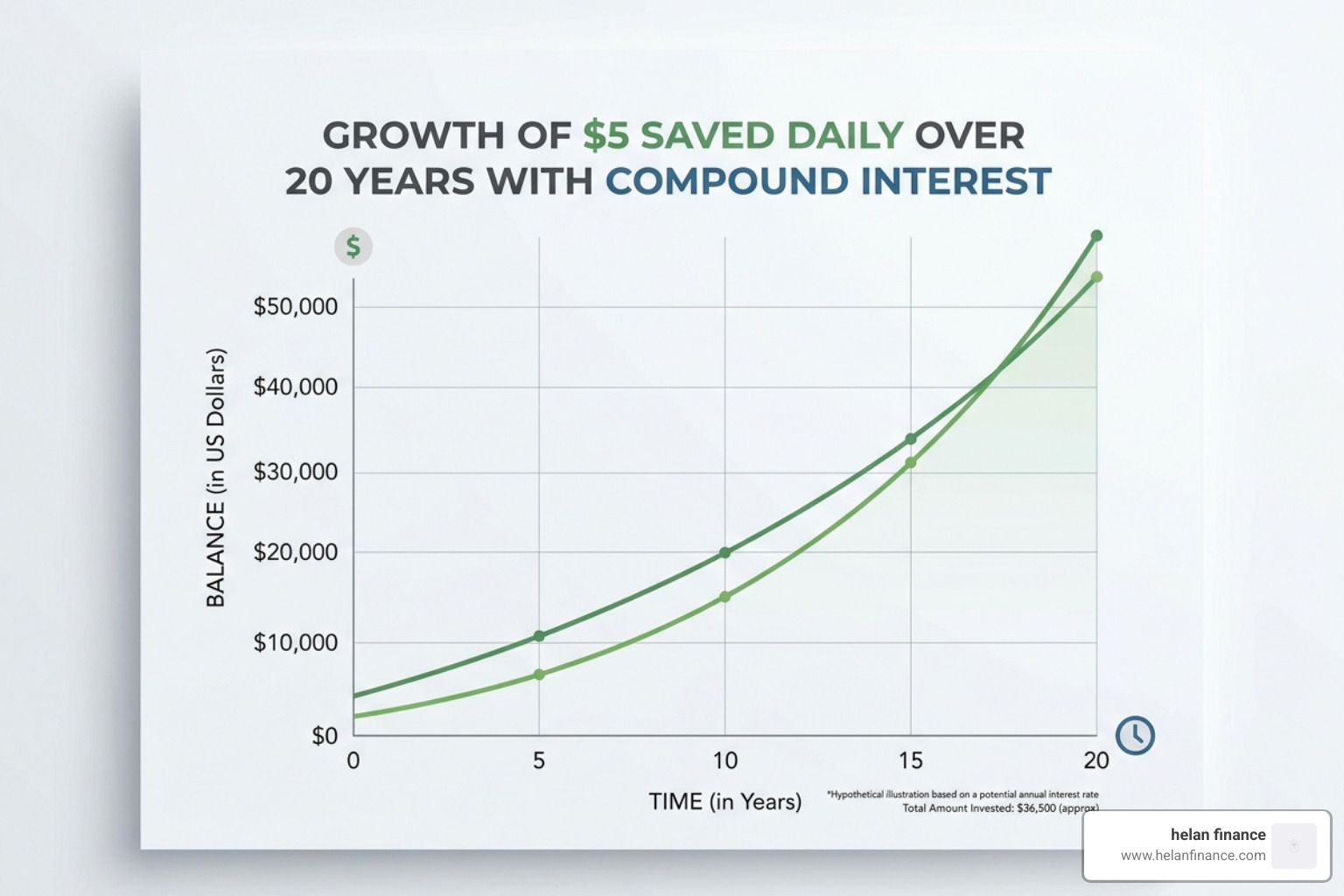
Think about it this way. A $5 daily habit — skipping a bought coffee, packing lunch, avoiding a vending machine run — adds up to $150 a month, nearly $1,825 a year, and over $50,000 in 20 years when invested. That’s not a theory. That’s arithmetic.
The problem for most busy people isn’t knowledge. It’s consistency. Around 1 in 4 people don’t budget at all, and among those who do, 84% admit to breaking it regularly. The habits just don’t stick.
That’s exactly what this guide is for. You’ll learn how to build a simple daily money routine that takes 5 to 15 minutes, fits into your existing schedule, and actually compounds into lasting financial stability — without feeling deprived or overwhelmed.
The Science of Small Wins: Why Daily Routines Build Wealth
At Helan Finance, we often say that financial literacy is like physical fitness. You don’t get fit by going to the gym once for ten hours; you get fit by showing up for thirty minutes every day. Wealth building works the same way through behavioral compounding. While financial compounding grows your balance, behavioral compounding makes good decisions easier and more frequent until they become your “default setting.”
The magic happens within the habit loop: a cue (like your morning coffee), a routine (checking your bank balance), and a reward (the peace of mind knowing exactly where you stand). Research suggests that 8 healthy financial habits are more likely to stick when practiced as daily rituals. Studies show it takes anywhere from 30 to 90 days for a new behavior to become automatic. By the time you reach that 90-day mark, you aren’t “trying” to save money anymore; you are simply a person who manages money well.
Psychologically, this is rooted in financial mindfulness. This concept involves two pillars: awareness (knowing your numbers) and acceptance (looking at those numbers without judgment). When we practice “decision literacy,” we stop making choices based on fleeting emotions or marketing pressure. Instead, we create a system that reduces friction for good moves and increases friction for bad ones.
Shifting Your Wealth Identity
To make daily money habits permanent, we need to move beyond “wanting to save” and toward a “Wealth Builder” persona. When you view yourself as a Wealth Builder, your daily actions align with your identity.
Instead of relying on unreliable willpower, you use identity-based habits. You don’t “deprive” yourself of a purchase; you choose to prioritize your future freedom. This shift helps master delayed gratification. By introducing a little “psychological friction”—like removing saved credit card info from shopping apps—you give yourself the space to practice value-based spending. You start asking: “Does this purchase move me toward my goals or away from them?”
5 Essential Daily Money Habits to Build Wealth
Building wealth doesn’t have to be a full-time job. By focusing on a few high-impact daily habits that help you build wealth, you can put your financial progress on autopilot.
- The 60-Second Money Check-In: Every morning, open your banking app. Check your balance and scan for any unauthorized charges. This keeps your “financial radar” active and prevents the anxiety of the unknown.
- The 24-Hour Cooling-Off Rule: For any non-essential purchase over $50, wait one full day before hitting “buy.” This simple delay kills impulse spending, which is often cited as the silent killer of budgets.
- Automate the Essentials: Set up recurring transfers for your savings, retirement accounts, and bill payments. If the money moves before you can spend it, you’ve removed the need for daily discipline.
- Micro-Debt Payments: If you’re carrying high-interest debt, try making tiny daily payments. Even $5 or $10 extra a day reduces the principal faster and keeps you motivated to see the balance drop.
- Build Your Daily Buffer: Treat your emergency fund like a non-negotiable bill. Even transferring $2 a day into a separate “buffer” account creates a safety net that protects you from life’s unexpected turns.

Implementing Daily Money Habits Without Overwhelm
The biggest mistake people make is trying to change everything at once. We recommend habit stacking. This means attaching a new money habit to an existing routine. For example, check your bank balance while your coffee brews, or log your daily spending while you wait for your dinner to cook.
Start with “minimum version” rules. On a busy day, a 60-second check-in is better than skipping your routine entirely. As you look for small money habits to pick up, consistency beats intensity every time.
Tracking Spending as a Daily Money Habit
Tracking every single cent can be exhausting, which is why most people quit. Instead, focus on leak detection. Identify your “problem areas”—usually food, drinks, or “extras”—and track only those.
Did you know Americans spend an average of over $200 a year on subscriptions they don’t even use? A daily scan of your transactions helps you spot these “leaks” before they drain your accounts.
| Feature | Daily Money Tracking | Monthly Traditional Budgeting |
|---|---|---|
| Effort | Low (1-2 mins/day) | High (1-2 hours/month) |
| Awareness | Real-time | Delayed/Retrospective |
| Flexibility | Adjusts instantly | Rigid until next month |
| Goal | Behavioral change | Numerical balancing |
Real-World Impact: The Power of the $5-a-Day Rule
The $5-a-day rule is the ultimate proof that daily money habits work. Small, seemingly insignificant choices are the bricks that build your financial fortress.
When you swap a $5 specialty coffee for a home-brewed cup or pack a lunch instead of ordering delivery, you aren’t just saving a few bucks. You are reclaiming your opportunity cost. If you earn $20 an hour, a $60 impulse buy isn’t just $60—it’s three hours of your life you can never get back. Using an “hourly earnings mindset” helps you decide if a purchase is truly worth the effort it took to earn the money.
- Meal Planning: Spending 10 minutes each evening planning tomorrow’s meals prevents the “emergency” takeout order that costs $30.
- Generic Brand Swaps: Switching to store brands for staples like cleaning supplies or pantry items can cut your grocery bill by 20-40%.
- Hydration Savings: Carrying a reusable water bottle can save you $200 a month if you typically buy bottled drinks on the go.
Customizing Habits for Every Income Level
These habits aren’t just for those with high incomes. In fact, they are more vital when money is tight because the margin for error is smaller.
- Low-Income Stability: Focus on avoiding fees and “leaks.” A $35 overdraft fee is a massive blow on a tight budget, but a daily balance check prevents it.
- Irregular Income: If your paycheck fluctuates, use a “percentage-based” daily habit. Instead of a fixed dollar amount, save 10% of whatever “found money” (tips, bonuses, tax refunds) comes in that day.
- Income Growth: Dedicate 10-20 minutes a day to skill development. Wealth building isn’t just about saving; it’s about increasing your earning power over time.
Common Pitfalls and How to Maintain Consistency
Even the best routines face challenges. Emotional spending is perhaps the biggest hurdle. When we are stressed, tired, or bored, we often use shopping as a quick hit of dopamine. To combat this, we suggest a “Money Pause.” Before you buy, ask: “Am I hungry, tired, or just bored?” Usually, a 10-minute walk or a glass of water can kill the urge to spend.
Another pitfall is subscription creep. Those $9.99 charges feel invisible until you realize you have twelve of them. Regularly audit your digital environment. Unsubscribe from marketing emails that tempt you with “limited-time” offers and remove your saved credit card details from browsers to add a layer of friction.
Security is also a daily habit. With over 2 in 5 Americans reporting losses to scams, protecting your accounts is non-negotiable. Use a password manager, enable multifactor authentication (MFA), and never use the same password twice.
Avoiding the Frugality Trap
There is a difference between being intentional and being miserly. False economies occur when you skip an essential car repair to save $100, only to have the engine fail a month later, costing $3,000.
Balanced financial health means knowing when to spend. This is especially true in retirement. Some people develop such a strong habit of saving that they struggle to enjoy their nest egg, a phenomenon known as “underspending.” Similarly, avoid “portfolio helicopter parenting.” Checking your investments daily during market volatility often leads to emotional panic-selling. Real wealth builders check their allocations every few months, not every few minutes.
Frequently Asked Questions about Daily Money Habits
How much time should these habits take each day?
A solid daily money routine should take no more than 5 to 15 minutes.
- Morning (2 mins): Check balances and upcoming bills.
- Daytime (1 min): Use the “Pause Rule” before buying non-essentials.
- Evening (7 mins): Log top-category spending and plan tomorrow’s food. Consistency is much more important than the amount of time spent.
What are the best tools for simplifying daily tracking?
We recommend leveraging technology to do the heavy lifting.
- Banking Alerts: Set notifications for low balances or large transactions.
- Round-up Apps: These automatically save the “spare change” from every purchase.
- Password Managers: Essential for security and preventing fraud.
- Helan Finance Tools: Our simplified exercises and routines are designed to make these habits feel like second nature.
How do I stay consistent during busy periods or setbacks?
Use the “never miss twice” rule. If you have a bad day and overspend, don’t throw away the whole week. Forgive yourself and return to your 60-second check-in the next morning. On your busiest days, stick to the “minimum version” of your habits. One minute of awareness is infinitely better than zero.
Conclusion
Mastering your daily money habits is the most direct path to financial peace. By shifting your identity to that of a Wealth Builder and implementing small, repeatable actions, you turn the complex world of finance into a simple, manageable routine.
At Helan Finance, we believe that everyone deserves a future where they have more choice, more security, and more freedom. It all starts with what you do tomorrow morning. Are you ready to take control?
Start your journey with Helan Finance today and turn these small daily wins into a lifetime of wealth.

