
How to Find the Motivation to Finally Kill Your Debt
Why So Many People Struggle to Stay Motivated While Paying Off Debt
Debt free motivation advice is one of the most searched personal finance topics — and for good reason. Paying off debt is simple in theory, but brutally hard in practice.
Here are the most effective ways to stay motivated while paying off debt:
- Use the debt snowball method — pay your smallest balance first to build momentum fast
- Track your progress visually — a debt thermometer or chart makes abstract numbers feel real
- Find your “why” — write down your top reasons for becoming debt-free and review them daily
- Set milestone rewards — small, budgeted treats keep you going without derailing your progress
- Get an accountability partner — someone who checks in on your progress dramatically improves follow-through
- Build a starter emergency fund first — even $500–$1,000 prevents you from sliding back into debt when life happens
Debt is heavy. And not just financially.
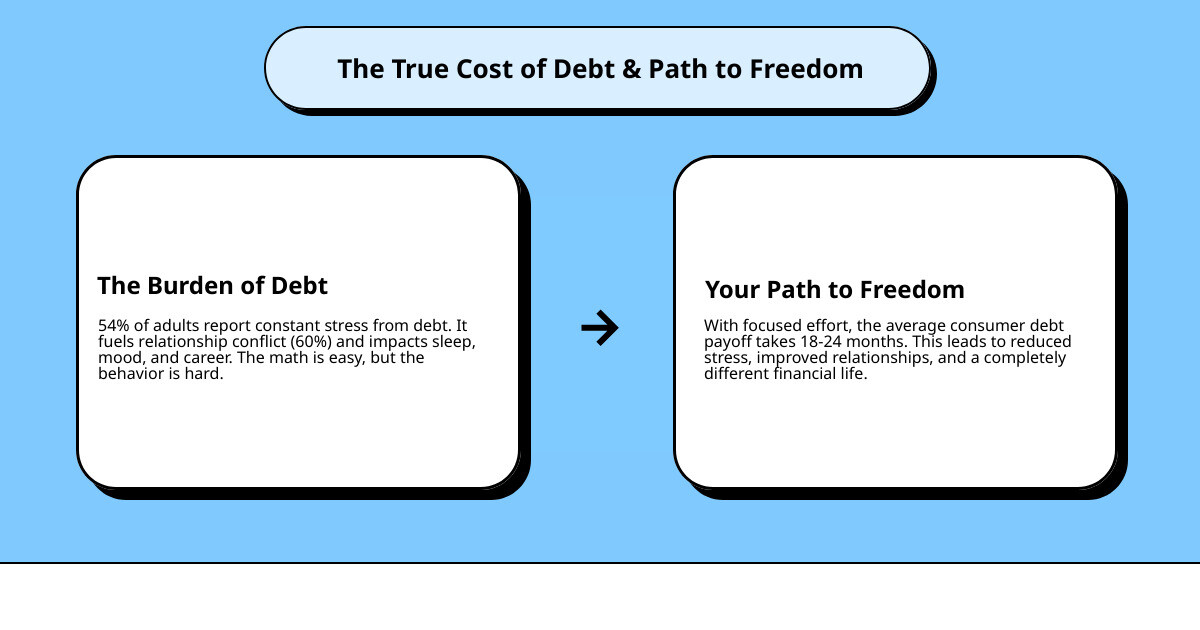
As of April 2026, 54% of adults say they feel stressed by their debt constantly or often. Another 32% say it stresses them out at least sometimes. That’s almost everyone carrying some kind of financial weight.
It gets worse. That stress doesn’t stay private — 60% of people say financial pressure has caused conflict in their relationships. Debt touches everything: your sleep, your mood, your career choices, and the people you love most.
The good news? The average person who attacks their debt with real focus pays off all their consumer debt — everything except their mortgage — in about 18 to 24 months. That’s not years of grinding misery. That’s less than two years to a completely different financial life.
But here’s the catch: most people don’t fail because they lack a good strategy. They fail because motivation fades before the finish line arrives. The math is easy. The behavior is hard.
This guide brings together expert-backed advice to help you stay focused, build momentum, and actually finish what you start.
The Psychology of Momentum: Why the Debt Snowball Works

When we talk about debt free motivation advice, we have to start with the “Snowball.” You might have heard people argue about whether you should pay off the highest interest rate first (the Avalanche) or the smallest balance first (the Snowball). While the Avalanche makes sense on a calculator, the Snowball wins in the real world because of how our brains work.
The Power of Quick Wins
The debt snowball method is a strategy where you list your debts from smallest balance to largest. You ignore interest rates for a moment and focus entirely on the balance. You pay the minimum on everything except that tiny $300 medical bill or $500 credit card. You attack that one with everything you’ve got.
When that first debt disappears, your brain gets a hit of dopamine. That “quick win” proves to you that you can do this. It’s psychological fuel. Once that first debt is gone, you take the money you were paying on it and roll it into the next smallest debt. Like a snowball rolling down a hill, your payments get bigger and your momentum becomes unstoppable.
Why Math Matters Less Than Behavior
Personal finance is 20% head knowledge and 80% behavior. If we were all great at math, we wouldn’t have gotten into debt in the first place! Motivation is the deciding factor between those who cross the finish line and those who quit at the halfway mark.
By focusing on behavior over math, we prioritize habit formation. Seeing a debt balance hit zero is more motivating than seeing an interest rate drop by 2%. We need to feel like we are winning to stay in the game. For more on how to structure your journey, check out our Understanding Debt Repayment Strategies – Helan Finance Resources.
Practical Debt Free Motivation Advice for 2026

In 2026, with the cost of living still a major topic of conversation, staying motivated requires more than just a “good attitude.” You need systems that make your progress visible.
Using Visual Progress as Debt Free Motivation Advice
One of the biggest motivation killers is the feeling that your money is disappearing into a black hole. When you send $500 to a credit card company, you don’t “see” anything change in your physical world. That’s why visual tracking is essential.
- The Debt Thermometer: Draw a thermometer on a piece of poster board and hang it on your fridge. Color it in as you pay off chunks of debt.
- Paper Chains: Make a link for every $100 or $1,000 you owe. Rip one off and throw it away every time you make a payment.
- Digital Trackers: Use apps that show your total debt dropping in real-time.
These tools turn abstract numbers into tangible goals. When you can see the finish line getting closer, you’re less likely to slow down. For more practical steps, visit Debt-Free and Stress-Free: Practical Tips for a Clear Financial Path.
Celebrating Milestones with Debt Free Motivation Advice
You can’t live in “total deprivation mode” forever without burning out. To keep your debt free motivation advice working, you need to celebrate.
We recommend setting specific milestones. Maybe when you pay off your first $5,000, you have a “home date night” with a nice bottle of sparkling cider. Or when a specific credit card is gone, you treat yourself to a $10 book or a trip to the local park. The key is to use small, non-monetary or low-cost rewards that are already in the budget. This prevents the “I’ve had it” moment where you blow your progress on an expensive impulse buy just because you feel deprived.
Building Resilient Habits: Systems That Beat Willpower
Willpower is like a battery—it runs out. Systems, however, work even when you’re tired.
| Method | Priority | Best For… |
|---|---|---|
| Snowball | Smallest Balance | Psychological momentum and quick wins |
| Avalanche | Highest Interest | Saving the most money on interest charges |
| Fireball | “Bad” Debt First | High-interest consumer debt while keeping “good” debt |
Accelerating Progress with Side Income
If you want to get out of debt faster, you have to widen the gap between what you earn and what you spend. In the modern gig economy, there are countless ways to boost your income. Whether it’s freelance writing, pet sitting, or selling that treadmill you haven’t used since 2023, every extra dollar should follow the “income split rule.”
A great way to stay motivated is to take 70% of any extra income and throw it at debt, 20% toward your emergency fund, and 10% toward a small quality-of-life treat. This makes the extra work feel rewarding. You can find more ideas in Tips For Living Debt Free: A Practical Step-by-Step Plan.
Adopting the Habits of Debt-Free People
People who live debt-free aren’t necessarily luckier; they just have different habits.
- Masters of Patience: They practice delayed gratification. If they can’t pay cash, they don’t buy it.
- Strategic Borrowing: They know that while a mortgage might be a tool for an appreciating asset, financing a car that loses value every day is like lighting money on fire.
- Cash-Only Rules: Many successful debt-killers delete their saved credit card info from online shops to create “financial friction.”
- Sinking Funds: They save for predictable “emergencies” like car repairs or Christmas so they never have to reach for a credit card.
Strategic Decisions: Balancing Debt, Savings, and Retirement
One of the most common questions we hear is: “Should I stop everything else until the debt is gone?”
Prioritizing the Starter Emergency Fund
Before you go “gazelle intense” on your debt, you need a buffer. We recommend a starter emergency fund of $1,000 to $2,000. Why? Because life happens. If your tire blows out and you have $0 in savings, you’ll go right back into debt to fix it. That cycle is a massive motivation killer. Having a cash cushion prevents panic spending and keeps your momentum alive.
The Debate: Debt Payoff vs. Retirement Investing
Experts like Dave Ramsey suggest stopping all retirement contributions until consumer debt is gone. Others, like Suze Orman, emphasize that you should never miss a company match.
From a debt free motivation advice perspective, the “all-in” approach often works best. When you stop investing for a short 18–24 month window, you feel the urgency to get the debt done so you can get back to building wealth. However, if your debt payoff will take five years or more, you may need to find a balance. Remember: every dollar in debt payments is a dollar that isn’t earning compound interest in your favor.
The Mental Health Rewards of Financial Freedom
Becoming debt-free isn’t just about the bank account; it’s about your brain.
Healing Relationships Through Financial Alignment
Money fights are one of the leading causes of divorce. When you and your partner sit down for a “weekly money meeting,” you stop being opponents and start being teammates. Sharing a common goal—like being debt-free by December 2027—changes the entire dynamic of the household.
Reclaiming Your Mental Margin
Imagine waking up and realizing that every cent you earn belongs to you. Not the bank, not the car dealership, and not the student loan servicer. That “mental margin” reduces anxiety and gives you the career flexibility to take a job you love rather than the one that pays the most just to cover the bills.
Frequently Asked Questions about Debt Payoff
What are the most common mistakes that derail debt repayment motivation?
The biggest mistakes are setting unrealistic timelines and comparing your journey to others. If you see someone on social media paying off $100k in six months, don’t feel bad if your $20k takes two years. Their income and expenses are different. Also, ignoring small wins or using “rewards” that actually create new debt will kill your progress every time.
How long does it typically take to become debt-free using proven strategies?
For those using the debt snowball with focused intensity, the average timeline is 18–24 months. This applies to consumer debt (credit cards, cars, student loans). Your personal timeline will vary based on your “margin”—the difference between your income and your living expenses.
Should I negotiate with creditors or consolidate debt to boost motivation?
Consolidation can be a double-edged sword. While it might lower your interest rate, it often makes you feel like you’ve done something when you’ve really just moved the dirt around. If you do consolidate, you must stop using the cards immediately. Negotiating for a lower interest rate is always worth a phone call—many creditors will work with you if you have a solid payment history and a plan.
Conclusion
Staying motivated on the road to debt freedom isn’t about having a perfect record; it’s about progress over perfection. You might have a month where the car breaks down and you can’t pay extra on your debt. That’s okay. The key is to get back on the horse the next month.
By using the debt snowball for quick wins, tracking your progress visually, and building a system of resilient habits, you can reclaim your financial life. Debt-free living might look “boring” from the outside, but the peace of mind it brings is the ultimate luxury.
At Helan Finance, we believe in simplified financial planning that fits your real life. Start your journey today and remember: the best time to start was yesterday, but the second-best time is right now.
Start your simplified financial planning journey today

