
How to build a student budget that works
Why Most Students Run Out of Money (and How to Stop It)
Student budget building tips are something every college student needs — but most never get taught. At Helan Finance, we specialize in simplified financial planning to help you navigate these challenges with ease. Here’s a quick overview of what actually works:
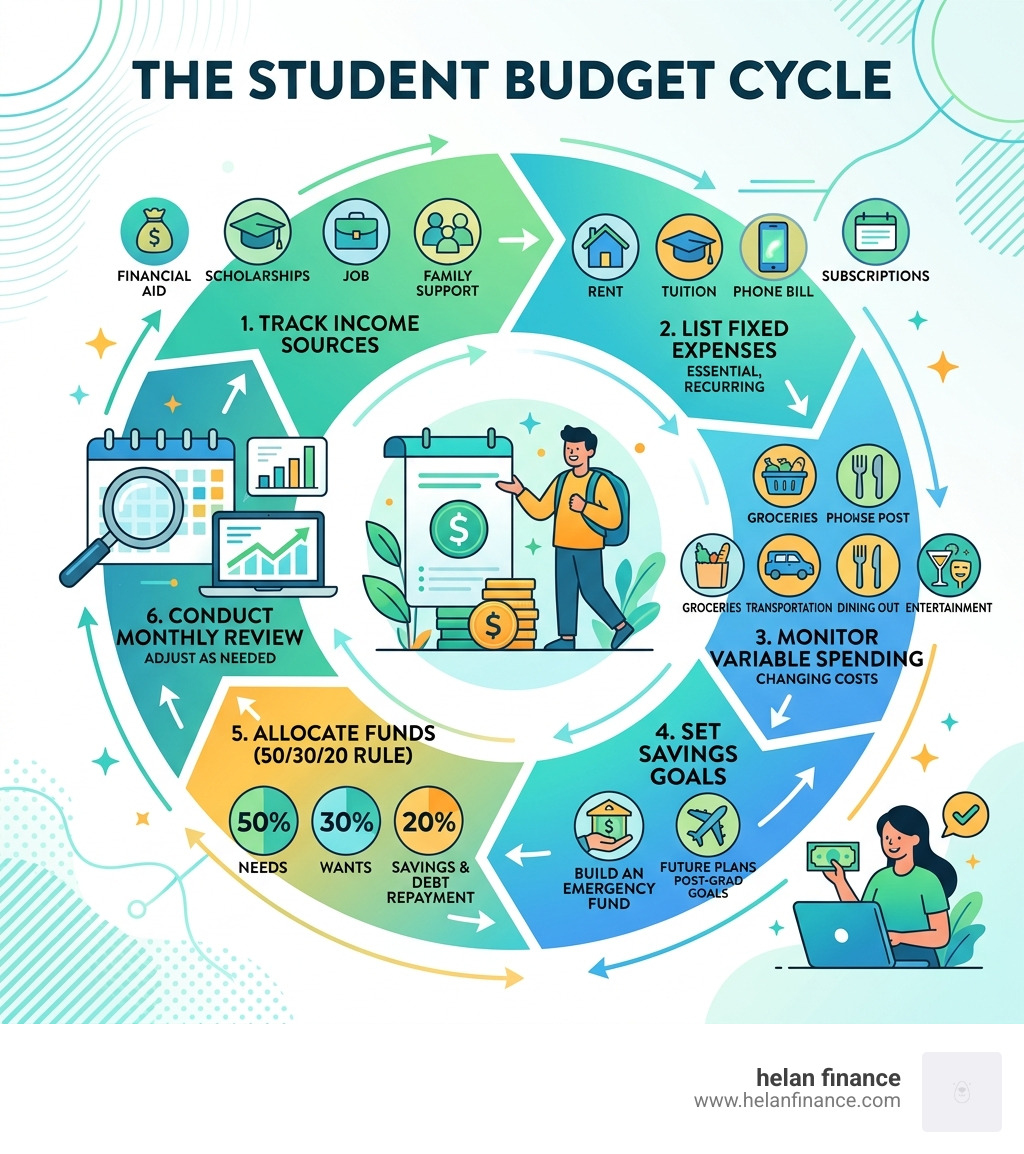
How to build a student budget in 6 steps:
- Add up your monthly income — include jobs, financial aid, family support, and scholarships
- List your fixed expenses — rent, phone, subscriptions, and anything that stays the same each month
- Track your variable spending — food, transport, entertainment, and other costs that change
- Categorize everything into needs, wants, and savings
- Apply the 50/30/20 rule — 50% needs, 30% wants, 20% savings or debt repayment
- Review and adjust every month as your situation changes
Financial stress is the number one reason students drop out of college — ranking higher than academic difficulty or personal issues. Yet most students arrive on campus without ever being taught how to manage money. By incorporating simple routines and financial health tips, you can avoid these common pitfalls.
The result? More than half of students run out of money before the end of term.
It’s not usually recklessness. It’s a knowledge gap. A lump-sum financial aid payment feels like a lot of money — until it isn’t. Small daily expenses like coffee, takeout, and forgotten subscriptions quietly consume hundreds of dollars a month without anyone noticing.
The good news: students who track their spending consistently spend 15 to 20 percent less than those who don’t. A simple, realistic budget is often all it takes to close that gap.
Assessing Your Income and Fixed Expenses

Before we can decide how much we can spend on weekend fun, we need to know exactly what is coming in and what must go out. This is where many students get tripped up by the “lump-sum illusion.” When a maintenance loan or financial aid refund of $5,000 hits your account in April 2026, it feels like you’ve won the lottery. But that money has to last for months.
Calculating Your Real Monthly Income
To build a budget that actually works, we have to convert those big payments into a monthly or even weekly allowance. We recommend looking at all your income sources:
- Financial Aid/Student Loan Refunds: Take the total amount you receive after tuition is paid and divide it by the number of months in the semester.
- Part-Time Jobs: Use your “net” pay (what actually hits your bank account) rather than your gross hourly wage.
- Family Support: Any monthly or occasional allowance from parents.
- Scholarships and Stipends: Even small, one-time awards should be factored into your total pool.
According to How to budget as a college student, underestimating your income and overestimating your expenses is the safest way to ensure you don’t run dry before finals week.
Fixed Monthly Expenses: The Non-Negotiables
Fixed expenses are the bills that stay the same every month. These are your “obligations.” Your living situation is the biggest factor here. Whether you are on-campus, off-campus, or living at home, your costs will vary significantly.
| Expense Category | On-Campus (Avg) | Off-Campus (Avg) | At Home (Avg) |
|---|---|---|---|
| Housing/Rent | $800 – $1,200 | $500 – $1,500 | $0 – $300 |
| Utilities/Internet | Included | $100 – $200 | $0 – $50 |
| Phone Plan | $40 – $80 | $40 – $80 | $40 – $80 |
| Streaming/Subs | $20 – $50 | $20 – $50 | $20 – $50 |
| Total Fixed | $860 – $1,330 | $660 – $1,830 | $60 – $480 |
Note: Off-campus costs vary wildly by city. A student in Manhattan might pay $1,500 for a shared room, while someone in the Midwest might pay $400.
Essential student budget building tips for Categorizing Spending
Once you know your fixed costs, it’s time to tackle the “variable” spending. These are the costs that change based on your choices — like how many times you order pizza or go to the movies.
The 50/30/20 Rule for Students
We love the 50/30/20 rule because it’s simple. Here is how to adapt it for student life:
- 50% for Needs: Rent, groceries, basic transport, and utilities.
- 30% for Wants: Dining out, hobbies, spring break savings, and that new outfit.
- 20% for Financial Goals: Building an emergency fund or paying down high-interest credit card debt.
If your “needs” (like high rent) take up 70% of your income, don’t panic. You can adjust the percentages by cutting from the “wants” category. The goal is visibility, not perfection. For more structured guidance, Preparing for college: Budgeting tips suggests using a zero-based budget, where you assign every single dollar a “job” before the month begins.
Building Credit While You Study
Budgeting isn’t just about surviving; it’s about setting up your future. College is the perfect time to start building a credit score. Most students start with a “fair” score (between 580 and 700).
By using a student credit card responsibly — meaning you only charge what you can pay off in full every month — you can graduate with an “excellent” score (800+). This makes it much easier to get an apartment or a car loan later. Just remember: credit card interest rates in 2026 are often 20% to 28%. If you carry a balance, you aren’t just spending money; you’re throwing it away.

Proven Ways to Reduce Costs and Increase Savings

If your budget shows you’re spending more than you’re making, you have two choices: make more or spend less. For most of us, spending less is the faster route.
The “Big Three” Savings Categories
- Textbooks: Never buy new from the campus bookstore. Renting can save you 50% to 70%. Look for used copies, international editions (which are often identical), or check if your library has a copy on reserve.
- Food: The average student spends $2,000 to $3,000 per year on dining out. By meal prepping and batch cooking on Sundays, you can eat for $250 a month instead of $600.
- Transportation: Skip the car if you can. Between insurance, gas, and maintenance, a car can cost $400 to $700 a month. Use your student ID for free or discounted bus and rail passes.
The Power of the Roommate
Living alone is a luxury most students can’t afford. Adding just one roommate can slash your housing and utility costs by 40% to 60%. Beyond rent, you can split bulk grocery runs and shared household items like cleaning supplies.
Using student budget building tips to build an emergency fund
One of the most important student budget building tips we can give you is this: prepare for the “oops” moments. A flat tire, a cracked laptop screen, or an unexpected medical co-pay can ruin a budget.
We recommend aiming for a $500 to $1,000 emergency fund.
- Start small: Even saving $10 or $20 a month helps.
- Automate it: Set up a recurring transfer to a high-interest savings account.
- Windfalls: If you get birthday money or a small tax refund, put it straight into this fund.
Frequently Asked Questions about Student Budgeting
How much money does a college student need per month in 2026?
In 2026, the average student needs between $1,200 and $2,500 per month for living expenses beyond tuition. This range is wide because location is everything. A student in a small college town might thrive on $1,300, while someone in a major city will struggle on $2,000. On average, you should budget $250–$400 for groceries and at least $100 for “hidden” costs like laundry and personal care.
What are the best student budget building tips for saving on food?
The “Two-Account Strategy” is a game changer. Keep your bill money in one account and your weekly food/fun allowance in a separate account (like a digital bank app). When the food account is empty, you stop eating out. Also, always shop with a grocery list. Shopping while hungry without a plan is a recipe for spending 20% more than you intended.
Is it advisable to work part-time while in college?
Yes, but balance is key. Research shows that working 10 to 15 hours per week is the “sweet spot.” It provides extra income and helps with time management without hurting your grades. However, working more than 20 hours per week is statistically linked to lower GPAs and higher dropout rates. If possible, look for Federal Work-Study jobs; they are usually more flexible and understand that you are a student first.
Conclusion
Building a budget doesn’t mean you have to stop having fun. In fact, it’s the opposite. When you have a plan, you can spend money on that concert or weekend trip without the guilt of wondering if you’ll be able to pay rent next week.
At Helan Finance, we believe that simplified financial planning is the key to a stress-free life. By using these student budget building tips and adopting consistent financial routines, you aren’t just surviving college; you are building habits that will serve you for the next forty years. Our approach combines practical advice with wellness-focused exercises to help you master your money.
Ready to take the next step in your financial journey? Start your financial planning journey with Helan Finance and see how easy it can be to manage your money with confidence through our simplified tools and routines.

