
How to Start Money Routine in Less Than an Hour
Why a Money Routine Is the Simplest Path to Financial Control
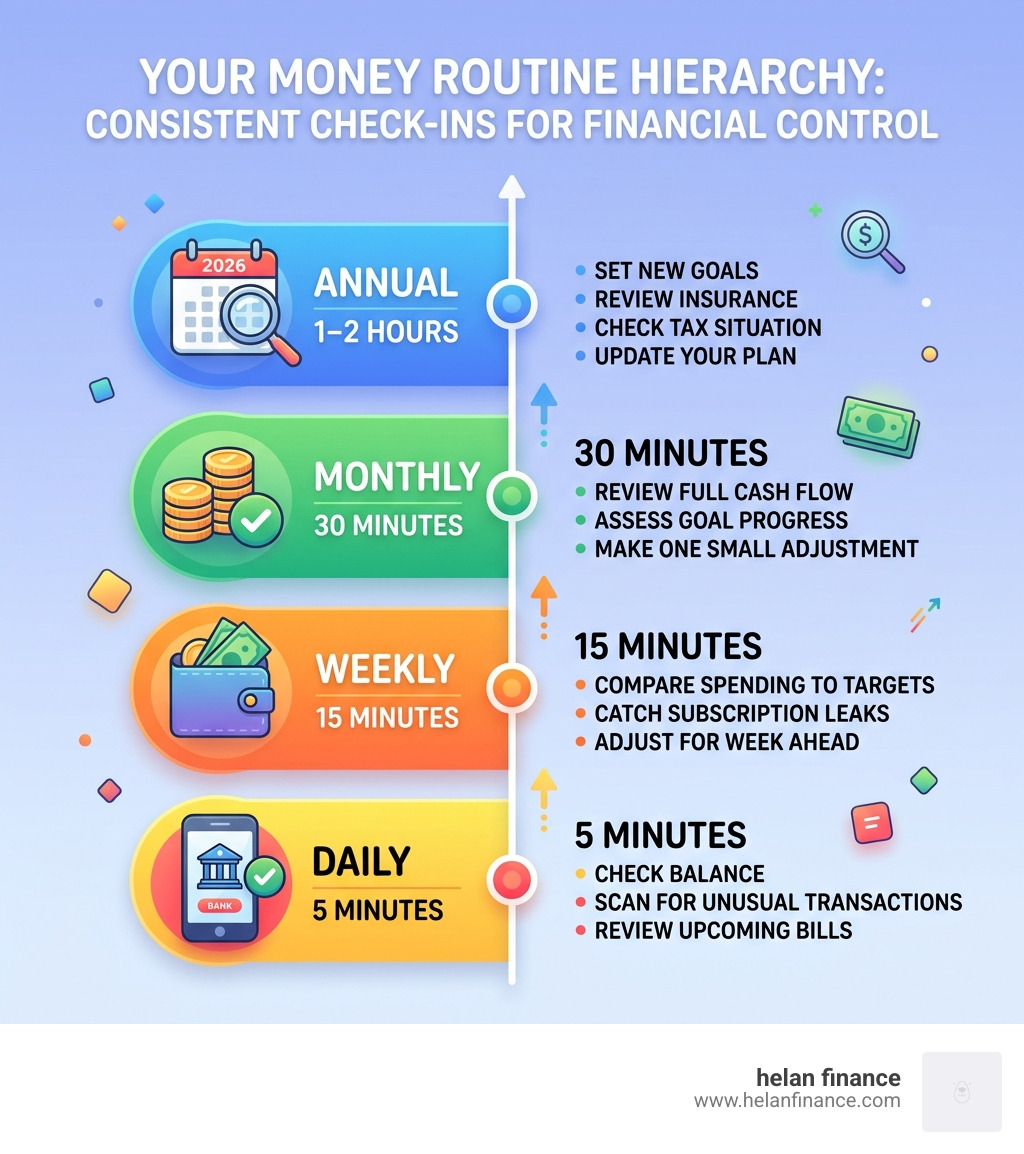
A money routine is a set of short, scheduled habits — daily, weekly, or monthly — that keep you aware of where your money is going and whether you’re moving toward your financial goals.
Here’s what a basic money routine looks like:
- Daily (5 minutes): Check your balance, scan for unusual transactions, review upcoming bills
- Weekly (15 minutes): Compare spending to your targets, catch subscription leaks, adjust for the week ahead
- Monthly (30 minutes): Review your full cash flow, assess goal progress, make one small adjustment
- Annually (1-2 hours): Set new goals, review insurance, check tax situation, update your plan
That’s it. No complicated spreadsheets. No financial degree required.
Here’s an uncomfortable truth: most people think they know what they spend each month. Research shows those mental estimates run 20 to 40% lower than actual spending. You’re not bad with money — you just don’t have a system that shows you reality in time to act on it.
The good news? You don’t need to track every coffee purchase or spend hours on spreadsheets. You just need consistent, short check-ins that catch problems before they become crises.
A money routine works because it replaces willpower with structure. Willpower runs out. A five-minute habit you do every morning while your coffee brews? That sticks.
In less than an hour, you can have your first money routine up and running. This guide shows you exactly how.
What is a Money Routine and Why is it Essential?
At its core, a money routine is about building financial awareness. It is the practice of checking in with your numbers regularly enough that nothing comes as a surprise. As we move through April 2026, the financial landscape is faster than ever. With instant digital payments and “buy now, pay later” schemes, it is incredibly easy for money to drift away if we aren’t looking.
Why is this essential? Because awareness precedes change. You cannot fix a leak you don’t see. Most of us suffer from “financial drift”—that slow, invisible increase in spending that happens when we aren’t paying attention. A routine acts as your financial GPS, recalculating your route every time you take a wrong turn.
Beyond the math, there is a powerful psychological component called identity-driven habits. When you perform a daily check-in, you aren’t just looking at numbers; you are reinforcing the identity of someone who is “good with money.” This shift in self-perception makes it easier to say “no” to impulse buys because they don’t align with who you are.
Furthermore, a money routine is your best defense against fraud. In an era of sophisticated digital theft, catching a suspicious $5 charge today can prevent an $8,000 identity theft disaster tomorrow. By aligning your daily actions with your long-term goals, you reduce the “existential dread” often associated with bank accounts. You stop fearing the balance and start using it as a tool. At Helan Finance, we believe that financial peace isn’t about how much you make, but how well you manage what you have. You can learn more about our philosophy on our Sobre Nós page.
The 5-Minute Daily Money Routine for Instant Clarity
The secret to a successful money routine isn’t intensity; it’s consistency. If you try to spend two hours every Sunday night reconciling every receipt, you will quit by February. But anyone can spare five minutes in the morning.

We recommend an “Anchor Habit” approach. Attach your money check-in to something you already do, like drinking your first cup of coffee or riding the train to work. Here is a simple 5-minute framework:
- The 60-Second Balance Check: Open your primary banking app. Look at your current balance and pending transactions. This isn’t for analysis—it’s just for reality-testing.
- The “Subscription Zombie” Scan: Quickly scroll through yesterday’s transactions. Do you recognize everything? Is there a $14.99 charge for a streaming service you haven’t watched in months?
- The Tomorrow Plan: Look at your calendar for the next 24 hours. Do you have a lunch date? Is your car insurance due? Knowing what’s coming prevents “surprise” spending.
To make this even more effective, implement a 24-hour rule for non-essential purchases. If you see something you want online, you can’t buy it until it has sat in your cart for a full day. This small speed limit on your spending can save thousands over a year. For a deeper dive into starting these habits, check out How to Create a Daily Money Routine | MACU and The 5-Minute Morning Routine to Organize Your Finances.
Tracking Spending and Detecting Fraud in Your Daily Money Routine
Daily tracking sounds tedious, but it is actually the most liberating part of a money routine. When you track daily, it takes seconds. When you track monthly, it takes hours of detective work to remember what “Vendor 402” was on your statement.
Focus on detecting “subscription zombies.” The average person has 4 to 6 forgotten subscriptions costing between $30 and $80 monthly. Finding and killing just one $15/month subscription is an instant $180 annual win. That’s a free dinner or a contribution to your emergency fund for 60 seconds of work.
Digital decluttering is also part of this. Unsubscribe from marketing emails that tempt you with “limited time offers.” If you don’t see the sale, you don’t feel the “need” to spend. This daily awareness keeps your security high. If you see a transaction you didn’t make, you can freeze your card immediately, rather than discovering the theft 30 days later when your rent check bounces.
How to Automate Your Money Routine for Effortless Management
While daily check-ins provide awareness, automation provides the muscle. We like to call this “behavioral design.” You want to make the “right” financial moves automatic and the “wrong” ones difficult.
The cornerstone of this is the Paycheck Routine. The moment your salary hits your account, your system should take over:
- Pay Yourself First: Set up an auto-transfer to your savings or investment account for the same day you get paid. If you wait until the end of the month to see “what’s left,” the answer will almost always be zero.
- The Bill Buffer: Keep a small buffer (around $100–$300) in your checking account to handle timing mismatches between when bills are due and when you get paid.
- Sinking Funds: These are accounts for “predictable emergencies.” Your car will eventually need tires. The holidays happen every December. By automating $50 a month into a “Car Maintenance” sinking fund, you turn a $600 crisis into a non-event.
As noted in My Life-Changing Money Morning Routine – Money With Katie, engaging with your finances daily—even with automation in place—fosters an “intimate” relationship with your money that leads to faster growth.
Structuring Your Weekly and Monthly Financial Rituals
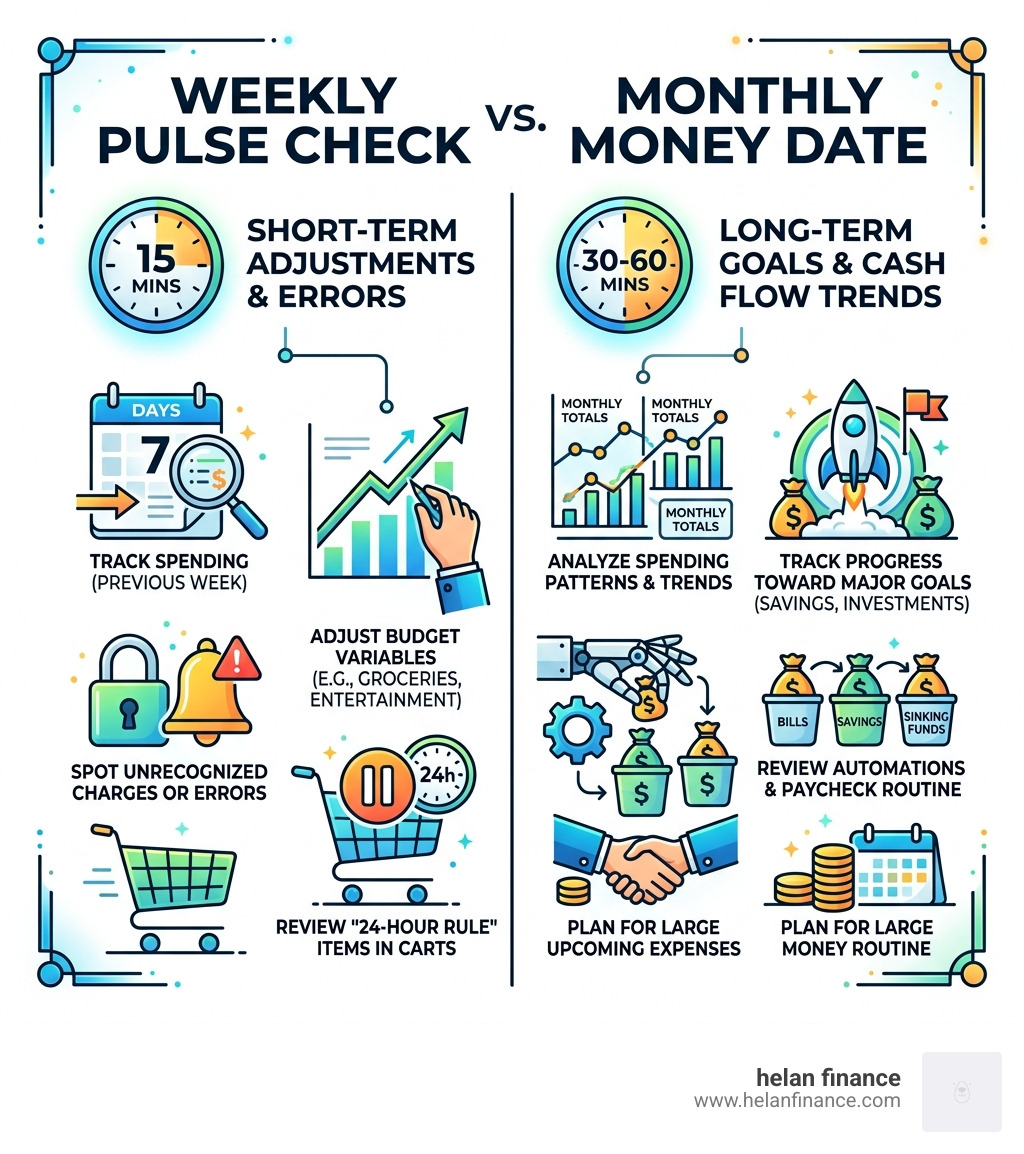
If the daily routine is about awareness, the weekly and monthly rituals are about strategy. Think of your daily check-in as looking at the dashboard while driving, and your weekly/monthly reviews as checking the map to ensure you’re still heading toward the right city.
Weekly Pulse Check vs. Monthly Money Date
| Feature | Weekly Pulse Check (15 Mins) | Monthly Money Date (30-60 Mins) |
|---|---|---|
| Primary Focus | Short-term adjustments & errors | Long-term goals & cash flow trends |
| Key Metric | Weekly spending “Speed Limit” | Net Worth & Savings Rate |
| Action Item | Catch double charges or missed subs | Adjust budget for next month’s events |
| Goal | Stay within your “Lifestyle Lane” | Ensure money is moving toward your “North Star” |
During your Weekly Pulse Check, identify your “North Star metric.” This is the one number that matters most to you right now—perhaps it’s your total debt balance or your emergency fund progress. Seeing this number move every seven days provides the dopamine hit needed to keep going.
The Monthly Money Date is more celebratory. Sit down with your partner (or yourself and a nice drink) and review the big picture. Did you spend more on dining out than you planned? Instead of feeling guilty, perform a “spending personality audit.” Was it because you were stressed? Busy? Socially pressured? Understanding the why behind your spending is more important than the what.
Customizing a Money Routine for Different Lifestyles
One size does not fit all in personal finance. Your money routine should reflect your life.

- For Freelancers: Since your income is variable, focus on a “Floor Income” approach. Use your lowest-earning month of the last year as your baseline for spending. Anything earned above that goes into a “Tax & Volatility” buffer.
- For Busy Professionals: Lean heavily on automation. Use apps to track your net worth and set high-priority alerts for large transactions so you only have to look when it matters.
- For Families: Hold a “Family Money Meeting” once a month. Discuss upcoming costs like school trips or summer camps. This keeps everyone on the same page and reduces money-related arguments.
Don’t forget the Annual Review Checklist. Every April, take an hour to:
- Review Insurance: Are you overpaying? Can you bundle?
- Tax Planning: Are you taking advantage of all your retirement account options?
- Goal Reset: Does your 2026 plan still reflect what you want for 2027?
Frequently Asked Questions about Money Routines
How do I start a money routine today with zero experience?
Start small. Don’t try to build a 50-tab spreadsheet today. Start with a 60-second check-in. Tomorrow morning, while your coffee brews or your toast pops, just open your bank app and look at your balance. Do that for seven days. Once that feels “normal,” add one more habit, like the 24-hour rule for shopping. Consistency beats intensity every single time.
What are the most common mistakes to avoid when building a routine?
The biggest killer of a money routine is “Complexity Creep.” If your system is too hard to maintain on a bad day, it’s a bad system. Avoid:
- Shame-based tracking: Don’t look at your spending to punish yourself. Look at it as data to help you make better choices tomorrow.
- Ignoring small leaks: A $10 subscription might seem small, but it’s the “death by a thousand cuts” that stops wealth building.
- Over-reliance on willpower: If you have to remember to save, you won’t. Automate the essentials.
How does a routine help with debt payoff and investing?
A routine turns the “math” of debt into a “game.” Using the Debt Avalanche method (paying off high-interest debt first), you can use your weekly check-ins to watch that interest charge get smaller and smaller. For investing, a routine ensures you are benefiting from compound interest. By automating contributions, you are buying into the market regardless of whether it’s up or down, which is a proven strategy for long-term success.
Conclusion
Starting a money routine is the single most effective thing you can do for your financial health. It transforms money from a source of anxiety into a tool for freedom. By dedicating less than an hour a month to these habits, you are building a foundation of “decision literacy” that will serve you for decades.
At Helan Finance, we are dedicated to making this journey as simple as possible. Whether you are just starting out or looking to optimize a complex portfolio, our tools and advice are designed to meet you where you are.
Ready to take the next step?
- Explore our resources: Sobre Nós
- Get personalized advice: Contate Nos
- Start your journey to financial health today
Financial peace is not a destination; it’s a routine. Start yours today.

