
A – Z Guide to Savings Calculator
Your Savings Growth, Calculated in Seconds
A savings calculator is a free tool that shows you exactly how much your money will grow over time — based on your starting balance, monthly contributions, interest rate, and how long you save.
Here’s what a savings calculator tells you at a glance:
| Input | What It Does |
|---|---|
| Starting balance | The money you already have saved |
| Monthly contribution | What you add each month |
| Interest rate (APY) | How much your bank pays you to hold your money |
| Time period | How many months or years you plan to save |
| Result: Future value | Your projected total balance |
So if you deposit $1,000 today, add $200 every month, and earn 4% APY — after 2 years you’d have roughly $6,067. That includes $267 earned purely from interest, money you never had to work for.
That’s the core idea. Your money earns interest. Then that interest earns interest too. Over time, this compounding effect turns small, consistent contributions into serious wealth.
The median American household holds just $8,000 in savings — while experts recommend keeping 3 to 6 months of expenses on hand. A savings calculator helps you close that gap with a clear, simple plan.
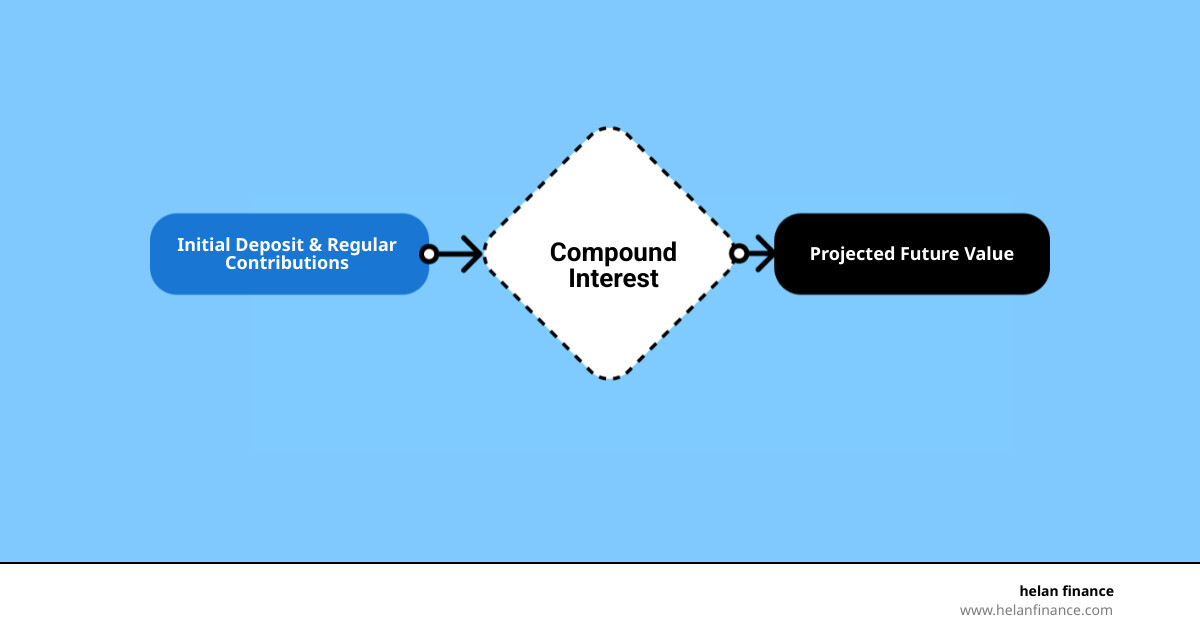
How a Savings Calculator Works
At its heart, a savings calculator is a mathematical engine designed to project the future. It takes the variables of your current financial life and projects them forward to show you a potential destination. By understanding the mechanics of how these tools operate, we can make better decisions about where to put our next dollar.
Most calculators operate on a Future Value logic. They assume that your money isn’t just sitting in a vault; it’s working. Whether you are using Helan Finance for financial planning or exploring our philosophy at Sobre Nós, the goal remains the same: clarity.
Key Inputs for Your Savings Calculator
To get an accurate projection, you need to provide the calculator with high-quality data. Here are the five “pillars” of a savings calculation:
- Starting Balance: This is your “seed money.” If you are starting from zero, that’s perfectly fine! But if you have an existing account, this initial amount acts as the base upon which all future interest is built.
- Contribution Frequency: Will you be adding money every week, every month, or once a year? Most of us save monthly to align with our paychecks.
- Deposit Timing: This is a subtle but important detail. Do you make your deposit at the beginning of the month or the end? Deposits made at the beginning of the period have more time to earn interest, which can lead to a surprisingly higher total over several decades.
- Interest Rate (APY): This is the annual percentage yield your bank offers. As of early 2026, rates vary wildly between traditional “big banks” (often as low as 0.01%) and high-yield online accounts (which can exceed 4.00% or 5.00%).
- Years to Grow: This is your time horizon. Are you saving for a vacation next year or a house in ten years? The longer the time, the more “heavy lifting” compound interest does for you.
Understanding the Savings Calculator Formula
While we usually let the software do the math, it helps to understand the “magic” under the hood. The standard formula used by a savings calculator to determine future value (FV) with regular contributions looks like this:
FV = P * [((1 + r)^n – 1) / r] + I * (1 + r)^n
Where:
- P = Monthly deposit
- r = Interest rate (as a decimal, divided by 12 for monthly)
- n = Total number of months
- I = Initial balance
Think of your growth in two parts: the growth of your initial “seed” and the growth of your “monthly waterings.” Together, they create a path to wealth that is predictable and manageable.
Maximizing Growth with Compound Interest
Compound interest is often called the “eighth wonder of the world.” It is the process where your interest earns interest. If you have $1,000 and earn 5% interest, you have $1,050. The next year, you earn 5% not just on your $1,000, but on that extra $50 too.
The Difference Between APY and Interest Rate
You will often see two different numbers: the “stated interest rate” and the Annual Percentage Yield (APY).
- Stated Rate: The base percentage the bank pays.
- APY: The actual amount you earn in a year, accounting for the effect of compounding.
If a bank compounds interest daily, your APY will be slightly higher than the stated rate. When using the savings calculator, always try to use the APY for the most accurate results.
Impact of Compounding Frequency on Total Returns
How often the bank “calculates” your interest matters. Common frequencies include:
- Daily: The gold standard. Your balance grows every single day.
- Monthly: Very common for standard savings accounts.
- Quarterly/Annually: Less common today, and generally less profitable for the saver.
For example, if you have $10,000 at a 5% rate, daily compounding will leave you with a few extra dollars at the end of the year compared to annual compounding. Over 20 or 30 years, those “few extra dollars” turn into thousands. We always recommend looking for accounts that offer daily compounding to maximize your yield optimization.

Evaluating Your Savings Potential
Seeing the numbers in black and white can be a wake-up call. Many people are surprised to see how much a low interest rate “costs” them in lost opportunity. At Helan Finance, we believe in using data to drive habit changes.
Maximizing Your Returns
Let’s look at how different interest rates impact a $10,000 deposit over 10 years (assuming no extra contributions):
| APY | Balance after 10 Years | Total Interest Earned |
|---|---|---|
| 0.01% (Standard Bank) | $10,010 | $10 |
| 0.41% (Natl. Average) | $10,418 | $418 |
| 4.50% (High-Yield) | $15,529 | $5,529 |
The difference is staggering. By simply moving money from a 0.01% account to a 4.50% account, you earn over $5,500 more without taking on any extra risk. This is why checking a savings calculator is the first step in any financial health routine.

Strategic Planning for Different Time Horizons
Your strategy should change based on when you need the money:
- Short-Term (0-2 years): Focus on liquidity and high APY. High-yield savings accounts (HYSAs) are perfect here.
- Medium-Term (2-5 years): You might consider Certificates of Deposit (CDs) or “CD Ladders” where you lock in rates for set periods.
- Long-Term (5+ years): While savings accounts are safe, you might start balancing them with investments to beat inflation.
Practical Strategies for Reaching Financial Goals
Calculators provide the map, but you have to drive the car. Reaching your goals requires a mix of automation and disciplined budgeting.
Setting Realistic Savings Targets
We often get asked, “How much should I have saved?” While everyone’s life is different, here are some industry benchmarks:
- The $2,000 Rule: The Federal Reserve suggests that $2,000 is the average amount needed to handle most common household emergencies.
- The 3-6 Month Buffer: For true security, aim for an emergency fund that covers 3 to 6 months of living expenses. If your monthly budget is $5,000, your target is $15,000 to $30,000.
- The 50/30/20 Rule: A simple way to budget. 50% of income goes to needs, 30% to wants, and 20% to savings or debt repayment.
Overcoming Inflation and Tax Implications
It is important to remember that the “Future Value” on your savings calculator is a nominal number. In the real world, two factors can eat into those gains:
- Inflation: If inflation is 3% and your savings account earns 4%, your “real” return is only 1%. Inflation erodes your purchasing power over time.
- Taxes: In the U.S., the interest you earn is generally considered taxable income. You will receive a Form 1099-INT at the end of the year. If you are in a 22% tax bracket, the government will take nearly a quarter of your interest earnings.
Frequently Asked Questions about Savings Calculators
How much should I save each month?
There is no “perfect” number, but a great starting goal is 10% to 20% of your take-home pay. However, consistency is more important than the amount. Saving $50 every single month is better than saving $500 once and then stopping for a year. Use the savings calculator to see how even small amounts like $20 a week add up over time.
How do I choose the right interest rate for my calculation?
Look at current market data. As of April 2026, many high-yield savings accounts are offering between 4% and 5%. If you are using a traditional “brick and mortar” bank, you should probably input 0.01% to 0.10% to be realistic. If you want to see what’s possible, run a second “best-case” scenario at 5%.
How does inflation affect my savings calculator results?
The calculator shows you how many dollars you will have, but it doesn’t tell you what those dollars will buy. To account for inflation, you can subtract the expected inflation rate (usually around 2-3%) from your APY. For example, if your bank pays 5% but inflation is 3%, enter 2% into the calculator to see your growth in “today’s dollars.”
Conclusion
Building wealth isn’t about luck or “timing the market.” It’s about the boring, beautiful discipline of consistent habits. By using a savings calculator, you take the guesswork out of your financial future. You can see exactly how a small raise, a side hustle, or a better interest rate can shave years off your journey to financial freedom.
At Helan Finance, we believe that financial planning should be as easy as checking the weather. Whether you are building your first $2,000 emergency fund or planning a down payment for a dream home, the numbers don’t lie. Start small, stay consistent, and let compound interest do the rest.

