
The Ultimate Guide to Retirement Planning
Why Retirement Planning Determines Your Financial Future
Retirement planning is the process of setting financial goals and building a strategy to make sure you have enough money to live comfortably when you stop working.
Here’s a quick overview of what smart retirement planning involves:
- Start early — the sooner you save, the harder compounding interest works for you
- Know your number — most experts suggest replacing 70–100% of your pre-retirement income
- Use the right accounts — 401(k)s, IRAs, and Roth IRAs each offer different tax advantages
- Plan for Social Security — delaying benefits until age 70 can increase your monthly payment by up to 76% compared to claiming at 62
- Don’t forget healthcare — Medicare, long-term care, and out-of-pocket costs add up fast
- Review regularly — your plan should grow and change as your life does
For most people, retirement doesn’t just happen. It takes consistent action, the right tools, and a clear plan.
The challenge? Life gets busy. Between work, family, and daily expenses, saving for a future that feels far away often gets pushed to the back burner.
But here’s the uncomfortable truth: the median retirement account balance for American households ages 55 to 64 was just $14,500 — far short of what most people need. That gap is almost always the result of starting too late or saving too little.
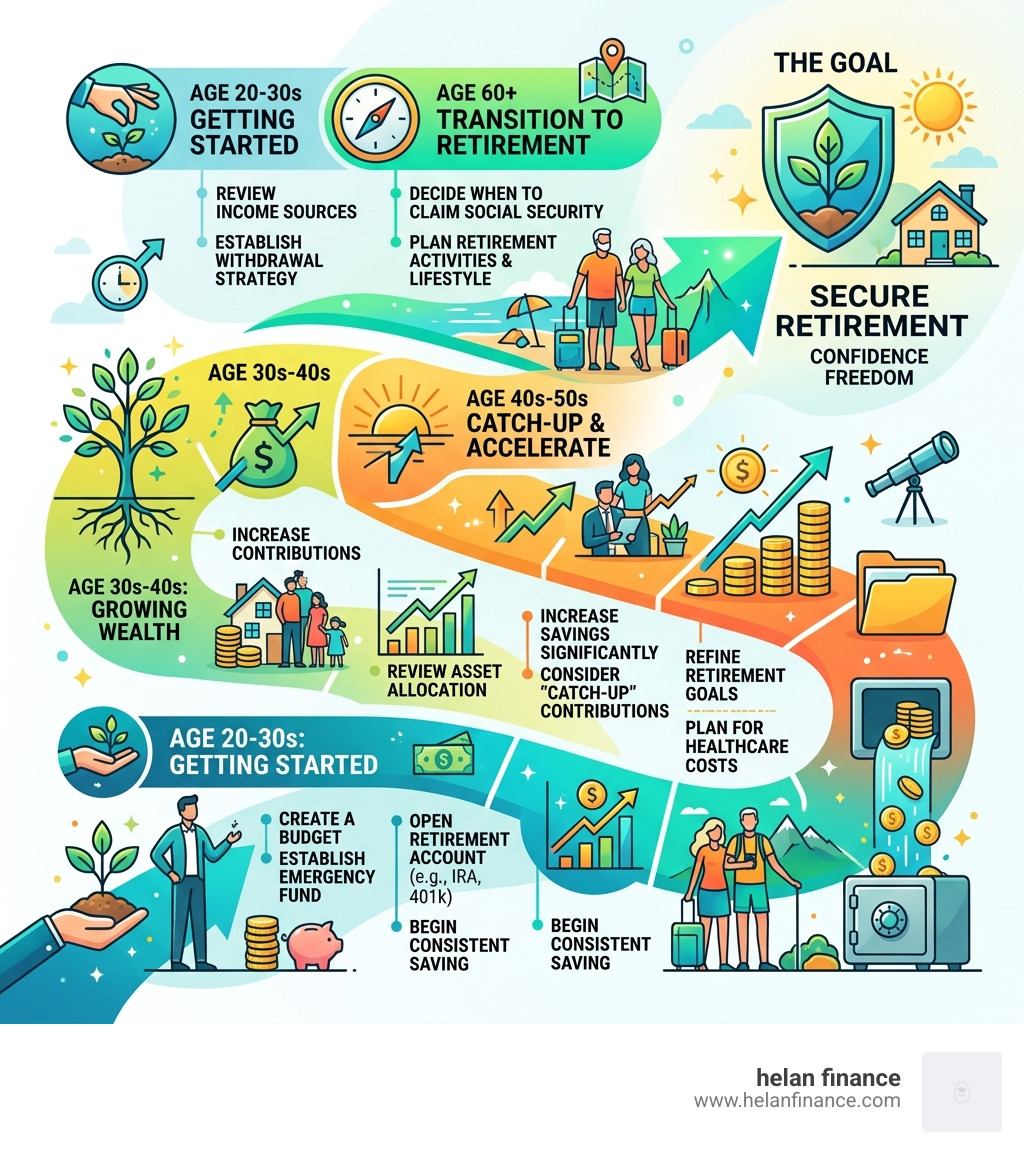
The good news is that it’s rarely too late to improve your position. Whether you’re in your 20s just starting out, or in your 50s playing catch-up, there are proven strategies that can help you retire with confidence.
This guide walks you through everything — from how much to save and which accounts to use, to Social Security timing, healthcare costs, and the lifestyle side of retirement that most financial guides skip entirely.
Determining Your Retirement Planning Needs and Goals
When we sit down to talk about retirement planning, the first question is usually: “How much is enough?” It’s a bit like asking how much a “vacation” costs—it depends on whether you’re camping in the backyard or renting a villa in Tuscany.
As of April 2026, the financial landscape has shifted slightly, but the core principles remain. To find your “magic number,” we start with the 80% rule. This suggests you’ll need roughly 80% of your pre-retirement income to maintain your current lifestyle. However, many experts now recommend aiming for closer to 100%, especially during the “active” early years of retirement when you finally have the time to travel or pursue expensive hobbies.

Estimating Your Future Expenses
To get a realistic estimate, we need to look beyond the rules of thumb. Your future expenses will likely fall into two categories: the ones that disappear (like your commute or professional wardrobe) and the ones that grow (like medical bills).
Common expenses to factor into your retirement planning include:
- Housing: Will your mortgage be paid off, or are you planning to downsize?
- Healthcare: This is often the largest “wildcard” expense.
- Taxes: Uncle Sam still wants his cut of your Traditional IRA and 401(k) withdrawals.
- Lifestyle: Hobbies, travel, and dining out.
- Inflation: Even a modest 2-3% inflation rate can erode your purchasing power over 20 or 30 years.
Life Expectancy and the Long Game
We are living longer than ever. For a man reaching age 65 today, the average life expectancy is about 84.3 years; for a woman, it’s 86.9. Many of us will spend 20, 30, or even 40 years in retirement. Your plan needs to account for this longevity to ensure you don’t outlive your money.
To help you visualize this, you can Plan for Retirement | SSA to see how your timeline matches up with potential benefits. Setting concrete goals—like “I want $5,000 in monthly disposable income”—gives us a target to shoot for.
Navigating Savings Accounts and Tax Implications
Once you know your goal, you need the right “buckets” to put your money in. Not all savings accounts are created equal. The tax advantages offered by different accounts can save you hundreds of thousands of dollars over a lifetime.
| Feature | 401(k) / 403(b) | Traditional IRA | Roth IRA |
|---|---|---|---|
| 2025 Contribution Limit | $23,500 ($31,000 if 50+) | $7,000 ($8,000 if 50+) | $7,000 ($8,000 if 50+) |
| Tax Treatment | Pre-tax (usually) | Often tax-deductible | After-tax (Tax-free growth) |
| Employer Match | Often available | No | No |
| RMDs | Yes (at age 73-75) | Yes | No |
The Power of the 401(k)
If your employer offers a 401(k) or 403(b) with a match, that is “free money.” As of 2025, the contribution limit is $23,500. If you are 50 or older, you can add a “catch-up” contribution of $7,500. Interestingly, for those aged 60 to 63 in 2026, a new “super catch-up” limit of $11,250 is available, allowing you to supercharge your savings just before the finish line.
Traditional vs. Roth IRAs
The choice between a Traditional and Roth IRA often comes down to when you want to pay taxes.
- Traditional IRA: You get a tax break now, but you pay taxes on withdrawals later.
- Roth IRA: You pay taxes now, but your money grows tax-free, and withdrawals in retirement are completely tax-free.
At Helan Finance, we often suggest a “tax-diversified” approach. Having money in both types of accounts allows you to manage your tax bracket more effectively once you stop working. You can explore our Retirement Planning and Savings Tools | Helan Finance to model how these different accounts impact your long-term wealth.
Maximizing Social Security and Investment Strategies
Investing for retirement is a marathon, not a sprint. In the early stages, we focus on accumulation—growing the pile as large as possible. As we get closer to retirement, the focus shifts to preservation and distribution.

The 4% Rule and Withdrawal Rates
A classic benchmark in retirement planning is the 4% rule. It suggests that if you withdraw 4% of your portfolio in the first year of retirement and adjust for inflation thereafter, your money has a high probability of lasting 30 years. However, with market volatility, many experts now suggest a more flexible withdrawal rate of 4% to 5%, depending on how the market is performing.
Investment Strategies for Long-Term Retirement Planning
We believe in the “3 A’s” of successful saving: Amount, Account, and Asset Mix.
- Asset Allocation: This is the balance between stocks (for growth) and bonds (for stability). When you’re 25, you can afford to be 90% in stocks. When you’re 65, you might want a 50/50 split to protect against a sudden market crash.
- Diversification: Don’t put all your eggs in one basket. Using low-cost Index Funds or ETFs allows you to own a piece of hundreds of companies at once, reducing your risk.
- Rebalancing: At least once a year, we should check our portfolio. if stocks have had a great year, they might now make up too much of your pie. Selling some stocks and buying bonds brings you back to your target risk level.
The Best Time for Social Security Retirement Planning
Social Security is a major pillar of retirement planning, but the timing is everything. You can start as early as 62, but your check will be permanently reduced.
- Full Retirement Age (FRA): Usually 66 or 67. This is when you get 100% of your earned benefit.
- Delayed Credits: For every year you wait past your FRA (up to age 70), your benefit increases by about 8%.
Waiting until age 70 can result in a monthly payment that is 76% higher than if you started at 62! If you have other assets to live on, delaying Social Security is often the best “investment” you can make. For more details on these trade-offs, see the Benefits Planner: Retirement | What Important Things to Consider When Planning for Retirement | SSA.
Healthcare, Estate Planning, and Lifestyle Considerations
It’s easy to get lost in the numbers, but retirement planning is also about how you live. You could have $5 million in the bank, but if you haven’t planned for your health or your hobbies, you might find yourself “rich but bored” or overwhelmed by medical debt.
The Healthcare Hurdle
Medicare usually starts at age 65, but it doesn’t cover everything. You will likely need to pay for Medicare Part B premiums (often deducted from Social Security) and potentially a Medigap or Medicare Advantage plan.
- Health Savings Accounts (HSAs): These are the “secret weapon” of retirement. Contributions are tax-deductible, growth is tax-free, and withdrawals for medical expenses are tax-free. If you don’t use it now, it can act as a secondary IRA after age 65.
- Long-Term Care: About 70% of 65-year-olds will need some type of long-term care. Whether through insurance or dedicated savings, having a plan for this prevents a health crisis from wiping out your spouse’s inheritance.
Estate Planning: Organizing Your Affairs
We don’t like to think about it, but organizing your legal affairs is a gift to your family. A complete plan includes:
- A Will: To dictate who gets what.
- Trusts: To avoid the slow, public process of probate.
- Power of Attorney: To name someone to make financial or medical decisions if you can’t.
- Beneficiary Designations: Check your 401(k) and life insurance! These designations usually override whatever is in your will.
The Non-Financial Side
Retirement is a major identity shift. We recommend “retiring to something” rather than just “retiring from a job.”
- Housing: Do you want to “age in place” or move closer to grandchildren?
- Relationships: Spend time mending fences or building new social circles.
- Routines: Without a 9-to-5, what will get you out of bed? Pursuing hobbies or volunteering provides the purpose that keeps us young.
For free resources to help organize these documents, check out the Retirement planning tools | USAGov.
Frequently Asked Questions about Retirement
How much do I really need to retire comfortably?
While the 80% rule is a good start, the “real” answer depends on your debt and lifestyle. If your house is paid off and you enjoy simple pleasures, you might need less. If you plan to travel the world, you might need 100% or more of your current income. A common target for a middle-class retirement is $1 million to $1.5 million, but your “number” is personal.
What if I haven’t saved enough by age 50?
Don’t panic—pivot. At age 50, you can start making catch-up contributions ($7,500 to 401(k)s and $1,000 to IRAs). By working just two or three years longer than planned, you can significantly increase your savings while reducing the number of years your nest egg needs to support you.
Should I pay off my mortgage before retiring?
It depends on your interest rate. If you have a 3% mortgage and your investments are earning 7%, it might make sense to keep the mortgage and let your money grow. However, the psychological freedom of being debt-free is a huge “return on investment” for many retirees.
Conclusion
Retirement planning isn’t a “set it and forget it” task. It’s a living strategy that requires an annual review. As we move through 2026 and beyond, staying flexible and informed is your best defense against uncertainty.
At Helan Finance, we believe financial freedom shouldn’t be complicated. Our mission is to provide simplified financial planning tools that fit into your daily life. Through easy-to-follow exercises, healthy routines, and expert advice, we help you build a future you can actually look forward to.
Ready to take the next step? Whether you’re refining your asset mix or just starting to save, we’re here to help you navigate the journey.
Start your simplified financial journey with Helan Finance

