
How to Zero-Based Budget in 5 Easy Steps
What is a Zero Based Budget and Why Use It?
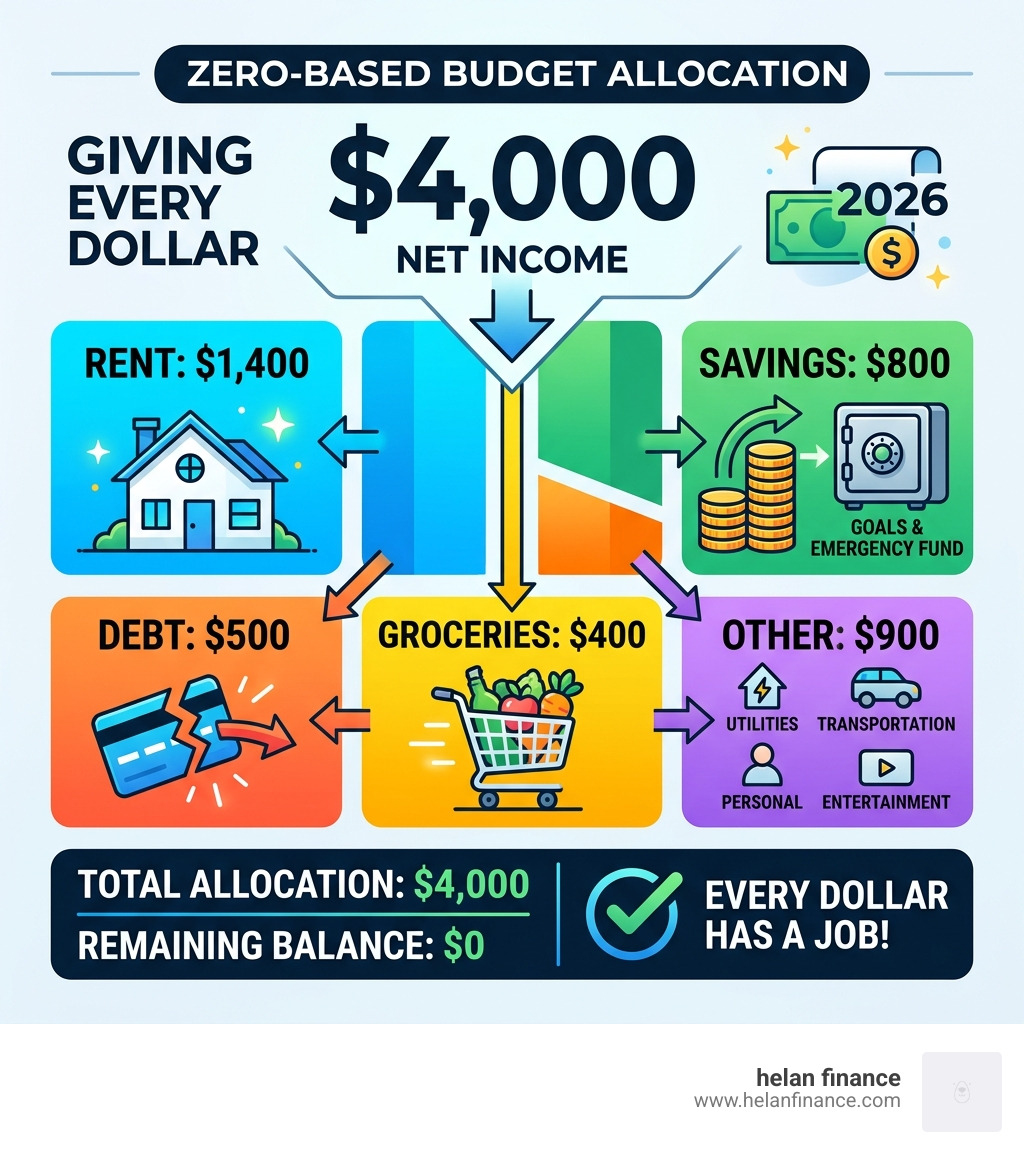
At its heart, the zero based budget is built on one core principle: every single cent you earn must be given a specific job. Whether that job is paying the rent, buying groceries, or padding your retirement fund, no dollar is left to wander off on its own. Mathematically, the formula is simple: Income – Expenditures = Zero.
While it feels modern, this method has deep roots. It was pioneered in the 1970s by Pete Pyhrr, an accounting manager at Texas Instruments. He developed it to help the company justify every expense from scratch each year, rather than just adding a small percentage to the previous year’s budget. The method gained national fame when former President Jimmy Carter, a fan of Pyhrr’s work, implemented it to manage the state budget of Georgia and later tried to bring it to the federal government.
Today, we use it in personal finance because it is arguably the most effective way to gain total control over your cash flow. Unlike traditional budgeting—where you might just say, “I’ll spend about $500 on food”—the zero based budget requires you to justify every allocation.
ZBB vs. Traditional Budgeting
Traditional budgeting is often “incremental.” You look at what you spent last month and tweak it. ZBB is “decision-oriented.” You start at zero every month and build your plan based on your current needs and future goals.
| Feature | Traditional Budgeting | Zero-Based Budgeting |
|---|---|---|
| Starting Point | Last month’s spending | Zero |
| Requirement | Adjusting previous totals | Justifying every dollar |
| Focus | Historical patterns | Future goals and efficiency |
| Flexibility | Rigid/Slow to change | High/Adjusts monthly |
This method is essentially a digital version of the old “envelope system.” In the past, people would put physical cash into envelopes labeled “Rent,” “Groceries,” and “Savings.” Once an envelope was empty, spending in that category stopped. A zero based budget does the same thing but allows for the strategic execution of your financial life. It fosters accountability and ensures that your money is working as hard as you do.
Master Zero-Based Budgeting: A Comprehensive Guide
The 5 Steps to Mastering Your Budget

Mastering your money doesn’t require a degree in finance; it requires a system. While many people use the 50/30/20 rule (allocating 50% to needs, 30% to wants, and 20% to savings/debt), the zero based budget takes it a step further by ensuring that even the “wants” and “savings” have a specific destination. It’s about intentionality. We want to help you move from passive spending to active wealth building.
Step 1: Calculate Your Total Monthly Income
Before you can give your dollars a job, you need to know how many “employees” you have. Start by totaling your take-home pay (the amount that actually hits your bank account after taxes and insurance).
Include everything:
- Your primary salary or hourly wages.
- Side hustles (freelancing, pet sitting, or selling items online).
- Bonuses or commissions.
- Passive income like dividends or rental income.
- Any government benefits or child support.
If your income is taxed at the end of the year (like freelance work), remember to set aside a portion for taxes before you start budgeting. We are looking for your net income—the actual cash available for you to use this month.
Step 2: List and Categorize Every Expense
Now, we look at the other side of the ledger. To make this work, you must be honest about where your money goes. We recommend looking back at your last three months of bank statements to get a realistic picture.
Common categories include:
- The Four Walls: Food, utilities, housing, and transportation. These are your non-negotiables.
- Fixed Costs: Subscriptions, insurance premiums, and internet bills.
- Variable Expenses: Personal care, entertainment, and that occasional coffee run.
Statistics show that most Americans spend more than 50% of their income on needs. By categorizing your spending, you can see if your “needs” are eating into your ability to save. For families, this is a great time to sit down together and discuss priorities. Are you spending $200 a month on streaming services you don’t watch? That’s $200 that could be doing a better job elsewhere.
What is zero-based budgeting and how does it work?
Step 3: Give Every Dollar a Job to Reach a Zero Based Budget
This is where the magic happens. Take your total income from Step 1 and start subtracting the expenses from Step 2.
But wait—don’t just stop at the bills. You must also assign money to:
- Debt Repayment: Credit cards, student loans, or car notes.
- Emergency Fund: Aim for 3-6 months of essential expenses.
- Savings Goals: Whether it’s a house down payment or a “sinking fund” for holiday gifts.
- Retirement: Just 14% of workers hit critical 401(k) goals. Don’t let your future self down!
If you subtract everything and still have $100 left, you aren’t done yet. That $100 needs a job. Put it toward your debt, add it to your vacation fund, or invest it. Your goal is to reach absolute zero.
Step 4: Track Your Spending in Real-Time
A budget is just a piece of paper (or a spreadsheet) until you put it into action. Tracking is the discipline that turns a plan into a reality. Throughout the month, every time you spend money, subtract it from the category it belongs to.
There is a psychological aspect to this: when you see that your “Dining Out” category only has $20 left for the month, you are much more likely to cook at home. This creates a built-in “pause” before you make a purchase. At Helan Finance, we believe that tracking tools are the bridge between your current financial state and your “Rich Life.”
Step 5: Review and Refine for the Next Month
Your first zero based budget will not be perfect. You might forget that your car registration is due or that your best friend has a birthday. That’s okay!
Budgeting is a learning curve. At the end of the month, look at where you overspent and where you had money left over. Use those insights to build next month’s budget. Maybe you realized that $400 for groceries was too low and $200 for entertainment was too high. Adjust the numbers for the following month. This cycle of continuous improvement is what builds lasting financial habits.
How to Make a Zero-Based Budget | Bankrate
Overcoming Challenges: Irregular Income and Variable Costs

One of the biggest myths is that you can’t use a zero based budget if you have an irregular income. Whether you are a freelancer, a real estate agent, or a tipped worker, you can absolutely make this work.
The trick is to use a lowest-month baseline. Look at your income over the last year and identify your lowest-earning month. Use that number as your “planned income.” You build your budget to cover your “Four Walls” and essentials using that minimum amount.
If you earn more than that baseline during the month, you simply apply that “extra” money to your highest-priority goals, like debt repayment or savings, at the end of the month. We also recommend building an income buffer—essentially one month’s worth of expenses sitting in your checking account—so you are always spending last month’s money rather than waiting for the next check to clear.
Additionally, always include a miscellaneous category. Life is messy. A small buffer for “unexpected but not emergency” costs (like a higher-than-usual utility bill) keeps your budget from breaking.
Zero-Based Budgeting: What It Is and How to Make It Work for You
Frequently Asked Questions about a Zero Based Budget
Is a zero based budget the same as being broke?
Absolutely not! Being “broke” means having no money. A zero based budget means having no unassigned money. You could earn $20,000 a month and still use a zero-based system. In fact, many people find that this method gives them more financial confidence because they know exactly how much they can spend on “fun” things without guilt, because the savings and bills are already covered.
How do I handle unexpected expenses?
Unexpected expenses fall into two categories: small surprises and true emergencies. For small surprises (like a $50 school field trip fee), use your “Miscellaneous” or “Buffer” category. For true emergencies (like a transmission failure), that is what your Emergency Fund is for. The beauty of ZBB is its flexibility; if something comes up, you can move money from your “Clothing” category to your “Car Repair” category mid-month to stay balanced.
Can businesses use this method too?
Yes! In the corporate world, ZBB is a powerful tool for strategic growth. Instead of departments getting a 5% increase every year just because they existed, they must justify their entire budget based on the value they bring to the company. This helps businesses eliminate “zombie” projects and reallocate resources to high-growth areas.
Conclusion
Achieving financial freedom doesn’t happen by accident; it happens by design. By giving every dollar a job, you stop wondering where your money went and start telling it where to go. Whether you are looking to pay off debt, save for a dream vacation, or simply stop living paycheck to paycheck, the zero based budget is your roadmap to a “Rich Life.”
At Helan Finance, we specialize in simplified financial planning. We believe that with the right routines and advice, anyone can master their money. Are you ready to take the first step toward a stress-free financial future?

