
Stop the Confusion and Learn the Difference Between Sinking Funds and Savings
Why Knowing the Difference Between a Sinking Fund vs Emergency Fund Can Change Your Financial Life
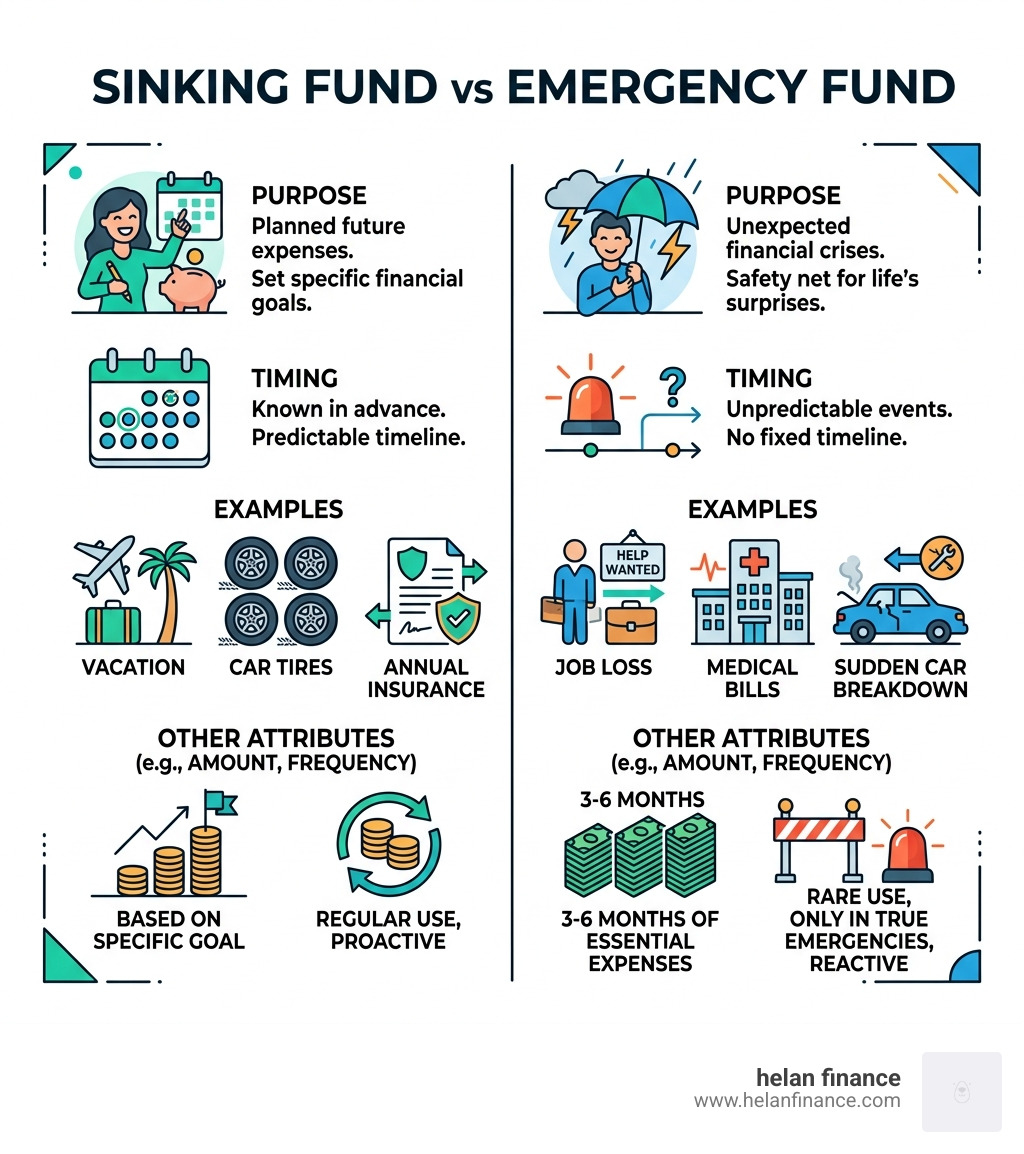
A sinking fund vs emergency fund — these two savings strategies might sound similar, but they serve very different purposes in your financial life.
Here’s the quick answer:
| Sinking Fund | Emergency Fund | |
|---|---|---|
| Purpose | Save for planned future expenses | Cover unexpected financial crises |
| Examples | Vacation, car tires, annual insurance | Job loss, medical bills, sudden car breakdown |
| Timing | Known in advance | Unpredictable |
| Amount | Based on specific goal | 3-6 months of essential expenses |
| How often used | Regularly, as planned | Rarely, only in true emergencies |
Most people keep all their savings in one account and hope for the best. Then a surprise car repair hits the same month as holiday shopping, and suddenly the budget is wrecked.
It doesn’t have to work that way.
Sinking funds are proactive — you save a little each month toward something you know is coming. Emergency funds are reactive — they protect you when life throws something unexpected your way.
Both are essential. And once you understand how each one works, managing your money gets a lot simpler.
What is a Sinking Fund?

While it might sound like your money is “sinking” into a hole, the term actually has a very productive history. The concept of a sinking fund dates back to the 18th century. Originally, it was an investment strategy used by governments and businesses to “sink” or pay off national debt and bonds gradually over time. In modern personal finance, we use it to describe money set aside intentionally for a specific, planned expense.
A sinking fund is essentially a “savings account with a job.” Instead of saving money just for the sake of having it, you are earmarking these funds for a specific goal. Because you know the expense is coming, you can divide the total cost by the number of months until you need the money. This turns a large, intimidating bill into a manageable monthly contribution.
One of the greatest “hidden” benefits of a sinking fund is the negotiating power it provides. When you walk into a store or a dealership knowing you have the full amount in cash ready to go, you are in a much stronger position to ask for discounts or better terms than someone relying on credit. It shifts you from a mindset of “Can I afford the monthly payment?” to “How much can I save on the total price?”
For more on the basics of these categories, you can explore this guide on Sinking Fund vs. Emergency Fund: What’s the Difference?
Common sinking fund categories
We often recommend starting with the expenses that tend to “surprise” people even though they happen every year. Here are some of the most common categories:
- Holiday Spending: If you spend $1,200 on gifts every December, a sinking fund of $100 per month starting in January prevents a “holiday debt hangover.”
- Annual Insurance Premiums: Many insurance companies offer discounts if you pay your premium annually or semi-annually. A sinking fund helps you capture those savings.
- Property Taxes: Average property taxes can be around 1.1% of your home’s value. Saving this monthly ensures you aren’t scrambling when the bill arrives.
- Car Maintenance: A full set of tires can cost between $400 to $700. Since tires wear out predictably, this is a perfect sinking fund candidate.
- Home Renovations: Whether it’s a kitchen upgrade or a new deck, these are planned improvements rather than emergency repairs.
- Technology Upgrades: If you know you’ll need a new laptop or phone in two years, start “sinking” the cost now.
What is an Emergency Fund?

If a sinking fund is your “offensive” strategy for buying things you want, an emergency fund is your “defensive” strategy against things you don’t want. It is your financial safety net, designed to catch you when life takes an unexpected turn.
As of September 2023, the U.S. unemployment rate was around 3.8%. While that may seem low, it highlights a persistent reality: job loss is a risk for almost everyone. An emergency fund is what stands between a temporary setback and a total financial crisis.
The standard recommendation is to save between three to six months’ worth of essential living expenses. Note the word essential — this doesn’t necessarily mean three months of your current salary. It means the amount you need to cover rent or mortgage, groceries, utilities, and insurance if your income were to disappear tomorrow.
To keep this money safe, we recommend using accounts that are liquid (easy to access) but separate from your daily spending. Most people choose a high-yield savings account or a money market account. These are often protected by FDIC insurance or NCUA coverage (up to $250,000), ensuring your safety net is actually there when you need it. You can learn more about the safety of these accounts at Sinking Fund vs. Emergency Fund: What’s the Difference? – Experian.
Typical emergency fund expenses
It’s important to define what constitutes a “true” emergency. If it’s something you could have predicted (like Christmas or a 10-year-old roof finally needing replacement), it should have been a sinking fund. True emergencies include:
- Job Loss: Covering your bills while you search for a new position.
- Medical Procedures: Unexpected health issues or emergency room visits.
- Major Home Repairs: A leaking roof repair can cost between $500 and $1,500. If it happens during a storm, it’s an emergency.
- Sudden Car Repairs: Repairing a vehicle averages around $500 for common unexpected issues like a failed alternator or transmission trouble.
- Vet Bills: When a pet gets sick or injured unexpectedly.
- Natural Disasters: Costs associated with evacuations or immediate repairs not covered by insurance.
Sinking Fund vs Emergency Fund: Key Differences
Understanding the nuances of a sinking fund vs emergency fund helps you build a more resilient budget. The primary difference lies in predictability. You know your car will eventually need tires (sinking fund), but you don’t know when a stray nail will cause a blowout (emergency fund).
By separating these two, you gain incredible financial visibility. You no longer have to wonder if you can “afford” a vacation; the sinking fund balance tells you exactly where you stand. This clarity leads to budget smoothing, where your monthly outgoings remain relatively stable even when large bills arrive.
According to insights from Sinking Fund vs Emergency Fund – Africa’s Pocket, using both funds together is the ultimate way to avoid debt. When you have a sinking fund for car maintenance, you don’t have to touch your emergency fund for new brakes. This keeps your safety net intact for much larger crises.
When to use a sinking fund vs emergency fund
The “timing” of the expense is your best guide.
- Anticipated Costs: If you can put it on a calendar (even a vague one, like “sometime this summer”), use a sinking fund.
- Unexpected Crises: If the event makes you gasp or panic, it’s likely an emergency fund situation.
- Routine Maintenance: Changing your oil or getting an annual HVAC tune-up is a sinking fund expense.
- Catastrophic Failure: If the HVAC system explodes in the middle of a July heatwave, that’s an emergency.
Calculating your sinking fund vs emergency fund goals
To calculate your sinking fund needs, look at your 12-month outlook. List every irregular expense: car registration, birthdays, back-to-school shopping, and annual subscriptions. Total them up and divide by 12. That is your monthly sinking fund contribution.
For your emergency fund, look at your “bare bones” budget. What is the absolute minimum you need to survive each month?
- Individual/Stable Income: Aim for 3 months.
- Family/Single Income/Freelancer: Aim for 6 to 9 months.
- High Risk/Variable Income: You may want to lean toward 12 months for extra peace of mind.
How to Build and Manage Your Funds Effectively
Once you’ve done the math, the next step is implementation. We are big fans of “out of sight, out of mind” banking. Keeping your savings in your primary checking account is a recipe for accidental spending.
The best place for these funds is a High-Yield Savings Account (HYSA). These accounts currently offer much better interest rates than traditional savings accounts, meaning your money grows while it sits. Many modern banks allow you to create “separate buckets” or sub-accounts within one main account. This allows you to see exactly how much you have for “Vacation” vs. “Car Repairs” without opening ten different bank accounts.
Automation is your best friend here. Set up an automatic transfer to hit the day after your paycheck arrives. By “paying yourself first,” you ensure your goals are met before you have the chance to spend the money elsewhere. For more on setting up these systems, check out Sinking Fund vs. Emergency Fund: What’s the Difference and Where ….
Prioritizing your sinking fund vs emergency fund
If you are starting from zero, the order of operations matters. We recommend a phased building approach:
- Starter Emergency Fund: Save a $1,000 buffer as quickly as possible. This covers most minor “emergencies” like a broken appliance or a small car repair.
- Essential Sinking Funds: Start small contributions to the things that definitely happen every year (like car insurance or Christmas).
- Full Emergency Fund: Once your starter buffer is in place, work toward that 3-6 month goal.
- Dream Sinking Funds: Once your safety net is secure, ramp up the savings for vacations, new cars, and home upgrades.
Common mistakes to avoid
Even with the best intentions, it’s easy to slip up. Here are the pitfalls we see most often:
- Mixing Funds: Using your emergency fund to pay for a “last-minute deal” on a cruise. That’s not an emergency; it’s a lack of planning!
- Underestimating Costs: Always add a 10% “buffer” to your sinking fund goals. Inflation and price hikes are real.
- Forgetting to Automate: If you have to remember to move the money manually, you eventually won’t.
- Ignoring Inflation: Re-evaluate your emergency fund size every year. As the cost of groceries and rent goes up, your “3-month” safety net might actually only cover 2 months.
Frequently Asked Questions about Savings
Why is it called a sinking fund?
As mentioned earlier, it’s an 18th-century term from debt management. To “sink” a debt meant to cancel it out or pay it off. While the term sounds a bit negative today, in the investment world, a “sinking fund” was a sign of a very stable and responsible organization. We’ve simply adapted that responsibility to our personal wallets!
How much should I save in an emergency fund?
The “rule of thumb” is three to six months of essential living expenses. However, don’t let that number intimidate you. If you have $0 in savings, your first goal should be $500. Then $1,000. Any amount of savings makes you more secure than having none at all. Base your ultimate goal on your specific risk factors, like the stability of your industry and the number of dependents you support.
Do I really need both types of funds?
In our experience, yes. Having both creates a balanced financial foundation. If you only have an emergency fund, you will constantly feel guilty for “dipping into it” for things like new tires or holiday gifts. If you only have sinking funds, a job loss will leave you completely exposed. Together, they provide both the freedom to spend on what you want and the security to survive what you don’t expect.
Conclusion
True financial security isn’t about how much you make; it’s about how well you manage what you have. By understanding the difference between a sinking fund vs emergency fund, you transition from being reactive to being proactive. You stop wondering where your money went and start telling it where to go.
At Helan Finance, we believe that financial planning shouldn’t be a headache. It’s about creating simple routines and using the right tools to build the life you want. Whether you’re saving for your next big adventure or building a wall of protection for your family, the best time to start is today.
Start your financial journey today

