
Financial Planning for Real Life and Real Estate Success
Why Real Life Financial Planning Is the Smartest Move You Can Make
Real life financial planning is the process of building a clear, actionable roadmap that connects your daily money decisions to your biggest life goals — from buying a home and paying off debt to retiring comfortably and building lasting wealth.
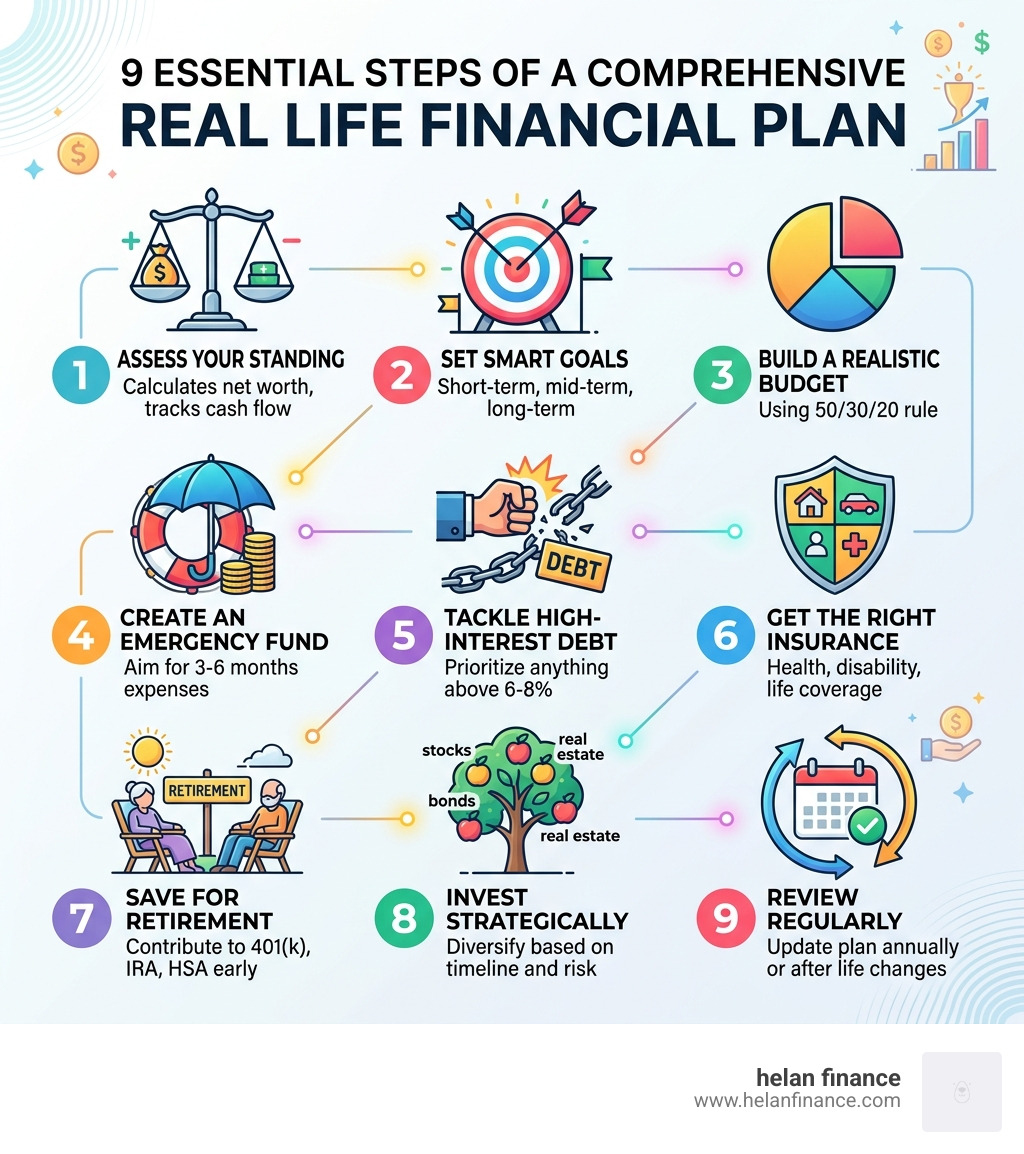
Here are the core steps to get started:
- Assess where you stand — calculate your net worth and track your cash flow
- Set SMART goals — short-term (1-2 years), mid-term (3-10 years), and long-term (10+ years)
- Build a realistic budget — using frameworks like the 50/30/20 rule
- Create an emergency fund — aim for 3-6 months of essential expenses
- Tackle high-interest debt — prioritize anything above 6-8% interest
- Get the right insurance — health, disability, and life coverage
- Save for retirement — contribute to your 401(k), IRA, or HSA early and consistently
- Invest strategically — diversify based on your timeline and risk tolerance
- Review regularly — update your plan at least once a year or after major life changes
Think financial planning is only for the wealthy? It isn’t.
Consider this: the average American household carries over $104,000 in debt, and just over half of all adults have even three months of emergency savings set aside. Meanwhile, one in four 20-year-olds today will face a disabling condition before they retire.
These aren’t abstract statistics. They are the financial realities that a solid plan is designed to protect you from.
A friend once received an inheritance and faced a simple but revealing question: pay off student loans or buy a four-wheeler? That small moment captures exactly why financial planning matters — without a clear plan, even good fortune can lead to poor decisions.
Whether you’re a busy professional with no time to spare or someone who just wants their money to stop feeling chaotic, this guide breaks everything down into simple, manageable steps.
The Foundation of Real Life Financial Planning
Before we can decide where we are going, we have to be brutally honest about where we are standing right now. Think of this as the “You Are Here” dot on a mall map. Without it, the directions are useless. At Helan Finance, we believe the foundation of any strategy is a clear financial assessment.

Understanding Cash Flow and Net Worth
The two most important numbers in your financial life aren’t your credit score or your salary—they are your Net Worth and your Cash Flow.
- Net Worth: This is a snapshot of your total financial health. To calculate it, list everything you own (Assets: bank accounts, retirement funds, home equity, cars) and subtract everything you owe (Liabilities: student loans, credit card balances, mortgages). If you have $200,000 in assets and $150,000 in debt, your net worth is $50,000.
- Cash Flow: This is the movement of money in and out of your life every month. Positive cash flow means you have money left over after paying bills. Negative cash flow means you’re likely leaning on credit cards to survive.
Understanding these components is the first step toward a professional financial strategy that actually sticks.
Setting SMART Goals for Real Life Financial Planning
We’ve all said, “I want to save more money.” But that isn’t a plan; it’s a wish. To make it a reality, your goals must be SMART: Specific, Measurable, Achievable, Relevant, and Time-bound.
We find it helpful to sort these into three buckets:
- Short-term (1–2 years): Building an emergency fund or paying off a high-interest credit card.
- Mid-term (3–10 years): Saving for a down payment on a home or starting a small business.
- Long-term (10+ years): Retirement planning or funding a child’s college education.
When setting these, distinguish between needs and wants. You need a place to live; you want a kitchen with marble countertops. By prioritizing needs first, you build flexibility into your plan. To begin mapping these out, visit our Página Inicial for resources tailored to your journey.
Creating and Sticking to a Realistic Budget
A budget isn’t a “money diet” designed to make you miserable; it’s a tool that gives you permission to spend on what matters. There are two popular frameworks we recommend for real life financial planning in April 2026:
- The 50/30/20 Rule: 50% of your income goes to Needs (rent, utilities, groceries), 30% to Wants (dining out, hobbies), and 20% to Savings and Debt Repayment.
- The 60/30/10+15 Guideline: A slightly more aggressive approach where 60% covers essentials, 30% goes to non-essentials, 10% to short-term goals/emergency funds, and an additional 15% is funneled specifically into retirement.
Whatever method you choose, the key is tracking your habits. Many people are shocked to find that small daily expenses—like that $5 coffee—can add up to over $1,800 a year.
Prioritizing Protection and Debt Management
Life has a habit of throwing curveballs. Whether it’s a flat tire or a sudden job loss, a resilient financial safety net is what keeps a “bad day” from becoming a “bad decade.”
Essential Insurance to Safeguard Your Plan
Protection is the “boring” part of financial planning, but it’s arguably the most vital. You are your greatest asset, and you need to protect your ability to earn an income.
- Health Insurance: A single medical emergency can wipe out years of savings.
- Disability Coverage: 1 in 4 statistic? A disabling condition is more common than most people realize. Check if your employer offers coverage, but ensure it replaces at least 60-70% of your income.
- Life Insurance: If anyone depends on your income, you need life insurance. A general rule of thumb is to carry 10–12 times your annual income in term life coverage.
Strategies for High-Interest Debt
Not all debt is created equal. While a mortgage can help you build equity, credit card debt is a wealth-killer. With average interest rates hovering between 18% and 25%, carrying a balance means you are paying a premium just to live your life.
To tackle this, consider these two proven methods:
| Method | Strategy | Best For |
|---|---|---|
| Debt Snowball | Pay off the smallest balance first for a “quick win.” | People who need psychological motivation. |
| Debt Avalanche | Pay off the debt with the highest interest rate first. | People who want to save the most money on interest. |
The 28/36 debt rule is a great benchmark for stability: try to keep your housing costs under 28% of your pre-tax income and your total debt payments under 36%. If you’re struggling to find the balance, learn more about our philosophy on the Sobre Nós page.
Building Wealth Through Retirement and Real Estate
Once the foundation is secure, we can focus on growth. In 2026, building wealth is about consistency and choosing the right “buckets” for your money.

Maximizing Tax-Advantaged Accounts
Taxes are one of the biggest expenses you’ll face. Using tax-advantaged accounts is like getting a “discount” on your future.
- 401(k) and IRAs: For 2026, the 401(k) contribution limit is $24,500. If your employer offers a match, contribute at least enough to get it—it’s essentially a 100% return on your investment.
- HSAs (Health Savings Accounts): These are the “secret weapon” of real life financial planning. They offer a triple-tax advantage: contributions are tax-deductible, growth is tax-free, and withdrawals for medical expenses are tax-free.
- Catch-up Contributions: If you are age 50 or older, you can contribute extra to your retirement accounts (an additional $8,000 for 401(k)s) to accelerate your progress.
Integrating Real Estate into Real Life Financial Planning
Real estate is a powerful way to diversify. Interestingly, 76% of active real estate investors today are Gen X or Millennials. It’s no longer just for the “old guard.”
Integrating property into your plan can take several forms:
- Rental Properties: Generating monthly passive income.
- 1031 Exchanges: A strategy that allows you to defer paying capital gains taxes when you sell an investment property and reinvest the proceeds into a new one.
- House Hacking: Living in one part of a multi-unit property while renting out the others to cover your mortgage.
Real estate allows for leverage (using the bank’s money to build your wealth), but it requires a strategic approach to ensure the risk aligns with your personal milestones.
Maintaining Your Real Life Financial Planning Strategy
A financial plan is not a “set it and forget it” document. It’s a living, breathing strategy that needs to evolve as you do.
Avoiding Common Planning Mistakes
Even the best plans can be derailed by human nature. Watch out for these common pitfalls:
- Lifestyle Inflation: As your income grows, your spending shouldn’t grow at the same rate.
- Neglecting Retirement for College: Your kids can get loans for school; you cannot get a loan for retirement.
- Perfectionism Paralysis: Don’t wait until you have “enough money” to start. An imperfect plan started today is better than a perfect plan started five years from now.
- Emotional Spending: Understanding your “money personality” can help you identify when you’re spending based on stress or social pressure rather than your goals.
Utilizing Financial Tools and Calculators
You don’t have to do the math by hand. There are incredible free resources available to simplify your planning:
- Compound Interest Calculators: These help you visualize how a small monthly investment grows over 30 years.
- Savings Goal Calculators: These tell you exactly how much to set aside each month to reach a specific target, like a $60,000 down payment.
- Social Security Estimators: Essential for long-term retirement timing.
Websites like Investor.gov offer free tools to help you check the background of investment professionals and research public company filings through the EDGAR database.
Frequently Asked Questions about Personal Finance
How much should I save for an emergency fund?
The standard recommendation is 3 to 6 months of essential living expenses. However, if you are a freelancer with irregular income or work in a volatile industry, aiming for 9 to 12 months provides a much-needed “sleep at night” factor.
When should I hire a fee-only financial advisor?
Consider a professional when your situation becomes complex—for example, if you’ve received a large inheritance, are navigating a 1031 exchange, or are nearing retirement. Look for a fee-only fiduciary, as they are legally obligated to act in your best interest and do not earn commissions on the products they sell you.
How do I calculate my required minimum distributions?
Required Minimum Distributions (RMDs) are the amounts the IRS mandates you withdraw from your retirement accounts once you reach a certain age. You can use an RMD calculator to determine these amounts based on your age and account balance to avoid heavy tax penalties.
Conclusion
At Helan Finance, we know that real life financial planning shouldn’t feel like a second job. Our mission is to provide simplified planning tools, from easy-to-follow exercises to routines that integrate your financial health with your overall well-being.
By following the steps in this guide—assessing your net worth, tackling debt, protecting your assets, and investing in both the market and real estate—you are doing more than just managing money. You are designing a life of freedom and security.
Ready to take the next step? Explore our simplified financial advice and health tips at https://www.helanfinance.com/ and start building the future you deserve today.

