
The Complete Guide to Using an Investment Planning Calculator
Why an Investment Planning Calculator Is the Smartest Tool You’re Not Using Yet
An investment planning calculator is a digital tool that shows you how your money can grow over time — based on what you invest today, what you add regularly, and how long you leave it alone.
Here’s what it does in plain terms:
| Input | What It Means |
|---|---|
| Initial investment | The money you start with |
| Monthly contributions | What you add regularly |
| Expected return rate | How fast your money grows (e.g. 7–10% for stocks) |
| Time horizon | How many years you invest |
| Compounding frequency | How often returns are reinvested |
The output tells you: your total contributions, total interest earned, and final balance — in both today’s dollars and future dollars.
Why does this matter? Because most people dramatically underestimate how much their money can grow — and how much they lose by waiting.
Consider this: a 25-year-old investing just $500 a month at an 8% average return could accumulate over $1.3 million by age 65. That same person, starting at 35, would end up with roughly half that amount — despite only missing 10 years of contributions.
As the saying goes, compound interest has been called “the eighth wonder of the world” — and an investment calculator is what makes that wonder visible.
The average American household holds just $41,600 in investment accounts. For most busy professionals, the gap between where they are and where they want to be isn’t a lack of income — it’s a lack of a clear plan and the right tools to build one.
That’s exactly what this guide is here to fix.
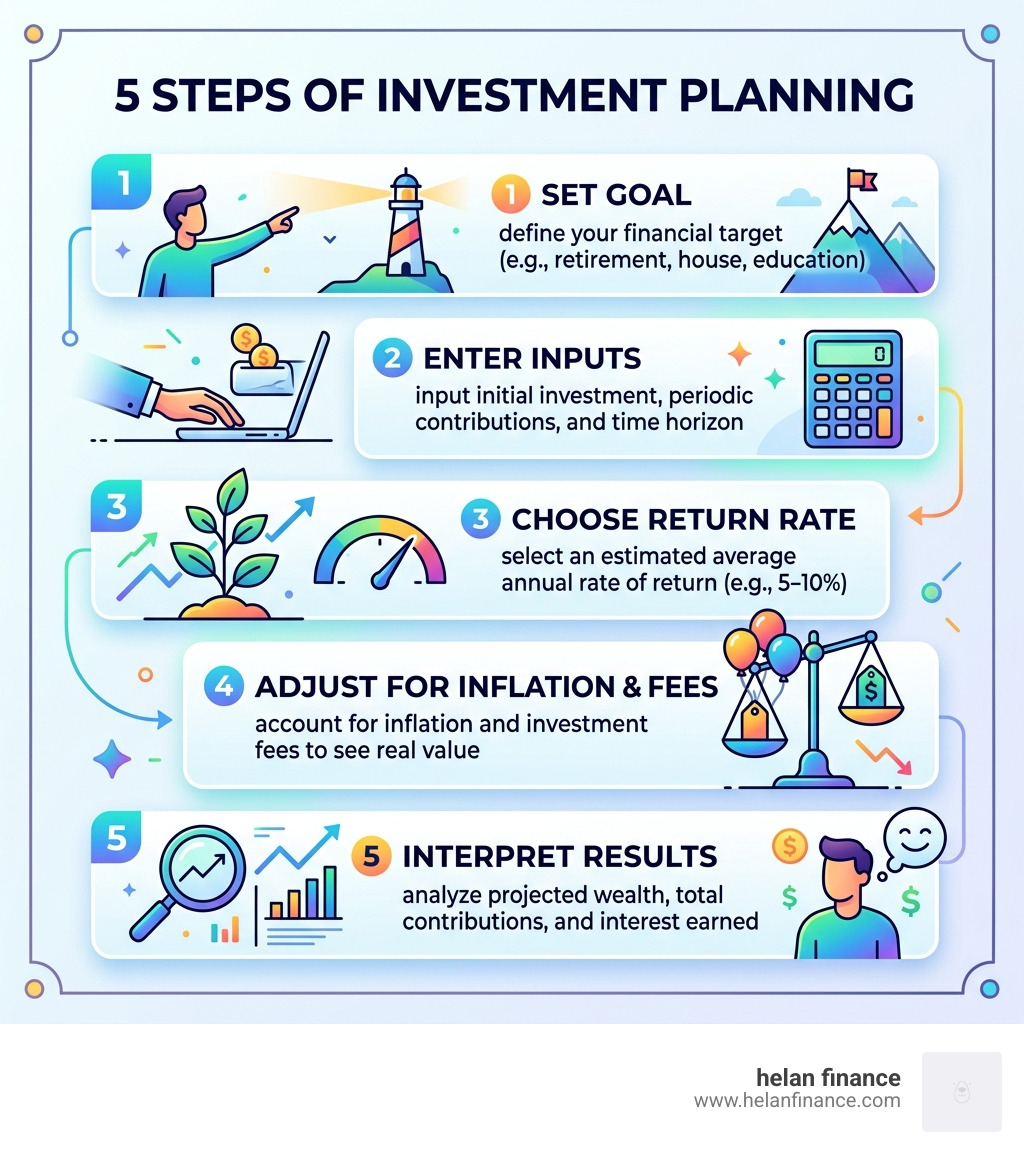
How an Investment Planning Calculator Works
At its core, an investment planning calculator is a mathematical engine designed to handle the heavy lifting of financial forecasting. While the formulas behind it—like the future value of an annuity—can look like alphabet soup, the interface is built for us humans. It takes your current financial data and projects it across a timeline to show your wealth trajectory.
Most tools, such as this Investment Calculator, function by taking your principal amount (the seed money) and adding your periodic contributions (the water). It then applies a growth rate over a specific time horizon.
The real magic happens through compounding frequency. This is how often the interest you’ve earned is added back into your principal to start earning interest of its own. Whether it happens daily, monthly, or annually, this “interest on interest” is what turns a modest savings account into a significant nest egg. In April 2026, with market volatility always a factor, using these tools helps us focus on nominal returns (the raw number) while keeping an eye on the big picture.

Essential Inputs for Your Investment Planning Calculator
To get an accurate “weather report” for your financial future, you need to provide the right data. Garbage in, garbage out! Here are the non-negotiables:
- Initial Balance: This is your starting line. It could be $0, or it could be the $41,600 average currently held by American households.
- Annual Return: This is your best guess at how the market will perform. While the S&P 500 has averaged about 10.68% since 1957, many of us at Helan Finance suggest using a more conservative 6–8% for planning.
- Contribution Timing: Do you invest at the beginning or the end of the month? Investing at the beginning gives your money thirty extra days to compound every single month.
- Inflation Rate: As of 2026, we typically use a default of 2.8% to 3%. This ensures you know what your money will actually buy in the future.
- Marginal Tax Rate: Your growth looks different inside a Roth IRA than it does in a taxable brokerage account.
- Asset Allocation: Are you 100% in stocks, or do you have a safety net of bonds? Your mix determines your expected return.
Interpreting Your Growth Projections
Once you hit “calculate,” you’ll be greeted with a few different numbers. Don’t just look at the biggest one!
- Total Contributions: This is the “sweat equity” — the actual cash you pulled from your paycheck.
- Interest Earned: This is the “free money” generated by compounding. In a healthy long-term plan, this number should eventually dwarf your contributions.
- Final Balance: The sum of the two above.
- Real vs. Nominal Value: This is the reality check. A $1 million balance in 30 years might only have the purchasing power of $412,000 today if inflation stays at 3%.
By visualizing your wealth trajectory, you can see exactly when your “money starts making more money than you do.”
The Power of Compounding and Consistency
Compounding is exponential growth, not linear. If you plot it on a graph, it doesn’t look like a steady hill; it looks like a hockey stick. The curve starts flat and then shoots toward the moon.
A great way to understand this is the Rule of 72. If you want to know how long it takes for your money to double, divide 72 by your expected return rate. At a 7% return, your money doubles roughly every 10 years. At 10%, it takes just 7.2 years.
You can experiment with these variables using the Compound Interest Calculator | Investor.gov. The most important takeaway? Starting early is more valuable than having a high salary. The opportunity cost of waiting even five years can be hundreds of thousands of dollars.
| Starting Age | Monthly Investment | Total Contributed | Final Balance (at age 65) |
|---|---|---|---|
| 25 | $500 | $240,000 | $1,200,000+ |
| 35 | $500 | $180,000 | ~$567,000 |
| 45 | $500 | $120,000 | ~$260,000 |
Assumes a 7% annual return.
Maximizing Growth with an Investment Planning Calculator
How do we actually reach those million-dollar milestones? It comes down to two main strategies:
- Lump-Sum Investing vs. Dollar-Cost Averaging (DCA): Research shows that lump-sum investing (putting all your money in at once) outperforms DCA about 65–70% of the time because you get more “time in the market.” However, for most of us, DCA via automated payroll deductions is the most practical way to build wealth.
- Dividend Reinvestment (DRIP): Don’t spend your dividends! By automatically reinvesting them, you buy more shares, which then produce more dividends. It’s a self-sustaining wealth accumulation cycle.
- Automated Contributions: The best investment plan is the one you don’t have to remember to execute. Setting up a “routine” of automated transfers is a core pillar of the Helan Finance philosophy.
Setting Realistic Expectations for Returns and Risks
We all want 20% returns every year, but the market isn’t a straight line up. The S&P 500 is the gold standard for historical data, returning about 10% annually before inflation. However, the ride can be bumpy. In 2022, the market was down 18%, only to roar back with 26% in 2023.
Using an Investment Return Calculator: Growth on Stocks, Bonds & More allows you to model different scenarios. You must balance your risk tolerance with your goals. If a 20% drop in your portfolio would make you panic-sell, you might need a more conservative mix.
Market volatility is the price we pay for long-term growth. We measure this “bumpiness” using standard deviation. A higher standard deviation means more potential for high returns, but also a higher chance of seeing red in the short term.
Portfolio Strategies: Conservative vs. Aggressive
Your investment planning calculator results will shift dramatically based on your strategy:
- Aggressive (8–12% expected return): Equity-heavy (90-100% stocks). Best for young investors who can weather the storms.
- Moderate/Balanced (6–8% expected return): A mix of stocks and bonds. This is often the “sweet spot” for mid-career professionals.
- Conservative (4–6% expected return): Focuses on fixed income (bonds and CDs) and stable assets. This is for those near retirement who need to protect their “nest egg.”
Don’t forget international exposure and diversification. Spreading your money across different sectors and geographies ensures that if one area of the economy fails, your whole plan doesn’t go with it.
Accounting for the Silent Killers of Wealth
Your calculator might show you a beautiful seven-figure number, but we need to account for the “wealth vampires” that can suck those returns dry.

- Inflation Adjustment: This is the biggest one. If you don’t adjust for inflation, you are looking at “monopoly money.” Always check the “real return” to see your future purchasing power.
- Expense Ratios and Fees: A 1% fee sounds small, right? Wrong. Over 30 years, a 1% annual fee on a $100,000 portfolio can cost you $180,000 in lost growth. We always advocate for low-cost index funds with fees below 0.2%.
- Tax Drag: Taxes can eat up to 30% of your gains in a standard brokerage account. This is why we prioritize:
- 401(k) and 403(b): Especially if there is an employer match (that’s a 100% instant return!).
- Roth IRA: Pay taxes now, but the growth and withdrawals are tax-free later.
- HSA (Health Savings Account): The “triple-tax advantage” — tax-deductible contributions, tax-free growth, and tax-free withdrawals for medical expenses.
Common Mistakes to Avoid in Investment Planning
Even with the best investment planning calculator, humans are prone to error. Here are the traps we see most often:
- Market Timing: Trying to jump in at the “bottom” and out at the “top.” Missing just the 10 best market days over 20 years can reduce your total returns by 50%.
- Overestimating Returns: Planning your retirement around a 15% return is a recipe for disaster. It’s always better to use a conservative estimate and be pleasantly surprised.
- Ignoring Fees: As shown above, fees are the silent killer. Check your 401(k) for high-fee mutual funds.
- Underestimating Inflation: Many people forget that a gallon of milk won’t cost the same in 2056 as it does in 2026.
- Emotional Trading: Selling when the news looks scary. Remember: a loss is only a “paper loss” until you sell.
- Lack of Rebalancing: Over time, your 80/20 stock-to-bond ratio might become 90/10 because stocks grew faster. You need to periodically sell some winners and buy some laggards to keep your risk in check.
Frequently Asked Questions about Investment Planning
What is a realistic rate of return to use in an investment planning calculator?
While the S&P 500 has a long-term nominal average of 10.68%, we recommend using 7% for a balanced portfolio and 5% for a conservative one. If you want to see your results in today’s purchasing power, use an inflation-adjusted return of 6–7% for an all-stock portfolio. In the 2026 market outlook, we expect continued growth but at a more moderate pace than the post-2020 boom.
How does inflation affect my long-term investment results?
Inflation erodes your purchasing power. Based on historical CPI data, the cost of living doubles roughly every 20-25 years. If your investment planning calculator doesn’t have an inflation toggle, you can manually subtract 3% from your expected return rate to see the “real” future value.
Should I prioritize tax-advantaged accounts or taxable brokerage accounts?
Always follow the “waterfall” method:
- Contribute to your 401(k) up to the match (it’s free money).
- Max out your HSA if eligible.
- Max out your Roth IRA or traditional IRA.
- Go back and finish maxing the 401(k).
- Only then move to a taxable brokerage account. This strategy minimizes “tax drag” and maximizes your long-term liquidity and wealth.
Conclusion
At Helan Finance, we believe that wealth isn’t about having a high-stress job; it’s about having a high-quality plan. Using an investment planning calculator is the first step in moving from “guessing” to “knowing.”
By establishing simple financial routines—like automating your contributions and checking your trajectory once a year—you can stop worrying about the daily market noise and start focusing on the life you want to lead. Whether you’re saving for a home, your children’s education, or a relaxed retirement, the math remains the same: start early, stay consistent, and keep your fees low.
Start your simplified financial planning journey today and take control of your wealth trajectory.

