
8 Financial Tips for Young Adults to Start Winning Early
Why Money Management for Students Sets the Foundation for Life
Money management for students is the practice of budgeting, saving, and spending wisely during college to build lasting financial habits.
Here are the core skills every student needs:
- Create a budget – Track income and expenses using the 50/30/20 rule (50% needs, 30% wants, 20% savings)
- Maximize free money – Apply for FAFSA, grants, and scholarships before taking on loans
- Borrow smart – Keep student loan payments under 10-15% of your future income
- Build credit safely – Use a student credit card, pay in full monthly, stay under 25% utilization
- Cut everyday costs – Use student discounts, buy used textbooks, and share expenses with roommates
- Start saving early – Build a $500-$1,000 emergency fund and automate transfers
College is often the first time you’re fully in charge of your own money. And that shift happens fast.
One month you’re at home with most expenses covered. The next, you’re juggling tuition, rent, groceries, and bills — often on a tight budget. According to the College Board, the average student spends around $2,932 per month on living expenses alone (2024/2025 school year). That’s real money, and it adds up quickly.
Here’s the thing most students don’t realize: the habits you build now follow you for decades. Research consistently shows that students who develop financial skills early are better equipped to handle debt, avoid financial stress, and reach major life goals faster — from renting their first apartment to buying a car.
And the cost of not learning? Over half of students graduate with debt, and 78% report that financial stress negatively impacts their mental health.
The good news is that none of this is complicated. A few simple habits, applied consistently, can completely change your financial trajectory.
This guide walks you through exactly what to do — step by step.
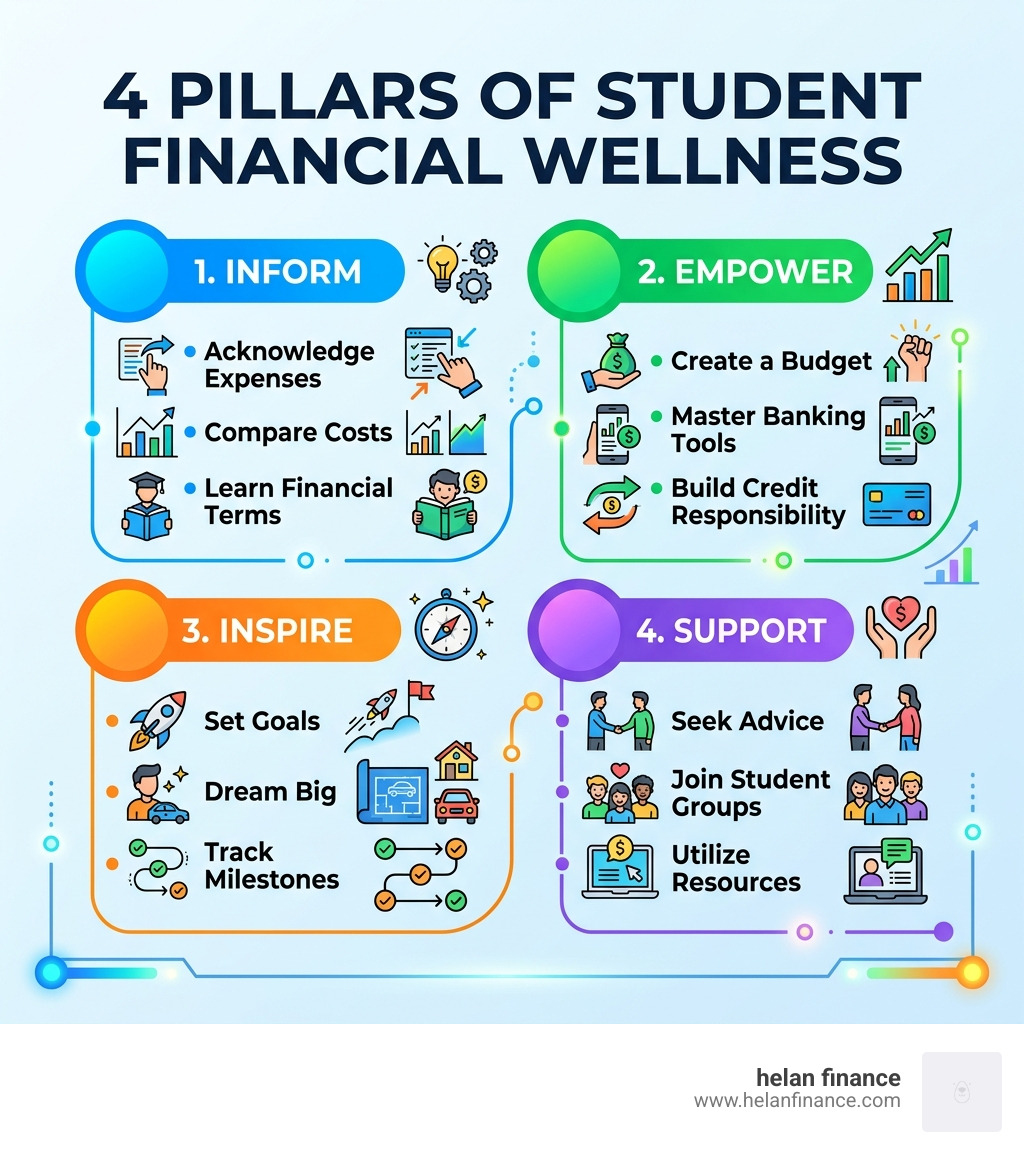
Master the Art of Money Management for Students with a Proactive Budget
If there is one “course” that should be mandatory for every freshman, it’s budgeting. Think of a budget not as a restriction on your fun, but as a financial game plan that ensures you can actually afford the things you enjoy.
Effective money management for students starts with a proactive mindset. We recommend the 50/30/20 rule as a gold standard. Under this framework, you allocate 50% of your income to “Needs” (rent, groceries, utilities), 30% to “Wants” (eating out, movies, new clothes), and 20% to “Savings or Debt Repayment.”
The goal is to shift from just having “financial literacy” (knowing the facts) to “financial capability” (having the confidence and resources to apply that knowledge). When you understand the difference between a need (a textbook for class) and a want (a third pair of trendy sneakers), you gain control over your cash flow.
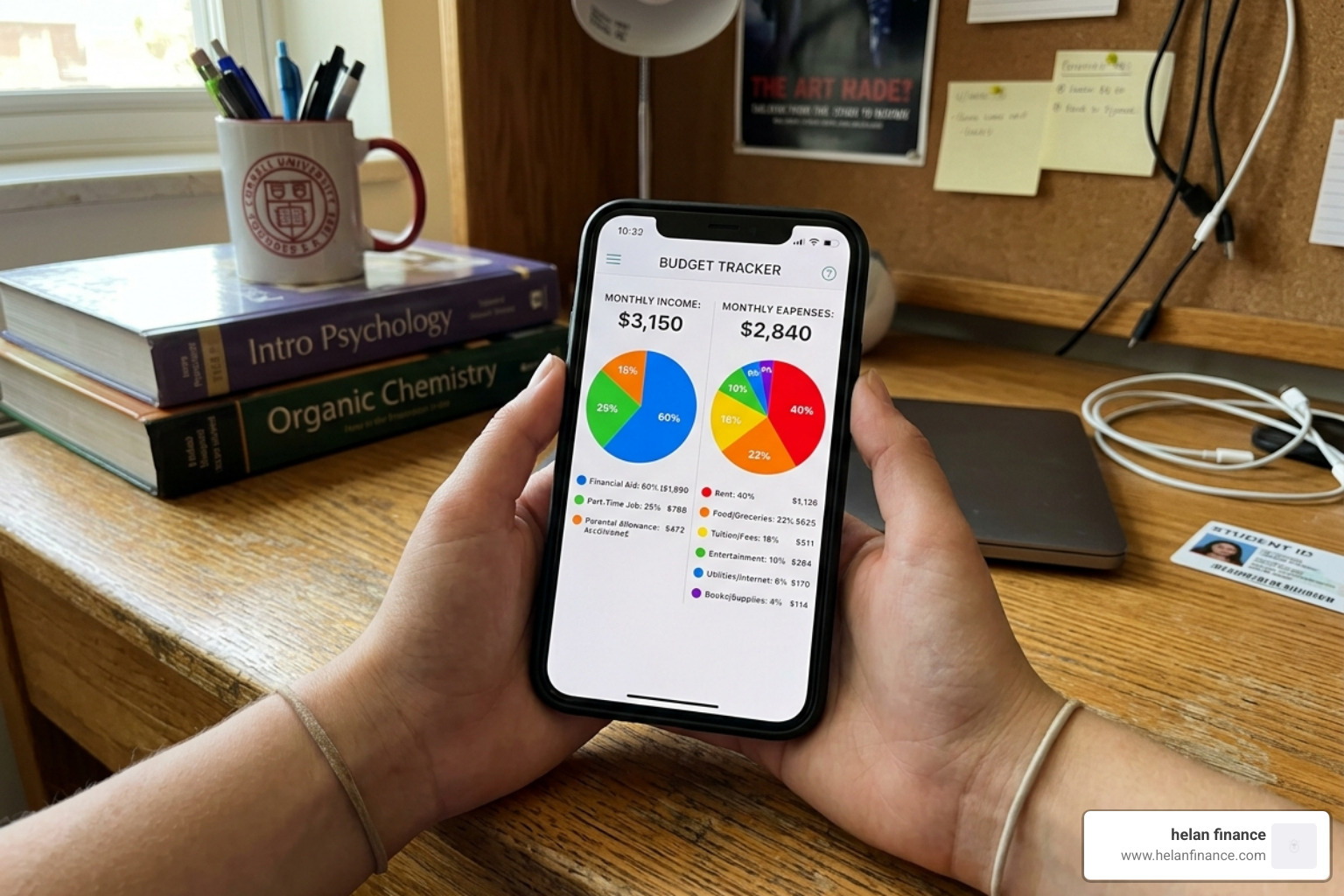
To get started, check out this Practical Budgeting Guide for College Students – Study.com. It provides a deeper look into aligning your spending with your personal priorities. Students who track their spending consistently tend to spend 15% to 20% less than those who don’t. That extra cash could be the difference between a stressful finals week and a celebratory post-exam dinner.
Tracking Your Monthly Living Expenses
Tracking is where the rubber meets the road. Many students are shocked to find that small, daily purchases—like a $5 latte or a late-night snack run—can total over $3,000 a year. Across a four-year degree, that’s more than $12,000!
To manage your money management for students effectively, you need to categorize your costs into “Fixed” and “Variable.” Fixed costs stay the same every month (like rent), while variable costs fluctuate (like groceries or entertainment).
| Expense Category | On-Campus (Estimated) | Off-Campus (Estimated) |
|---|---|---|
| Housing/Rent | Included in Room & Board | $800 – $1,200 |
| Food/Groceries | Meal Plan Pre-paid | $350 – $500 |
| Transportation | Walking/Campus Shuttle | $100 – $200 (Gas/Public Transit) |
| Utilities | Included | $100 – $150 |
| Total Monthly | High Upfront, Low Monthly | $1,350 – $2,050+ |
Essential Tools for Money Management for Students
You don’t need a degree in accounting to manage your money. We suggest using a mix of digital and physical tools to stay organized:
- Budgeting Apps: Tools like EveryDollar or YNAB (which often offer student discounts) can link to your bank account and categorize spending automatically.
- Semester Planners: Map out your big expenses (tuition, books) at the start of each term.
- Cash Envelope System: If you struggle with overspending on “wants,” put a set amount of cash in an envelope for the month. Once it’s gone, it’s gone.
- Official Checklists: Use this Money Management Checklist for College Students to ensure you aren’t missing any critical steps in your financial journey.
Maximize Financial Aid and Navigate Student Loans Wisely
Before you even think about borrowing, you must exhaust all “free money” options. This means filing your FAFSA (Free Application for Federal Student Aid) as early as possible—ideally in October when it opens. Billions of dollars in Pell Grants go unclaimed every year simply because students didn’t finish their paperwork.
Grants and scholarships are essentially “gifts” that don’t need to be repaid. Beyond federal aid, check with your school’s financial aid office for identity-based or merit-based scholarships. If your family’s financial situation changes (like a parent losing a job), don’t be afraid to file a financial aid appeal with your university.

When it comes to borrowing, follow these 4 money management tips for college students to stay on the right side of debt. A good rule of thumb is to use student loans as a last resort and never borrow more than you absolutely need for educational purposes.
Understanding Loan Repayment and the 20-10 Rule
Not all loans are created equal. Federal Subsidized Loans are the best option because the government pays the interest while you’re in school. Unsubsidized Loans and Private Loans accrue interest from day one.
To avoid being “debt-poor” after graduation, we recommend two major rules:
- The 10-15% Limit: Your total monthly student loan payment should not represent more than 10% to 15% of your expected starting monthly salary.
- The 20-10 Rule: Limit your total borrowed amount to less than 20% of your annual net income, and keep monthly payments under 10% of your monthly net income.
Pro-Tip: Setting up auto-debit for your federal student loans can often snag you a 0.25% interest rate reduction. It’s a small win that adds up over ten years!
Build a Bulletproof Credit Score Without the Debt Trap
Your credit score is like a financial GPA. It tells lenders how “trustworthy” you are. In April 2026, having a strong FICO score is more important than ever—it affects your ability to rent an apartment, get a car loan, and even pass background checks for certain jobs.
The biggest factor in your score (35%) is Payment History. One late payment can linger on your report for seven years. The second biggest factor (30%) is Credit Utilization. We recommend using only 25% of the total credit available to you. If your limit is $1,000, never let your balance exceed $250.
To build credit safely:
- Start with a Secured Card: You provide a deposit that acts as your credit limit.
- Pay in Full: Treat your credit card like a debit card. If you can’t pay for it in cash today, don’t put it on the card.
- Monitor Regularly: Visit AnnualCreditReport.com to check for errors or signs of identity fraud. Students are often targets for scams because they are less likely to monitor their reports.
Slash Everyday Costs with Strategic Student Discounts
One of the best perks of being a student is the sheer volume of discounts available. Your .edu email address is a golden ticket to savings. By being strategic, you can slash your cost of living by hundreds of dollars a month.
- Tech & Software: Apple, Microsoft, and Lenovo offer significant education pricing. The GitHub Student Developer Pack is a must-have for tech-leaning students.
- Entertainment: Spotify and Amazon Prime offer 50% discounts (or more) for students.
- Insurance: Companies like GEICO and State Farm offer “Good Student Discounts” that can save you up to 25% on auto insurance.
- Textbooks: Never buy new from the campus bookstore if you can help it. Buying used, renting from sites like Chegg, or looking for international editions can save you up to 90%. Check out these Helpful Resources for College Students for more ways to save on supplies.
Beyond retail, look at your lifestyle. Sharing a “bulk” grocery run with roommates or splitting the cost of a streaming service can keep your money management for students on track. Also, consider the “24-hour pause”—if you want to buy something non-essential, wait a full day. Usually, the impulse passes, and your bank account stays full.
Start Your Wealth Journey with Early Savings and Investing
We know what you’re thinking: “How can I save when I’m a broke student?” But wealth isn’t about how much you make; it’s about how much you keep.
The first priority is an Emergency Fund. Aim for a starter goal of $500 to $1,000. This is your “safety net” for when your laptop breaks or you have an unexpected medical bill. Having this buffer prevents you from reaching for a high-interest credit card when things go wrong.
Once you have a buffer, look at the power of Compound Interest. If you invest just $50 a month starting at age 20, you will have significantly more at retirement than someone who starts with $200 a month at age 30.
- High-Yield Savings Accounts (HYSA): Put your emergency fund here so it earns more interest than a standard checking account.
- Roth IRA: If you have a part-time job, you can open a Roth IRA. Since students are usually in a low tax bracket, paying taxes on the money now and letting it grow tax-free for 40 years is a massive win.
- Automate It: Set up a recurring transfer of even $20 a month. If you don’t see the money, you won’t miss it.
This proactive approach is the core of the F.I.R.E. movement (Financial Independence, Retire Early). Even if you don’t plan to retire at 35, the principles of living below your means and investing early will give you incredible freedom later in life.
Frequently Asked Questions about Money Management for Students
What is the difference between financial literacy and financial capability?
Financial literacy is the knowledge—understanding what an interest rate is or how a budget works. Financial capability is the application of that knowledge. It involves having the skills, confidence, and access to financial products (like a bank account) to make the best decisions for your life. We want you to be capable, not just literate!
How much should a college student save for emergencies?
While experts recommend 3-6 months of expenses for working adults, that can feel impossible for a student. Start with a target of $500 to $1,000. This covers most common student “emergencies,” like a car repair or a last-minute flight home. Once you graduate and start earning a full salary, you can build it up to a larger buffer.
How can I avoid common credit card pitfalls in college?
The biggest traps are high-interest debt and late fees. To avoid them:
- Set up Autopay: Ensure at least the minimum payment is made every month to protect your credit score.
- Stay under the 25% limit: Don’t max out your cards.
- Avoid “Buy Now, Pay Later” (BNPL): These services make it easy to overspend on things you don’t need.
- Treat it like cash: If you don’t have the money in your checking account, don’t swipe the card.
Conclusion
Your financial wellness journey is just that—a journey. You don’t have to be perfect from day one, but you do have to start. By mastering money management for students, you aren’t just surviving college; you’re setting yourself up for a life of independence and reduced stress.
Every small choice you make today—choosing the used textbook, setting up that $20 automated savings transfer, or checking your credit report—is a vote for your future self. At Helan Finance, we believe that financial planning should be easy and efficient. Our goal is to simplify the complex so you can focus on what matters most: your education and your future.
Ready to take the next step in your financial journey? Start your simplified financial planning today and build the habits that will help you win early.

