
Beginner’s Guide to Savings Plans
Why a Savings Plan Is the Foundation of Financial Security
A savings plan is a structured strategy for setting aside money consistently to reach a specific financial goal — whether that’s building an emergency fund, buying a home, or retiring comfortably.
Here’s a quick overview of what you need to know:
| Question | Quick Answer |
|---|---|
| What is a savings plan? | A strategy to regularly set aside money toward a specific goal |
| How does it work? | You set a goal, calculate how much to save, and contribute consistently |
| Who is it for? | Anyone who wants to build financial security, at any income level |
| How much can I save? | Even $25/week adds up to $1,300 a year — or $1,000 in about 40 weeks |
| Where do I start? | Set a goal, pick a timeline, automate your contributions |
Most people know they should save more. The problem isn’t motivation — it’s having a clear, simple system that actually works without demanding hours of your time.
That’s exactly what a savings plan gives you.
Think of it like this: saving $1,000 for an emergency fund sounds overwhelming. But saving $25 a week for 40 weeks? That feels doable. Breaking big goals into small, regular steps is the core idea behind every effective savings plan.
In this guide, you’ll learn how savings plans work, which types fit different goals, and how to set one up — even if your finances feel chaotic right now.
What is a Savings Plan and How Does It Work?
At its heart, a savings plan is a roadmap for your money. It’s the difference between “hoping” you have money left over at the end of the month and “knowing” your future is being funded. By definition, a savings plan involves setting a specific target and creating a budget that allocates a portion of your income to a designated account on a consistent basis.
Think of it as a financial strategy that moves you from reactive spending to proactive wealth building. Instead of wondering where your paycheck went, you tell it where to go. This consistent allocation is what builds the “savings habit,” which is often more important than the actual dollar amount you start with.

Understanding the Commitment Model
The most successful plans are built on commitment. This doesn’t mean you’re signing a scary legal contract with yourself, but it does mean deciding on a fixed dollar amount to set aside each period.
- Monthly or Weekly Contributions: Breaking down a large goal (like a $5,000 car down payment) into monthly chunks (about $208 over two years) makes the mountain look like a molehill.
- Time-Bound Goals: A savings plan works best when it has an expiration date. Are you saving for three months, three years, or three decades? Your timeline dictates which financial vehicles you should use.
- Fixed vs. Variable: While we recommend a fixed amount for consistency, we also know life happens. A good plan is firm enough to create discipline but flexible enough to survive a surprise car repair.
How Automation Drives Results
If we had to name one “secret sauce” for financial success in April 2026, it would be automation. Human willpower is a finite resource; we get tired, we see a shiny new gadget, or we simply forget. Automation removes the “friction” of saving.
By setting up automatic transfers or using direct deposit to send a portion of your paycheck straight to a savings account, you adopt the “pay yourself first” mentality. When the money is moved before you even see it in your checking account, you learn to live on the remainder. This simple routine is the cornerstone of modern wealth building.
Common Types of Savings Plans for Every Goal
Not all goals are created equal, and neither are the plans used to reach them. We categorize these by their duration to help you pick the right “bucket” for your money.

Personal Finance Savings Plan Options
- Emergency Funds: This is the “must-have” plan. We recommend saving enough to cover 3-6 months of essential expenses. This acts as your personal safety net, protecting you from high-interest debt when emergencies strike.
- SMART Goals: These are Specific, Measurable, Achievable, Relevant, and Time-bound. Whether it’s a $1,000 “starter” emergency fund or a vacation fund, having a clear “why” keeps you motivated.
- Debt Reduction: Sometimes the best savings plan is actually a “pay-down-debt” plan. Reducing high-interest credit card debt can often provide a better “return” than a standard savings account.
Structured vs. Flexible Savings Plans
Where you put your money matters as much as how much you save.
- High-Yield Savings Accounts: Great for short-term goals (0-3 years). They offer better interest rates than traditional accounts while keeping your cash “liquid” (easy to access).
- Money Market Accounts: These often offer tiered interest rates—the more you save, the more you earn—but may have higher minimum balance requirements.
- Certificates of Deposit (CDs): These are “time deposits.” You lock your money away for a set period (1 month to 5+ years) in exchange for a higher, fixed interest rate. These are perfect for medium-term goals where you don’t need immediate access to the cash.
- Retirement Plans: These are the ultimate long-term savings plan. Options like the Thrift Savings Plan (TSP) for federal employees or 401(k)s for private sector workers allow for tax-advantaged growth.
| Plan Type | Timeline | Best For | Liquidity |
|---|---|---|---|
| Emergency Fund | Ongoing | Unexpected costs | High |
| High-Yield Savings | 0-2 Years | Vacations, gadgets | High |
| CD / Time Deposit | 1-5 Years | House down payment | Low |
| Retirement (TSP/401k) | 10+ Years | Senior years | Very Low |
Key Benefits of Implementing a Savings Plan
Beyond just having a bigger bank balance, a savings plan provides structural advantages to your life.
Maximizing Your Financial Growth
The biggest benefit is the math. Compound interest is the eighth wonder of the world. When you save consistently, you don’t just earn interest on your contributions—you earn interest on your interest.
- The Power of Compounding: In some retirement plans, every $1 invested can grow to $10 over 35 years.
- Low Expense Ratios: Choosing plans with low fees (some as low as 0.041%) ensures more of your money stays in your pocket.
- Catch-up Limits: For those aged 60–63, higher catch-up limits (up to $11,250 in certain plans) allow you to supercharge your savings as you approach retirement.
Flexibility and Adaptation
A modern savings plan isn’t a cage; it’s a platform. As your life changes—you get a promotion, move to a new region with a higher cost of living, or start a family—your plan should adapt. You can reallocate funds between “buckets” or increase your weekly target as your income grows. This portability of wealth ensures that your financial security follows you wherever life leads.
How to Start and Manage Your Savings Plan
Starting is often the hardest part, but we believe in keeping it simple. You don’t need a degree in finance; you just need a few good routines.
Step-by-Step Setup and Recommendations
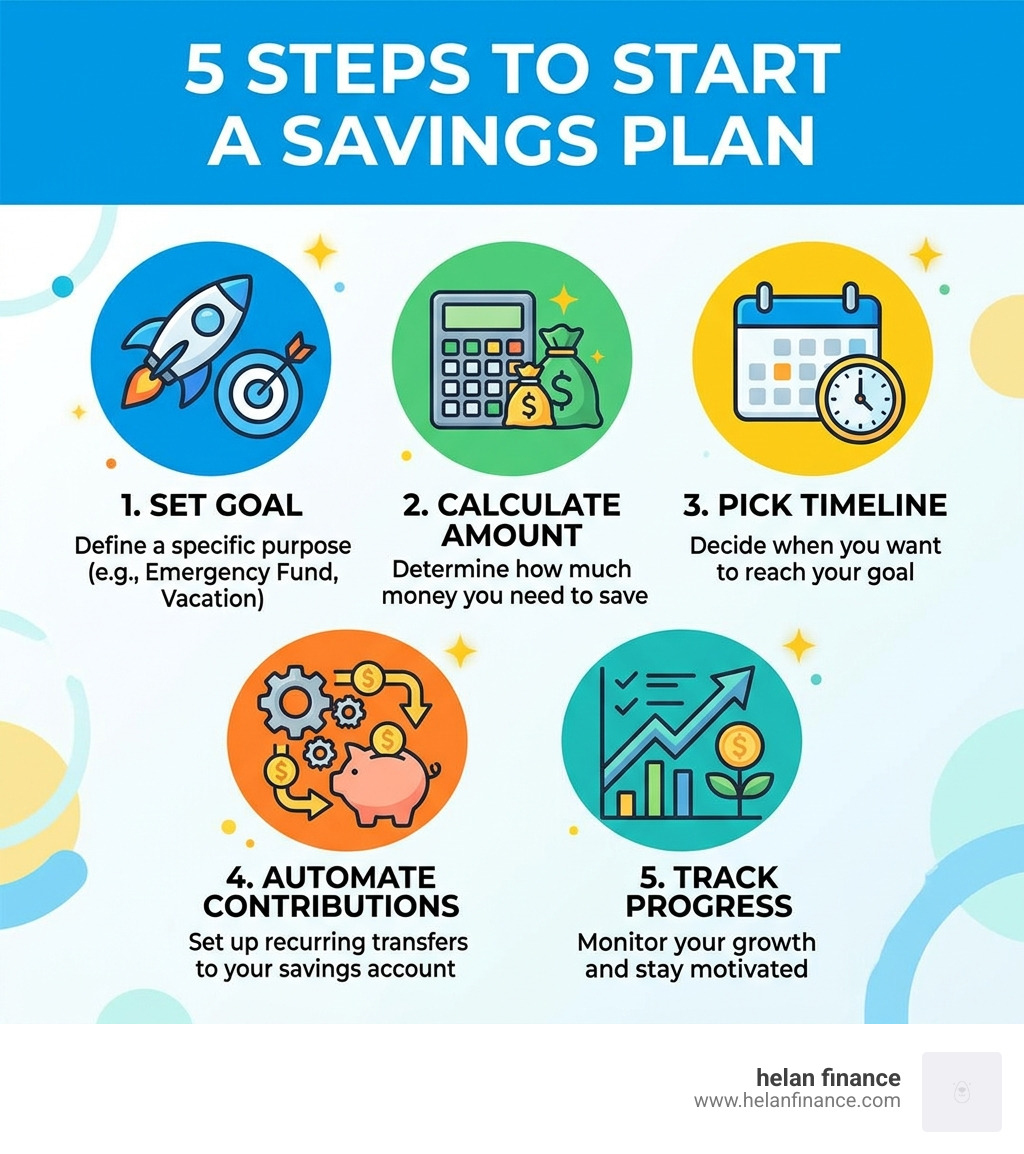
- Identify Your Goal: Be specific. “I want to save money” is a wish. “I want to save $5,000 for a car down payment” is a goal.
- Set a Timeline: When do you need the money? Two years? Ten months?
- Calculate the Monthly Amount: Divide your total goal by the number of months. If you need $1,000 in 10 months (about 40 weeks), your target is $25 per week.
- Select the Right Account: Match the account to the timeline. Short-term? High-yield savings. Long-term? Retirement accounts.
- Use Simplified Tools: At Helan Finance, we advocate for using exercises and routines to make this second nature. Our tools help you visualize this growth without the headache.
Monitoring and Adjusting for Success
We recommend sitting down weekly to review your bank accounts and expenses. This isn’t about punishment; it’s about awareness.
- Expense Reduction: Look for “leaks.” Can you cancel an unused subscription? Switch from premium cable to basic? These small wins (like saving $10/week on cable) go directly into your savings plan.
- Budget Alerts: Set up notifications on your mobile app to let you know when you’ve reached a spending limit or when your automatic transfer has cleared.
- Performance Reporting: Once a quarter, look at how much your money has grown through interest. Watching those small amounts add up builds the confidence to keep going.
Frequently Asked Questions about Savings Plans
Who is eligible to participate in a savings plan?
Virtually everyone! While specific employer-sponsored plans (like a 401k or TSP) require you to be an employee, anyone can open a traditional savings account, a high-yield account, or an Individual Retirement Account (IRA). The only real “requirement” is having a source of income—no matter how small—to start your contributions.
Can I modify or cancel my plan after the commitment starts?
In personal banking, absolutely. You can usually change your automatic transfer amount or frequency at any time through your banking app. However, some structured products like CDs may charge a penalty if you withdraw funds before the term expires. In the cloud computing or enterprise world, “Savings Plans” are often rigid contracts, but for your personal finances, flexibility is usually built-in.
What happens to my savings when the plan expires?
When you reach your goal or the “term” of your plan ends (like a CD maturing), the money is yours! You can choose to use it for the intended goal, roll it over into a new savings plan to continue the growth, or move it into a higher-interest investment vehicle. Most people find that once they reach one goal, they have the confidence and the routine established to immediately start the next one.
Conclusion
A savings plan is more than just a ledger of numbers; it’s a commitment to your future self. By breaking down daunting financial hurdles into manageable weekly targets and leveraging the power of automation, you turn “someday” into a certainty.
At Helan Finance, we believe financial planning shouldn’t be a chore. By integrating simple routines, health-focused habits, and straightforward advice, we help you build a foundation that lasts. Whether you’re starting with $25 a week or $2,500 a month, the most important step is the one you take today.
Ready to simplify your financial life? Start your journey to financial wellness and see how easy it can be to watch your future grow.

