
The Best Save Money Habits You Probably Haven’t Tried Yet
Why Save Money Habits Are the Real Secret to Financial Security
Save money habits are the small, repeatable actions that — done consistently — build real wealth over time.
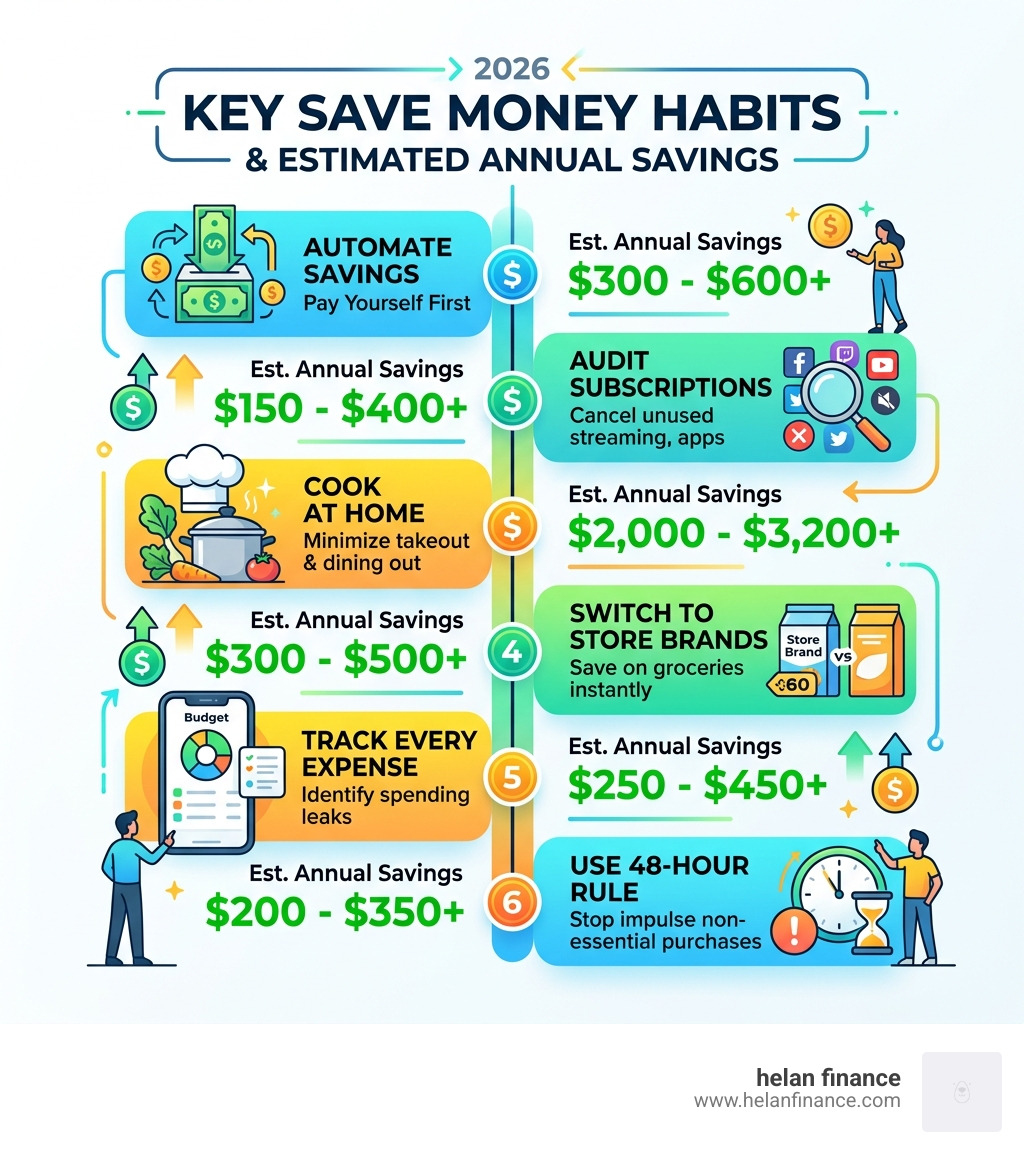
Here are the most effective ones to start today:
- Track every expense for one month to find where your money actually goes
- Automate savings by transferring money to savings on payday, before you spend it
- Build a $500 emergency fund first, then grow to 3-6 months of expenses
- Use the 48-hour rule before any non-essential purchase over $50
- Audit subscriptions monthly and cancel anything you haven’t used in 30 days
- Switch to store brands at the grocery store to save 20-25% instantly
- Set SMART goals — specific, measurable, and time-bound savings targets
- Cook at home instead of eating out to save up to $3,200 a year
Most people think saving money requires a dramatic lifestyle overhaul. It doesn’t.
The US personal savings rate recently sat at just 3.5% — meaning the average American keeps only $3.50 of every $100 earned. That’s not a willpower problem. It’s a systems problem.
Small habits, done automatically and consistently, do more than big one-time efforts. Research consistently shows that people with a savings plan are twice as likely to save successfully compared to those without one. The goal isn’t perfection — it’s building the right systems so saving happens without thinking about it.
This article walks through the best save money habits that most people overlook, organized so you can start with the easiest wins and build from there.
Foundation: Simple Save Money Habits to Start Today
Before we can build a skyscraper of wealth, we need a solid foundation. In April 2026, the financial landscape is faster and more digital than ever, which means our save money habits need to be even more intentional.

At Helan Finance, we believe that saving isn’t a personality trait; it’s a series of behavioral systems. The first step is to stop guessing where your money goes. We recommend starting with a core set of Seven Tips to Establish Good Saving Habits to anchor your strategy.
One of the most effective frameworks is the 50/30/20 rule. This allocates 50% of your income to needs, 30% to wants, and 20% to savings and debt repayment. If you’re currently living paycheck to paycheck, don’t panic. You can start with a 90/5/5 split and gradually move the needle. Another powerful tool is zero-based budgeting, where every single dollar is assigned a “job” before the month begins. This prevents that mysterious “disappearing money” act that happens at the end of every pay cycle.
Finally, schedule a “money date.” This is a 15-minute weekly check-in with yourself (or your partner) to review your progress. It keeps your goals top-of-mind and prevents small slips from turning into landslides.
Tracking Every Penny
You cannot manage what you do not measure. For the next 30 days, we want you to track every single cent. Whether you use a high-tech budgeting app or go old-school with receipt collection, the goal is the same: visibility.
Tracking reveals “spending leaks”—those $5 convenience fees, $10 unused apps, and $15 “quick snacks” that quietly erode your bank account. When we perform category audits, we often find that “invisible” spending compounds dramatically. For instance, three $5 coffees a week might seem small, but that is $780 a year. Seeing these numbers in black and white changes your psychology from “I can afford this” to “Is this worth $800 a year to me?”
Building a Resilient Emergency Fund with Save Money Habits
An emergency fund is your financial “firewall.” It stops a bad day from turning into a bad year. Currently, more than one-third of Americans do not have enough saved to cover a $400 unexpected expense. We want to make sure you aren’t one of them.
Your first goal is a $500 starter emergency fund. This covers the “annoyance” level of emergencies:
- A flat tire or blown battery
- A broken kitchen appliance
- An unexpected co-pay at the doctor
- A last-minute school expense for the kids
Once that $500 is secure, aim for 3-6 months of essential living expenses. Keep this money in a high-yield savings account (HYSA). In 2026, some HYSAs are offering 4.5% to 5.0% APY, compared to the measly 0.4% at traditional big banks. On a $5,000 balance, that’s a difference of over $200 in free interest every year.
Advanced Systems: Automating Your Wealth
Willpower is a finite resource. If you have to decide to save money every single month, eventually, you will have a month where you decide not to. The secret to long-term success is removing the decision entirely.
Automation is the “cheat code” of personal finance. By setting up systems that move money before you can touch it, you ensure your future self is paid first. There are several Simple ways to save money for the future that rely on this “out of sight, out of mind” philosophy.
The Power of Automation
The most effective strategy is the payday transfer. Set your bank account to automatically move a specific amount—even if it’s just $25—into your savings account the very same day your paycheck hits.
You can also use:
- Direct deposit splitting: Ask your employer to send 10% of your check directly to a separate savings account.
- Micro-saving apps: These apps round up your purchases to the nearest dollar and save the change. While it sounds small, it can easily add $30–$50 to your savings every month without you feeling the pinch.
- Recurring deposits: Set up a “sinking fund” for yearly expenses like car registration or holiday gifts.
Leveraging Compound Interest
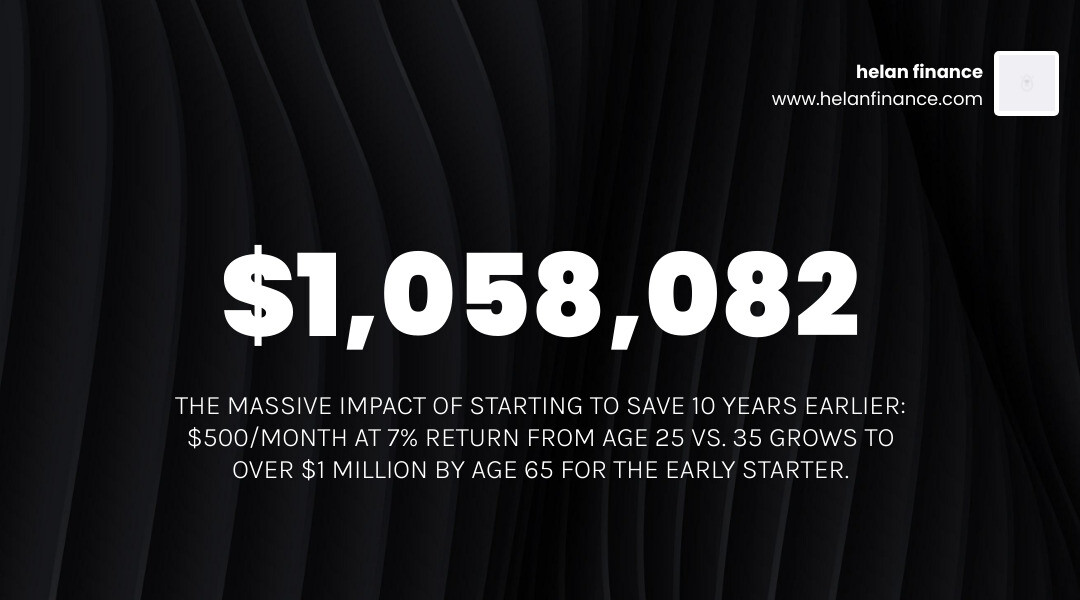
Time is the most powerful ingredient in wealth building. Consider the classic example of Alex and Jordan. Alex starts saving $100 per payday at age 20. Jordan starts saving $200 per payday (double the amount!) but waits until age 30. By age 65, Alex has $1,004,915, while Jordan has $896,047. Alex ends up with over $100,000 more, despite contributing less total money, simply because of the time horizon.
This is why capturing your employer 401(k) match is non-negotiable. It is literally a 100% return on your investment instantly. If you aren’t taking the match, you are leaving free money on the table. Similarly, contributing to a Health Savings Account (HSA) offers a triple tax advantage, making it one of the smartest save money habits for long-term growth.
Mindful Spending: Rules to Curb Impulse Buys
In a world of one-click ordering and targeted social media ads, impulse buying is the enemy of the saver. To combat this, we need to build “friction” back into our spending.

Many people are turning to frugal habits used to save money like “broke planning,” which involves acting as if you have less than you do to force creative problem-solving. One of the best ways to do this is to remove credit card autofill from your browser and delete shopping apps from your phone. If you have to walk to the other room to get your wallet and manually type in 16 digits, you’re much more likely to ask, “Do I actually need this?”
The 48-Hour Rule for Impulse Buys
This is our favorite psychological barrier. For any non-essential purchase over a certain threshold (we suggest $50), you must wait 48 hours before buying it.
This cooling-off period allows the “dopamine hit” of the potential purchase to fade. Often, after two days, you’ll realize you didn’t actually want the item; you just wanted the feeling of buying something. For larger purchases, some people even use a 30-day rule. If you still want it after a month, and it fits in the budget, you can buy it with zero guilt.
Daily Save Money Habits for Food and Dining
The average American spends around $3,200 per year eating out. While we love a good meal out, treating it as a deliberate event rather than a reflexive “I’m tired” decision can save thousands.
- Meal Planning: Spending 20 minutes on Sunday planning your week can prevent those $60 mid-week delivery orders.
- The “Lazy Meal” Prep: Always keep one or two “ready-ish” meals in the freezer (like a frozen pizza or ingredients for grilled cheese). It’s much cheaper than takeout when you’re too exhausted to cook.
- Grocery Lists and Pickup: Using a grocery pickup service helps you stick to a list and prevents the “eye-balling” impulse buys that happen in the aisles.
- Brown-Bagging Lunch: Bringing lunch to work just four days a week can create a $500 emergency fund in a single year.
Lifestyle Optimization: Cutting Hidden Costs
Sometimes, the best save money habits aren’t about buying less, but about paying less for what you already use. This is called lifestyle optimization.
Start with the “Generic Challenge.” Switching to generic or store brands for staples like flour, salt, and cleaning supplies can save 20% to 25% on your grocery bill. This is especially true for store-brand medications, which often cost 20-40% less than name brands but contain the exact same active ingredients.
Auditing Subscriptions and Fees
The average person underestimates their monthly subscription costs by $133. We recommend a “Streaming Rotation.” Instead of paying for Netflix, Hulu, Disney+, and HBO all at once, pick one per month. Watch your shows, cancel, and switch to the next one.
Other quick wins include:
- ATM Fee Avoidance: Using another bank’s ATM once a week at $3 per withdrawal costs over $150 a year. Stick to your bank’s network.
- Virtual Credit Cards: Use services that allow you to set spending limits on subscriptions so you don’t get hit with a surprise “free trial” renewal.
- Bank Maintenance Fees: If your bank charges you $12 a month just to hold your money, it’s time to switch to a no-fee online bank or credit union.
Reducing Home and Utility Costs
U.S. households spend an average of $366 per month on utilities. You can chip away at this with a few low-effort habits:
- Lower the Water Heater: Dropping the temperature to 120 degrees can save up to 5% on your heating costs.
- Cold Water Laundry: Most modern detergents work perfectly in cold water, and you’ll save on the energy required to heat the tank.
- Eliminate Standby Power: Use power strips for electronics and turn them off when not in use. “Vampire power” can account for up to 10% of a home’s electricity use.
- LED Bulbs: If you haven’t switched yet, do it now. They use 75% less energy and last 25 times longer than incandescent bulbs.
Frequently Asked Questions about Save Money Habits
How do I start saving money right now with no extra income?
The fastest way is to find “found money” in your current spending. Track your expenses for 48 hours—you will likely find a subscription you forgot about or a recurring convenience purchase you don’t actually value. Cancel one $15 subscription today, and you’ve already started. Also, focus on the “Big Three”: housing, transportation, and food. Cutting $50 from your grocery bill by switching to store brands is more effective than trying to save pennies on smaller categories.
What is the most effective automatic saving strategy for 2026?
The “Payday Split” remains the gold standard. Have a portion of your paycheck sent directly to a high-yield savings account that is not connected to your main checking account. This creates a “friction” barrier—it takes a day or two to transfer the money back, which prevents you from spending your savings on a whim.
How does the 24-hour rule help prevent impulse spending?
The 24-hour rule (or 48-hour rule) works by breaking the emotional cycle of shopping. Retailers design websites to make buying as fast as possible to capitalize on your immediate excitement. By forcing a waiting period, you allow your logical brain to take over from your emotional brain. Most of the time, the “need” for the item disappears once the initial excitement wears off.
Conclusion
Building save money habits is not about deprivation; it’s about intention. It’s about deciding that your future security is more important than a fleeting purchase today. Whether you start by tracking your expenses, automating a $20 transfer, or finally switching to those generic-brand meds, every small step counts.
In April 2026, the tools to manage your money are more powerful than ever. At Helan Finance, we specialize in making this process simple and efficient. By focusing on consistency over intensity, you can build a financial foundation that provides peace of mind and the freedom to enjoy life without guilt.
Ready to take the next step? Find more info about simplified financial planning and start your journey toward financial freedom today. The best time to start was ten years ago; the second best time is right now.

