
Average Weekly Expenses for a Single Person: A Reality Check
What Are the Average Weekly Expenses for a Single Person in the US?
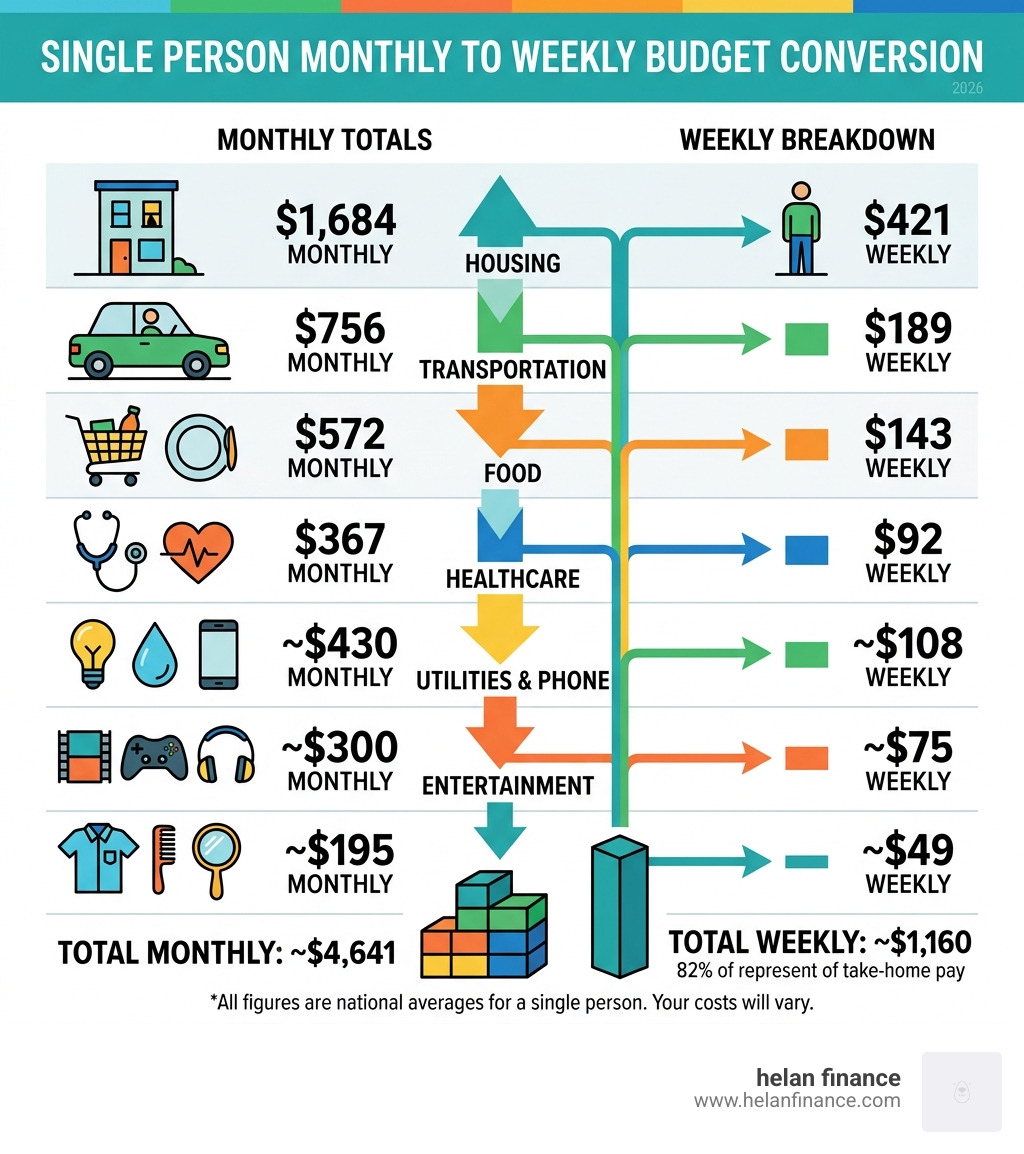
The average weekly expenses for a single person in the US run approximately $1,160 per week (around $4,641 per month), based on Bureau of Labor Statistics data. Here’s how that breaks down by major category:
| Expense Category | Monthly Average | Weekly Average |
|---|---|---|
| Housing | $1,684 | $421 |
| Transportation | $756 | $189 |
| Food | $572 | $143 |
| Healthcare | $367 | $92 |
| Utilities & Phone | ~$430 | ~$108 |
| Entertainment | ~$300 | ~$75 |
| Clothing & Personal Care | ~$195 | ~$49 |
| Total (approximate) | ~$4,641 | ~$1,160 |
Note: Figures are national averages. Your actual costs will vary based on location, lifestyle, and debt obligations.
Living alone means every bill lands on one person. There’s no splitting rent, no sharing a grocery run, no splitting a streaming subscription. That financial reality hits differently when you see it laid out week by week.
Most personal finance articles talk in monthly or annual numbers. But weekly is how most people actually experience money — it’s closer to how we get paid, how we plan, and how we overspend.
The good news? Once you know what the average single person actually spends each week, you have a real benchmark. You can spot where you’re on track, where you’re overpaying, and where a small change could free up serious cash.
Whether you’re earning a steady salary or juggling irregular income, understanding your weekly cost baseline is the first step toward feeling in control of your finances — without needing a finance degree to get there.
Breaking Down the Average Weekly Expenses for a Single Person
When we look at the 2026 economic landscape, the total average weekly expenses for a single person can fluctuate between $1,160 and $1,237 depending on the specific data set used (such as the Bureau of Labor Statistics or the Bureau of Economic Analysis). These organizations track “consumer units,” which include single persons living alone or sharing a household while remaining financially independent.
Understanding these numbers requires looking at after-tax income. On average, American households spend about 82% of their take-home pay on living expenses. For a single person, the lack of “economies of scale”—the ability to share a pizza or a two-bedroom apartment—means that a higher percentage of their income often goes toward fixed costs.
Fixed costs are those “non-negotiables” like rent or insurance, while variable costs include things like your Friday night out or a new pair of shoes. According to What Are the Average Monthly Expenses for One Person? | SoFi, singles often devote about 36% of their total income to housing alone, which is a higher burden than that faced by married couples or families.
Geographic Variations in Weekly Spending
National averages are a helpful starting point, but they don’t tell the whole story if you live in a high-cost coastal city versus a rural town in the Midwest. Location is arguably the biggest factor in determining your personal “reality check.”
- Coastal Cities: In places like New York City or San Francisco, a studio apartment can easily cost $3,500 a month, driving your weekly housing cost up to $875.
- Midwest and South: In cities like Oklahoma City or Roanoke, that same one-bedroom might cost $800 to $1,200 a month, bringing the weekly expense down to a more manageable $200–$300.
- Modest Living Standards: The Family Budget Fact Sheet – Economic Policy Institute notes that a “modest but adequate” lifestyle is based on the 40th percentile of fair market rents. This means you aren’t living in luxury, but you aren’t in substandard housing either.
The Impact of 2026 Inflation
As of April 2026, we are still navigating the ripples of recent inflationary trends. While the runaway price hikes of previous years have slowed, the Consumer Price Index (CPI) shows that shelter and food remain volatile.
Shelter inflation has hovered around 3.2% year-over-year, while food costs have seen a 3.1% increase. For a single person, this means your purchasing power is constantly being tested. Even if your salary stays the same, your “weekly basket” of goods—eggs, milk, gas, and electricity—costs slightly more every few months. This makes it more important than ever to have a clear view of your average weekly expenses for a single person.
Essential Costs: Housing, Food, and Transportation

The “Big Three”—housing, food, and transportation—typically consume over 60% of a single person’s budget.
Housing and Utility Breakdown
Housing is the undisputed heavyweight champion of expenses. At a national average of $421 per week, this includes rent or mortgage payments, property taxes, and maintenance.
However, the “sticker price” of rent isn’t the whole story. Utilities add a significant weekly layer:
- Electricity: ~$34/week
- Natural Gas: ~$17/week
- Water: ~$12/week
- Renter’s Insurance: ~$5/week (an essential but often overlooked cost)
For homeowners, these costs can be higher due to maintenance and HOA fees, whereas renters might save on those but face annual rent hikes.
Food and Grocery Logistics for Singles
Food expenses for a single person average about $143 per week. This is usually split between groceries (~$90) and dining out or takeout (~$53).
Singles face unique logistical challenges here:
- Bulk Buying: It’s hard to finish a “family size” bag of spinach before it turns into green slime.
- Food Waste: Portions at the grocery store aren’t designed for one. We often pay a “convenience tax” for smaller portions or end up throwing money in the trash.
- Meal Prep Efficiency: We recommend meal planning not just to save money, but to ensure you actually use what you buy. The USDA “low-cost” food plan suggests that a single adult can eat nutritiously for less if they prioritize home-prepared meals.
Transportation: The Cost of Getting Around
Whether you’re commuting to an office or just running errands, transportation costs average $189 per week. This includes:
- Car Payments: The average new car payment has climbed to over $700/month, or $175/week.
- Fuel and Insurance: Gas prices fluctuate, but insurance for a single driver is often higher than multi-car policies.
- Public Transit: If you live in an urban center and ditch the car, you might spend only $50–$60 a week on transit passes, which is a massive win for your budget.
Healthcare, Utilities, and Discretionary Spending

Once the essentials are covered, we move into the costs that keep us connected, healthy, and—let’s be honest—sane.
Healthcare and Insurance
Healthcare averages $92 per week. This covers health insurance premiums (which can be significantly higher if you aren’t covered by an employer plan), as well as out-of-pocket costs like co-pays and prescriptions. For those in their 20s and 30s, this might feel high until an unexpected urgent care visit happens.
Communication and Digital Services
In 2026, being “offline” isn’t really an option.
- Cell Phone: A basic single-line plan can be found for $25/week, though many “unlimited” plans run higher.
- Internet: High-speed internet is a necessity for remote work, averaging about $15–$20 per week.
- Streaming & Subscriptions: Between Netflix, Spotify, and that gym membership you intend to use, singles spend about $20–$30 weekly. “Subscription fatigue” is real; we suggest auditing these monthly to see what you actually use.
Personal Insurance and Debt Obligations
This is the “hidden” part of the average weekly expenses for a single person.
- Student Loans: With the average graduate carrying significant debt, weekly payments can range from $50 to $150.
- Credit Cards: If you’re carrying a balance, interest payments can eat up $20–$40 a week without ever touching the principal.
- Retirement: We strongly believe in “paying yourself first.” Even $50 a week into a 401(k) or IRA makes a massive difference over time.
Strategies to Manage Your Weekly Budget
Knowing the numbers is half the battle; managing them is the other half. At Helan Finance, we believe in simplified routines to keep your finances healthy.
Tracking Your Average Weekly Expenses for a Single Person
If you don’t know where your money is going, you can’t tell it where to go.
- Daily Logging: Spend two minutes every evening recording what you spent.
- Categorization: Separate your “Needs” from your “Wants.”
- Calculate Take-Home Pay: Base your budget on what actually hits your bank account, not your gross salary.
The 50/30/20 Rule
We recommend this classic framework for singles:
- 50% for Needs: Housing, utilities, groceries, and basic transit.
- 30% for Wants: Dining out, hobbies, and entertainment.
- 20% for Savings and Debt: Building that emergency fund and killing off high-interest credit cards.
Reducing Your Weekly Costs
If your average weekly expenses for a single person are higher than the national average and it’s causing stress, consider these “levers”:
- Shared Housing: Getting a roommate can cut your largest expense (housing) by 40% or more.
- Subscription Audit: Cancel anything you haven’t used in the last 30 days.
- Generic Brands: Switching to store-brand groceries can shave $15–$20 off your weekly food bill.
- Energy Efficiency: Small habits like using a programmable thermostat or washing clothes in cold water can lower utility bills by $10 a week.
Frequently Asked Questions about Single Person Expenses
Is $1,200 a week enough for a single person?
Yes, in most parts of the US, $1,200 a week is a very solid budget. Since the national average is around $1,160, this amount covers the basics and allows for some savings and “fun” money. However, in ultra-high-cost cities like NYC, $1,200 might feel tight after paying for a solo apartment.
How much should a single person spend on groceries weekly?
A realistic goal is $75 to $100 per week. This allows for a mix of fresh produce, proteins, and some convenience items. If you are spending more than $150 a week on groceries alone, you might be dealing with significant food waste or buying expensive pre-packaged meals.
Does living alone increase your weekly costs compared to sharing?
Absolutely. Singles pay what is often called the “Singles Tax.” You carry the full cost of high-speed internet, trash pickup, and heating/cooling a home. Shared households can split these fixed costs, often reducing individual weekly expenses by 20–30%.
Conclusion
Managing the average weekly expenses for a single person doesn’t have to be an overwhelming chore. It’s about finding a balance between enjoying your independence and securing your financial future. By understanding the benchmarks—like the $421 for housing or the $143 for food—you can make informed decisions about where to splurge and where to save.
At Helan Finance, we specialize in making this process easy and efficient. Our goal is to provide you with the routines and advice you need to turn these statistics into a sustainable, healthy lifestyle. The goal isn’t just to be “average”—it’s to be intentional.
Start your journey to efficient financial planning and take control of your weekly budget today.

