
How to Build Better Financial Habits Before Your Next Paycheck
Why Financial Habits for Wealth Building Matter More Than Your Income
Financial habits for wealth building are the small, repeated money behaviors that compound into lasting wealth over time — and they matter far more than how much you earn.
Here are the core habits that move the needle:
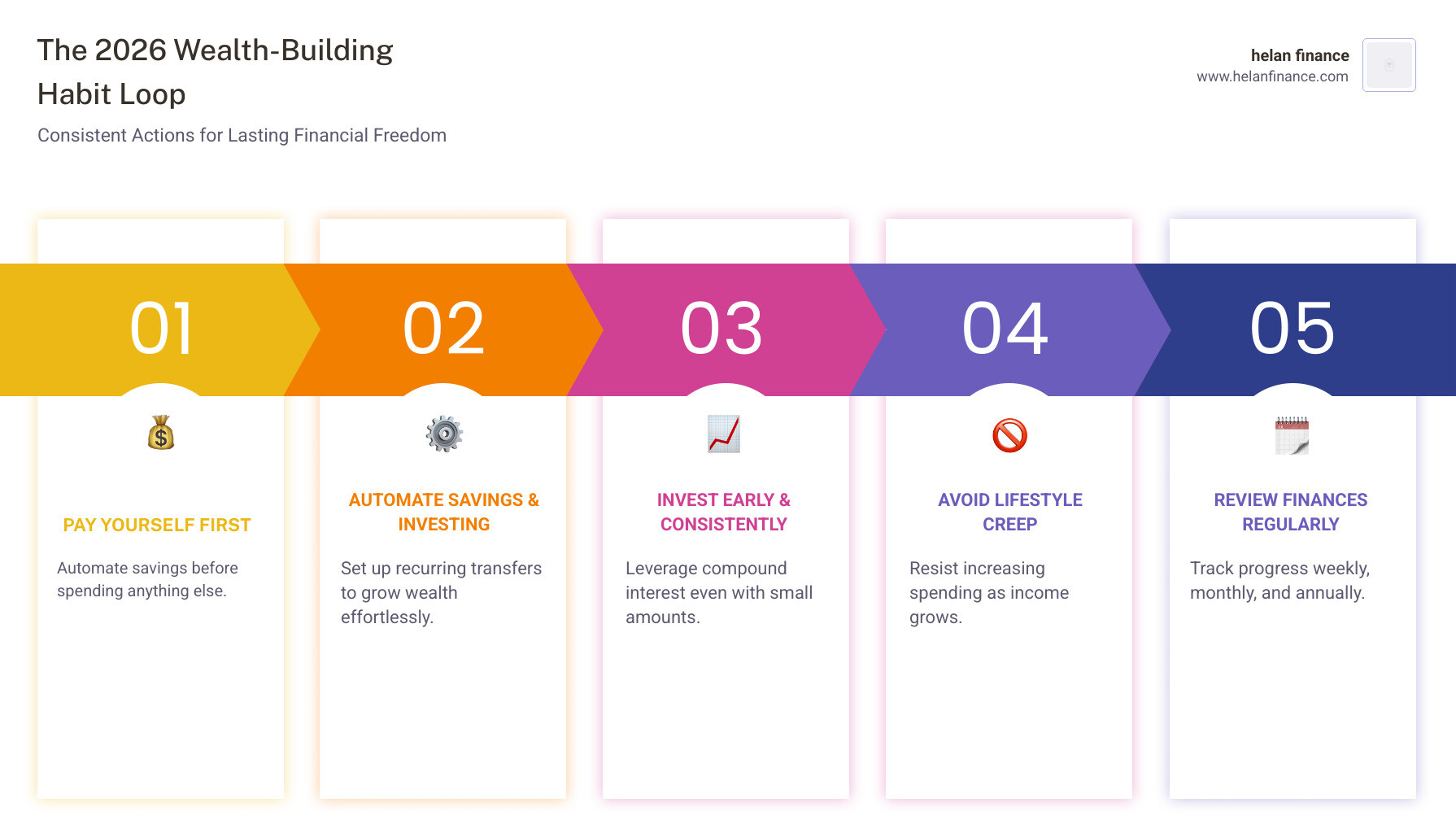
- Pay yourself first — automate savings before you spend anything
- Live below your means — keep expenses below your income, consistently
- Build an emergency fund — 3–6 months of essential expenses, kept liquid
- Eliminate high-interest debt — use the avalanche or snowball method
- Invest early and automatically — even small amounts grow significantly over time
- Avoid lifestyle creep — don’t let spending rise every time income does
- Review your finances regularly — weekly, monthly, and annually
Most people assume wealth is about a big salary, a lucky investment, or an inheritance. It’s not.
Research consistently shows that automated savers accumulate 3–5x more wealth than non-automated savers over 20 years. And someone investing $500 a month starting at age 25 can reach nearly $1.2 million by age 65 — while someone who waits until 35 reaches only about half that.
The difference isn’t talent or income. It’s behavior, repeated consistently.
Less than one-third of Americans understand compound interest — yet those who do are significantly more likely to build real wealth. That knowledge gap is exactly what this guide is designed to close.
Whether you’re juggling a busy schedule, feeling behind on savings, or just want a cleaner system for your money — the right financial habits, applied consistently, are the most reliable path forward.
The Foundation of Financial Habits for Wealth Building
Building wealth isn’t a sprint; it’s a series of small, intentional steps that create a sturdy financial house. Before we can talk about advanced investment strategies or complex tax planning, we must stabilize the foundation. This starts with the most non-negotiable trait among the wealthy: the habit of paying themselves first.

When we “pay ourselves first,” we treat our savings and investments like a mandatory bill that must be paid as soon as our paycheck hits our account. If we wait until the end of the month to see what’s left over, the answer is usually “nothing.” By automating a transfer to a savings or brokerage account on payday, we remove the need for willpower.
Coupled with this is the practice of living below our means. This doesn’t mean living in deprivation; it means being intentional with every dollar. We like to think of a budget not as a cage, but as a roadmap. It gives us permission to spend on what we value while cutting ruthlessly on what we don’t. For more on these basics, checking out 10 Tips For Money Management & Building Personal Wealth can provide a great starting point for organizing your cash flow.
A critical part of this foundation is the emergency fund. In 2026, the macroeconomic landscape can be unpredictable. An emergency fund acts as an “investment protector.” It ensures that when a car breaks down or a roof leaks, we don’t have to sell our stocks at a loss or take on high-interest debt to cover the cost. We recommend keeping 3 to 6 months of essential living expenses in a liquid, high-yield savings account.
Core Financial Habits for Wealth Building in Young Adulthood
If you are in your 20s or early 30s, your greatest asset isn’t your paycheck—it’s time. This is the era of financial socialization, where the habits we form now dictate our trajectory for the next forty years.
The most important habit for young adults is capturing the full employer match in their retirement accounts. This is essentially a 100% return on your money immediately. Beyond that, maintaining credit health is vital. A high credit score saves you thousands in interest on future home or car loans. A simple rule to live by? Keep your credit utilization below 30% and never miss a payment.
Managing Debt with the Avalanche and Snowball Methods
Debt is the primary anchor that holds back financial habits for wealth building. To get ahead, we must address high-interest debt (anything above 10% APR) aggressively. There are two main ways to do this:
- The Debt Avalanche: You list debts by interest rate and pay off the highest rate first. This is mathematically superior and saves the most money in the long run.
- The Debt Snowball: You list debts by balance and pay off the smallest one first. This provides quick psychological wins that keep you motivated.
Neither is “wrong.” The best method is the one you will actually stick to until the balance hits zero.
Advanced Strategies to Accelerate Your Net Worth
Once the foundation is set, it’s time to shift from defense to offense. Advanced wealth building is about optimization—making sure every dollar is working as hard as possible.
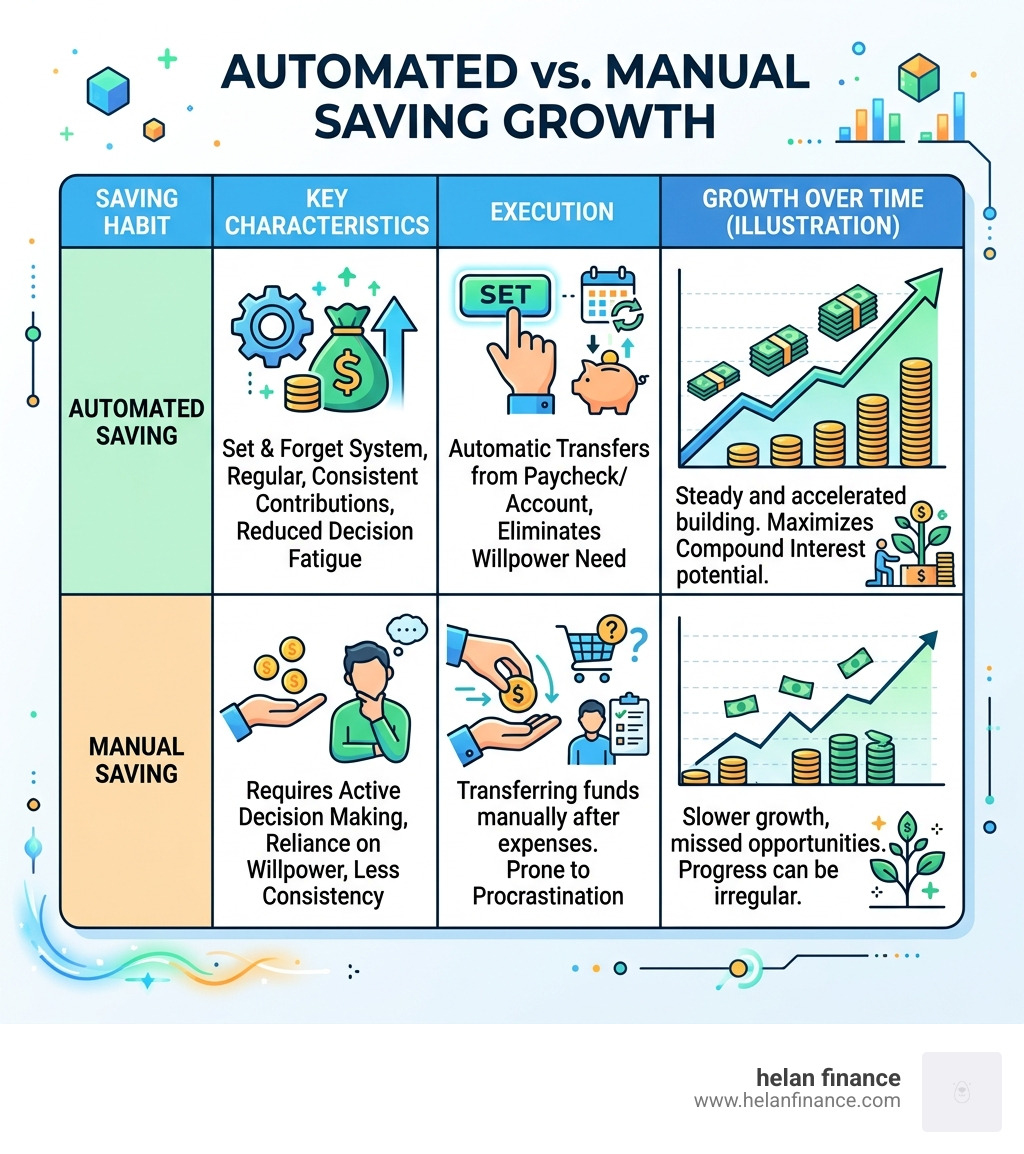
Automation is the “secret sauce” here. Systems outperform motivation every single time. By automating your contributions to tax-advantaged accounts like an HSA (Health Savings Account) or a Roth IRA, you ensure your wealth grows in the most tax-efficient way possible. An HSA is particularly powerful as a “stealth retirement account” because it offers a triple-tax advantage: contributions are tax-deductible, growth is tax-free, and withdrawals for medical expenses are tax-free.
Another advanced habit is the obsession with minimizing fees. In the investing world, you don’t get what you pay for; you get what you don’t pay for. High expense ratios in mutual funds can quietly drain hundreds of thousands of dollars from your lifetime wealth. We look for low-cost index funds with expense ratios under 0.20% (ideally closer to 0.05%). For a deeper dive into how these habits look in practice, Simple Financial Habits to Help Build Wealth offers excellent checklists for keeping your portfolio on track.
Protecting Your Financial Habits for Wealth Building Against Inflation
In April 2026, inflation remains a “silent tax” that erodes purchasing power. To protect your wealth, you must own assets that have “pricing power”—companies that can raise prices as costs rise—and real estate.
Diversifying into Treasury Inflation-Protected Securities (TIPS) or maintaining a portfolio of broad-market index funds allows your money to outpace the rising cost of goods. Additionally, leveraging fixed-rate debt, like a 30-year mortgage, can actually be a hedge against inflation, as you are paying back the loan with “cheaper” future dollars.
Minimizing the Success Tax and Lifestyle Creep
Lifestyle creep is the phenomenon where your spending rises exactly in tandem with your raises. To build wealth, you must maintain a gap between what you earn and what you spend.
When you get a raise or a bonus, try the “50/50 rule”: Put 50% of the increase toward your future (savings/investments) and use the other 50% to improve your current lifestyle. This allows you to enjoy your success without sabotaging your long-term goals. Tracking your net worth monthly—not just your income—is the best way to stay honest about your progress.
The Behavioral Science of Making Money Habits Stick
Why is it so hard to save even when we know we should? It’s because our brains are wired for immediate rewards, not long-term security. The basal ganglia, the part of the brain responsible for habits, loves the dopamine hit of a new purchase.

To combat this, we use “friction.” If you struggle with impulse spending, delete your saved credit card info from your favorite websites. Implement the 48-hour rule: for any non-essential purchase over $50, you must wait two days before hitting “buy.” Research shows that over 70% of impulse desires fade within this window.
Building a “saver identity” is also key. Instead of saying “I can’t afford that,” try saying “I don’t spend money on things that don’t align with my values.” This shift from deprivation to intention makes the habit feel like a choice rather than a chore. For a comprehensive look at how these behaviors transform into wealth, 13 financial habits that could help you build wealth – TruStage breaks down the timeline of habit formation.
A Year-Round Checklist for Consistent Wealth Growth
Wealth building is a routine, not an event. To keep the momentum, we recommend a structured checklist:
Daily Habits:
- Check your bank balance (awareness prevents overspending).
- Practice contentment (remind yourself of what you already have).
- Avoid market noise (don’t check your portfolio every time the news gets loud).
Weekly Habits:
- Review your spending for the week.
- Check that automated payments went through.
Monthly Habits:
- Calculate your net worth.
- Review your budget vs. actual spending.
- Ensure 10-20% of your income went toward savings/investments.
Quarterly Habits:
- Audit your subscriptions. That $10 “forgotten” app costs $120 a year.
- Check your progress toward your “big” annual goals.
Annual Habits:
- Rebalance your investment portfolio.
- Increase your automated contribution amounts by at least 1-2%.
- Review your insurance coverage (life, disability, homeowners).
- Update your estate plan or will.
Frequently Asked Questions about Wealth Building
How long does it take for a new financial habit to become automatic?
While the old myth says 21 days, modern behavioral research suggests it takes closer to 40-66 days of consistent repetition for a financial habit to feel automatic. For things like checking a budget or saving a portion of a paycheck, expect it to feel “natural” after about three cycles of consistent practice.
What is the most effective way to stop impulse spending?
The most effective tool is the 48-hour rule. By introducing a time delay, you move the decision from the emotional part of your brain to the logical part. Additionally, calculating the cost of an item in “life energy”—how many hours you had to work to pay for it—is a powerful deterrent for unnecessary spending.
How much should I save in an emergency fund for 2026?
We recommend 3-6 months of essential living expenses. If you have a stable job and low expenses, 3 months might suffice. If you are self-employed or have dependents, aim for 6 months. Keep this money in a high-yield savings account so it stays liquid but still earns a bit of interest to combat inflation.
Conclusion
At Helan Finance, we believe that wealth building shouldn’t be a source of stress. Our mission is to provide simplified financial planning tools that fit into your actual life—not a life lived in a spreadsheet. By focusing on small exercises, daily routines, and even health tips that keep you energized for the journey, we help you build a system that runs on autopilot.
Building financial habits for wealth building is about reclaiming your time and your freedom. It starts with one small action today—perhaps setting up a $50 auto-transfer or canceling one unused subscription.
Ready to take the next step toward a simpler financial future? Start your financial journey with us today and see how easy wealth building can be when you have the right habits in place.

