
How to Keep Your Eyes on the Prize with This Debt Reduction Motivation Guide
Why You Need a Debt Reduction Motivation Guide (And How to Use One)
A debt reduction motivation guide is a structured system that combines proven payoff strategies with psychological tools to help you stay consistent until your last balance hits zero. Here’s what actually works:
Quick-start steps to stay motivated while paying off debt:
- Write down every debt you owe — balance, interest rate, minimum payment
- Choose a payoff method that fits your personality (snowball for quick wins, avalanche for interest savings)
- Track progress visually — a simple chart or thermometer keeps momentum real
- Set milestone rewards — small, budget-friendly treats tied to specific payoff goals
- Find an accountability partner — someone to check in with regularly
- Automate your payments — remove the friction of remembering every due date
- Build a small emergency buffer ($500–$1,000) so surprises don’t derail you
Debt is exhausting — and not just on your wallet.
About 25% of Americans list paying off debt as their number one financial goal. Yet most people don’t fail because they lack information. They fail because motivation runs out before the balance does.
Here’s the uncomfortable truth: carrying debt doesn’t just drain your bank account. Research from the National Academy of Sciences found that debt actively reduces cognitive performance, raises anxiety, and impairs decision-making — even when you’re not thinking about it. It occupies mental space constantly, like a browser tab you can never close.
The good news? The same research shows that paying off even one debt account can reduce anxiety by around 30% and sharpen decision-making within just four to six weeks.
That means getting started — and staying started — is the most valuable financial move you can make right now.
This guide is built for busy people who don’t have hours to spend on spreadsheets. You’ll get clear, simple strategies to stay motivated, pick the right payoff method, find extra money, and build habits that actually stick.
The Science of Debt: Why Your Brain Craves a Debt Reduction Motivation Guide
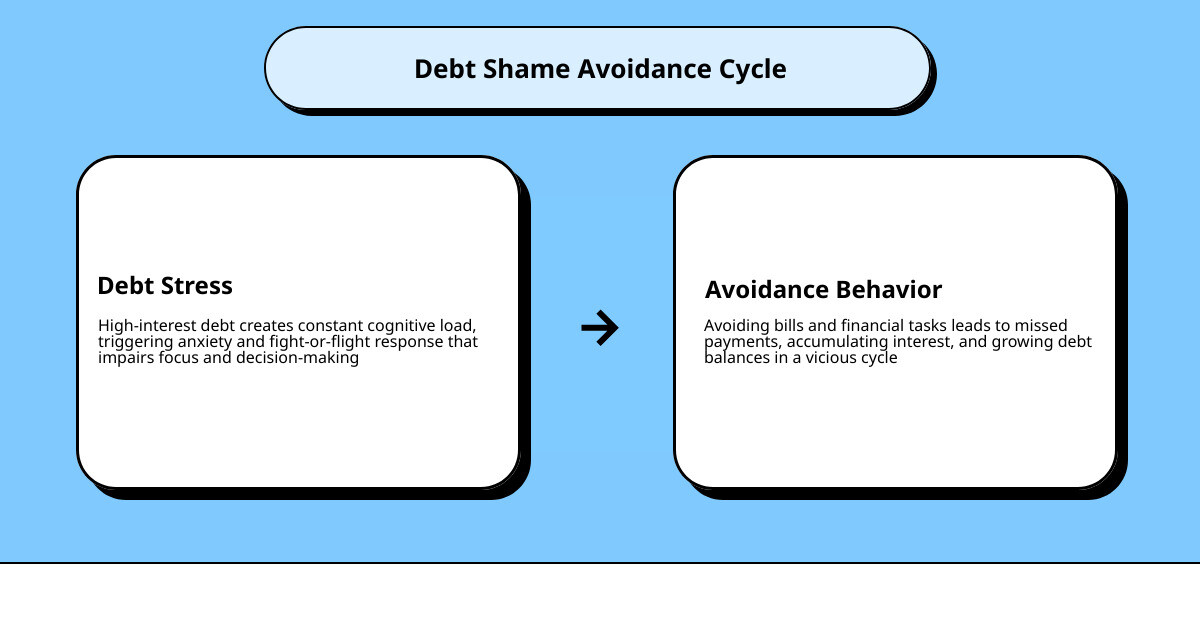
In April 2026, the economic landscape continues to shift, and with it, our understanding of how debt affects the human brain. We often think of debt as a math problem, but it is deeply rooted in neurobiology. Debt acts as a “cognitive load”—a heavy mental weight that consumes energy and decision-making capacity. When we carry high-interest balances, our brains are constantly diverted to a state of low-level “fight or flight,” which makes it harder to focus on long-term goals or complex tasks.
Science shows that paying off debt improves psychological functioning. When you use a debt reduction motivation guide to navigate this journey, you aren’t just saving money; you are reclaiming your mental clarity. Studies from the National Academy of Sciences indicate that reducing poverty and debt improves cognitive performance. Essentially, as your debt goes down, your IQ—or at least your ability to use your existing intelligence effectively—goes up.
The psychological drivers at play here involve dopamine and behavioral economics. Every time we see a balance drop, our brain releases a small hit of dopamine. This is why “quick wins” are so vital. Without a guide to help us structure these wins, we often feel like we are throwing money into a black hole, leading to burnout and surrender.
Using a Debt Reduction Motivation Guide to Break the Shame Cycle
Debt often triggers a “shame-avoidance cycle.” We feel bad about the debt, so we avoid looking at the statements, which leads to missed payments and more debt, which then increases the shame. To break this, we must separate our self-worth from our net worth. Having debt doesn’t make you irresponsible; it makes you human in a complex world.
By following a debt reduction motivation guide, you can shift your focus from past mistakes to future victories. Small wins—like paying off a $500 store card—provide the positive reinforcement needed to tackle a $10,000 car loan. These small victories act as behavioral nudges that increase completion rates by 30-40%. When we stop avoiding the numbers and start naming them, the debt loses its power over our emotional well-being.
Assessing the Damage and Choosing Your Battle Plan
Before we can move forward, we have to know exactly where we stand. This starts with a complete debt inventory. You need to list every creditor, the total balance, the interest rate (APR), and the minimum monthly payment. This single act of documentation has been shown to increase success rates by 40% because it removes the “fear of the unknown.”
We also need to look at your Debt-to-Income (DTI) ratio. In April 2026, lenders typically look for a DTI below 43% for mortgage approvals. If yours is higher, don’t panic—this guide is your roadmap to bringing that number down.

Choosing Your Strategy: Efficiency vs. Psychology
There are two primary ways to attack your debt. Choosing the one that matches your personality is the difference between finishing the journey and quitting in month three.
| Feature | Debt Snowball Method | Debt Avalanche Method |
|---|---|---|
| Primary Focus | Smallest balance first | Highest interest rate first |
| Psychological Benefit | Quick wins and high motivation | Knowing you are saving the most money |
| Mathematical Goal | Behavioral modification | Interest rate optimization |
| Completion Rate | 90%+ (highest follow-through) | 70-75% (higher risk of burnout) |
| Best For | People who need to see immediate progress | Analytical people who prioritize math |
The Debt Snowball is widely considered the gold standard for motivation. You pay minimums on everything except the smallest debt. You attack that smallest debt with everything you’ve got. When it’s gone, you take the money you were paying on it and “roll” it into the next smallest debt.
The Debt Avalanche focuses on the highest interest rate. While it saves more money on paper (averaging 30-40% more in interest savings), it can feel slower. If your largest interest rate is on a $20,000 loan, it might take months or years to see your first “win,” which is why many people abandon it.
How to make a debt reduction plan that works for you involves deciding whether you are driven by logic or emotion. Most of us are driven by emotion—and that’s okay.
Practical Tools and Family Strategies to Fuel Your Progress
Motivation is a flickering flame; you need systems to keep it burning. Visual trackers are incredibly effective. Whether it’s a “debt thermometer” on the fridge that you color in as you pay off chunks of $1,000, or a paper chain where each link represents $100 of debt, seeing the progress makes it real.

The Debt Diary and Zero-Spend Days
A debt diary is a fantastic tool for tracking your daily spending and reflecting on your habits. It’s not just about the numbers; it’s about noting small victories. Pair this with “zero-spend days”—challenges where you commit to spending nothing outside of essential bills. Tracking these in your diary provides a sense of control and pride.
Finding “Found” Money
To accelerate your debt reduction motivation guide, you need to find extra cash.
- Subscription Audit: The average person in 2026 spends over $200 a month on subscriptions they barely use. Cancel them.
- The Side Hustle: Picking up even a few hours of freelance work or selling unused household items can generate $200 to $800 a month.
- Windfalls: Use tax refunds (the average in 2024 was $3,011) and bonuses to take massive bites out of your smallest balances.
Involving the Family
Debt reduction shouldn’t be a secret burden. Involve your family in a shared commitment. Hold a family financial meeting to explain the goal: “If we pay off this credit card, we can afford a modest camping trip next summer.” When everyone is on board, it reduces friction and creates a built-in support system.
Frequently Asked Questions about Debt Payoff
How do I stay consistent with a debt reduction motivation guide when progress feels slow?
Consistency is more important than intensity. When progress feels slow, revisit your “Why.” Write down ten reasons you want to be debt-free. Is it to sleep better? To buy a home? To show your children that challenges can be overcome?
Use non-costly rewards to celebrate milestones. If you pay off $1,000, treat yourself to a movie night at home or a visit to a local park you love. Accountability partners are also key; having a friend or a budgeting group to check in with can increase your completion rate by up to 40%. The average person working a focused plan pays off their consumer debt in 18–24 months. You are running a marathon, not a sprint.
Should I prioritize saving or debt repayment in April 2026?
The short answer: do both, but in a specific order.
- The Starter Emergency Fund: Before you throw every extra cent at debt, save $500 to $1,000. This is your “insurance policy” against new debt. If your car needs a tire, you pay cash instead of using the credit card you just tried to pay off.
- High-Interest Debt: Attack anything with an APR over 7% or 8%. Paying off a 22% credit card is the equivalent of a guaranteed 22% return on your investment.
- The 20/10 Rule: Aim to keep your consumer debt payments under 10% of your monthly take-home pay and your total consumer debt under 20% of your annual income.
Your Ultimate Guide to Debt Reduction suggests that once high-interest debt is gone, you can redirect those payments into long-term savings and wealth building.
When is it time to seek additional financial guidance?
If you are only making minimum payments, using credit cards for necessities, or receiving collection calls, it is time for professional help. Options include:
- Debt Management Plans (DMPs): Often offered by nonprofit credit counseling agencies, these can lower interest rates to 6-9% and consolidate payments.
- Balance Transfers: If you have a credit score above 670, a 0% APR balance transfer card can save you hundreds in interest, provided you pay the balance before the promo ends.
- Debt Consolidation Loans: These can simplify multiple high-interest payments into one lower-interest personal loan.
How to Stay Motivated When Dealing With Debt emphasizes that learning about your rights and talking to others can remove the “pit in your stomach” feeling.
Conclusion
At Helan Finance, we believe that financial planning doesn’t have to be a source of stress. Our mission is to provide simplified routines and tools that turn the overwhelming into the achievable. By following this debt reduction motivation guide, you are taking the first steps toward a life of financial wellness and mental clarity.
Becoming debt-free is a journey of behavior modification. It’s about trading temporary impulses for permanent freedom. As you move forward, every dollar paid toward your principal is a dollar of your future freedom bought back.
Your Next Steps to Financial Clarity:
- Today: Create your complete debt inventory. Don’t judge the numbers; just name them.
- This Week: Build your $1,000 emergency buffer to protect your progress.
- This Month: Choose either the Snowball or Avalanche method and make your first extra payment.
- Ongoing: Use a visual tracker and celebrate every small win with a non-costly reward.
For more tips on staying focused, check out 15 Ways to Stay Motivated When Paying Down Debt and explore 7 Common Debt Reduction Strategies to refine your approach.
You have the tools, the science, and the strategy. Now, it’s time to take action.
Start your journey to financial clarity

