
Healthy Spending Habits: Stop the Bleeding and Start Building Wealth
Nearly Half of Americans Are Losing the Money Game — Here’s How to Win It
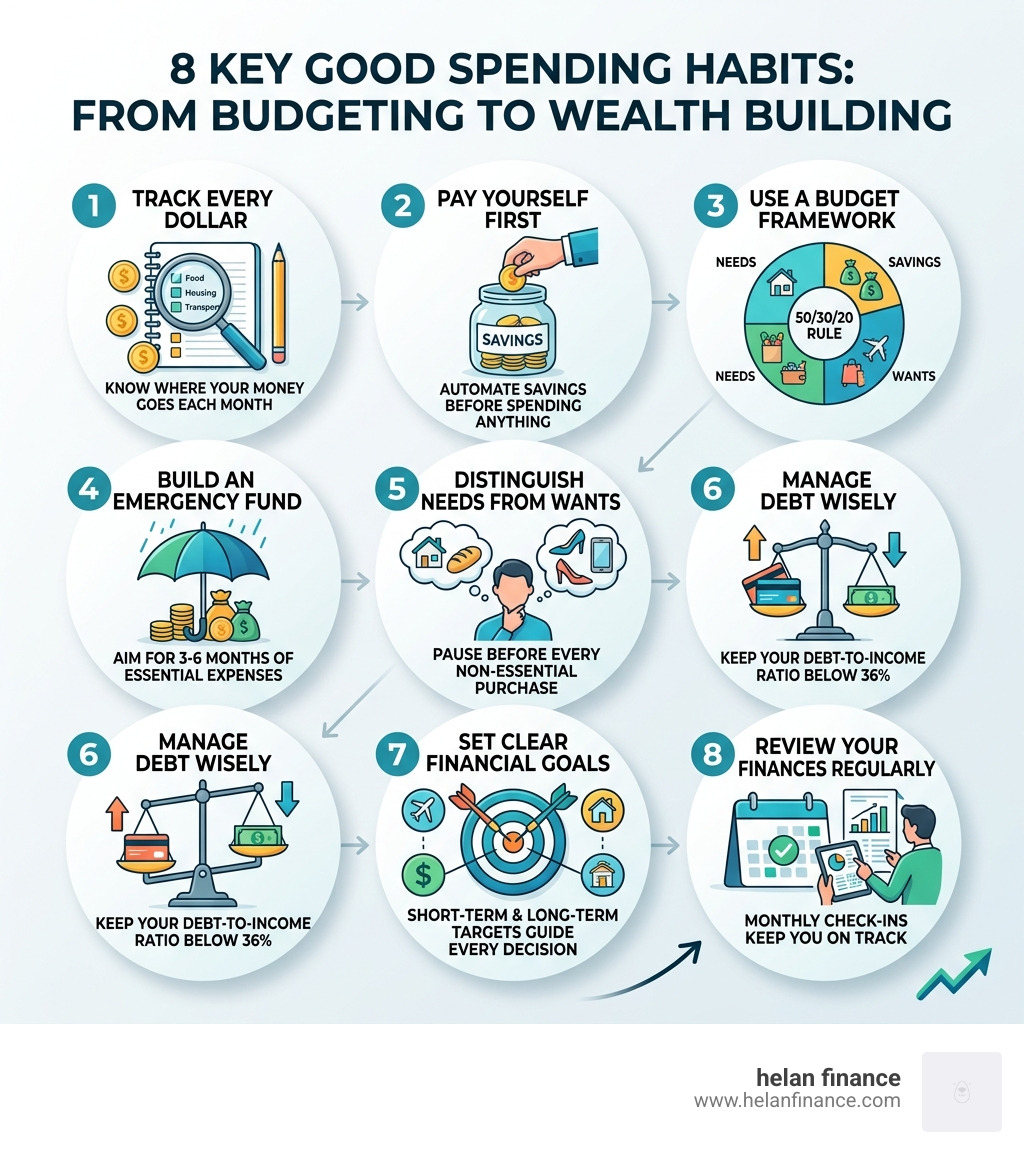
Good spending habits are the foundation of financial success. Here’s a quick look at the most important ones:
The core good spending habits to adopt:
- Track every dollar — know where your money goes each month
- Pay yourself first — automate savings before spending anything
- Use a budget framework — like the 50/30/20 rule (needs/wants/savings)
- Build an emergency fund — aim for 3–6 months of essential expenses
- Distinguish needs from wants — pause before every non-essential purchase
- Manage debt wisely — keep your debt-to-income ratio below 36%
- Set clear financial goals — short-term and long-term targets guide every decision
- Review your finances regularly — monthly check-ins keep you on track
Have you ever checked your bank account and wondered where all your money went? You’re not alone.
Nearly half of all Americans live paycheck to paycheck — not because they earn too little, but often because small, untracked expenses quietly drain their finances month after month.
The gap between financial stress and financial freedom usually isn’t a huge salary jump. It’s a handful of consistent daily habits that compound over time — just like interest does.
The good news? You don’t need to overhaul your entire life. A few smart, simple changes — done consistently — can stop the financial bleeding and start building real wealth.
This guide breaks down exactly what those habits are, why they work, and how to make them stick.
Mastering the Fundamentals of Good Spending Habits
To build a skyscraper, you need a solid foundation. In finance, that foundation is built on good spending habits. Many of us view budgeting as a form of restriction—a “financial diet” that keeps us from having fun. At Helan Finance, we believe a budget is actually a roadmap to freedom. It doesn’t tell you that you can’t spend; it tells you where you can spend so you can reach your goals faster.
One of the most effective ways to structure your money is using a proven framework. The 50/30/20 rule is a fantastic starting point:
- 50% for Needs: This covers your absolute essentials like rent, utilities, groceries, and insurance.
- 30% for Wants: This is your “fun” money—dining out, hobbies, and that streaming service you love.
- 20% for Savings and Debt Repayment: This is the portion that builds your future.
If you want to be even more aggressive with your wealth building, you might consider the 60/20/20 rule, which allocates 60% to living expenses, 20% to savings, and 20% to discretionary spending. Whichever you choose, the goal is to ensure you aren’t overextending yourself. According to research on 8 Healthy Financial Habits You Should Develop, living within your means is the single most important habit you can cultivate.

Tracking Your Progress for Financial Clarity
You cannot manage what you do not measure. Most of us underestimate our spending by hundreds of dollars every month because we ignore the “small” things. That $5 latte or $12 app subscription might not seem like much, but they are often the “leaks” that sink the ship.
To get started, we recommend pulling your bank statements from all accounts for the last three months. This gives you a bird’s-eye view of your patterns. Use a spreadsheet or a digital app to categorize every transaction.
| Expense Category | Type | Examples |
|---|---|---|
| Fixed Costs | Essential | Mortgage/Rent, Insurance, Car Payments, Student Loans |
| Variable Costs | Essential | Groceries, Utilities, Gas |
| Discretionary | Non-Essential | Entertainment, Dining Out, Hobbies |
| Periodic | Essential | Annual Taxes, Car Registration, Holiday Gifts |
By identifying these categories, you can spot pattern recognition. Do you spend more on weekends? Is there a spike in “boredom shopping” on Tuesday nights? Tracking also serves as a vital tool for fraud detection; checking your accounts daily ensures no unauthorized charges slip through the cracks.
The Wealth-Building Blueprint: Pay Yourself First
The biggest mistake people make is saving what is “left over” at the end of the month. Spoiler alert: there is rarely anything left over. The wealthy use a different strategy: they pay themselves first.
This means that as soon as your paycheck hits your account, a portion is immediately moved to savings or investments before you pay a single bill. This removes willpower from the equation. If the money isn’t in your checking account, you won’t spend it.
Living Within Your Means to Accelerate Growth
Living within your means doesn’t mean living in poverty; it means making sure your lifestyle doesn’t expand every time your salary does. This is known as avoiding “lifestyle creep.” When you get a raise in April 2026, instead of moving into a more expensive apartment, try redirecting that extra income straight into your retirement fund.
Consistency is the key to compound interest. Even saving just $60 a month results in over $700 in a year. By age 30, experts suggest having half of your annual income saved for retirement, and double that by age 40. To make this easier, follow these 5 Ways to Practice Good Spending Habits and automate your transfers.
Your first major milestone should be an emergency fund. Aim for 3-6 months of essential living expenses. This fund acts as a buffer against life’s “surprises”—like a car repair or a medical bill—so you don’t have to reach for a high-interest credit card.
Psychological Strategies to Control Your Cash Flow
Spending is rarely just about math; it’s about emotions. We shop when we are stressed, bored, or trying to keep up with the neighbors. In 2020, 26% of shoppers admitted to buying things simply because they were bored.
Understanding your spending triggers is essential. Do you scroll through shopping apps when you’re tired? Do you head to the mall for “retail therapy” after a bad day at work? Recognizing these moments allows you to pause and choose a healthier coping mechanism, like going for a walk or calling a friend.
Developing Good Spending Habits Through Mindful Consumption
Mindful spending is about aligning your purchases with your personal values. Before you buy something, ask yourself: “Does this add real value to my life, or am I just reacting to an impulse?”
A great tip for mindful spending habits is to prioritize experiences over material goods. While a new gadget might provide a temporary thrill, memories from a trip or a dinner with friends often provide more sustained happiness.
To help distinguish needs from wants, try the 24-hour rule. If you see something you want, wait 24 hours before buying it. Research shows that about 70% of the time, that “must-have” feeling fades, and you’ll end up not buying it. For larger purchases, extend this to a 30-day rule.
Breaking the Cycle of Impulse and Boredom Spending
We live in a world designed to make us spend. One-click ordering and targeted ads are the enemies of good spending habits. Here is how we can fight back:
- Use Shopping Lists: Never enter a store (or an app) without a specific list. If it’s not on the list, it doesn’t go in the cart.
- The “One In, One Out” Rule: For every new item you bring into your home, you must get rid of one old item. This forces you to consider if the new purchase is truly worth the space it takes up.
- Add Friction: Delete your saved credit card information from online retailers. Having to walk across the room to get your wallet gives you just enough time to reconsider the purchase.
- Unsubscribe: If your inbox is full of “FLASH SALE” emails, unsubscribe. If you don’t see the deal, you won’t feel the “need” to spend.
For more examples of how to pivot your behavior, check out these 13 Examples of Good and Bad Spending Habits.
Managing Debt and Setting Financial North Stars
Debt is a heavy backpack that slows down your journey to wealth. To manage it wisely, you need to know your numbers. An ideal debt-to-income (DTI) ratio is below 36%. If yours is above 43%, it’s time to take aggressive action.
When paying off debt, you have two main strategies:
- The Avalanche Method: Pay off the debt with the highest interest rate first. This saves you the most money in the long run.
- The Snowball Method: Pay off the smallest balance first to get a quick “win” and build momentum.
Don’t be afraid to negotiate. You can often call your credit card company to ask for a lower interest rate, especially if you have a history of on-time payments. Also, remember to keep your credit card utilization below 30% of your limit to protect your credit score. For more on living frugally while managing debt, see the advice on Good Spending Habits.
Aligning Purchases with Long-Term Financial Goals
Every dollar you spend on a “want” today is a dollar that cannot grow for your future. This is the concept of opportunity cost. When you set clear financial goals—like buying a home, starting a business, or retiring early—it becomes much easier to say no to impulse buys.
We suggest creating “sinking funds” for your goals. If you know you want to take a $2,400 vacation next year, start saving $200 a month now. Naming these accounts (e.g., “European Adventure” or “New Car Fund”) makes the act of saving feel like a reward rather than a sacrifice.
Sustaining Success with Consistent Financial Check-ins
Good spending habits aren’t a “one and done” event; they require regular maintenance. Think of your budget like a garden—if you don’t weed it regularly, the expenses will overgrow.
We recommend a tiered approach to reviews:
- Weekly: Spend 15 minutes reviewing your transactions. Did you stick to your categories? Are there any “sneaky” expenses you missed?
- Monthly: Adjust your budget for the upcoming month. Do you have a friend’s birthday coming up? Does your car need an oil change?
- Annually: Rebalance your investment portfolio and audit your subscriptions. Cancel anything you haven’t used in the last 90 days.
Daily Routines to Maintain Good Spending Habits
The most successful people build small routines that make financial health automatic.
- Daily Account Check: Spend two minutes looking at your bank app. It keeps your balance top-of-mind and helps you catch errors early.
- Receipt Logging: If you use cash, log the expense immediately in a notes app.
- Habit Stacking: Link a financial habit to something you already do. For example, “Every time I brew my morning coffee, I will check my bank balance.”
- Celebrate Small Wins: Did you resist an impulse buy at the checkout line? Give yourself a mental high-five. Progress, not perfection, is the goal.
Frequently Asked Questions about Financial Wellness
How long does it take to form a new spending habit?
Most experts agree it takes about 2 to 3 months for a new habit to truly stick. The first few weeks will feel awkward and restrictive, but if you push through, it eventually becomes your “new normal.” Don’t let one slip-up derail you; just get back on track the next day.
What is the most effective way to distinguish needs from wants?
The best way is the “Wait and Reflect” method. Ask yourself: “Can I survive and perform my job without this?” If the answer is yes, it’s a want. Then, apply a 24-hour cooling period. If you still want it after a day, check if it fits into your “30% Wants” category in your budget. If the money isn’t there, the answer is no for now.
How much should I realistically save for an emergency fund in 2026?
As we look toward April 2026, the standard advice remains to aim for 3 to 6 months of essential living expenses. If your monthly essentials (rent, food, utilities, minimum debt payments) cost $3,000, your goal is $9,000 to $18,000. Keep this in a high-yield savings account so it stays liquid but still earns a bit of interest.
Conclusion
Developing good spending habits is the most powerful thing you can do for your future self. It’s not about how much you make, but how much you keep—and how intentionally you use it. By tracking your spending, paying yourself first, and staying mindful of your triggers, you can transform your relationship with money from one of stress to one of empowerment.
At Helan Finance, we specialize in simplified financial planning. We provide the tools, routines, and advice you need to stop the bleeding and start building the wealth you deserve. The best day to start a good habit was yesterday, but the second-best day is today.
Start building your wealth with Helan Finance today

