
How to refinance debt and save for retirement
Why Refinance Debt Savings Tips Matter for Your Retirement
Refinance debt savings tips can be the difference between retiring on time and working years longer than you planned.
Here are the most important tips at a glance:
- Lower your interest rate by at least 0.75-1% to make refinancing worth the closing costs
- Calculate your break-even point — divide total closing costs by monthly savings to find how many months to recoup
- Shop at least 3-5 lenders within a 45-day window (counts as one credit inquiry)
- Improve your credit score before applying — a 740+ score unlocks significantly better rates
- Redirect your monthly savings into retirement contributions immediately after refinancing
- Avoid extending your loan term — it can cost you tens of thousands more in total interest
- Use cash-out refinancing only for high-return purposes like debt consolidation, not consumption spending
High-interest debt is one of the biggest obstacles between you and a comfortable retirement. Credit card rates averaged 22.83% APR in Q3 2025, according to Federal Reserve data. Meanwhile, mortgage refinance rates sit well below 8%. That gap is enormous — and closing it strategically can free up hundreds of dollars per month.
Those extra dollars don’t just feel good. Redirected into retirement savings, they compound over decades.
But refinancing isn’t automatically a win. Done wrong — by extending your loan term, ignoring closing costs, or refinancing for the wrong reasons — it can quietly cost you more than you save. This guide walks you through exactly how to do it right.
Understanding Debt Refinancing for Long-Term Wealth
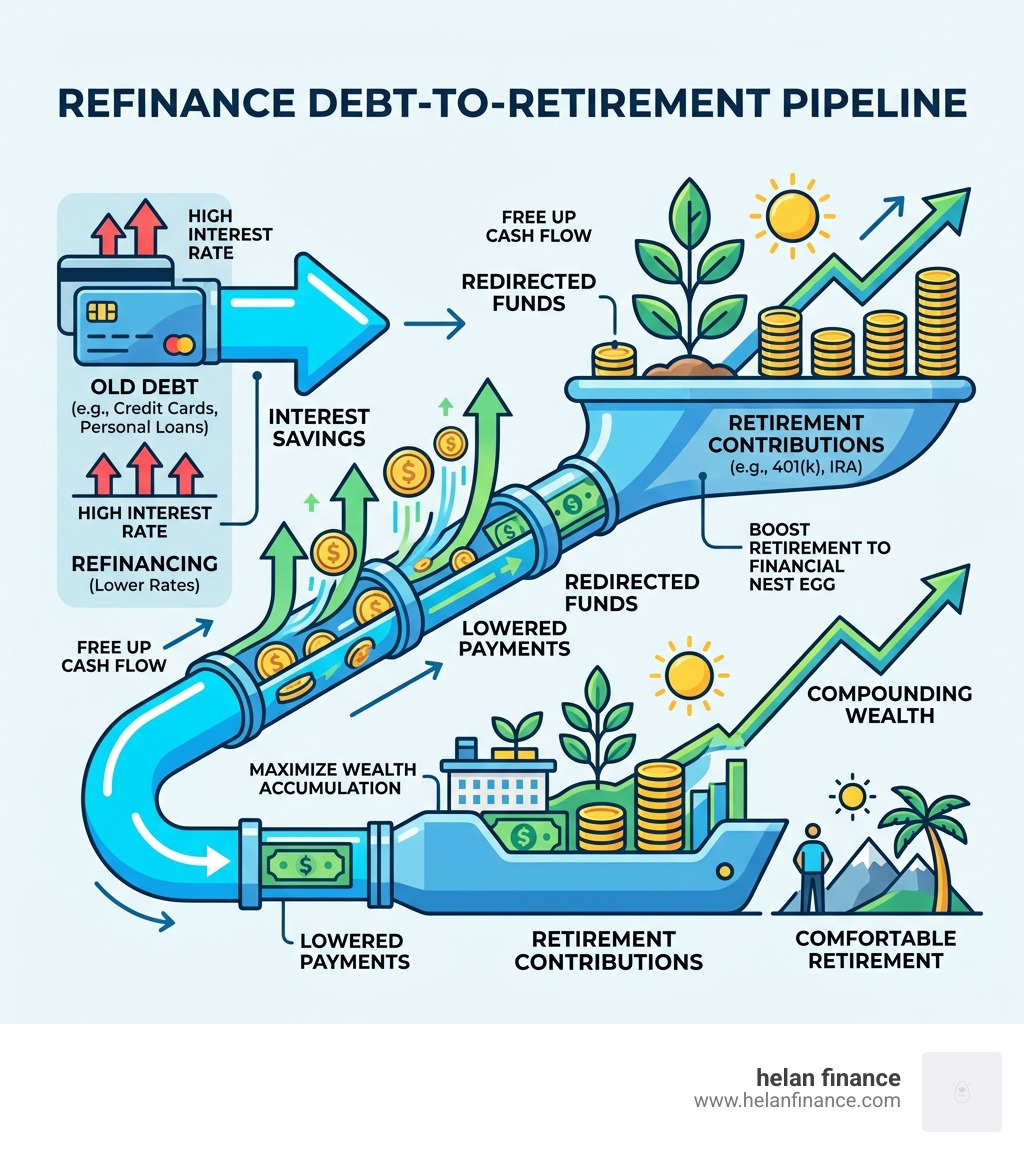
At its core, refinancing is simply replacing an old debt with a new one that has better terms. We often think of it as a way to lower a monthly payment, but for those of us focused on retirement, the real goal is interest savings and principal reduction.
When you lower your interest rate, less of your hard-earned money goes to the bank, and more stays in your pocket. This improves your monthly cash flow, which is the lifeblood of any retirement plan. However, we must look at the “Net Present Value” of the deal. It isn’t just about the rate today; it’s about the total cost of the debt over the remaining life of the loan.
One of the most powerful refinance debt savings tips is to pay attention to your amortization schedule. In the early years of a loan, your payments mostly cover interest. If you are ten years into a 30-year mortgage and you refinance into a new 30-year mortgage, you might lower your monthly payment, but you’ve just “reset the clock.” You’ll be paying interest for an extra ten years, which could actually destroy your wealth instead of building it. To avoid this, we recommend matching your new loan term to your remaining original term.
To understand the mechanics of a successful move, check out this Refinance Your Home – Save Money with Smart Strategies guide. It breaks down the process so you can ensure your strategy aligns with your long-term freedom.
Top Refinance Debt Savings Tips to Maximize Your Retirement Fund
If we want to supercharge our retirement, we need to be aggressive about shopping for the best deal. In April 2026, the market is competitive, and even a 0.25% difference in your rate can result in tens of thousands of dollars in savings over time.

One of our favorite refinance debt savings tips is to utilize the “14-45 day inquiry window.” Many people fear that shopping around will ruin their credit score. However, credit scoring models are smart; they recognize when you are rate shopping. If you submit all your applications within a few weeks, they count as a single “hard inquiry,” protecting your score while allowing you to find the lowest APR.
Don’t forget to look at “lender credits.” Sometimes, a lender will offer to pay your closing costs in exchange for a slightly higher interest rate. If you plan to move in three years, this might be a great deal. But if this is your “forever home” where you’ll retire, paying the costs upfront to secure the lowest possible rate is usually the smarter move.
Calculating Your Break-Even Point: Essential Refinance Debt Savings Tips
Before you sign any paperwork, you must know your break-even point. This is the moment when the amount you’ve saved on interest finally exceeds the amount you spent on closing costs.
Refinancing isn’t free. You’ll typically face fees ranging from 2% to 5% of the loan amount. If your closing costs are $6,000 and you save $200 a month, your break-even point is 30 months. If you plan to move or pay off the loan before those 30 months are up, you are actually losing money.
| Loan Type | Monthly Payment | Total Interest (over life) | Total Savings |
|---|---|---|---|
| 30-Year Mortgage (6.5%) | $1,896 | $382,600 | – |
| 15-Year Mortgage (5.75%) | $2,490 | $128,000 | $254,600 |
As shown in the table above, switching from a 30-year to a 15-year mortgage can be a massive win for retirement. While the monthly payment is higher, the total interest saved—over $250,000 in this example—is money that stays in your net worth rather than going to a lender.
Improving Your Credit Score Before Applying
Your credit score isn’t just a number; it’s a key that unlocks different “pricing tiers.” Lenders use Loan-Level Price Adjustments (LLPAs), which means a borrower with a 660 score might pay thousands more in fees or a much higher interest rate than someone with a 740 score.
To get the most out of these refinance debt savings tips, spend 60 to 90 days polishing your credit before you apply:
- Check for errors: One in five credit reports has an error. Correcting a mistake could jump your score instantly.
- Lower utilization: Aim to keep your credit card balances below 30% of your limits.
- Don’t open new lines: Avoid buying a new car or opening a store card right before you refinance.
Strategic Refinancing Across Different Debt Types
Refinancing isn’t just for houses. To truly optimize your retirement, we need to look at every “leak” in your financial bucket.

Each type of debt has its own rules. For example, auto loan refinancing is often most effective between months 6 and 24 of the loan. Student loan refinancing can save you a fortune if you have private loans, but be careful with federal loans—refinancing them into a private loan means you lose access to government protections like income-driven repayment.
For a deep dive into the “math and mechanics” of various loans, we highly recommend this Refinancing Guide: When to Refi Any Loan (And When It’s a Mistake). It’s a fantastic resource for avoiding the traps that catch many borrowers off guard.
Consolidating High-Interest Credit Card Debt
This is where the “massive financial win” happens. As of late 2025, credit card interest rates were hovering around 22.83%. If you are carrying a $20,000 balance at that rate, you are fighting an uphill battle.
By using a cash-out refinance or a personal loan with a single-digit rate, you can slash your interest costs by more than half. Imagine moving that 22% debt to a 7% or 8% loan. The interest savings alone could fund a significant portion of your annual IRA contribution. We call this a “debt avalanche” accelerator—you use the lower rate to pay down the principal much faster.
Optimizing Mortgage Terms for Retirement
As you get closer to retirement, your goal should shift from “low payments” to “equity ownership.” If you have built up significant home equity, you might be able to eliminate Private Mortgage Insurance (PMI). Typically, once you reach 20% equity, you can refinance to drop that monthly fee, which usually ranges from $100 to $300. That’s “found money” you can route directly into your 401(k).
Also, if you are currently in an Adjustable-Rate Mortgage (ARM), transitioning to a fixed-rate loan provides the stability you need for retirement planning. You don’t want your housing costs to spike just as you stop working.
When to Avoid Refinancing: Protecting Your Financial Future
We have to be honest: sometimes refinancing is a terrible idea. At Helan Finance, we want you to build wealth, not destroy it.
The most dangerous trap is “refinancing for consumption.” This happens when people take cash out of their home equity to pay for vacations, new cars, or lifestyle inflation. This is a wealth-destruction strategy. You are essentially turning your home—an appreciating asset—into a giant credit card for things that lose value.
Avoiding Common Pitfalls with These Refinance Debt Savings Tips
Watch out for these common mistakes that can derail your retirement:
- The “No-Cost” Myth: There is no such thing as a free lunch. “No-closing-cost” refinances usually just bake the fees into a higher interest rate. Over 30 years, that “free” refi could cost you $15,000 more in interest.
- Ignoring Prepayment Penalties: Some older or subprime loans charge you a fee for paying them off early. Make sure your savings exceed this penalty.
- The Psychological Cycle: If you consolidate your credit cards into your mortgage but don’t change your spending habits, you’ll likely run the cards up again. Now you have a bigger mortgage and new credit card debt.
Frequently Asked Questions about Refinancing Debt
How does refinancing impact my credit score in 2026?
In the short term, expect a small dip of 5 to 10 points. This happens because of the “hard inquiry” and the fact that you are opening a new account while closing an old one (which affects the average age of your accounts). However, this is temporary. As you make on-time payments on the new, more affordable loan, your score typically recovers and even improves within 6 to 12 months.
What are the typical costs of refinancing a mortgage today?
Expect to pay between 2% and 5% of the loan amount. For a $300,000 mortgage, that’s roughly $6,000 to $15,000. These costs cover the appraisal (to see what your home is worth), title insurance, attorney fees, and lender origination charges. Always ask for a “Loan Estimate” form so you can see these costs itemized clearly.
Is a cash-out refinance safe for retirement planning?
It can be, but only if used as an investment. If you use the cash to consolidate 20% interest debt into a 7% mortgage, you are saving a massive amount of money. If you use it to remodel a kitchen that adds $50,000 in value to your home, that’s also a win. But remember: you are turning unsecured debt (like a credit card) into secured debt (your home). If you can’t make the payments, you risk foreclosure.
Conclusion
Refinancing is one of the most powerful tools in our financial toolkit, but it requires a strategic approach. By following these refinance debt savings tips, you can stop the “interest bleed” and start redirecting that money toward your future self.
At Helan Finance, we believe that small, smart routines lead to big results. Whether it’s calculating your break-even point today or setting up an automated transfer of your “refi savings” into your retirement account tomorrow, every step counts. Don’t let high-interest debt dictate your retirement date. Take control of your trajectory and ensure your golden years are truly golden.
Start your simplified financial plan today

