
The Top Rated Banks for Consolidation Loans This Year
The Best Banks for Consolidation Loans in 2026 (Quick Answer)
The best banks for consolidation loans right now include a mix of traditional banks, credit unions, and online lenders — each with different strengths depending on your credit score, loan size, and budget.
Here’s a quick look at the top options:
| Lender | APR Range | Loan Amounts | Best For |
|---|---|---|---|
| LightStream | 7.24% – 23.89% (with autopay) | $5,000 – $100,000 | Best overall / low APR |
| PenFed | 6.09% – 17.99% (with autopay) | $600 – $50,000 | Small loans / no fees |
| Wells Fargo | 6.74% – 25.99% | $3,000 – $100,000 | Existing customers / large loans |
| Discover | 7.99% – 24.99% | $2,500 – $40,000 | No origination fees |
| Citi | 9.99% – 17.49% | Up to $30,000 | Zero fees / fast funding |
| SoFi | 7.74% – 35.49% | $5,000 – $100,000 | Large loan amounts |
Managing multiple debt payments every month is exhausting. Different due dates, different interest rates, different minimums — it adds up fast, both mentally and financially.
That’s exactly why debt consolidation has exploded in popularity. Lenders originated 7.2 million unsecured personal loans in Q3 2025 alone — a 21% jump from the year before. The average borrower balance sits around $11,700, and with average household credit card balances hitting $11,413, it’s clear that millions of people are looking for a simpler way out.
A consolidation loan rolls all those debts into one fixed monthly payment — often at a lower interest rate. The right bank can make a real difference in how much you pay and how fast you get free.
But not every lender is built the same. APRs, fees, loan limits, and eligibility rules vary widely — and picking the wrong one can cost you more than doing nothing.
This guide breaks down the top-rated banks for consolidation loans so you can find the right fit without wasting hours on research.
Understanding How Debt Consolidation Works in 2026

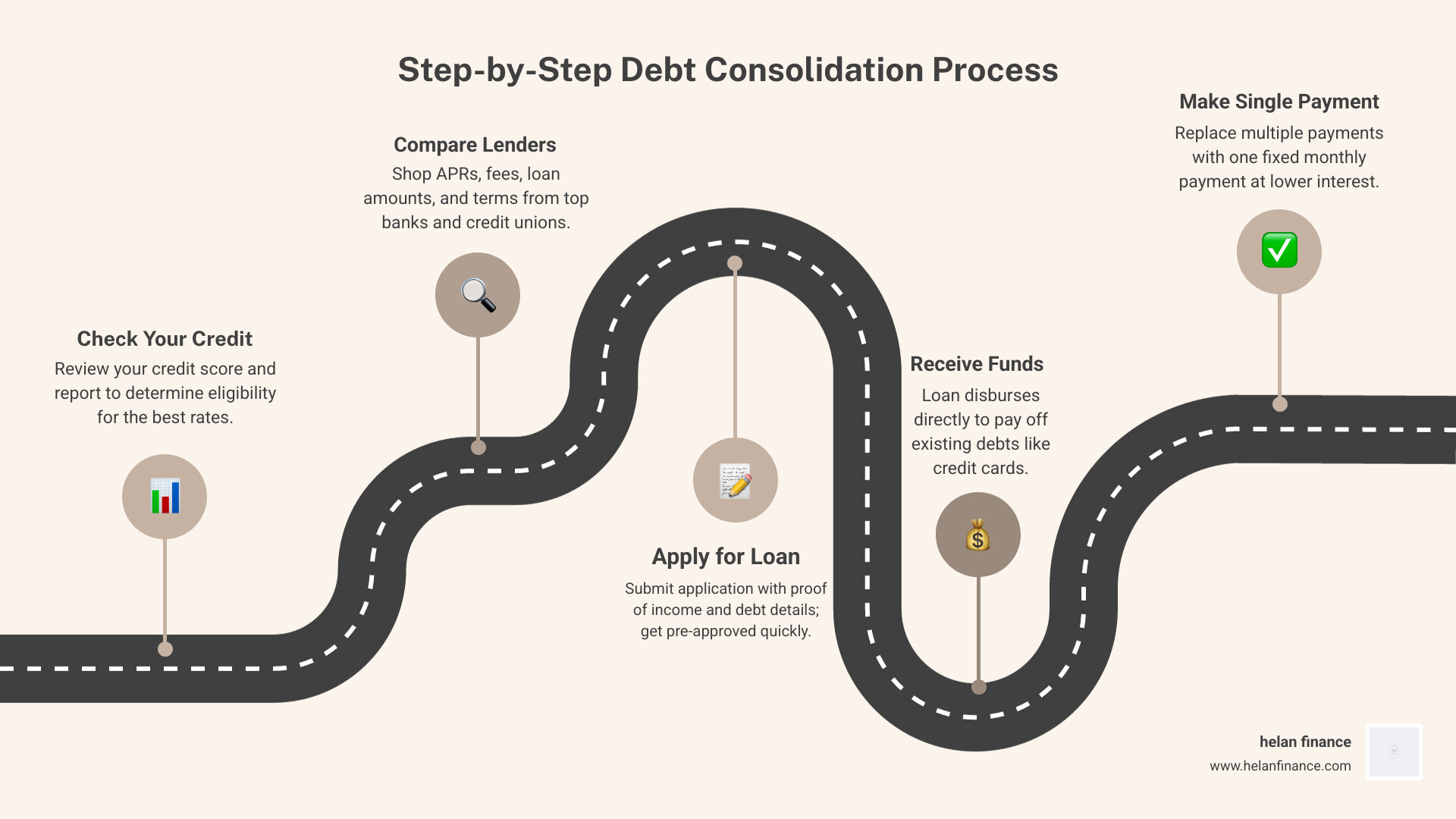
Debt consolidation isn’t magic; it’s a strategic financial swap. At its core, you are taking out a new unsecured personal loan to pay off several smaller, high-interest debts. Most of us use these loans to tackle revolving debt, like credit cards, which often carry astronomical interest rates that make it impossible to touch the principal balance.
When you secure a loan from one of the best banks for consolidation loans, the lender often sends the funds directly to your creditors or deposits them into your bank account as soon as the next business day. You then have a single monthly payment with a fixed interest rate and a set end date. This is a massive improvement over the “minimum payment trap” where you could be paying off a credit card for decades.
By simplifying your finances into one payment, you gain clarity. We find that when our clients use a Detailed Guide To Debt Management, they feel a significant reduction in “financial fog”—that overwhelming feeling of not knowing exactly where your money is going. In 2026, the process is faster than ever, with many banks offering mobile-first applications that give you a decision in minutes.
The Primary Benefits of the Best Banks for Consolidation Loans
Why bother with a new loan? The benefits usually fall into three main categories: interest savings, simplified budgeting, and a psychological “reset.”
- Lower Interest Rates: If your credit cards are charging 22% APR and you qualify for a consolidation loan at 8%, you are saving thousands of dollars over the life of the debt.
- Fixed Repayment Terms: Unlike credit cards, where the “finish line” moves every time you make a new purchase or the interest fluctuates, a bank loan has a fixed term (usually 12 to 84 months). You know exactly when you will be debt-free.
- Credit Score Boost: While the initial application might cause a small dip due to a hard inquiry, paying off multiple maxed-out credit cards can significantly lower your credit utilization ratio, which is a major factor in your FICO score.
Consolidating isn’t just for credit cards, either. Many people use these loans to handle medical expenses. If you’re struggling with healthcare costs, check out A Guide To Reducing Medical Debt And Finding Financial Relief for more targeted advice.
Evaluating the Best Banks for Consolidation Loans by APR
The Annual Percentage Rate (APR) is the most important number in your loan agreement. It includes both the interest rate and any fees, giving you the “true” cost of borrowing. As of April 2026, the market is competitive, but rates are highly dependent on your creditworthiness.
- Wells Fargo currently offers rates as low as 6.74% APR for their most qualified borrowers. This rate includes a 0.25% relationship discount, which is a common perk for existing customers of major banks.
- LightStream is famous for its “Rate Beat” program. They promise to offer a rate 0.10 percentage points lower than a competitor’s approved rate for an unsecured loan, provided you meet certain criteria.
- PenFed (Pentagon Federal Credit Union) is a standout for lower-tier rates, starting as low as 6.09% for those who use autopay.
When comparing, always look for the “autopay discount.” Most top-tier lenders offer a 0.25% to 0.50% reduction in your rate just for setting up automatic monthly transfers.
How to Access the Best Banks for Consolidation Loans with Fair Credit
You don’t need a perfect 850 credit score to find a great loan. While the “headline” rates of 6% or 7% usually require excellent credit (740+), there are many options for those in the “fair” to “good” range (600–700).
- Minimum Credit Scores: Lenders like Upgrade and LendingClub often work with borrowers starting at a 600 FICO score. Universal Credit even considers scores as low as 560, though you should expect higher APRs and origination fees.
- Co-signer Options: If your score is too low to qualify for a rate that actually saves you money, some banks allow a co-signer. This person (usually a family member with better credit) becomes equally responsible for the debt, helping you secure a much lower APR.
- Relationship Banking: Sometimes, the bank where you have your checking account is more willing to look at your full financial picture—like your direct deposit history—rather than just your credit score.
If you’re working on your credit while managing debt, we recommend Building A Debt Snowball Plan That Actually Works to help you gain momentum.
Key Features and Eligibility for Top-Rated Bank Loans
When we look for the best banks for consolidation loans, we look beyond just the interest rate. You need to consider the “fine print” like origination fees and repayment flexibility.
| Feature | What to Look For | Top Bank Examples |
|---|---|---|
| Loan Amounts | $600 to $100,000 | Wells Fargo, SoFi, LightStream |
| Repayment Terms | 12 to 84 months | Discover, KeyBank, Citi |
| Origination Fees | 0% is ideal (some charge up to 10%) | Discover, Citi, PenFed (all 0%) |
| Funding Speed | Same-day or Next-day | Citi, LightStream, Rocket Loans |
Origination fees are a common trap. These are one-time upfront fees deducted from your loan balance. For example, if you take out a $10,000 loan with a 5% origination fee, you only receive $9,500, but you still owe interest on the full $10,000. Banks like Discover and Citi are highly rated because they charge $0 in origination fees.
Before you sign, make sure there are no prepayment penalties. You want the freedom to pay off your loan early if you get a tax refund or a bonus at work. Most of the top-rated banks on our list have eliminated these penalties to stay competitive. For a broader look at how to structure your year for success, see The Ultimate Guide To Becoming Debt Free In One Year.
Strategic Alternatives to Traditional Bank Consolidation
A personal loan isn’t always the right answer. Depending on your situation, one of these alternatives might be more cost-effective:
- Balance Transfer Credit Cards: If you have a smaller amount of debt (under $10,000) and a high credit score, a 0% intro APR card can be better. These cards often give you 12 to 21 months of zero interest. However, if you don’t pay it off in time, the rate can jump to 25% or higher.
- Home Equity Lines of Credit (HELOC): If you own a home with equity, you can borrow against it. These rates are often lower than personal loans because they are secured by your house. The risk? If you can’t pay, you could lose your home.
- Credit Counseling: If your debt-to-income ratio is over 50%, you might not qualify for a loan. Non-profit credit counseling agencies can set up a Debt Management Plan (DMP) to lower your rates without a new loan.
Choosing between these options requires looking at your long-term goals. For example, if you’re trying to balance debt payoff with retirement, you might find How To Refinance Debt And Save For Retirement particularly helpful.
Frequently Asked Questions about Bank Consolidation
How does a consolidation loan impact my credit score?
Applying for a loan usually involves two steps. First, most best banks for consolidation loans allow you to “pre-qualify” using a soft credit pull, which does not affect your score. This lets you see your potential rate.
Once you officially apply, the bank does a hard credit inquiry, which may temporarily drop your score by a few points. However, the long-term impact is usually very positive. By paying off revolving credit card balances, you improve your “credit utilization” ratio. If you keep those cards open (with a zero balance) and make your new loan payments on time, your score will likely climb higher than it was before. To keep that momentum, check out How To Maintain Your Financial Health After Paying Off Debt.
What types of debt can be consolidated with a bank loan?
You can use a personal loan for almost any high-interest debt, including:
- Credit card balances
- Medical bills
- Existing high-interest personal loans
- Payday loans
- “Buy Now, Pay Later” (BNPL) accounts
However, there are restrictions. Most banks, including Wells Fargo and LightStream, explicitly prohibit using these loans for student loan debt or business expenses. If you’re looking to speed up your progress, consider how you can Accelerate Your Debt Reduction Plan With These Daily Habits.
Are there hidden fees with top-rated bank loans?
In 2026, transparency is a major selling point. The most reputable banks are very clear about their fees. The “big three” to watch for are:
- Origination Fees: Upfront costs (try to find 0%).
- Late Payment Fees: Can range from $15 to $45.
- Check Processing Fees: Some banks charge a small fee if you don’t use electronic payments.
Always read the Schumer Box (the standardized table of rates and fees) before accepting a loan offer.
Conclusion

Finding the best banks for consolidation loans is a major step toward taking back control of your life. Whether you choose the low rates of LightStream, the zero-fee structure of Discover, or the large loan limits of Wells Fargo, the goal is the same: to stop the bleeding of high interest and start building a foundation for the future.
At Helan Finance, we believe that financial planning shouldn’t be a chore. It’s about creating routines and using the right tools to make your money work for you, not the other way around. Consolidating your debt is just the beginning of the journey. Once those high-interest payments are gone, you can start focusing on the things that actually matter—like building an emergency fund, saving for a home, or simply enjoying the peace of mind that comes with a “zero” balance.
Start your journey to financial freedom today and let us help you simplify the path ahead.

