
Your Guide to Saving Ten Thousand Dollars
Is the 10000 Savings Challenge Right for You?
The 10000 savings challenge is a structured savings method that helps you build $10,000 through small, consistent contributions — daily, weekly, or monthly.
Here are the most popular ways to do it:
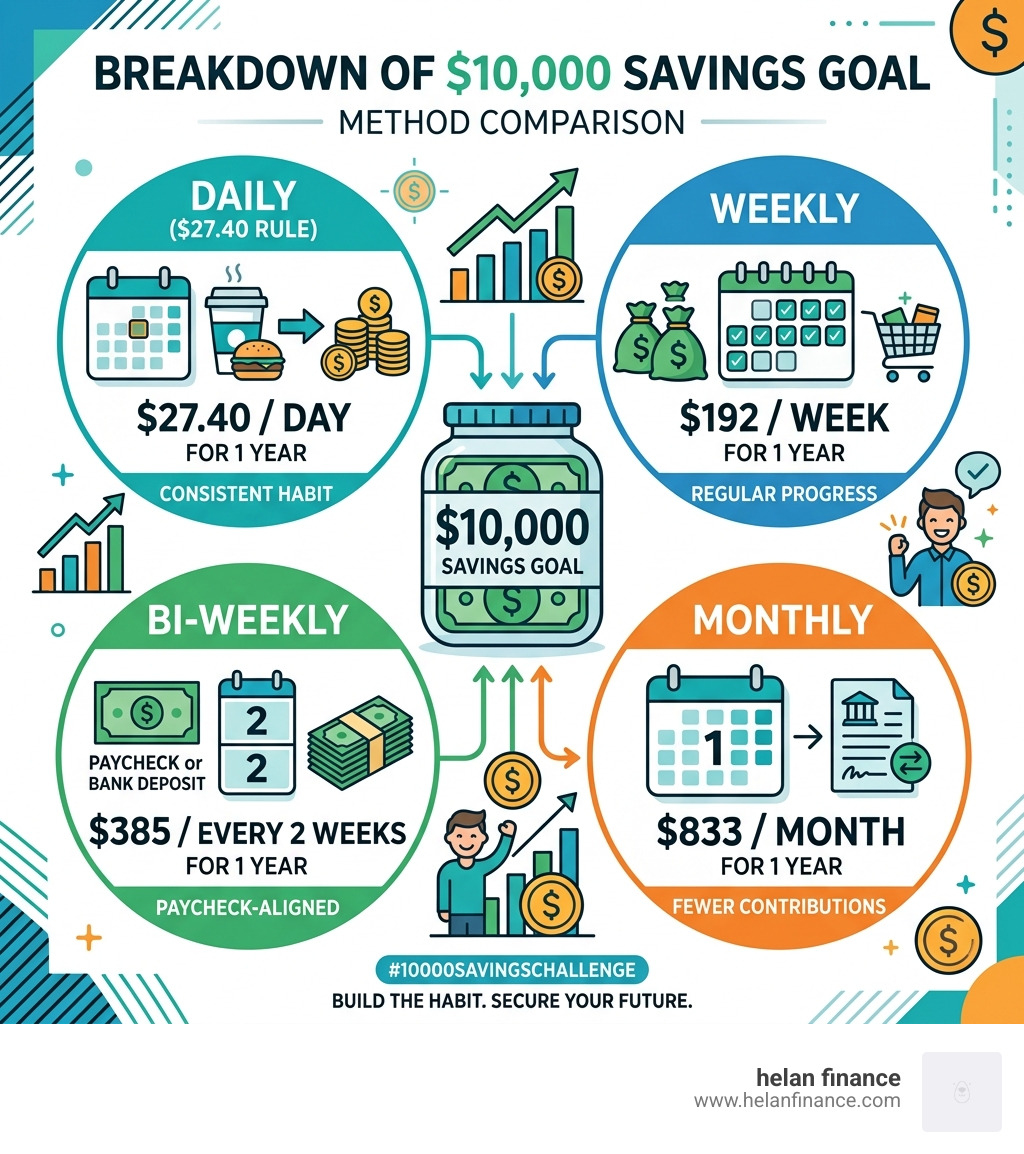
| Method | Timeframe | Amount Per Period |
|---|---|---|
| Daily savings ($27.40 rule) | 1 year | $27.40/day |
| Weekly savings | 1 year | $192/week |
| Bi-weekly savings | 1 year | $385 every 2 weeks |
| Monthly savings | 1 year | $833/month |
| 100-envelope challenge | 100 days | $1–$100 per envelope |
| 52-week challenge | 1 year | Increasing weekly amounts |
| Wooden savings box | Flexible | Your chosen pace |
No single method works for everyone. The best one depends on your income, schedule, and how you stay motivated.
Saving $10,000 feels big. But broken down, it’s just $27.40 a day — roughly the cost of a lunch out and a coffee. The challenge is less about the math and more about building the habit.
Only 59% of U.S. adults feel comfortable with their savings level. That means nearly half of people are one unexpected bill away from financial stress. This challenge is designed to move you out of that group.
Whether you prefer a physical savings box on your desk, a printable tracker on your wall, or an automated bank transfer you never have to think about — this guide compares every major method so you can pick what actually fits your life.
Why the 10000 Savings Challenge is a Financial Game-Changer
Have you ever heard the saying that the first $10,000 is the hardest? Financial experts often point to this specific number as a major psychological and mathematical milestone. Reaching it doesn’t just put a five-figure sum in your bank account; it fundamentally shifts how you view money.
When we hit that $10,000 mark, we move from “surviving” to “planning.” This amount typically covers a robust emergency fund for most households, providing a safety net that reduces daily stress. Moreover, once you have $10,000, the power of compound interest begins to look a lot more interesting. It is the foundation upon which wealth is built.
Participating in a 10000 savings challenge builds financial confidence. It proves to you that you have the discipline to set a massive goal and see it through. As you explore 7 Money Challenges to Save up to $10,000 in One Year, you’ll realize that the structure of a challenge removes the “decision fatigue” of saving. You don’t have to ask if you should save today; the challenge tells you exactly how much to save.
To make this journey easier, we recommend looking into the best save money habits you probably havent tried yet to supplement your challenge efforts. Whether it’s the “24-hour rule” for impulse buys or finding ways to cut non-essentials, these habits ensure the money you’re trying to save doesn’t leak out elsewhere.
Popular Methods to Complete the 10000 Savings Challenge
Choosing the right method is like choosing a workout plan—if you hate it, you won’t stick to it. Some of us are high-tech and want everything automated, while others need the tactile satisfaction of crossing a number off a list or putting a physical bill into a box.
Here is a comparison of the most effective ways to tackle the 10000 savings challenge:
| Method | Best For | Psychological Hook |
|---|---|---|
| 100-Envelope System | Cash lovers | Gamified “hunting” for envelopes |
| $27.40 Daily Rule | Consistent earners | Makes a big goal feel tiny |
| Bi-Weekly Transfers | Salaried employees | “Set it and forget it” ease |
| Savings Challenge Box | Visual learners | Seeing the box fill up over time |
The 100-envelope system is a viral sensation for a reason. Traditionally, it involves labeling envelopes from 1 to 100 and filling one daily with the corresponding dollar amount. However, to reach $10,000, you have to adjust the math (since 1-100 only totals $5,050). You might use 100 envelopes labeled $2 to $200 in even increments. You can find plenty of visual inspiration for these setups on 10000 Savings Challenge – Pinterest.
The 52-Week 10000 Savings Challenge
If you prefer a weekly rhythm, the 52-week version of the 10000 savings challenge is a fantastic choice. This method relies on the power of incremental progress. In a standard 52-week challenge, you might start by saving a small amount in Week 1 and slowly increase it. To reach $10,000, you’ll need to save an average of about $192 per week.
Some people prefer to do this “backward”—starting with the largest amounts ($300+) in January when motivation is high, and letting the weekly requirements drop as the year goes on and holiday spending approaches. This flexibility is why we consider it the 52-week money challenge-the only money-saving plan you need. By using a structured approach, you can excel your way to wealth with the savings plan formula that works for your specific income fluctuations.
Using a 10000 Savings Challenge Box
In April 2026, one of the trendiest ways to save is the wooden 10000 savings challenge box. These boxes, like the popular CVLDM models, have become Amazon best-sellers, ranking high in the “Money Banks” category. They are typically made of durable boxwood and feature a clear acrylic front panel.

The magic of the box is in its simplicity. The front panel is printed with various dollar amounts. Every time you drop cash into the box, you use a marker to cross out the corresponding number. It’s a physical, “smashable” (or reusable) representation of your progress. Seeing those numbers slowly disappear provides a dopamine hit that digital banking just can’t replicate. It turns saving into a game, which is one of our favorite 10 tips and tricks to master money saving.
How to Use a Savings Box Effectively
If you’ve decided to go the route of a physical box for your 10000 savings challenge, success starts with the setup. Most of these boxes arrive flat-packed to save on shipping.
- Assembly: Carefully slot the boxwood panels together. Most models don’t require glue, but they should feel sturdy once clicked into place.
- The Protective Film: This is the step most people miss! The acrylic board usually has a thin protective film on both sides. Peel it off to ensure your marker lines are clear and the board is truly reusable.
- Placement: Put the box somewhere you see it every day—your nightstand, the kitchen counter, or your home office. Visibility is the key to habit formation.
- Marking Progress: Use the provided water-soluble marker. If you save $50, find a “$50” slot and tick it off. If you only have $10, find a “$10” slot.
To ensure you actually have the cash to put in the box, you’ll need efficient money saving strategies for your monthly saving plan. We suggest “paying yourself first”—as soon as your paycheck hits, take out the cash for that week’s challenge goal and put it in the box before you have a chance to spend it on something else.
Pros and Cons of Physical Savings Boxes
Before you hit “buy” on that $8.99 Prime deal, it’s worth looking at what other savers think. The standard 10000 savings challenge box holds an average rating of 4.0 out of 5 stars from over 700 reviewers.
The Pros:
- Visual Motivation: 58% of reviewers gave these boxes 5 stars, mostly citing how much they love seeing the numbers get crossed off.
- Reusability: Because the acrylic board can be wiped clean, you can use the box for your next $10k once you finish the first.
- Educational: Many parents use these to teach kids about large-scale saving.
The Cons:
- Build Quality: About 13% of reviewers gave 1-star ratings, often complaining about thin wood or pieces not fitting perfectly during assembly.
- Cash Security: Unlike a bank, a wooden box in your living room doesn’t have a PIN code or FDIC insurance. If you’re uncomfortable keeping $10,000 in cash at home, a digital tracker might be better.
- Size: Some users find the slots a bit tight when the box starts getting full of bills.
If you’re unsure about the math involved in these physical products, you can always check our a-z-guide to savings calculator to see how your physical savings compare to what you could be earning in a high-yield account.
Tips for Success with Your 10000 Savings Challenge
Saving ten grand in a year (or even two) is a marathon, not a sprint. You will hit hurdles. You might have a month where the car breaks down or the vet bill is higher than expected. Here is how to stay on track:
- Use a Hybrid Approach: Keep the physical box for the “fun” of the challenge, but deposit the bulk of your money into a high-yield savings account (HYSA). This way, your money earns interest while you save. You can see how much extra you could make using the high-yields-savings-account-calculator-that-makes-math-fun-again.
- Automate What You Can: If you aren’t using a cash box, set up an automatic transfer for $385 every payday. If you don’t see the money, you won’t miss it.
- Side Hustles: Sometimes, you can’t “frugality” your way to $10,000. You might need to increase your income. Selling old clothes, taking on freelance gigs, or even using tax refunds can give you a massive boost.
- Visual Trackers: If you don’t want a box, use a Save 10,000 Dollars in One Year-printable 10K Savings Challenge …. Pin it to your fridge so your goal is always top-of-mind.
Before starting, ask yourself: Should you try the 100-envelope challenge? If the idea of handling cash sounds stressful, go digital. If it sounds like a fun game, go for the envelopes or the box!
Frequently Asked Questions about the 10000 Savings Challenge
How much do I need to save daily to reach $10,000 in a year?
To hit the $10,000 mark in exactly 365 days, you need to save $27.40 per day. This is often called the “$27.40 rule.” While it sounds manageable, this includes weekends and holidays. If you prefer to save only on workdays (roughly 260 days a year), you’ll need to set aside about $38.46 per day.
Is the wooden savings box better than a digital tracker?
It depends on your personality. A wooden box provides tactile feedback and a constant visual reminder in your physical space. This is excellent for people who struggle with “out of sight, out of mind” budgeting. However, a digital tracker or app is safer (your money is in a bank) and more efficient (you can earn interest). Many successful savers use a “hybrid” method: they track progress on a physical board but keep the actual money in a secure bank account.
What should I do after I save my first $10,000?
Congratulations! Reaching $10,000 is a huge win. Your first step should be ensuring you have a “starter” emergency fund of 3–6 months of expenses. If that’s already covered, consider moving toward high-interest debt repayment or starting your investment journey. $10,000 is a great “seed” for a Roth IRA or a diversified brokerage account. The habits you built during the 10000 savings challenge are actually more valuable than the money itself—keep those routines going!
Conclusion
At Helan Finance, we believe that financial freedom shouldn’t be complicated. The 10000 savings challenge is a perfect example of how a large, intimidating goal can be conquered through simple daily routines and the right tools. Whether you choose a wooden box, a 52-week printable, or the $27.40 daily rule, the most important step is the one you take today.
By gamifying your savings and using visual markers to track your progress, you turn a chore into a triumph. Saving is a marathon. There will be weeks where you save less, and that’s okay. The goal is consistency over perfection. Ready to start your journey to five figures? We’re here to help you simplify your planning every step of the way.
Find more tools and advice to master your money at helanfinance.com.

