
Stop the Bleeding with These Daily Money Habits
Why Most People Stay Broke (And How Daily Money Organization Routines Fix That)
Daily money organization routines are simple, repeatable habits — usually taking just 5 minutes a day — that help you track spending, catch fraud, review goals, and stay in control of your finances without overwhelm.
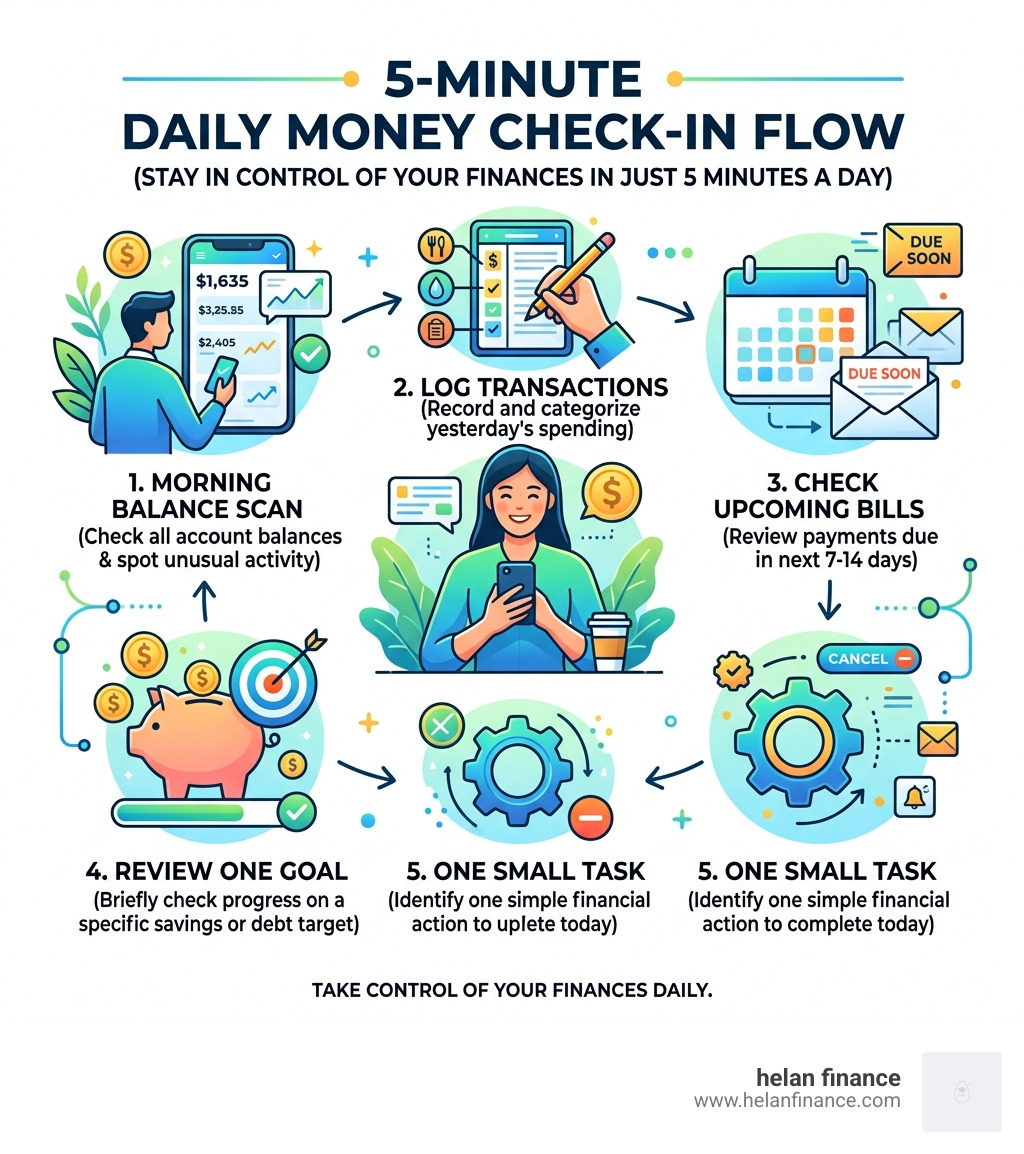
Here’s what an effective daily routine looks like:
- Morning balance scan — Check account balances and spot any unrecognized charges
- Log transactions — Categorize what you spent yesterday
- Check upcoming bills — Know what’s due in the next 7-14 days
- Review one goal — Briefly check progress on a single savings or debt target
- One small task — Identify one financial action to complete today (e.g., cancel an unused subscription)
More than 50% of Americans are living paycheck to paycheck. Nearly 60% can’t cover a $1,000 emergency without going into debt. These aren’t just statistics — they describe real, daily stress.
But here’s the thing: most money problems aren’t caused by ignorance. They’re caused by forgetting what you already know in the moment it matters — when you’re tired, distracted, or emotionally triggered.
That’s exactly where daily money habits come in.
Think of it like fitness. You don’t get healthy from one long workout. You get healthy from showing up consistently, even briefly. The same is true for your finances. A few focused minutes each day creates what researchers call behavioral compounding — better decisions become easier and more automatic over time.
One person described making “hundreds of budgets” over the years before realizing the missing piece wasn’t knowledge — it was routine. Building money tasks into a regular rhythm, and rewarding yourself afterward, is what finally made it stick.
You don’t need to overhaul your entire financial life this week. You just need a starting point that’s simple enough to actually do.
The Core Benefits of Daily Money Organization Routines
When we talk about daily money organization routines, we aren’t just talking about moving numbers around a spreadsheet. We are talking about building “decision literacy.” This is the ability to apply financial concepts in the heat of the moment—like when you’re staring at a tempting “limited time offer” online.
The core benefits of these routines include:
- Instant Fraud Detection: Checking your accounts daily means you catch that $1.99 “test charge” from a scammer before they drain your account.
- Spending Awareness: It’s easy to ignore a $5 coffee, but when you see it every day, you start to realize it’s actually $150 a month.
- Mental Health Gains: Much of our financial stress comes from the unknown. When you know exactly what is in your account, the “boogeyman” under the bed disappears.
- Protection of Your Financial Floor: Your “financial floor” is the bare minimum you need to survive (rent, utilities, food). Daily routines ensure this floor is always covered first.
Establishing these habits is one of The Daily Habits That Lead to Financial Freedom. According to experts at MACU, being intentional with your money means aligning your spending with your values and future goals, rather than just reacting to your bank balance.
Why Consistency Matters in Daily Money Organization Routines
Consistency is the “secret sauce” of wealth building. Why? Because of habit stacking. This is the practice of attaching a new habit (like checking your budget) to an existing one (like drinking your morning coffee).
When we use “identity language”—saying “I am the kind of person who manages my money well” instead of “I’m trying to save”—we shift our psychology. This makes building better financial habits feel less like a chore and more like self-care. Small wins, like skipping a non-essential purchase for 24 hours, release dopamine that encourages us to keep going.
Your 5-Minute Daily Money Checklist

You don’t need an hour to get your house in order. In fact, if it takes an hour, you probably won’t do it tomorrow. The goal is to make your daily money organization routines as frictionless as possible.
A great way to start is with a bit of digital decluttering. Unsubscribe from those “flash sale” newsletters that tempt you to spend. Once the noise is gone, you can focus on the data. As noted by Old National Bank, taking five minutes while you eat breakfast or commute can save you thousands by keeping you proactive rather than reactive.
Step 1: The Morning Balance Scan
The first thing we recommend in our morning money habits is a quick scan of your bank and credit card apps.
- Look for Fraud: Are there any charges you don’t recognize?
- Check Pending Charges: Did that restaurant tip finally clear?
- Account Security: Ensure no one has changed your password or contact info.
- The “Spendable” Number: Know exactly how much is left in your discretionary “pot” before you head out the door.
Step 2: Log and Categorize Transactions
Don’t wait until Friday to log your spending. By then, you’ve forgotten that the $42.15 charge at the grocery store actually included $15 worth of cleaning supplies that should be in a different category.
Real-time tracking allows for micro-adjustments. If you see you’ve already spent 80% of your “dining out” budget by Wednesday, you can choose to cook at home on Thursday. To do this effectively, you need to know the 10 essential categories for personal expenses. Using the best expense tracking apps makes this process take seconds rather than minutes.
Mastering the Payday and Weekly Reset
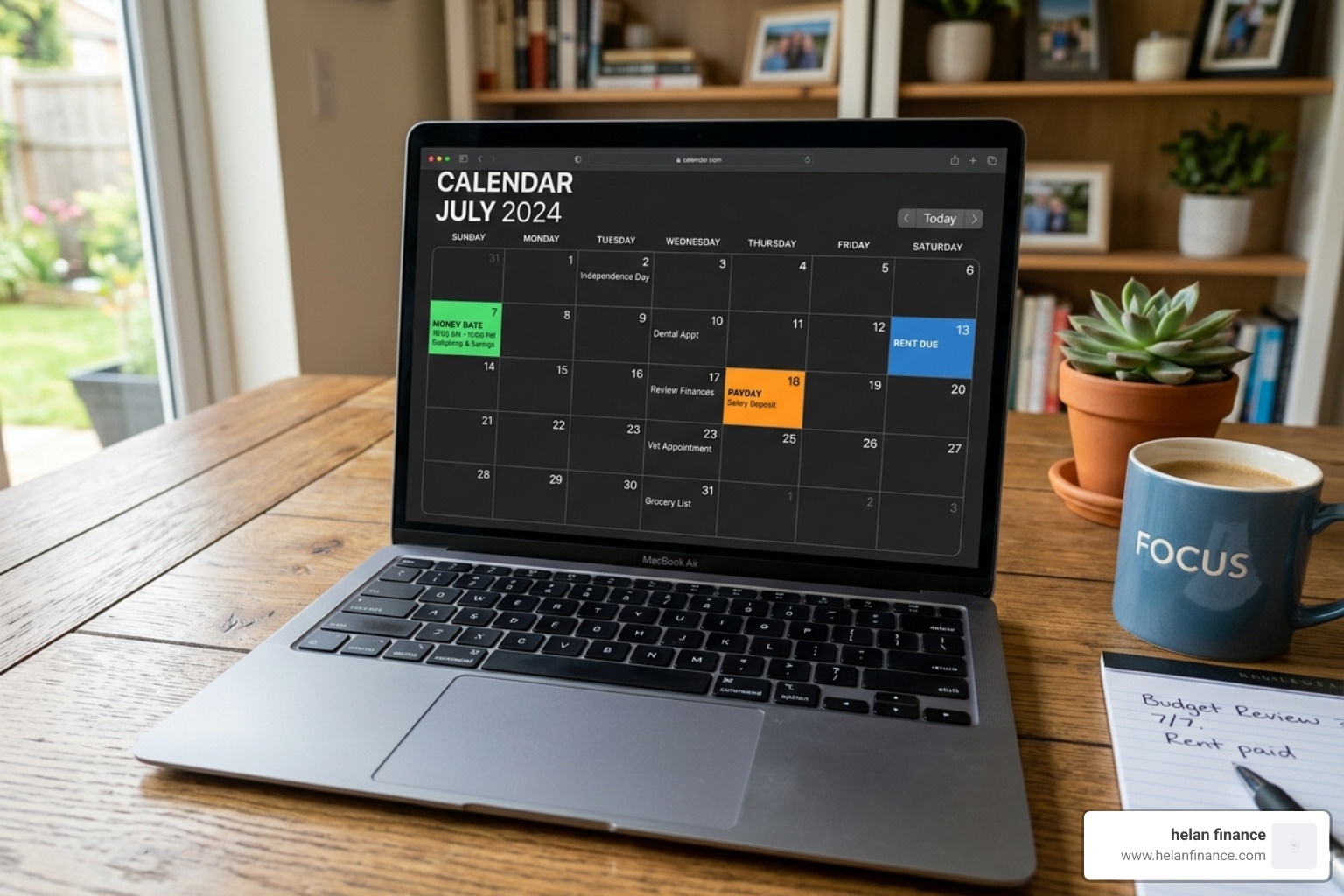
While daily habits keep the ship afloat, your weekly and payday routines are the engine. We like to call these “Money Dates.” This is a time—usually Friday or Sunday—to look at the bigger picture.
Automation is your best friend here. By using bi-weekly bill planners, you can sync your payments with your actual cash flow. The goal is to reach a state of “blissful indifference” where your savings move themselves and your bills are paid before you even see the money. This is the heart of a successful Money Date routine.
Building Sinking Funds into Daily Money Organization Routines
One of the biggest budget-killers is the “unexpected” expense that was actually predictable. Your car will need tires eventually. Your Christmas shopping will happen in December.
Sinking funds are separate “pots” or “spaces” in your bank account dedicated to these specific goals.
- Emergency Buffer: Start with a $1,000 “starter” fund to stop the cycle of debt.
- Irregular Expenses: Set aside $20 a week for car maintenance.
- The “Basement” Fund: Or whatever home repair is looming on your horizon.
By using different types of savings plans, you treat these future costs like monthly bills. When the “emergency” happens, you don’t panic; you just use the money you already set aside.
Managing Irregular and Self-Employed Income
If you are a freelancer or business owner in April 2026, your daily money organization routines look a little different. You can’t rely on a steady paycheck, so you have to create your own “salary.”
A popular method is Revenue Averaging. Look at your last 12 months of income, take the average, and pay yourself that amount. Anything extra goes into a “Tax Envelope” or a business reserve. This is often called the “Profit First” method.
| Feature | Salaried Routine | Irregular/Self-Employed Routine |
|---|---|---|
| Income Timing | Fixed (Bi-weekly/Monthly) | Sporadic/Variable |
| Tax Strategy | Automated via W-2 | Manual “Tax Envelope” (25-30%) |
| Budgeting Style | Zero-Based Budgeting | Percentage-Based Allocation |
| Emergency Fund | 3-6 Months of Expenses | 9-12 Months of Expenses |
Frequently Asked Questions about Daily Money Habits
How do I stop emotional spending during my daily routine?
Emotional spending is usually a reaction to stress, boredom, or “reward” seeking. To manage your money without losing your mind, try these three distractions:
- The 24-Hour Rule: Wait one full day before hitting “buy” on non-essentials.
- The Purchase Checklist: Ask yourself: “Do I need this? Will I value it in 30 days? What goal am I delaying to buy this?”
- The Mood Journal: Note down how you feel when you spend. Are you tired? Anxious? Identifying the trigger is 90% of the battle.
What are the best tools for tracking daily expenses?
The “best” tool is the one you will actually use.
- High-Yield Savings Accounts (HYSA): Essential for your emergency fund so you earn interest while you save.
- Bank “Spaces” or “Pots”: Many modern banks allow you to sub-divide one account into different goals.
- Digital Dashboards: Tools like YNAB or Notion can help you track expenses effectively.
- Spreadsheets: For those who love total control, a custom sheet is still king.
How can I build an emergency fund on a tight budget?
If money is tight, don’t focus on the $1,000 goal. Focus on the $1 habit.
- Autosave: Set up a transfer for just $5 a week. You won’t miss it, but it starts the habit.
- Micro-Bills: Use a subscription analyzer to find and cancel that streaming service you haven’t watched in three months.
- The 52-Week Challenge: Use the 52-week money challenge to scale up your savings slowly.
Conclusion
Financial literacy isn’t a destination; it’s a daily practice. By implementing daily money organization routines, you move from being a victim of your circumstances to being the architect of your future.
At Helan Finance, we believe that simplified financial planning is the key to long-term wealth. It’s not about how much you make, but how you manage what you have. Through behavioral compounding—those tiny, better decisions made every day—you can stop the bleeding and start building a life of financial freedom.
Ready to take the next step? Explore more about simplified financial planning and our expert advice to find the tools that fit your unique lifestyle. Your future self in 2027 will thank you for the habits you start today.

