
Your 2026 Wrap-Up: The End of Year Financial Checklist
Why an End of Year Financial Checklist Can Change Your Financial Year
The end of year financial checklist is one of the most powerful tools you have to close out the year strong and start the next one with confidence. Think of it as a financial reset — a chance to catch mistakes, capture savings, and set yourself up for a better year ahead.
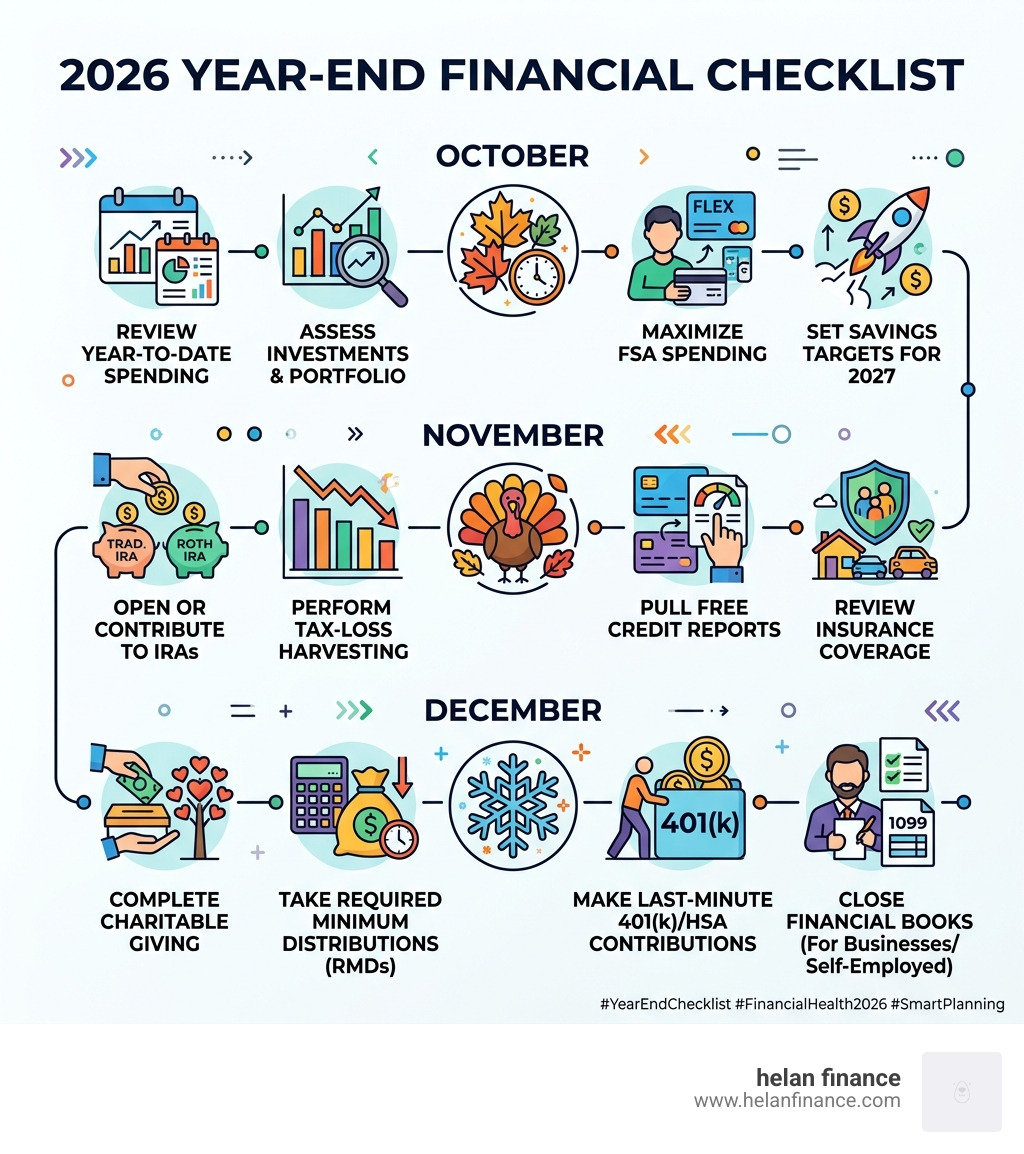
Here are the essential steps to complete before December 31:
- Review and reconcile your spending — check bank and credit card statements for the full year
- Max out tax-advantaged accounts — 401(k), IRA, HSA, FSA, and 529 plans have hard deadlines
- Harvest tax losses — sell underperforming investments to offset capital gains
- Take Required Minimum Distributions (RMDs) — if you’re 73+, missing this costs you 25% in penalties
- Check your FSA balance — you can only carry over up to $660; the rest disappears
- Review insurance and beneficiaries — life changes fast, and outdated forms can be costly
- Pull your free credit reports — one from each bureau, every year
- Set SMART financial goals — specific, measurable targets for the year ahead
- Make charitable contributions — Donor-Advised Funds and QCDs (up to $108,000) can cut your tax bill
- Business owners: close your books — reconcile accounts, prepare 1099s, and review payroll
Year-end isn’t just about compliance. It’s about taking control of your money before the calendar forces your hand.
Most people wait until January — or April — and scramble. The ones who don’t scramble? They use a checklist like this one, work through it methodically, and walk into the new year without the stress.
Whether you’re a busy professional trying to stay on top of your finances or a small business owner facing a stack of year-end tasks, this guide covers everything you need to do right now.
Reviewing Spending and Setting SMART Goals
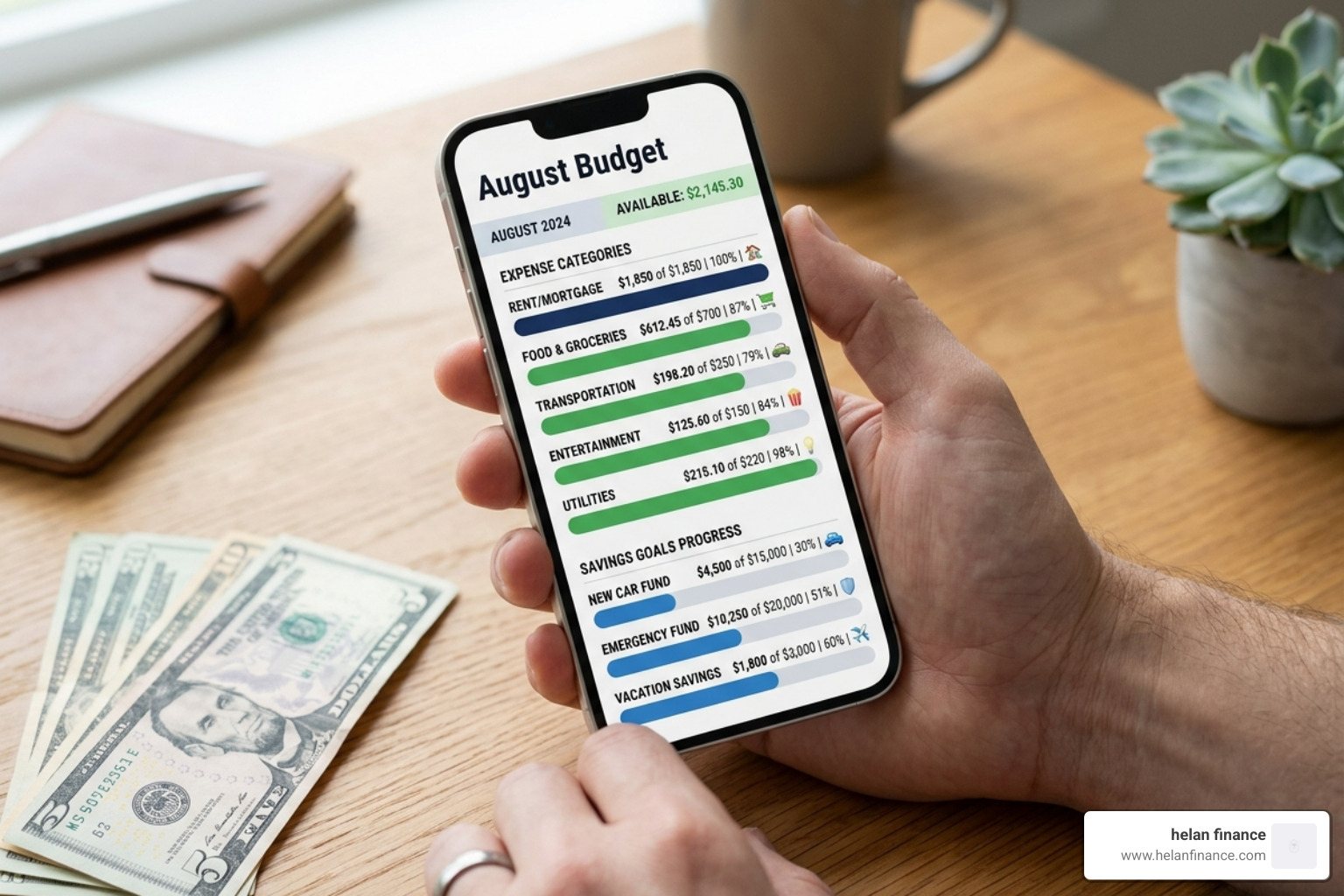
Before we look forward to 2027, we need to see exactly where 2026 went. Spending reconciliation isn’t about judging ourselves for that extra vacation or the daily lattes; it’s about gaining insight into our priorities. We recommend sitting down with your bank and credit card statements from the last 12 months. Categorize your expenses into “Needs,” “Wants,” and “Savings/Debt.”
This process often reveals “money leaks”—those sneaky recurring subscriptions for apps you haven’t opened since May or gym memberships you’re not using. Identifying these now can save you hundreds of dollars in the coming year. If you find your spending habits are a bit messy, don’t worry. Building healthy spending habits is a marathon, not a sprint.
Once you have a clear picture of your past, it’s time to plan your future. Instead of vague resolutions like “I want to save more,” we use SMART goals: Specific, Measurable, Achievable, Relevant, and Time-bound. For example, “I will save $5,000 for a house down payment by December 2027 by automating a $417 monthly transfer.”
Learning how to set financial goals without the headache is the first step toward a realistic 12-month spending plan. This plan acts as your roadmap, ensuring your money goes exactly where you want it to go. For those just starting, our Financial Planning 101 guide offers a great foundation, while simple budgeting routines can keep your wallet happy throughout the year.
Maximizing Your Tax-Advantaged Accounts

One of the most effective ways to build wealth is to keep more of what you earn. Your end of year financial checklist must include a review of tax-advantaged accounts. These accounts are “use it or lose it” in many ways, and the deadlines are firm.
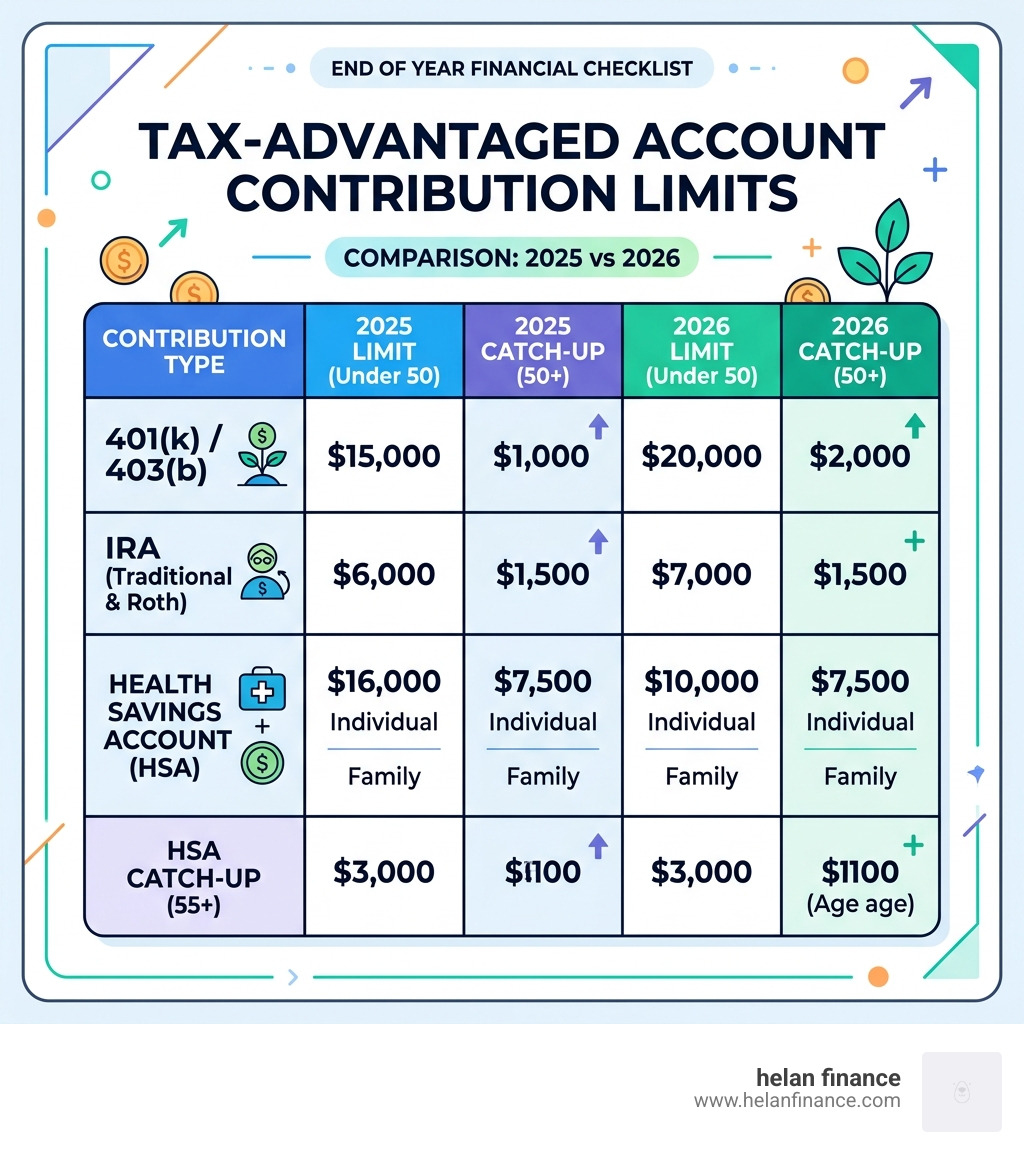
First, let’s talk about the Health Savings Account (HSA). It is often called the “triple-tax-advantaged” account because contributions are tax-deductible, growth is tax-free, and withdrawals for qualified medical expenses are tax-free. For 2025 (the tax year we are wrapping up), individual limits are $4,300 and family limits are $8,550. If you are 55 or older, you can add an extra $1,000 catch-up contribution.
For parents or grandparents, 529 plans offer a unique “superfunding” opportunity. You can contribute up to five years’ worth of annual gift exclusions at once ($95,000 in 2025) to jumpstart a child’s education fund while removing that money from your taxable estate.
Be particularly careful with Flexible Spending Accounts (FSAs). Unlike HSAs, FSAs usually have a “use it or lose it” rule. While some plans allow a grace period or a carryover of up to $660, any remaining balance at the end of the year could be forfeited to your employer. Spend those funds on vision exams, dental work, or over-the-counter medical supplies before December 31. For a deeper dive into these moves, check out Vanguard’s essential year-end moves and our ultimate guide to retirement planning.
Maximizing Retirement Accounts for Your End of Year Financial Checklist
If you have an employer-sponsored 401(k) or 403(b), the deadline to contribute is December 31. For 2025, the deferral limit is $23,500 for those under 50. If you’re 50 or older, you can contribute $31,000, and a special “super catch-up” for those aged 60–63 allows for $34,750.
At the very least, ensure you are contributing enough to receive your full employer match—that is essentially a 100% return on your investment! If you find yourself choosing between debt and retirement, we have strategies on how to refinance debt and save for retirement simultaneously. While you can contribute to an IRA until April 15, 401(k) contributions must be processed through payroll by year-end.
Advanced Tax Planning and Your End of Year Financial Checklist
As we navigate the complexities of 2026, we have to account for the “One Big Beautiful Bill Act” (OBBBA), which has shifted the tax landscape. One major change is the State and Local Tax (SALT) deduction, which has increased to a $40,000 maximum for 2025, though it begins to phase out for those earning over $500,000.
Strategic tax moves can significantly lower your bill. Tax-loss harvesting is the process of selling investments that are currently at a loss to offset capital gains you’ve realized elsewhere in your portfolio. You can even use up to $3,000 of excess losses to offset your ordinary income.
For high earners, the Backdoor Roth IRA or Mega Backdoor Roth remain vital tools. To ensure these are handled correctly for the tax year, both the contribution and the conversion steps should ideally be completed by December 31. Similarly, if you are in a lower-than-usual tax bracket this year, a Roth conversion (moving pre-tax IRA money to a Roth IRA) might be a smart move, though you’ll owe taxes on the converted amount now.
Other tactics include:
- Accelerating expenses: If you itemize, paying your January mortgage payment or property taxes in December can increase your 2026 deductions.
- Delaying income: If you expect to be in a lower tax bracket next year, you might defer a year-end bonus until January.
- Bunching deductions: Grouping two years of charitable giving into one year to surpass the standard deduction threshold.
For more tailored advice, see our guide on how to save on taxes this year.
Essential Protection and Estate Planning
Financial planning isn’t just about the numbers on a screen; it’s about protecting the people you love. Your end of year financial checklist should include a thorough review of your insurance policies. Has your home value increased significantly? You might need more coverage. Did you have a child or get married? It’s time to update your life insurance and disability policies.
Crucially, check your beneficiary designations. These forms override whatever is written in your will. We’ve seen cases where an ex-spouse inherited a large IRA because the owner forgot to update a simple form. Ensure your primary and contingent beneficiaries are correct on every bank account, brokerage account, and insurance policy.
While you’re at it, pull your credit reports from Equifax, Experian, and TransUnion. You are entitled to one free report from each bureau annually. Look for errors, unrecognized accounts, or signs of identity theft. Maintaining a healthy credit score is essential for future loans and even insurance rates. If you’re looking for more ways to tighten your financial ship, here are 10 personal finance tips to start saving today.
Protecting Your Legacy: The End of Year Financial Checklist for Estates
Estate planning is “one of the most loving things you can do for your family,” as it provides clarity during difficult times. Ensure your will, trust, and Power of Attorney documents are up to date. This is also the time to manage Required Minimum Distributions (RMDs). If you are 73 or older, you must take your RMD by December 31 (or April 1 of the year after you turn 73). The penalty for missing an RMD is a steep 25% of the amount not taken.
If you don’t need the RMD for living expenses, consider a Qualified Charitable Distribution (QCD). In 2025, you can send up to $108,000 directly from your IRA to a qualified charity. This satisfies your RMD requirement without adding a penny to your taxable income. Alternatively, a Donor-Advised Fund allows you to take a tax deduction for a large contribution now while distributing the funds to charities over several years. Finally, don’t forget the annual gift exclusion: you can give up to $19,000 per person ($38,000 for couples) in 2025 without even needing to file a gift tax return. For a list of what to tidy up, see Consult Vera’s year-end review.
Small Business Year-End Close and Automation
For our small business owners, the end of the year is a sprint. A proper year-end close is more than a tax requirement; it’s a strategic health check. Start by reconciling all accounts—bank statements, credit cards, and loans—to ensure your internal books match reality.
Key business tasks include:
- Payroll Reconciliation: Ensure all bonuses, fringe benefits, and owner health insurance premiums are correctly reported on W-2s.
- 1099-NEC Forms: Collect W-9s from any contractor you paid over $600 so you can issue 1099s in January.
- Inventory Counts: If you sell physical goods, a year-end physical count is necessary to calculate the Cost of Goods Sold (COGS) accurately.
- Audit Preparation: Organize your receipts and digital files now to make a potential audit a breeze.
The secret to a stress-free year-end is finance automation. Tools that automatically categorize expenses and sync with your bank can turn a 40-hour “closing the books” nightmare into a few hours of review. As you look at your business spending, healthy spending habits apply to your company just as much as your personal life. For a deep dive into the technical steps, follow this year-end close checklist to finish the fiscal year strong.
Frequently Asked Questions about the End of Year Financial Checklist
What is the penalty for missing a Required Minimum Distribution (RMD)?
If you fail to take your full RMD by the deadline, the IRS imposes a 25% penalty on the amount that was not withdrawn. For example, if your RMD was $10,000 and you took nothing, you would owe a $2,500 penalty. This can sometimes be reduced to 10% if corrected promptly, but it is much better to avoid the penalty altogether by including RMDs in your end of year financial checklist.
How much can I carry over in my Flexible Spending Account (FSA)?
For the 2025 plan year, the IRS allows employers to let you carry over up to $660 into 2026. However, this is optional—your employer must specifically allow it. If they don’t, or if your balance is higher than the limit, you will lose that money. Always check your specific plan documents before December 31.
What is the maximum SALT deduction under the OBBBA?
Under the One Big Beautiful Bill Act (OBBBA), the maximum State and Local Tax (SALT) deduction has been increased to $40,000 for 2025. This is a significant jump from the previous $10,000 cap, providing much-needed relief for taxpayers in high-tax states, though it does phase out for very high earners.
Conclusion
At Helan Finance, we believe that financial freedom isn’t about luck; it’s about the small, steady steps you take every day. Completing an end of year financial checklist is one of those steps. It moves you from a state of “hoping for the best” to “planning for success.”
By reconciling your spending, maximizing your accounts, and protecting your legacy, you aren’t just doing paperwork—you’re building a fortress against future stress. We encourage you to adopt the daily habits that lead to financial freedom as you move into 2027.
Ready to take the next step? Use our simplified tools and routines to make your financial planning easy and efficient. Visit us at www.helanfinance.com to download your printable checklist and start your journey toward a stress-free new year.

