
How to Win Your First Simple Budget Challenge
Why a Budget Challenge Starter Guide Is the Fastest Way to Take Control of Your Money
A budget challenge starter guide gives you a simple, structured way to build better money habits — without needing a finance degree or hours of planning. Here’s a quick overview of what it covers:
Quick-start steps for your first budget challenge:
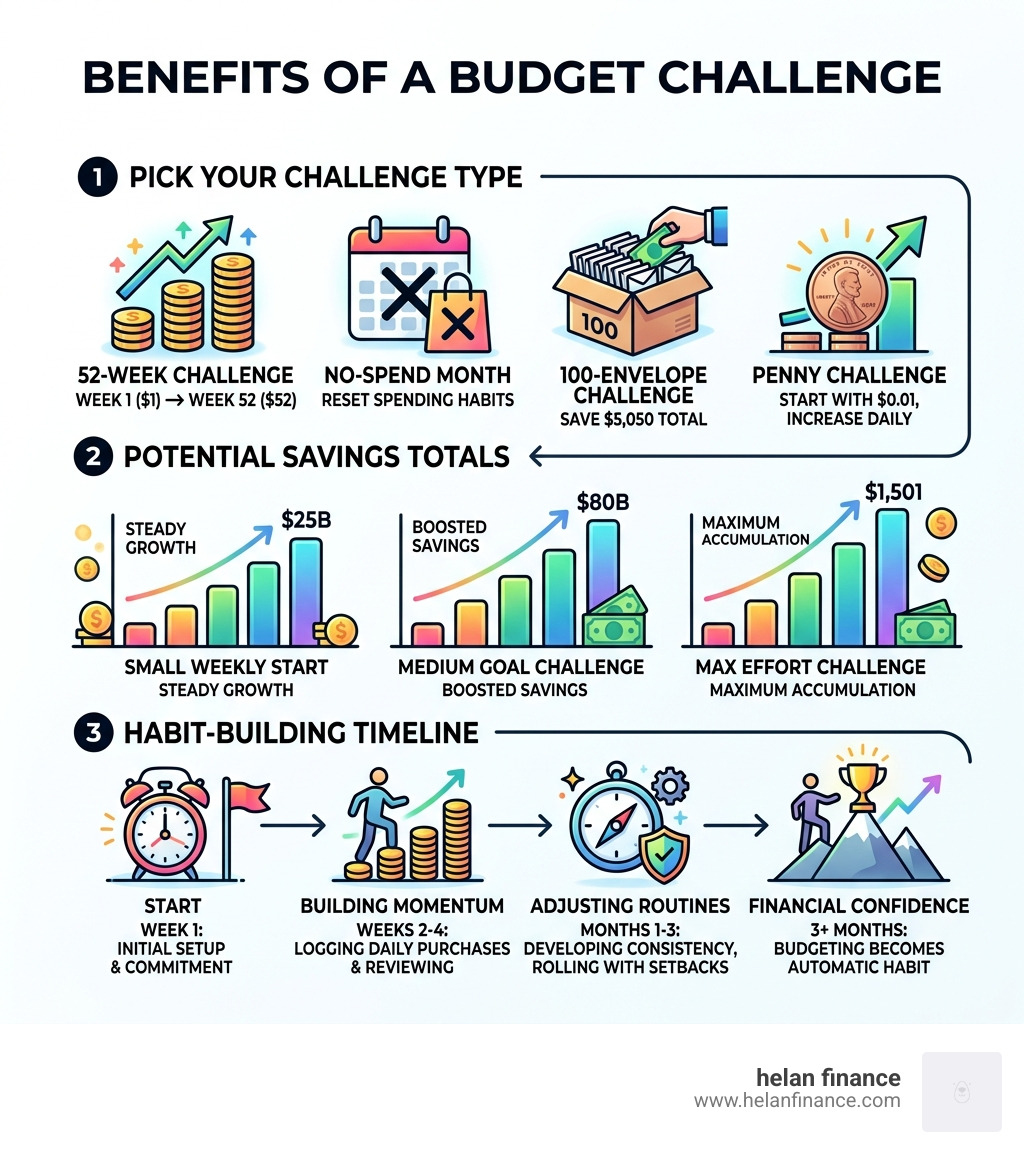
- Pick a challenge — 52-week, no-spend month, 100-envelope, or penny challenge
- Calculate your take-home income — use real numbers, not estimates
- List your fixed and variable expenses — know exactly where your money goes
- Set a clear savings goal — even $5/week counts
- Track daily — log every purchase as it happens
- Review weekly — adjust categories that aren’t working
- Roll with setbacks — one bad week doesn’t mean failure
Nearly 78% of Americans live paycheck to paycheck. If that sounds familiar, you’re not alone — and you’re not stuck.
The problem usually isn’t income. It’s the absence of a plan.
A budget challenge fixes that. It turns saving money into something closer to a game than a chore. Instead of vague goals like “spend less,” you follow a clear structure with a defined finish line. That structure is what makes it work.
Most people start feeling comfortable with their budgeting skills after just a few months of consistent practice. The hard part isn’t the math — it’s just getting started.
This guide walks you through everything: which challenge to pick, how to set it up, what goes wrong in the first 90 days, and how to keep the habit going long after the challenge ends.
What is a Budget Challenge and Why Start One?
At its core, a budget challenge is a financial reset. It is a time-bound commitment to manage your money with specific rules, designed to break old spending patterns and replace them with intentional habits. Think of it as a “couch-to-5K” program, but for your bank account.
Why should you consider one? Because most of us struggle with the “goal-only” mindset. Research from a Bank of America study suggests that focusing on a distant goal alone can actually reduce your likelihood of success by 50%. A budget challenge starter guide shifts your focus from the destination to the process.
Here is why these challenges are so effective:
- Gamification: By turning savings into a game—like the 100-envelope challenge—you trigger the reward centers in your brain. It stops being about “deprivation” and starts being about “winning.”
- Habit Formation: Most people need 30 to 60 days of consistent tracking before budgeting feels automatic. A challenge provides the structure to get you through that “awkward phase.”
- A Decision-Making System: Budgeting isn’t about restriction; it’s a system for making trade-offs visible. When you follow a budget challenge starter guide, you aren’t saying “no” to spending; you’re saying “yes” to your priorities.
- Embracing Scarcity: When we have a vague idea of our money, we spend optimistically. A challenge forces us to look at the actual cash on hand, creating a healthy scarcity mindset that helps us prioritize needs over fleeting wants.
Whether you are trying to escape the 78% of Americans living paycheck to paycheck or simply want to build a foundation for long-term wealth, a challenge is the fastest way to prove to yourself that you can control your money.
Popular Types of Challenges in Your Budget Challenge Starter Guide
Not every challenge fits every lifestyle. If you have a small budget, a “save $10,000 in a year” challenge might feel impossible and lead to frustration. The key is to pick something “doable.” Here are the most popular options:
The 52-Week Money Challenge
This is a classic for a reason. You start by saving $1 in week one, $2 in week two, and so on, until you save $52 in the final week of the year. By the end, you’ll have saved $1,378. It’s highly customizable; you can even do it in reverse if you want to get the bigger amounts out of the way first. Check out our 52-week money challenge-the-only-money-saving-plan-you-need for a deep dive.
The 100-Envelope Challenge
This one is a bit more aggressive but very rewarding. You label 100 envelopes from $1 to $100. Each day (or whenever you have extra cash), you pick an envelope and put that specific amount of money inside. If you complete all 100 envelopes, you will have saved a whopping $5,050.
The No-Spend Month
This is a total financial “detox.” For 30 days, you commit to spending zero money on non-essential items. You pay your bills and buy basic groceries, but everything else—dining out, new clothes, subscriptions—is off-limits. It’s the fastest way to identify “budget leaks.”
The 365-Day Penny Challenge
Perfect for those who think they can’t afford to save. You save one penny on day one, two pennies on day two, and so on. On the final day of the year, you’re only putting aside $3.65, but the total saved is $668. It’s proof that small changes lead to big results.
Comparison Table: Savings Challenges
| Challenge Type | Duration | Total Savings | Difficulty | Best For |
|---|---|---|---|---|
| Penny Challenge | 365 Days | $668 | Very Easy | Total Beginners |
| 52-Week Challenge | 52 Weeks | $1,378 | Easy | Consistent Savers |
| No-Spend Month | 30 Days | Varies | Moderate | Habit Reset |
| 100-Envelope | 100 Days | $5,050 | Hard | Aggressive Goals |
How to Prepare and Set Up Your Financial Reset
Preparation is the difference between a challenge that lasts three days and one that changes your life. You wouldn’t run a marathon without shoes; don’t start a budget challenge without data.

1. Calculate Your Real Income
Start with your take-home pay (the amount that actually hits your bank account), not your gross salary. If you have a variable income, look at the last 3-6 months and use the lowest month as your baseline. This ensures your plan is based on reality, not optimism.
2. List Your Fixed Expenses
These are the non-negotiables: rent, utilities, insurance, and minimum debt payments. Pull these numbers directly from your bank statements. For more help on organizing these, see our Budget Planner 101 guide.
3. Identify Your Variable Expenses
This is where most budgets fail. We estimate we spend $300 on food, but the bank statement says $600. Be honest. Use our Budget Worksheet Free Download Template to list every category from gas to that monthly streaming service you forgot you had.
4. Set Up Sinking Funds
Don’t let “surprise” bills ruin your challenge. Annual car registrations or holiday gifts aren’t surprises—they are irregular expenses. Divide the annual cost by 12 and set that money aside every month. Learn more in our Beginners Guide To Sinking Funds.
Essential Steps for a Budget Challenge Starter Guide
Once you have your numbers, it’s time to choose a framework. We recommend one of these three:
- The 50/30/20 Rule: This allocates 50% of your income to necessities, 30% to wants, and 20% to savings and debt repayment. It’s a great “sense-check” for beginners.
- Zero-Based Budgeting: This is the “give every dollar a job” method. You subtract your expenses from your income until you reach zero. Every cent is accounted for. Follow our guide on How To Zero Based Budget In 5 Easy Steps to master this.
- The Daily Limit Method: If categories feel overwhelming, calculate your “discretionary” income (money left after bills and savings) and divide it by 30. That is your daily spending limit. If you spend less today, the extra rolls over to tomorrow.
Whatever method you choose, make sure you Give Every Cent A Purpose With These Top Zero Based Budgeting Tools to keep yourself organized.
Overcoming Setbacks and Staying Consistent
The first 90 days of any budget are the hardest. In month one, you’re learning. In month two, you’re adjusting. By month three, things finally start to click. But between day one and day 90, life will happen. Your car will need a repair, or you’ll have a stressful day and end up ordering $40 worth of takeout.

Roll with the Punches
One of the most important secrets to winning a budget challenge is realizing that overspending is part of the process. Even experts overspend. The goal isn’t perfection; it’s awareness. If you overspend in one category, simply move money from another to cover it. This isn’t “failing”—it’s managing.
Common Hurdles in the First 90 Days
- The “Forgotten” Expense: You’ll likely forget a subscription or an annual fee. Don’t sweat it. Just add a new category for next month.
- Social Pressure: Your friends might want to go to an expensive dinner. This is where “loud budgeting” comes in. Be honest about your challenge! You might find they want to save money, too.
- The Complexity Trap: If your budget has 40 categories, you will quit. Keep it simple. You can always add detail later.
To keep the momentum going, establish Simple Budgeting Routines To Keep Your Wallet Happy, such as a 10-minute weekly check-in to review your progress.
Strategies to Stick to Your Budget Challenge Starter Guide
- Daily Tracking: Log expenses immediately at the point of purchase. Statistics show this has a 95% success rate, compared to just 30% if you wait until the end of the week.
- Visual Progress: Use a tracker or a jar for physical cash. Seeing your savings grow is a powerful motivator. Try these 10 Insanely Simple Budget Template Tricks to make your tracking more visual.
- Accountability Partners: Share your goals with a spouse or a friend. Having someone to celebrate small wins with makes the journey much easier.
- Sync with Your Pay Cycle: If you get paid bi-weekly, your budget should reflect that. Find the Best Weekly Budget Planner For Your Pay Cycle to ensure you always have money for bills when they are due.
Frequently Asked Questions about Budgeting Challenges
How much money should I aim to save on a small budget?
The amount you save is never as important as the habit of saving. If you are just starting, aim for a “doable” goal. Completing the 365-day penny challenge nets you $668, while the 52-week challenge gets you $1,378. Even saving $5 a week is a win because it proves you can live on less than you earn. Your first major goal should be a starter emergency fund of $1,000 to break the cycle of using credit cards for surprises. Explore more options in our Beginners Guide To Savings Plans.
What should I do with the money I save after the challenge?
First, celebrate! Then, put that money to work.
- High-Yield Savings: Put your emergency fund in an FDIC-insured account where it can earn interest.
- Debt Repayment: Use the “extra” money to pay down high-interest credit cards.
- Retirement: Consider increasing your 401(k) contribution. For a typical worker earning $62,000, a 1% increase is less than $24 per paycheck, but it can make a massive difference over decades.
How do I make budgeting a sustainable habit?
A budget challenge is a sprint, but financial health is a marathon. To make it stick:
- Automate Everything: Set up automatic transfers to your savings account on payday. If you don’t see the money, you won’t spend it.
- Monthly Reviews: Your life changes, and your budget should, too. Use our One Simple Way To Create Monthly Budget to keep your plan fresh.
- Include “Fun Money”: A budget that allows for zero fun will fail. Build in a small, guilt-free allowance for things you love.
Conclusion
At Helan Finance, we believe that financial planning doesn’t have to be complicated to be effective. By using a budget challenge starter guide, you are taking the first step toward a life of clarity and freedom. You are moving from a place of “where did my money go?” to a place of “this is exactly where my money is going.”
The first month is a draft, not a final exam. Be kind to yourself, roll with the punches, and keep tracking. Your future self will thank you for the habits you are building today.
Ready to start? Download our tools and let’s win this challenge together.
For more tips and simplified tools, visit us at https://www.helanfinance.com/.

